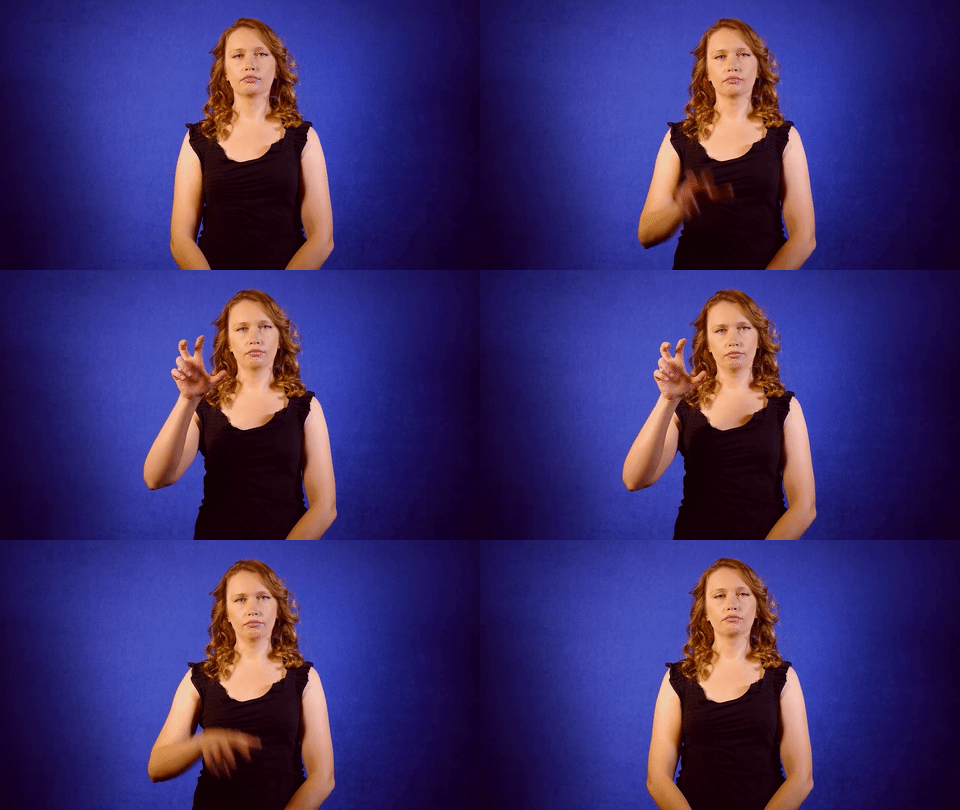
Sign for the number THREE HUNDRED v2 in ASL | Master the Number 300 in ASL with the #1 Best Dictionary – Fast & Easy! ✨

Definition: Refers to the number three hundred (v2)

Sign for the number THREE HUNDRED v2 in ASL

YouTube player

Practice Activities:

Practice activities for the sign for the number THREE HUNDRED v2 in ASL involve engaging in both isolated practice and contextual usage to build fluency. Begin by practicing the production of the sign in isolation. Form the number three by extending the thumb, index, and middle fingers while the ring and pinky fingers remain closed. Then, transition into forming the “Claw-3” handshape, moving your dominant hand slightly forward to complete the sign. Repeat this motion slowly and precisely to ensure accurate form and fluidity.

Work on these exercises by incorporating the sign for the number THREE HUNDRED v2 in ASL into a numerical practice drill. Count aloud from 100 to 1,000 in sequences of 100, making sure to include three hundred as a milestone. Pair the sign with written numbers to reinforce recognition. For advanced learners, include variations of numbers that surround three hundred, like 295 or 305, to practice switching between numerical values and keeping transitions smooth.

Use storytelling prompts that require learners to sign numbers, such as describing the cost of an item. For example: “Imagine you’re at a store purchasing a jacket worth three hundred dollars. Use the sign for the number THREE HUNDRED v2 in ASL to describe the price.” Incorporating relatable everyday scenarios can improve retention.

Engage in partner activities by creating mock dialogues. One partner can act as a customer, and the other as a cashier. The customer can sign, “Excuse me, is this item three hundred dollars?” The cashier can respond appropriately. These role-playing exercises emphasize conversational context.

Another fun practice activity is creating number scavenger hunts. One partner signs a number, like 300, and the other must match it with objects representing that value (e.g., stacks of items or written examples). This activity reinforces numerical comprehension.

Lastly, practice sentences like, “My father’s car cost about three hundred dollars to fix” or “Three hundred students attended the event.” Using the sign for the number THREE HUNDRED v2 in ASL in complete sentences emphasizes accuracy in context.

Cultural Context:

The sign for the number THREE HUNDRED v2 in ASL is signed by combining the signs for “three” and “hundred.” This unique number in ASL reflects how numerical concepts are expressed through specific gestures that align with the language’s grammar and structure. To sign the number three hundred in ASL, you must first sign “three” and then use the “claw-3” to indicate “hundred.” Understanding this method helps ASL learners bridge the gap between numerical expressions in English and ASL. When signing three hundred, handshape accuracy and clarity are essential to maintain communication effectiveness.

ASL numeracy is integral to everyday use, and knowing how to sign the number three hundred in ASL opens up practical and meaningful applications. From discussing amounts, prices, or measurements to sharing historical dates or personal milestones, the number three hundred might frequently surface in daily interactions. For example, in conversational ASL, you might use the sign for three hundred to describe a $300 purchase, a 300-mile road trip, or the number of students in a school assembly. Being precise with the number three hundred in ASL ensures your communication remains accurate within these contexts.

Culturally, the use of the sign for the number THREE HUNDRED v2 in ASL underscores the importance of clear and direct communication between Deaf and hearing individuals. The number three hundred is not just a concept but also a bridge between spatial, visual language, and numeric ideas in the Deaf community. Additionally, seeing and using the number three hundred in ASL promotes an appreciation for how the Deaf community adapts everyday concepts into a visually intuitive format.

Whether you’re learning ASL for personal enrichment, professional use, or academic research, mastering numbers like the number three hundred is a foundational skill. beginners often appreciate how number signs, such as three hundred in ASL, build fluency and confidence. T

ranslations like three hundred into ASL also help expand understanding of how gestures replace spoken language, especially in numeric communication. Using the sign for the number THREE HUNDRED v2 in ASL may seem simple, but mastering it fully demonstrates critical language skills applicable to various real-world scenarios. Accurate usage ensures others understand when signing common quantities or discussing three hundred in ASL grammar and conversation.

Extended Definition:

“The number three hundred in ASL” is signed by combining the signs for the digit “3” and the concept of “hundred.” In American Sign Language (ASL), numbers are an integral part of communication, and each number has specific rules for its representation. Understanding proper handshape, movement, and placement is essential for clear and accurate signing.

To sign the sign for the number THREE HUNDRED v2 in ASL, start with your dominant hand in the number “3” handshape—your thumb, index, and middle fingers extended while your ring and pinky fingers are tucked in. Next, transition this handshape into the concept of “hundred.” Instead of signing each digit separately, ASL uses a more fluid motion to represent numbers in the hundreds. After holding the “3” momentarily, the hand smoothly arcs downward into the “Claw-3” handshape, symbolizing “hundred.” This movement is brief but essential for clarity.

The palm orientation during this sign generally faces outward for the “3” handshape and then slightly adjusts in the “C” handshape. Make sure the motion connecting “3” and “Claw-3” is deliberate yet smooth. Accurate transitions ensure that viewers can easily distinguish “three hundred” from similar numbers like “thirty” or “thirteen.”

Context is also crucial when using the sign for the number THREE HUNDRED v2 in ASL. In casual conversation, this number might refer to a quantity, an address, or even a measurement. However, in formal contexts such as financial discussions or academic settings, it’s vital to ensure precision when signing numbers to avoid miscommunication.

Learning to sign the sign for the number THREE HUNDRED v2 in ASL not only improves numerical literacy but also enhances your ability to engage effectively within the Deaf community. For beginners, it may take some practice to flow seamlessly between the “3” handshape and “C” handshape. Repetition and attention to detail will help you master this concept over time.

Pronounced facial expressions and a clear, concise signing style will also make using the sign for the number THREE HUNDRED v2 in ASL more effective. Like all ASL signs, numerical expressions rely heavily on non-manual markers to convey tone and context. Be mindful of these visual cues as you integrate numbers into broader sentences.

For ASL learners, consider practicing the sign for the number THREE HUNDRED v2 in ASL alongside other three-digit numbers. Grouping similar signs can help you notice patterns and improve retention. For instance, numbers like “200,” “400,” and “500” follow comparable movement

Synonyms: three hundred, 300, 3 hundred

Educational resources: Find related learning materials in our course bank!

Want more? Check out some of our popular learning activities on the homepage!

Need to look up a sign? Use our highly rated dictionary: https://aslinteractive.com/best-asl-dictionary/

Follow us on tiktok: https://www.tiktok.com/@aslinteractive. More social media links at the bottom of this page!

Long-tail Keywords: what is the sign for the number three hundred in ASL, how do you sign the number three hundred in American Sign Language, learn how to sign the number three hundred in ASL

Categories: Numbers – Basics, hundreds, cardinal numbers

tags: Numbers, Counting, Mathematics, Educational, Language Learning

Parameters

*Handshape*:

The sign for the number THREE HUNDRED v2 in ASL uses a combination of two signs. Start with the handshape for “3,” where the thumb, index finger, and middle finger are extended while the ring and pinky fingers are tucked in. Then transition to the handshape for “Claw-3,” where the fingers curve to form a “C” shape. This smooth transition ensures clarity when expressing the sign for the number THREE HUNDRED v2 in ASL effectively.

*Palm Orientation*:

The palm orientation for the number three hundred (v2) in ASL begins with the palm facing outward, showing the number three. Then, the hand transitions to the number sign for hundred by forming a “Claw-3” shape with the palm facing inward. Throughout the sign, the hand maintains smooth motion while slightly curving for the hundred portion. The sign for the number THREE HUNDRED v2 in ASL emphasizes clarity with palm positioning shifting visibly.

*Location*:

The sign for the number THREE HUNDRED v2 in ASL is signed in the neutral space in front of the body. Begin by forming the handshape for the number “3” (thumb, index, and middle fingers extended) with the dominant hand. Transition smoothly to the handshape for “Claw-3” (curved hand resembling the shape of a letter “C”). Maintain consistent hand positioning while keeping the movements fluid to clearly represent the sign for the number THREE HUNDRED v2 in ASL.

*Movement*:

The sign for the number THREE HUNDRED v2 in ASL begins with the dominant hand in a “3” handshape, palm facing outward. Then, transition the hand into a “C” handshape by curling the index and middle fingers into a curved position while pulling the hand slightly inward. The movement is fluid but distinct, emphasizing the change between the “3” and “C” shapes to clearly convey The number three hundred (v2) in ASL.

*Non-Manual Signals*:

The facial expression for the sign for the number THREE HUNDRED v2 in ASL involves a neutral or slightly raised eyebrow position, maintaining steady eye contact with the addressee to ensure clarity. The head remains upright, with minimal movement, to draw attention to hand formations. Mouth posture is relaxed without added mouthing, as it is not typically necessary for this numeral. A composed and focused demeanor supports clear communication for the sign for the number THREE HUNDRED v2 in ASL.

*Prosody, Dominant/Non-Dominant Hand*:

The sign for the number THREE HUNDRED v2 in ASL is signed with the dominant hand. To indicate “three,” form the number 3 by extending the thumb, index, and middle fingers. Transition smoothly into “hundred” by curving the dominant hand in a claw-like C-shape, starting near the forehead or in front of the torso and moving slightly outward. The non-dominant hand remains stationary or neutral. Ensure the transition between the number and “hundred” is fluid.

Tips for Beginners:

The sign for the number THREE HUNDRED v2 in ASL is expressed by combining the sign for the number “three” and the handshape for “C” to represent “hundred.” Begin by holding up your dominant hand with three fingers extended (thumb, index, and middle fingers), which is the number three in ASL. Then, transition smoothly into the “Claw-3-handshape” to represent “hundred.” The motion should flow naturally, moving slightly forward as you form the “Claw-3,” indicating a small conceptual shift for “hundred.”

**Tips for Beginners:**

1. Start by practicing the sign for the number THREE HUNDRED v2 in ASL. Ensure that the thumb, index, and middle fingers are fully extended while the ring finger and pinky stay tucked against the palm. Take care to avoid bending your fingers awkwardly, as this can confuse the meaning.

2. Pay attention to the transition from the “three” handshape to the “Claw-3-handshape.” This movement should be smooth and deliberate. Beginners often struggle with making the change too abruptly, which can disrupt the flow of the sign. Practice the transition slowly at first to build muscle memory.

3. Maintain proper palm orientation throughout the sign. For the “three,” your palm should face outward. As you move into the “Claw-3-handshape,” ensure that the “Claw-3” remains visible to the person you’re signing to. This improves clarity and avoids misinterpretation.

4. Keep your movements small and concise. Over-exaggerating the motion for “hundred” can make the sign look less natural. Remember, subtlety often enhances clarity in ASL.

5. Practice making eye contact while signing the sign for the number THREE HUNDRED v2 in ASL. Effective communication in sign language involves more than just the hands—it also includes facial expressions and eye engagement to support the message’s context.

6. Avoid common pitfalls such as forming your “Claw-3” too tightly or too loosely. The correct “Claw-3” handshape should resemble the letter, with your fingers curved naturally. If you find yourself struggling, practice forming the “Claw-3” shape in isolation before combining it with other movements.

Connections to Other topics:

The sign for the number THREE HUNDRED v2 in ASL connects to other numerical expressions commonly used in American Sign Language, as it encourages learners to focus on the fluidity between individual numbers and compound numerical concepts. In this variation, “three” is formed first, followed by a subtle but clear gesture representing “hundred,” creating a visually distinct representation of the number.

This structure is essential when discussing monetary amounts, years, or measurements in ASL, ensuring clarity and avoiding confusion with smaller or larger numbers. Learning the sign for the number THREE HUNDRED v2 in ASL also reinforces the importance of precision in non-manual markers, such as slight head nods or pauses, which assist in creating proper numerical segmentation and context for the viewer.

The sign for the sign for the number THREE HUNDRED v2 in ASL relates to broader conceptual groupings, such as calendar years (e.g., “1300s” or “1800”), mathematics, and age-related numbers. It also connects to principles of ASL numbering systems, such as the distinction between cardinal numbers (e.g., indicating a quantity of 300 apples) and ordinal numbers when used in ordered series (e.g., “the 300th episode”).

For learners exploring numerical classifiers, understanding how the sign for the number THREE HUNDRED v2 in ASL varies with context adds depth to conversations involving volume, distance, or other scaled calculations.

Additionally, the construction of the sign for the number THREE HUNDRED v2 in ASL can be a gateway to compound signs. For instance, combining three hundred with a time sign like “year” creates “300 years,” a concept frequently used when discussing history timelines. Similarly, attaching this number to classifiers aids communication in contexts such as vehicle descriptions (e.g., “a 300-horsepower engine”).

Mastery of such compound expressions not only enhances numerical literacy but also fosters engagement in richly descriptive ASL conversations. The sign for the number THREE HUNDRED v2 in ASL, therefore, represents more than just counting—it serves as a building block for broader topics.

Summary:

The sign for the number THREE HUNDRED v2 in ASL is a representation of numerical values achieved through specific handshapes, movements, and spatial orientations. Variations in ASL numbering, especially for larger numbers like three hundred, reflect the language’s dynamic, multi-dimensional nature, wherein numerical expression can vary depending on regionalisms, formality, or situational context.

Representing the sign for the number THREE HUNDRED v2 in ASL intrinsically links body mechanics with conceptual abstraction, combining precise hand movements, systemic logic, and cultural norms. Numeral signs serve to communicate quantity, enumeration, and counts, forming a critical foundation of computation and formal languages within ASL.

To sign the sign for the number THREE HUNDRED v2 in ASL accurately, you begin by forming the handshape for the number “3,” which involves extending the thumb, index finger, and middle finger while the ring finger and pinky remain tucked into the palm. Ensuring that this basic three-fingered handshape is executed with clarity and proper orientation is crucial to avoid confusion with other numbers or signs.

Following this, the sign transitions into a gesture commonly related to the representation of “hundreds.” The “Claw-3” handshape, with the four fingers curled into a semicircular “C” form and the thumb rounded along their curve, is subtly implied but does not always have to be explicitly shown in version two, seamlessly melding into ASL’s tendency for numeral simplification.

The second version (v2) of this sign reflects a streamlined evolution of traditional signing conventions. It is influenced by natural linguistic economy and visual clarity, both fundamental principles in ASL. Unlike a prolonged representation of “3” transforming explicitly and physically into “hundreds,” this variant may rely on fluidity in the initial numeric handshape combined with a slight forward movement in the signing space to indicate “hundreds” understood through contextual linguistic use.

Therefore, the sign for the number THREE HUNDRED v2 in ASL demonstrates the language’s flexibility, offering native users freedom to choose efficient articulations while ensuring shared understanding.

Grammatically, signing three hundred aligns with ASL’s numerical framework and sequencing principles, often contextualized by its placement in phrases or broader constructs. Numerals in ASL function both independently and in conjunction with other signs to convey measurements, addresses, dates, money amounts, or quantities. Numbers above one hundred are typically grouped for clarity, making the distinguishing of hundreds, thousands, tens, and units integral to the form. Thus

Want more? Check out some of our popular learning activities!

ASL Interactive Resources

ASLInteractive YouTube Channel

Follow us on tiktok: @aslinteractive.com

Follow us on Instagram: aslinteractive

Facebook page: aslinteractive

Facebook group: aslinteractive

LInkedIn: ASL Interactive LLC

Twitter: @ASL_interactive

*Some information on this page is AI-generated. AI can make mistakes. Please check the information.

Sign for THREE HUNDRED v2 in ASL, Sign for Number THREE HUNDRED v2 in ASL, Sign for the number 300 v2 in ASL, Sign for the number THREE HUNDRED v2 in ASL

Responses