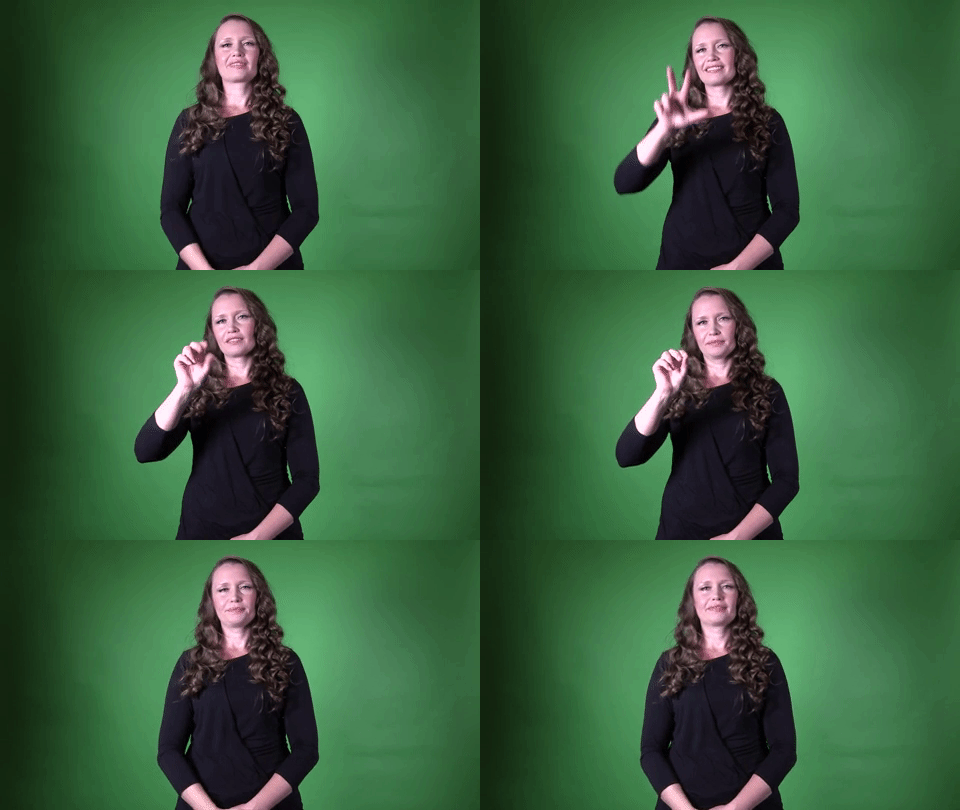
Definition: The number thirty
Sign for THIRTY in ASL

Practice Activities:
Practicing the sign for thirty in ASL involves repetition, number recognition, and real-world application. Begin by signing thirty slowly and paying attention to your handshape and movement. Use a mirror or record yourself to check accuracy. Try signing the number multiple times at different speeds to build fluency.
Incorporate the sign for thirty in ASL into counting sequences. Count from one to fifty, pausing at twenty-nine and making sure you smoothly transition to thirty. Reverse the practice by starting from fifty down to one. This will help reinforce the sign’s formation and consistency in different contexts.
Create real-life scenarios where you would use the sign for thirty in ASL. Practice signing common phrases such as “I have thirty friends,” “My appointment is in thirty minutes,” or “I need thirty dollars.” Write a short dialogue using the number and sign it in front of a mirror or to a partner.
Use flashcards with different numbers written on them. Shuffle them and sign the number that appears, paying special attention to thirty. Challenge yourself by mixing in similar numbers like thirteen and three to ensure you can differentiate them quickly. Practicing with a partner can make this more interactive and fun.
Storytelling can help reinforce the sign for thirty in ASL. Create a short story involving a situation with the number thirty, such as “I bought thirty balloons for a party” or “This book has thirty chapters.” Sign your story while focusing on clear, expressive movements.
Engage in a countdown activity, such as counting down from thirty while watching a clock. Try timing yourself to sign the number quickly and accurately. Use daily routines like checking the clock or discussing ages, money, or quantities to naturally incorporate the sign for thirty in ASL into conversations.
Cultural Context:
The sign for thirty in ASL is an essential number sign in American Sign Language. Numbers play a crucial role in everyday conversations, from counting to expressing time, age, and quantity. Mastering the sign for thirty in ASL helps improve communication fluency and understanding.
In ASL, numbers are signed using distinct handshapes and movements. The sign for thirty in ASL combines the digits three and zero in a fluid motion. Learning this number sign ensures clarity when discussing numbers in casual and formal settings.
Deaf culture values clear and precise signing of numbers, as they are frequently used in daily interactions. Knowing how to correctly use the sign for thirty in ASL allows for seamless conversations involving age, money, and measurements. Accuracy in signing numbers ensures effective communication between Deaf and hearing individuals.
American Sign Language has a structured number system with unique signs for different numerical values. The sign for thirty in ASL is part of this system, making it easy to convey numerical concepts quickly. Fluency in number signs is beneficial in personal, academic, and professional settings.
Within Deaf communities, expressing numbers accurately is essential for clarity. Using the correct sign for thirty in ASL prevents misunderstandings when discussing dates, addresses, or math-related topics. Consistency in number signs enhances overall sign language proficiency.
ASL learners benefit from practicing number signs to develop better signing skills. The sign for thirty in ASL is commonly used in everyday discussions about time, age, and counting. Frequent use of number signs reinforces familiarity and improves communication confidence.
Children and adults learning American Sign Language should focus on mastering number signs early in their studies. The sign for thirty in ASL, along with other number signs, builds a strong language foundation. Numbers are a key component of ASL conversations in both social and academic environments.
Engaging with native signers helps learners refine their use of number signs. Observing how Deaf individuals use the sign for thirty in ASL in real conversations aids in understanding proper execution. Interaction within the Deaf community enhances fluency and cultural awareness.
Technology and digital resources make learning ASL more accessible than ever. Online videos, ASL dictionaries, and virtual classes offer opportunities to practice the sign for thirty in ASL. Visual learning improves retention and increases confidence in signing numbers accurately.
ASL number signs, including the sign for thirty in ASL, follow a logical pattern. Recognizing these patterns helps learners remember number signs more easily. Consistent practice strengthens
Extended Definition:
The sign for thirty in ASL is a simple and efficient way to express the number 30 using your hands. American Sign Language uses a combination of handshapes and movements to represent numbers, and thirty is formed using a distinct motion that makes it easy to recognize. Learning how to sign thirty in ASL is essential for everyday conversations, whether you are discussing age, quantities, or time.
To make the sign for thirty in ASL, start with the number three handshape, with your thumb, index, and middle fingers extended while keeping your ring and pinky fingers down. Then, transition into a zero by bringing your extended fingers together to form an “O” shape. This quick movement represents the number 30 in a clear and concise way.
Numbers play a crucial role in American Sign Language, and knowing how to sign thirty in ASL can help improve your fluency. Whether you are signing phone numbers, telling time, or discussing prices, understanding how to sign numbers accurately is a key skill. The fluid motion of signing thirty allows for easier communication in different contexts.
When practicing the sign for thirty in ASL, pay attention to finger positioning and the smooth transition between the three and the zero. Proper hand movement ensures that the sign is clear and correctly understood by other ASL users. Watching videos or practicing in front of a mirror can help perfect this sign.
In ASL, numbers are commonly used in everyday interactions, making it important to learn the correct way to sign them. The sign for thirty follows a consistent pattern used for other numbers ending in zero, such as twenty and forty. Once you master thirty, it becomes easier to learn additional numbers in American Sign Language.
Learning the sign for thirty in ASL is beneficial for both beginners and advanced learners. Whether you are communicating with Deaf individuals, teaching ASL, or simply expanding your signing vocabulary, numbers are an essential component. Mastering thirty will help build confidence in using American Sign Language in different situations.
Practice using the sign for thirty whenever possible to reinforce its recognition and correct execution. Repetition and consistency will make signing numbers feel more natural over time. Engaging in conversations, playing number-related games, or describing everyday situations using ASL numbers can be helpful.
Understanding how to sign thirty in ASL enhances communication skills and allows for smoother interactions. Numbers are frequently used in daily life, and being able to express them clearly in sign language is important. Signing thirty accurately shows a deeper
Synonyms: thirty, number thirty, number 30, the number 30, the number thirty
Educational resources: Find related learning materials in our course bank!
Want more? Check out some of our popular learning activities on the homepage!
Need to look up a sign? Use our highly rated dictionary: https://aslinteractive.com/best-asl-dictionary/
Follow us on tiktok: https://www.tiktok.com/@aslinteractive. More social media links at the bottom of this page!
Long-tail Keywords: what is the sign for thirty in ASL, how do you sign thirty in American Sign Language, learn to sign thirty in ASL
Categories: Numbers – Basics, Numbers 21-30, cardinal numbers
tags: Numbers 21-30, Numbers, Math, Language Learning, Educational
Parameters
*Handshape*:
The sign for THIRTY in ASL uses a handshape that starts with the number three, where the index, middle finger, and thumb are extended while the ring and pinky fingers remain curled. As the motion completes, the index and middle fingers close in to touch the thumb, forming an “O” shape. This movement is a common pattern in number signs and ensures clarity in communication.
*Palm Orientation*:
The palm orientation for the sign for THIRTY in ASL faces forward, with the dominant hand forming a “3” shape. The index, middle finger, and thumb are extended, while the ring and pinky fingers remain tucked in. As the motion begins, the thumb and index finger repeatedly tap together to form a modified “0” shape, transitioning smoothly between “3” and “0.” The movement is small and controlled, keeping the palm facing outward throughout.
*Location*:
The sign for THIRTY in ASL is produced in a neutral space in front of the body, typically at chest or shoulder level. The motion takes place in the dominant hand, which starts in the shape of the number three and then transitions to a closed “O” shape. This sign is executed with a quick movement, ensuring clarity and accuracy in numerical representation.
*Movement*:
To produce the sign for thirty in ASL, start with your dominant hand in the number three handshape, with the thumb, index, and middle fingers extended while the ring and pinky fingers remain curled in. Quickly bring the tips of the extended fingers together to form an “O” shape, then return to the original three-handshape. This movement is fluid and repeated once to clearly indicate the number.
*Non-Manual Signals*:
When using the sign for THIRTY in ASL, your facial expression should remain neutral or slightly focused, depending on the context. If emphasizing the number, slightly raise your eyebrows to signal importance. Keep your posture relaxed, ensuring fluid hand movement. If asking about an amount involving thirty, furrow your eyebrows slightly to indicate questioning. Smooth and controlled hand motions will help maintain clarity when signing.
*Prosody, Dominant/Non-Dominant Hand*:
The sign for THIRTY in ASL uses the dominant hand. Start with the number “3” handshape, with the index, middle finger, and thumb extended, while the ring and pinky fingers are curled down. Bring the index and middle fingers together, closing them toward the thumb to form a modified “O” shape. This movement represents the number visually. The non-dominant hand is not used in this sign.
Tips for Beginners:
When learning the sign for THIRTY in ASL, focus on clarity and fluidity. This sign is a combination of the handshape for the number 3 and a quick movement to a closed 0-handshape. Proper finger positioning is key—ensure your thumb, index, and middle fingers are extended at the start before smoothly transitioning into a closed hand.
A common beginner mistake is not fully forming the initial 3-handshape or rushing through the movement too quickly. Take your time to practice each step carefully, making sure the transition between handshapes is deliberate. Watching yourself in a mirror or recording your practice can help catch inconsistencies in hand positioning.
Finger dexterity plays a big role in signing numbers accurately. If you’re struggling with shaping your fingers correctly, try finger exercises to strengthen movement control. Stretching your fingers before practicing can also prevent stiffness, which helps in forming the handshapes naturally.
Consistency in repetition will help commit the sign for THIRTY in ASL to muscle memory. Practicing in different signing environments, such as with a friend or in front of a camera, can increase confidence. Try signing numbers in sequence (e.g., 10, 20, 30) to reinforce the pattern and make recall easier.
Pay close attention to hand orientation. The palm should face outward while forming the 3, and as you transition to 0, maintain a smooth motion rather than a jerky switch. Keeping movements controlled and intentional will make your sign easier to read.
Engaging with native or fluent ASL signers can refine your technique. If you’re unsure about your accuracy, ask for feedback or watch multiple demonstrations online. With consistent practice and attention to detail, your ability to sign numbers fluently will improve over time.
Connections to Other topics:
The sign for THIRTY in ASL connects to other number signs, particularly multiples of ten like twenty, forty, and fifty. These numbers follow a similar structural pattern in ASL, where the formation often incorporates the digits 3 and 0 in a fluid motion. This pattern helps learners recognize a rhythmic consistency in number signs, making it easier to recall related numerical signs quickly.
Numbers play a significant role in ASL beyond counting, extending to expressions of age, time, money, and measurements. The sign for THIRTY in ASL often appears in contexts like stating an age, referencing a price, or specifying the number of minutes in a duration. Understanding how numbers integrate with other signed concepts improves fluency in everyday conversations.
The efficiency of ASL signs for numbers, including the sign for THIRTY in ASL, highlights how ASL emphasizes visual and spatial efficiency. The way higher numbers like thirty through ninety are signed in a consistent pattern helps reinforce the logic of number formation in ASL. This pattern also connects to broader concepts of quantification and numerical engagement in the Deaf community.
When discussing dates, learning how to incorporate numbers correctly with month names and time references is essential. The sign for THIRTY in ASL may appear when describing the 30th day of a month or referencing “30 minutes past” the hour. These applications make numerical fluency essential for clear communication involving schedules, deadlines, or appointments.
A solid grasp of number signs strengthens a signer’s ability to engage in educational, professional, or financial discussions. Recognizing the structure of the sign for THIRTY in ASL reinforces the broader system of numerical representation in ASL. This connection improves comprehension when learning additional numbers, making it easier to pick up higher values and related sign structures.
Summary:
The sign for THIRTY in ASL follows a numerical pattern commonly used in signing larger numbers. It is formed using the number 3 handshape and transitioning into a 0 handshape. This movement visually represents the concept of the number, making it an intuitive and efficient way to sign.
The motion of the sign for THIRTY in ASL mirrors that of other numbers in the 30–90 range. This consistency helps signers recognize patterns in numerical signs. Understanding these patterns can enhance fluency and speed when communicating numbers.
Numbers are a fundamental part of ASL, and the sign for THIRTY in ASL plays a crucial role in describing quantities, ages, time, prices, and more. Since numbers often appear quickly in conversation, recognizing numerical signs effortlessly is an important skill for ASL users. Many proficient signers develop the ability to process numbers automatically.
When signing numbers like 30, handshape changes must be executed smoothly. The transition from the 3 handshape to the closed 0 requires precise control of the fingers. This movement may require practice for those new to ASL, but over time, fluidity develops naturally.
In ASL, numbers can function as adjectives, nouns, or part of a classifier system. The sign for THIRTY in ASL can describe age, a series of events, or quantify objects. Understanding how numbers fit into ASL grammar is essential for effective communication.
Number signs in ASL can vary slightly based on regional dialects and signing preferences. While the most common variation of the sign for THIRTY in ASL follows a specific handshape change, some signers may have subtle differences in execution. Exposure to a variety of signers helps in recognizing these variations.
Numbers in ASL are often incorporated into financial, academic, and medical settings. The sign for THIRTY in ASL may be used in telling prices, giving addresses, or discussing statistics. Developing numerical fluency in ASL enhances communication in these contexts and ensures clarity.
Just like spoken language has accents, ASL has variations in numerical signs. Some older signers may use slightly different methods for forming number signs. The sign for THIRTY in ASL might appear more deliberate or slightly varied when used by different generations of Deaf community members.
Historically, ASL has evolved through community adaptations, and number signs have followed this evolution. The current sign for THIRTY in ASL reflects a streamlined approach that prioritizes efficiency. Earlier versions may have had more exaggerated movements or finger changes.
Psycholinguistics suggests that ASL users process numbers similarly to spoken language users. The sign for THIRTY in ASL activates numerical cognition in the brain, allowing for rapid comprehension. Fluent signers often recognize and produce numbers without conscious thought.
Applied linguistics examines how ASL learners acquire number signs. The sign for THIRTY in ASL may be challenging at first but becomes second nature with repetition. Learning numerical signs early in ASL education strengthens overall language proficiency.
Numbers also play a role in Deaf culture and identity. The sign for THIRTY in ASL might represent a person’s age, a year in history, or even a cultural milestone. Numbers may carry personal significance in storytelling, historical discussions, and identity expression.
ASL storytelling often incorporates numbers to set time frames or describe sequences. When signing the sign for THIRTY in ASL within a narrative, the movement should be clear to avoid confusion. Hand positioning and transitions are essential for maintaining fluency in signed stories.
Finger dexterity is an important skill in mastering ASL numbers. The sign for THIRTY in ASL relies on controlled transitions between handshapes. Practicing basic hand strengthening exercises can improve precision and ease in producing numerical signs.
Numbers are frequently used in everyday conversations among signers. Whether discussing schedules, planning events, or providing directions, the sign for THIRTY in ASL appears often in practical communication. Mastering number signs ensures clarity in daily interactions.
ASL teachers often prioritize numerical signs in early instruction. The sign for THIRTY in ASL is introduced alongside basic counting to familiarize students with numerical patterns. Repetition and structured exposure help learners integrate these signs effectively.
When conveying large numbers, ASL may combine numerical components efficiently. The sign for THIRTY in ASL is often paired with other number signs to form values like 130 or 3000. Understanding these combinations is key to fluency.
Many ASL users employ non-manual markers when signing numbers. The sign for THIRTY in ASL might be accompanied by facial expressions to indicate emphasis or questioning. These grammatical markers add nuance to number-related statements.
Technology has played a role in teaching number signs. Videos and digital learning platforms often demonstrate the sign for THIRTY in ASL with slow-motion replays. Visual repetition reinforces muscle memory and accuracy in execution
Want more? Check out some of our popular learning activities!
ASL Interactive Resources
ASLInteractive YouTube Channel
Follow us on tiktok: @aslinteractive.com
Follow us on Instagram: aslinteractive
Facebook page: aslinteractive
Facebook group: aslinteractive
LInkedIn: ASL Interactive LLC
Twitter: @ASL_interactive
*Some information on this page is AI-generated. AI can make mistakes. Please check the information.


Responses