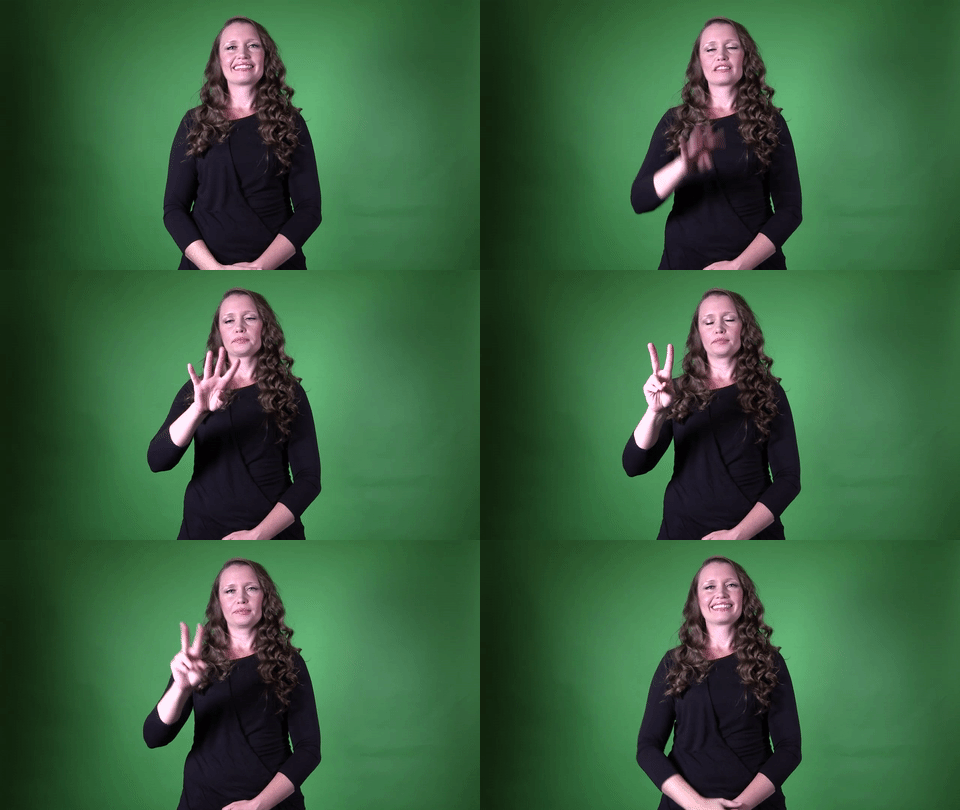
Definition: The number forty-two.
Sign for 42 in ASL

Practice Activities:
Start by practicing the sign for 42 in ASL in isolation. Hold up your dominant hand in a “4” handshape, then quickly change it to a “2” handshape. Repeat this transition multiple times to build muscle memory and fluency. Sign in front of a mirror to check accuracy and use a slow, controlled motion.
Try counting from 40 to 45 to integrate the sign for 42 in ASL into a sequence. Say each number aloud while signing to reinforce recognition. Then, challenge yourself by counting backward from 45 to 40, ensuring smooth transitions between numbers.
Use the sign for 42 in ASL in real-life contexts. Imagine you are at a store and need to tell a cashier a total of 42 dollars. Practice signing “I have 42 dollars” or “The bill is 42 dollars.” Try creating price tags with numbers and signing them out loud.
Engage in a number relay game with a partner. One person signs a random number, and the other has to sign the next number in sequence. Include the number 42 frequently so you build confidence in signing it naturally.
Create a short story where the number 42 is important. It could be about a person celebrating a 42nd birthday, traveling 42 miles, or buying 42 apples. Sign your story while focusing on maintaining clarity and fluidity in your signs.
Watch authentic ASL videos or number games online that incorporate numerical signs. Try to spot when signers use the sign for 42 in ASL and mimic their movements. The goal is to integrate the sign naturally into conversations and real-world situations.
Cultural Context:
The sign for 42 in ASL follows the number-signing conventions used in American Sign Language. Numbers in ASL are an essential part of daily communication, whether for counting, addresses, or sharing personal details. When signing 42 in ASL, it’s important to form the number clearly using the correct handshape and palm orientation.
Deaf culture values precision in number signs, as miscommunication can lead to misunderstandings. The sign for 42 in ASL is part of a structured number system that makes it easy to convey numerical information quickly and efficiently. This structure is especially important in education, banking, and sports, where numbers are frequently discussed.
Within ASL, number signs like 42 are typically signed with one dominant hand, moving fluidly to represent the number. The sign for 42 in ASL follows a natural progression from other numbers and is consistent within ASL’s numbering framework. Mastering number signs helps develop fluency in ASL and ensures accurate exchanges of numerical information.
In Deaf sports events, game scores often include the number 42, requiring clear and rapid signing. Teachers and interpreters use the sign for 42 in ASL during math lessons or when discussing important statistics. Understanding how to sign numbers correctly is crucial for students and professionals in the Deaf community.
Technology and social media have also influenced the way numbers like 42 are signed in ASL. Video communication plays an important role in Deaf culture, making it easier to see and learn proper number signs. Digital resources provide valuable tools for practicing the sign for 42 in ASL in real-world contexts.
ASL learners benefit from understanding the handshape and motion required to sign 42 accurately. Consistency and clarity help ensure numbers are easily understood in conversations. Proper technique is especially valuable in formal settings, such as business meetings or medical appointments.
Numbers hold cultural significance in many communities, and ASL users appreciate the role numeric signs play in everyday life. Whether discussing time, money, or measurements, knowing how to correctly sign numbers like 42 enhances communication. Learning the sign for 42 in ASL supports language development and helps bridge communication gaps for ASL users.
Practice and repetition help reinforce number signs like 42, making it easier to sign naturally and with confidence. Watching fluent ASL users sign numbers improves recognition and accuracy. Learning the sign for 42 in ASL is part of a broader skill set that enhances overall proficiency in ASL.
Using the proper
Extended Definition:
The sign for 42 in ASL follows the standard number signing rules of American Sign Language. It uses a combination of hand shapes and movement to clearly convey the number. Learning this sign helps improve number comprehension in ASL conversations.
To sign 42 in ASL, start with the number 4 handshape, then smoothly transition to a 2. The movement should be clear and controlled to ensure accurate communication. This two-part motion is common in ASL number signs for numbers in the forties.
Numbers play a vital role in ASL, enabling communication about dates, quantities, and counting. The sign for 42 in ASL follows a logical pattern used for other numbers in the same range. Understanding this system makes learning larger numbers easier.
Many ASL learners struggle with number transitions, especially with two-digit numbers. Practicing the sign for 42 in ASL helps with finger dexterity and smooth transitions. Repetition and visual reinforcement are key to mastering this sign.
Different number signs may vary slightly depending on location or regional accents in signing. While the basic sign for 42 in ASL remains consistent, some signers might use slight modifications. Observing fluent signers or using ASL resources can help clarify variations.
Using the correct number signs is essential for clear ASL communication. The sign for 42 in ASL needs precise hand shapes to avoid confusion with similar numbers. Paying attention to placement and movement ensures accuracy.
Learning to sign numbers correctly builds confidence in ASL fluency. The sign for 42 in ASL is just one of many numerical signs that enhance everyday communication. Practicing regularly helps reinforce knowledge and improve speed.
ASL numbers follow a structured system that makes signing sequential numbers easier. The sign for 42 in ASL fits naturally into this framework, making it easy to recall. Once learned, signing two-digit numbers becomes second nature.
In conversations, numbers often appear when discussing ages, prices, or addresses. Knowing how to sign 42 in ASL ensures smooth communication in daily interactions. Mastering numbers in ASL enhances overall signing proficiency.
Watching videos or working with experienced signers can help improve accuracy when signing numbers. Seeing the sign for 42 in ASL demonstrated correctly provides valuable visual reinforcement. Practicing with a partner can also build confidence.
ASL number signs are an important part of visual language expression. The sign for 42 in ASL contributes to a strong foundation in ASL numer
Synonyms: forty-two, number forty-two, number 42, the number 42, the number forty-two
Educational resources: Find related learning materials in our course bank!
Want more? Check out some of our popular learning activities on the homepage!
Need to look up a sign? Use our highly rated dictionary: https://aslinteractive.com/best-asl-dictionary/
Follow us on tiktok: https://www.tiktok.com/@aslinteractive. More social media links at the bottom of this page!
Long-tail Keywords: what is the sign for 42 in ASL, how do you sign 42 in American Sign Language, ASL sign for the number 42
Categories: Numbers – Basics, Numbers 41-50, cardinal numbers
tags: Numbers 41-50, Numbers, Math, Educational, Language Learning
Parameters
*Handshape*:
The sign for 42 in ASL uses the number 4 handshape, followed by the number 2. Start with the palm facing forward, fingers extended, and thumb touching the pinky. Then, transition to the number 2 handshape, keeping the index and middle fingers extended while the other fingers remain folded. The movement should be fluid to clearly represent the number sequence in the sign for 42 in ASL.
*Palm Orientation*:
The palm orientation for the sign for 42 in ASL starts with the palm facing outward as the number 4 is formed. The hand then transitions into the number 2 while maintaining the outward palm orientation. The movement is fluid, ensuring that the sign for 42 in ASL is clearly understood. Both numbers are signed in quick succession with a slight bounce between them for clarity.
*Location*:
The sign for 42 in ASL is formed in the neutral space in front of the torso. Begin by forming the number 4 with the dominant hand, palm facing outward. Quickly transition to the number 2 in the same location. The movement should be smooth and fluid, ensuring clarity. This sign remains within the signing space, generally between the chest and shoulder levels, to maintain natural visibility for the conversation partner. ️
*Movement*:
To make the sign for 42 in ASL, start by forming the number 4 with your dominant hand, extending the index, middle, ring, and pinky fingers while keeping the thumb tucked. Then, smoothly transition into the number 2 by pulling in the ring and pinky fingers, leaving the index and middle fingers extended. This movement should be fluid, with a slight bounce or repetition to emphasize the numerical transition.
*Non-Manual Signals*:
Facial expression remains neutral or slightly focused when forming the sign for 42 in ASL. The eyebrows stay relaxed unless emphasizing the number in a question or statement. Mouth movements can be minimal, though slight mouthing of “forty-two” may naturally occur. Head movement might be subtle, such as a small nod when confirming or clarifying the number. Overall, the face should stay engaged but not exaggerated, allowing the hand movements to clearly convey the number.
*Prosody, Dominant/Non-Dominant Hand*:
The sign for 42 in ASL uses the dominant hand, forming the number “4” with the palm facing outward. Then, the fingers transition into the number “2” without changing orientation. This movement is fluid, ensuring clarity and accuracy in number representation.
When signing the number 42, keep the hand steady and maintain a smooth motion between digits. The sign for 42 in ASL follows a numerical sequencing pattern, making it easily recognizable in conversation or when counting.
Tips for Beginners:
Mastering the sign for 42 in ASL requires a clear understanding of ASL number patterns. Since 42 is a two-digit number, it follows the general rule of signing each digit separately. Start by signing 4 with your dominant hand, keeping your palm facing forward and fingers spread. Then transition smoothly to 2, keeping the movement fluid to maintain clarity.
One common mistake beginners make is not fully separating the two numbers while signing. Ensure there is a distinct pause or a slight bounce when switching from 4 to 2 to avoid confusion with similar numbers like 32 or 52. Keep your hand steady and in a consistent position to prevent misinterpretation.
Finger placement is crucial for accuracy when signing the sign for 42 in ASL. The number 4 should have all four fingers extended with the thumb tucked, while the number 2 should only have the index and middle fingers extended. Avoid curving your fingers too much or spreading them too widely. Clear and intentional hand shapes enhance readability.
Practice signing in front of a mirror to check your hand orientation and transitions. Watching ASL number videos and practicing along with them can help reinforce the correct movements. You can also practice with a partner to get real-time feedback and improve fluency. Repetition is key to building muscle memory and confidence.
When using the sign for 42 in ASL in conversation, context can play an important role. If you are giving an address, age, or quantity, emphasize each number clearly to prevent misunderstandings. In fast-paced signing, experienced signers may sign numbers smoothly without pausing too long, but beginners should focus on separation first before speeding up. With consistent practice, signing numbers will become second nature.
Connections to Other topics:
The sign for 42 in ASL follows the standard pattern for numbers in ASL, making it an essential part of learning numerical concepts. Numbers are heavily used in ASL for counting, telling time, giving prices, and providing personal information like addresses or phone numbers. Understanding the sign for 42 in ASL helps learners recognize the system of number signs and how they relate to larger mathematical and practical applications.
The structure of ASL numbers follows a logical progression. The sign for 42 in ASL is formed by combining 4 and 2 in a fluid motion, which aligns with how other two-digit numbers are signed. This same pattern occurs when signing phone numbers, years, or addresses. Mastering numerical sequences helps reinforce fluency when discussing various topics where numbers are frequently used.
Numbers are also frequently incorporated into time-related signs, such as ages, years, and ordinal sequences. The sign for 42 in ASL can be used when expressing an age, such as “42 years old,” or when referencing an event that happened in 1942. Understanding how numbers integrate into everyday signing makes communication smoother and more natural.
Some conceptually related signs build on the idea of numerals being used for categorization. For example, numbers can appear in ranking systems, such as signing “42nd” by incorporating an ordinal marker. This is common in competitive rankings, sports, or describing historical events using numerical order.
The sign for 42 in ASL also connects to discussions of money and pricing. When discussing a $42 price, the dollar sign often follows immediately after. Learning number systems in ASL helps clarify money-related conversations, an essential skill when shopping, working, or budgeting in ASL.
Summary:
The sign for 42 in ASL follows the numerical conventions in American Sign Language. It is a two-digit number, so it is signed sequentially. The signer starts by forming the number 4 on one hand, followed by the number 2.
The number 4 is signed by holding up four fingers of the dominant hand while keeping the thumb tucked in. The palm can face forward or slightly outward. Hand orientation should remain steady before transitioning to the number 2.
For the number 2, the signer extends the index and middle fingers while tucking the rest of the fingers into the palm. The palm generally faces forward in this motion. The transition between the two digits should be smooth and natural.
The sign for 42 in ASL follows the pattern of two-digit number constructions. Unlike higher numbers, where a single sign blends two digits, 42 uses a sequential approach. This makes it distinct from numbers in the sixties, seventies, or eighties.
One key aspect of signing numbers is clarity. Signers should maintain steady hand movement to ensure visual accuracy. The numbers 4 and 2 should not blur together or resemble other number signs.
Numbers in ASL hold both numerical and cultural significance. The sign for 42 in ASL follows the general principles of signed numbers, but its meaning may vary depending on context. In some settings, numbers may carry specific implications beyond their literal value.
Finger dexterity plays a role in signing numbers clearly. Beginners may struggle to maintain consistent hand shapes when signing the sign for 42 in ASL. Regular practice ensures accuracy and fluency.
Numbers in ASL are often used in daily interactions. Telephone numbers, addresses, and prices require clear numerical signing. The sign for 42 in ASL could occur in various conversations, such as stating an age or a quantity.
ASL numbers follow grammatical rules distinct from spoken English. The structure of ASL numbers aligns with visual-spatial communication. The sign for 42 in ASL, like other numbers, depends on precise hand positioning and movement.
Number signs often adapt to different environments. In formal settings, numeric signs remain clear and deliberate. In casual conversations, signers may use a more relaxed style when signing the sign for 42 in ASL.
Linguistic research examines numerical expressions in ASL. The sign for 42 in ASL falls within the category of cardinal numbers. Researchers analyze how signers process and produce number sequences visually.
ASL uses a base-ten system, like English. However, the delivery method is entirely visual. When signing the sign for 42 in ASL, one must consider handshape, movement, and palm orientation.
Technology influences how ASL numbers are taught and learned. Video resources help learners see the sign for 42 in ASL in motion. These tools provide visual reinforcement for newer signers.
Digits in ASL can be incorporated into larger numerical sequences. The sign for 42 in ASL may appear in financial transactions or statistics. Signers should ensure that each digit remains distinct.
Facial expressions sometimes accompany number signs, depending on context. Emphasis or clarification may be necessary in certain conversations. However, for the sign for 42 in ASL, the hand configuration remains the primary focus.
Some signs incorporate numerical classifiers to express meaning. The sign for 42 in ASL remains straightforward as a cardinal number. Other signs, like age numbers, may be modified slightly.
ASL has regional variations, but numerical signs are generally consistent. The sign for 42 in ASL does not vary significantly between dialects. This makes number recognition easier across ASL communities.
Fingerspelling is different from numerical signing. While fingerspelling uses lettered handshapes, the sign for 42 in ASL uses numerical handshapes. Both require clear articulation for effective communication.
ASL teachers emphasize number fluency in instruction. Learners practice signing two-digit numbers smoothly. Mastering the sign for 42 in ASL helps build confidence in numerical signing.
Numbers also appear in ASL storytelling and games. The sign for 42 in ASL could be used in educational activities. Signing numbers quickly and accurately can be a fun way to develop skill.
Bilingual ASL-English users often analyze number structure in both languages. The sign for 42 in ASL demonstrates how numerical concepts translate visually. Comparing ASL numbers with spoken English reinforces comprehension.
ASL number signs have evolved with time. While the core structure remains stable, teaching methods adapt. Learning the sign for 42 in ASL reflects the ongoing development of ASL pedagogy.
Numbers can carry symbolic meanings in different cultures. The sign for 42 in ASL may have personal or cultural relevance. Some numbers are associated with luck, age, or historical events.
Deaf culture values clear and expressive signing. Numerical clarity is crucial in
Want more? Check out some of our popular learning activities!
ASL Interactive Resources
ASLInteractive YouTube Channel
Follow us on tiktok: @aslinteractive.com
Follow us on Instagram: aslinteractive
Facebook page: aslinteractive
Facebook group: aslinteractive
LInkedIn: ASL Interactive LLC
Twitter: @ASL_interactive
*Some information on this page is AI-generated. AI can make mistakes. Please check the information.


Responses