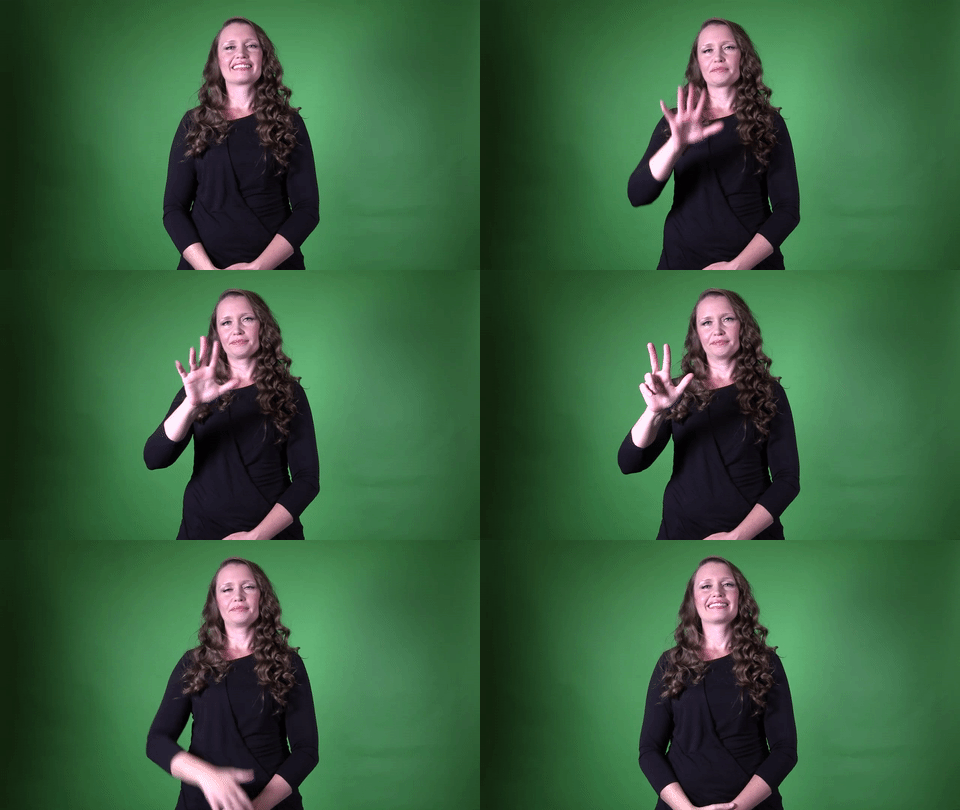
Definition: The number fifty-three
Sign for FIFTY-THREE in ASL

Practice Activities:
Practicing the sign for FIFTY-THREE in ASL starts with reinforcing number recognition and fluent transitions between similar signs. Begin by warming up with counting exercises, signing numbers from one to sixty, and paying special attention to transitioning smoothly between fifty-two, fifty-three, and fifty-four. Use a mirror or record yourself to ensure your fingers form the correct shape and movement.
Try practicing the sign for FIFTY-THREE in ASL in response to written or spoken numbers. Have a friend or instructor say random numbers from fifty to sixty while you sign them back as quickly as possible. Alternatively, look at flashcards with different numbers and produce the correct sign without hesitation. This will help with speed and recognition.
Engage in a shopping or counting scenario to apply the sign in context. Imagine a conversation where you are discussing prices or quantities, such as counting a collection of items or stating an age. Example: “I have fifty-three marbles.” This helps learners place the sign in a meaningful real-life context.
For partner practice, play a number-guessing game. One person signs a number between fifty and sixty while the other guesses, and then switch roles. You can also sign a sequence of numbers and have your partner repeat them correctly in order. This builds accuracy and strengthens recognition of number signs.
Use storytelling to reinforce fluency with numbers. Create a short scenario where the sign for FIFTY-THREE in ASL appears naturally, like “Grandpa turned fifty-three today!” or “She counted fifty-three stars in the sky.” This will help integrate the number into everyday communication.
Cultural Context:
The sign for fifty-three in ASL is an important part of learning numbers in American Sign Language. Numbers play a key role in conversations, whether discussing age, money, time, or quantities. Knowing the correct way to sign fifty-three in ASL ensures clear communication in both casual and formal settings.
In Deaf culture, fingerspelling and number signs are frequently used in everyday interactions. Learning the sign for fifty-three in ASL helps signers build confidence when discussing numerical information. Since ASL is a visual language, proper handshape and movement make a big difference in effective communication.
When signing fifty-three in ASL, handshape is crucial to maintaining clarity. The number signs in ASL follow a pattern that makes counting easier for fluent signers. Mastering numbers not only improves signing skills but also helps with understanding larger numerical concepts in ASL.
The sign for fifty-three in ASL is commonly used in financial conversations, such as discussing prices, salaries, or transactions. It is also helpful when signing dates, addresses, and statistics. ASL users rely on number signs frequently in work, school, and personal life.
In teaching ASL, practicing number signs consistently helps beginners recognize patterns in the language. Understanding the sign for fifty-three in ASL contributes to smoother communication when discussing numbers in any setting. Learning numbers in ASL helps signers become more fluent and engaged with the language.
ASL numbers are deeply tied to Deaf culture and history. Deaf schools and organizations often use numbers for identification and reference. Knowing how to sign fifty-three in ASL connects learners to the broader Deaf community.
Many ASL learners practice number signs through repetition and real-life application. The sign for fifty-three in ASL is easily incorporated into everyday conversations, making it a useful sign to learn. Consistent use of number signs helps strengthen overall ASL proficiency.
Accurate signing of numbers ensures better understanding between ASL users. When signing fifty-three in ASL, it is important to maintain proper handshape and movement to avoid confusion. Clear and precise signing helps messages get across effectively.
Numbers in ASL often follow standardized patterns that make them easier to learn. The sign for fifty-three in ASL follows regular number signing principles, making it intuitive for learners of all levels. Practicing frequently helps with fluency and confidence in using numbers in ASL.
Mastering numbers like fifty-three in ASL helps signers engage in real-world conversations. Discussions about quantities
Extended Definition:
The sign for fifty-three in ASL is formed using a combination of hand shapes and movement that clearly represent the number. It follows the standard number pattern in American Sign Language, making it easy to learn once you understand the basics of ASL numbers. Mastering number signs like fifty-three in ASL is important for conversations involving age, money, addresses, or dates.
Numbers in ASL rely on handshapes and palm orientation to convey meaning accurately. The sign for fifty-three in ASL starts with the palm facing outward while forming the number five, then transitions smoothly into the number three. The movement should be clear and fluid to ensure proper understanding.
When signing fifty-three in ASL, keep your fingers steady and your hand positioned at chest level. Consistency in signing numbers helps improve communication efficiency, especially in fast-paced conversations. Proper finger placement is key to avoiding confusion with similar numbers.
ASL numbers beyond ten follow a consistent pattern, making them easier to recognize with practice. The sign for fifty-three in ASL builds on familiar handshapes used for other numbers in the same range. Becoming comfortable with multiple-digit numbers will improve fluency in ASL conversations.
Learning the sign for fifty-three in ASL is useful for many real-life situations, such as discussing prices or telling someone your age. Knowing how to sign numbers correctly ensures clarity in discussions, whether you’re talking to a Deaf friend or interpreting in a professional setting. Practicing number signs regularly will help reinforce them in everyday use.
In ASL, numbers are often integrated smoothly within sentences to convey complete thoughts. When signing fifty-three in ASL in conversation, facial expressions and context help clarify meaning. This makes it easier for the listener to understand whether you’re talking about a quantity, a time, or a measurement.
Regional variations may slightly alter how the sign for fifty-three in ASL is performed. While most ASL users follow standard number signing conventions, minor differences in technique exist within different Deaf communities. Itβs always helpful to learn from native ASL users to ensure accuracy.
Numbers like fifty-three in ASL are commonly used in educational settings for teaching math concepts to Deaf students. Knowing how to sign numbers correctly helps bridge communication gaps in classrooms and supports a more inclusive learning environment. Practicing ASL numbers can build confidence in both teachers and students.
Using the sign for fifty-three in ASL correctly is essential in professional settings like interpreting, business transactions, and customer service. Accuracy in
Synonyms: fifty-three, number fifty-three, number 53, the number 53, the number fifty-three
Educational resources: Find related learning materials in our course bank!
Want more? Check out some of our popular learning activities on the homepage!
Need to look up a sign? Use our highly rated dictionary: https://aslinteractive.com/best-asl-dictionary/
Follow us on tiktok: https://www.tiktok.com/@aslinteractive. More social media links at the bottom of this page!
Long-tail Keywords: what is the sign for fifty-three in ASL, how do you sign fifty-three in American Sign Language, ASL sign for fifty-three
Categories: Numbers – Basics, Numbers 51-60, cardinal numbers
tags: Numbers, Numbers 51-60, Counting, Math, Language Learning
Parameters
*Handshape*:
The sign for FIFTY-THREE in ASL uses a shifting number handshape. Start with the number five handshape β, where all fingers are extended. Then, quickly transition to the number three handshape, extending only the index and middle fingers while keeping the thumb out. This transition should be smooth and fluid. The sign for FIFTY-THREE in ASL relies on clear finger positioning and movement to convey the correct numerical value.
*Palm Orientation*:
The palm orientation for the sign for FIFTY-THREE in ASL starts with an open hand facing forward. The fingers briefly form the number five before transitioning into a three, where the thumb, index, and middle fingers extend while the ring and pinky fingers retract. Throughout the motion, the palm remains facing outward, ensuring clarity and visibility for the number being signed.
*Location*:
The sign for fifty-three in ASL is produced in the neutral space in front of the body, typically at chest level. The dominant hand forms the number five, then transitions to showing three fingers while the thumb and pinky close. The movement should be smooth and fluid to ensure clarity. The sign remains in the same location without traveling across the body. Keep your palm facing forward for accurate presentation.
*Movement*:
To produce the sign for fifty-three in ASL, start with an open hand facing forward. Bring the thumb, index, and middle fingers together while keeping the ring and pinky fingers extended. This motion represents the number fifty transitioning into three. The movement is fluid but distinct to ensure clarity. Keep the hand steady and positioned at chest level for easy visibility. This sign is part of the larger number system in ASL.
*Non-Manual Signals*:
Facial expressions for the sign for FIFTY-THREE in ASL remain neutral or slightly attentive, depending on the context. If emphasizing a numerical value in conversation, a slight eyebrow raise may occur. The mouth typically stays relaxed, but a small tightening of the lips can appear if clarifying or confirming the number.
Head movements are minimal but may include a brief nod when giving a response. Eye contact should be steady, ensuring clear communication of the numerical information. In a casual setting, the expression is generally neutral, while in formal or instructional contexts, a more deliberate articulation of the sign for FIFTY-THREE in ASL is helpful.
*Prosody, Dominant/Non-Dominant Hand*:
The sign for FIFTY-THREE in ASL uses the dominant hand, forming the number “5” handshape with fingers spread apart. Quickly transition by pulling in the ring and pinky fingers while the index, middle, and thumb remain extended. This movement should be fluid and natural, maintaining palm orientation outward. The non-dominant hand is not used in this sign. Ensure a quick and smooth transition between the two handshapes for clarity and accuracy.
Tips for Beginners:
When learning the sign for FIFTY-THREE in ASL, remember that it follows a consistent pattern used in ASL number signs. The number is formed by transitioning between two digits within one fluid motion. Keep your hand relaxed and move smoothly to ensure clarity.
A common mistake is tensing your fingers too much, which can make the transition from five to three stiff or awkward. Make sure to start with an open β5β hand and then naturally retrace the fingers into a β3β without jerky or disconnected movement. Practice in front of a mirror to see if your sign is smooth.
Proper hand orientation is essential. The palm should face outward, ensuring that others can see the sign clearly. If your palm is turned too far inward or downward, it may be hard to read. Always maintain a comfortable but precise hand position.
Finger strength and flexibility can help improve your signing. If you’re struggling to transition from five to three smoothly, try finger exercises to increase dexterity. Spreading your fingers too far apart or holding them too close together can make it harder to distinguish the numbers clearly.
When signing numbers in a conversation, keep your facial expressions and eye contact natural. Looking at your hand too often might signal uncertainty. Instead, trust your muscle memory and gradually build confidence in signing numbers fluidly.
Repetition is key to mastery. Practice counting from fifty to sixty in ASL to reinforce the movement for the sign for FIFTY-THREE in ASL. Watching native signers, using ASL apps, or attending deaf community events will also help you improve and recognize numbers faster.
Connections to Other topics:
The sign for FIFTY-THREE in ASL is part of a broader numerical system that follows a consistent pattern in number formation. Numbers in ASL often use the same handshape patterns, modifying only a few fingers to represent different values. The formation of fifty-three follows this pattern, making it easy to learn in context with related numbers like fifty-two and fifty-four. Recognizing the shared elements in numerical signs helps reinforce number fluency and build confidence in using ASL for counting, addresses, quantities, and mathematical discussions.
Numbers in ASL play a crucial role in daily communication, including money, time, and age. The sign for FIFTY-THREE in ASL may appear in contexts such as listing an address, indicating someone’s age, or describing a quantity in everyday conversation. Understanding how numbers are signed fluidly can enhance comprehension, particularly when exchanging information that involves multiple digits. Practice with sequential numbers also improves signing speed and accuracy, which is essential for fluent communication.
Compound number signs, such as those involved in currency or measurements, frequently involve numerical signs like FIFTY-THREE. For example, a signer might use fifty-three in the context of “fifty-three dollars” or “fifty-three minutes,” combining it smoothly with classifiers or unit signs. Mastering numerical gestures ensures clarity, particularly in fast-paced interactions like business transactions or scheduling discussions. Additionally, recognizing number integration in larger numerical structures is valuable when discussing statistics, dates, and mathematical concepts in ASL.
ASL numbers follow a logical formation that often integrates with other sign structures, making them essential for complex conversations. The sign for FIFTY-THREE in ASL follows the general numerical signing system, reinforcing the importance of handshape transitions and consistent movements. Practicing with number patterns and sequences helps signers build strong foundational skills for broader ASL proficiency.
Summary:
The sign for fifty-three in ASL follows the general numeric pattern used in American Sign Language for numbers between fifty and fifty-nine. It consists of a combination of a five-handshape and a three-handshape in a fluid motion. Because the numbers in this range follow a consistent format, recognizing this sign is intuitive for experienced signers.
To perform the sign for fifty-three in ASL, begin by forming the number five with your dominant hand, palm facing outward. Then, transition smoothly into the number three by folding the pinky and ring finger down while keeping the index, middle finger, and thumb extended. This movement should be fluid, ensuring that the numbers blend into one another naturally.
The sign for fifty-three in ASL is part of the counting system that follows a structured approach. ASL numbers often involve motion or subtle changes in hand configuration, making them visually distinct. It is important to maintain clarity in the number changes to avoid confusion with other signs.
Handshape accuracy is crucial when signing fifty-three to ensure proper distinction from other numbers. Misplacing fingers or altering the movement can lead to misinterpretation, with numbers like fifty-four or fifty-two being mistakenly signed instead. Consistency in execution is key for fluency.
Number signs in ASL play an important role in daily communication, appearing in contexts ranging from age references to monetary amounts. Fifty-three is a specific number but can also surface in casual or formal conversations, such as addressing statistics or specifications. Keeping a natural rhythm while signing allows for smooth numerical exchanges.
ASL numbers often incorporate a rhythmic element when signed in sequence. The sign for fifty-three in ASL is no exception, requiring a comfortable and practiced transition between the digits. This rhythm makes numerical expressions more efficient and natural when used in conversation.
Numerical literacy in ASL is an important skill, as many concepts rely on number usage. The sign for fifty-three in ASL is just one of many that is necessary to understand in numerical contexts. Because numbers follow predictable patterns, once the pattern is recognized, it is easier to pick up additional numbers.
Numbers can shift slightly in their execution depending on regional signing variations or individual preferences. Some ASL users sign numbers larger with exaggerated motion, while others keep them compact. Observing how different signers approach numbers can help learners adapt effectively.
Fifty-three does not typically carry cultural significance in ASL, but numbers in general can reflect societal norms. For example, certain numbers have symbolic associations in different cultures. In ASL, numerical associations can appear in sign names or references to historical events.
When signing for educational purposes, instructors often emphasize number clarity. Teachers will encourage students to practice transitions in numbers like fifty-three to gain confidence. This reinforces consistency and improves comprehension among learners.
Standard ASL number signs, including the sign for fifty-three in ASL, come up in teaching scenarios frequently. Whether in classrooms, presentations, or group discussions, clear numerical signs help express quantitative information effectively. Mastering numerical fluency strengthens overall ASL communication skills.
In real-life applications, numbers, including fifty-three, appear in various contexts like addresses, sports scores, and financial figures. The ability to accurately sign numbers is essential for everyday interactions. Knowing number signs well ensures seamless conversations in personal and professional settings.
Linguistically, ASL numbers demonstrate unique characteristics that differ from spoken languages. The visual nature of ASL allows numbers like fifty-three to be expressed with one concise sign versus multiple spoken words in other languages. This efficiency makes ASL highly effective in number-based communication.
The syntax and grammar of ASL influence how numbers are incorporated into complete sentences. Numbers like fifty-three can appear before or after a noun depending on emphasis. When used in counting or lists, they maintain a structured flow fitting ASL syntax patterns.
Many signs in ASL rely on movement and spatial organization to convey meaning effectively. The sign for fifty-three in ASL must maintain its intended structure to be understood correctly. This visual organization plays a role in how numbers integrate into broader ASL discourse.
ASL numbers are an example of how signed languages encode quantitative information visually. Instead of speech-based articulation, numerical information is represented through gestures and spatial positioning. This visual distinction offers a unique linguistic system different from spoken numeric expressions.
Comparatively, number systems in other signed languages might use different finger configurations or movements. While there are similarities worldwide, variations exist in certain numbers. Examining international number signs provides insight into linguistic diversity in signed languages.
Numbers in ASL also serve a role in name signs and coded expressions. Specific numbers can be used to represent concepts, initials, or even organizations. The sign for fifty-three, while a standard numeric sign, could appear in stylized or symbolic ways depending on context.
Learning numerical signs effectively requires repetition and real-world application. Practicing signs like fifty-three in daily conversations enhances retention. Engaging in number-based activities, such
Want more? Check out some of our popular learning activities!
ASL Interactive Resources
ASLInteractive YouTube Channel
Follow us on tiktok: @aslinteractive.com
Follow us on Instagram: aslinteractive
Facebook page: aslinteractive
Facebook group: aslinteractive
LInkedIn: ASL Interactive LLC
Twitter: @ASL_interactive
*Some information on this page is AI-generated. AI can make mistakes. Please check the information.


Responses