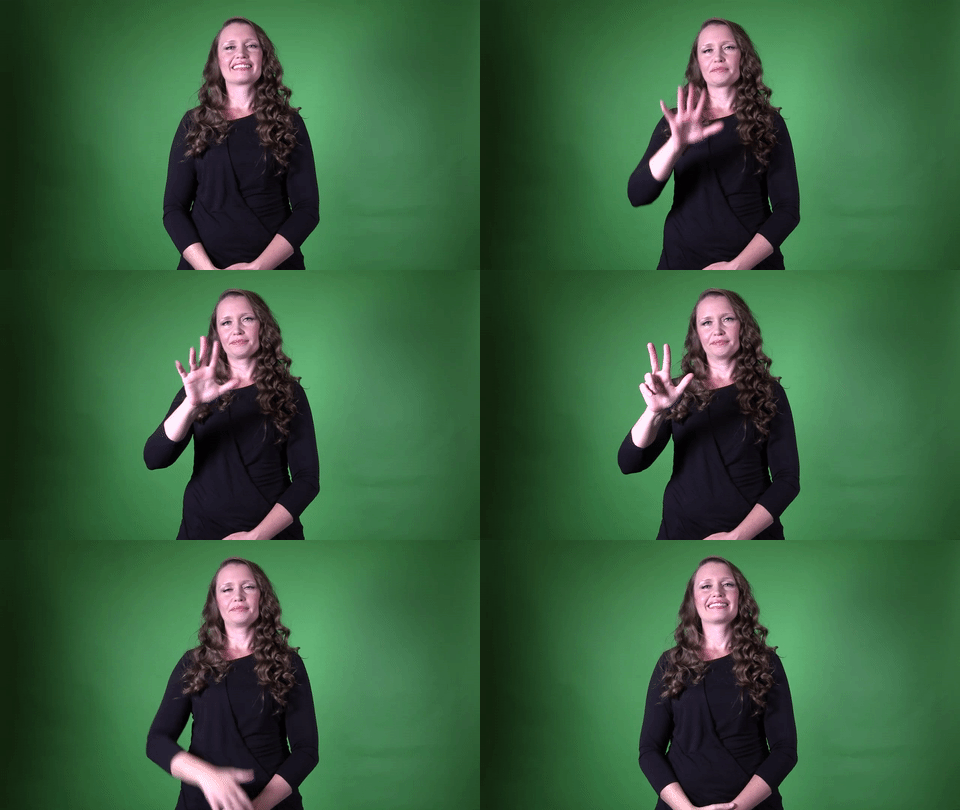
Definition: Refers to the number fifty-three
Sign for THE NUMBER FIFTY-THREE in ASL

Practice Activities:
To practice the sign for the number fifty-three in ASL, start by isolating the handshape and movement. Hold up the number five handshape and transition smoothly to the number three handshape. Repeat this several times, focusing on clarity and fluidity. Use a mirror to check your accuracy and ensure the transitions are consistent.
Once you are comfortable forming the sign for the number fifty-three in ASL, try practicing it in real-life contexts. Count aloud in ASL from fifty to sixty, pausing at fifty-three each time. Then, randomly mix up numbers in the fifties and sign them to reinforce recognition.
Use the sign in simple sentences. For example, sign “I have fifty-three books” or “There are fifty-three students in the class.” Incorporate fingerspelling to practice combining numbers with other ASL structures. Ask a practice partner to quiz you, signing several numbers and having you identify them.
For storytelling practice, imagine you are talking about a large group or an event where the number fifty-three is relevant. Describe a scenario like “Fifty-three people attended the meeting” or “Fifty-three balloons were at the party.” This helps reinforce the sign in fluid conversation.
Engage in number-focused games with a partner. Take turns signing random numbers while the other person writes them down. This improves both receptive and expressive skills. You can also play a guessing game where one person signs numbers quickly, and the other responds by signing back the correct answer.
Challenge yourself by incorporating the sign into daily activities. When reading or watching something with numbers, sign them in ASL, paying special attention when the number fifty-three appears. This will strengthen your recognition and reinforce your ability to sign it naturally in conversation.
Cultural Context:
American Sign Language is deeply rooted in Deaf culture, providing an essential means of communication for the Deaf and hard-of-hearing community. Numbers play a significant role in daily conversations, from counting to expressing ages, dates, and measurements. The sign for the number fifty-three in ASL is one of many number signs that follow a consistent pattern, making them easier to remember and use.
When signing the number fifty-three in ASL, handshape and movement are crucial. The numbers fifty and three blend together smoothly, following the structured system of number signs in ASL. Understanding the sign for the number fifty-three in ASL helps increase fluency and enhances communication within the Deaf community.
The number fifty-three can appear in various conversations, whether discussing age, money, measurements, or mathematical concepts. ASL users rely on these number signs to share important details quickly and clearly. Learning how to sign the number fifty-three in ASL correctly ensures effective and accurate communication.
Numbers in ASL are not just about memorization; they carry cultural significance. The visual nature of ASL makes number signs distinct, and they often follow logical hand movements that are intuitive once learned. Practicing the sign for the number fifty-three in ASL will help users become more comfortable with larger numbers.
In educational settings, ASL numbers are used for teaching math concepts, taking attendance, and giving instructions. For Deaf students, mastering these signs is essential for academic success. Knowing how to sign the number fifty-three in ASL can be useful when working in schools, interpreting, or engaging with the Deaf community.
Social interactions also involve numbers, from sharing addresses to discussing events and schedules. When signing the number fifty-three in ASL, facial expressions and clarity in handshape improve comprehension. Accurate number signs prevent misunderstandings and help maintain smooth conversations.
Technology has made learning ASL more accessible, with videos and online resources demonstrating number signs. Watching fluent signers perform the sign for the number fifty-three in ASL helps learners develop accuracy and confidence. Regular practice with native signers or instructors is the best way to master these essential number signs.
ASL follows a logical structure where numbers build upon each other using consistent patterns. The sign for the number fifty-three in ASL follows the same principles, making it easier to learn after understanding similar number signs. Becoming comfortable with ASL numbers helps users engage more naturally in signed conversations.
Numbers are widely used in business transactions, making ASL number flu
Extended Definition:
The sign for the number fifty-three in ASL is a combination of the handshape and movement that represents this specific number. In American Sign Language, numbers are signed using one hand, following a consistent pattern to ensure clarity. When signing fifty-three, the handshape involves forming the numbers five and three in a fluid motion.
To sign the number fifty-three in ASL, start by holding up all five fingers of your dominant hand. Then, transition smoothly to a three-handshape by folding down the pinky and ring fingers while keeping the thumb, index, and middle fingers extended. This movement clearly distinguishes fifty-three from other similar numbers.
Numbers in American Sign Language follow a structured pattern to maintain consistency. The sign for the number fifty-three in ASL builds upon the foundation of counting, making it easy to recognize among other numbers. Proper finger placement and movement are important to ensure that the number is understood correctly.
When learning the sign for the number fifty-three in ASL, practice is essential for fluidity. By repeatedly signing the number, fingers will become more comfortable with the transition. Watching experienced signers can also help with mastering the correct form.
Using the number fifty-three in ASL is common in conversations that involve counting, addresses, and measurements. It appears in everyday situations such as discussing ages, prices, or times. Knowing how to sign numbers accurately improves overall communication skills in ASL.
When signing fifty-three, ensure that the hand is positioned in a way that makes the fingers visible to the viewer. A clear and direct signing space helps prevent confusion with other numbers. Proper lighting and contrast between hands and background also aid visibility.
Some learners may find it helpful to practice by signing multiple numbers in sequence. Moving from fifty-two to fifty-three, then to fifty-four reinforces muscle memory. Repetition helps build confidence and speed in signing numbers.
In ASL, numbers play an important role in both everyday communication and structured settings like classrooms or business environments. The sign for the number fifty-three in ASL is just one example of how number signs follow a logical progression. Mastering number signs leads to more effective interactions with other signers.
The number system in ASL allows for efficient and clear communication. Each number has its own unique handshape, and transitioning smoothly between them ensures that the message is understood. The sign for the number fifty-three in ASL maintains this principle by using a clear transition from five to three.
When learning numbers in
Synonyms: fifty-three, number fifty-three, number 53, the number 53, the number fifty-three
Educational resources: Find related learning materials in our course bank!
Want more? Check out some of our popular learning activities on the homepage!
Need to look up a sign? Use our highly rated dictionary: https://aslinteractive.com/best-asl-dictionary/
Follow us on tiktok: https://www.tiktok.com/@aslinteractive. More social media links at the bottom of this page!
Long-tail Keywords: what is the sign for the number fifty-three in ASL, how do you sign the number fifty-three in ASL, ASL sign for the number fifty-three
Categories: Numbers – Basics, Numbers 51-60, cardinal numbers
tags: Numbers, Numbers 51-60, Counting, Math, Language Learning
Parameters
*Handshape*:
The sign for the number fifty-three in ASL uses a handshape where the palm is facing outward. The thumb, index, and middle fingers are extended while the ring and pinky fingers curl slightly toward the palm. This handshape smoothly transitions from fifty-two, changing as the count progresses. The sign for the number fifty-three in ASL emphasizes clarity by keeping the fingers distinct, ensuring easy recognition in communication. ️
*Palm Orientation*:
The palm orientation for the sign for the number fifty-three in ASL starts with the palm facing forward. The hand transitions smoothly between showing the number five, then three, keeping the fingers extended naturally. The motion is controlled, ensuring clear number distinction. Throughout the sign for the number fifty-three in ASL, the palm remains outward to maintain visibility and clarity.
*Location*:
The sign for the number fifty-three in ASL is produced in the neutral space in front of the body, slightly above waist level. The dominant hand forms the number five and then transitions smoothly to the number three. This movement happens in a fluid motion to indicate the numerical value. Keeping the hand facing outward ensures clarity. The sign for the number fifty-three in ASL should be made with a steady, controlled motion for accuracy.
*Movement*:
To sign for the number fifty-three in ASL, begin with the number five handshape, palm facing outward . Transition smoothly by folding the pinky and ring fingers down while keeping the index, middle, and thumb extended, forming the number three ✌️. This movement should be fluid, shifting directly from five to three in a slight flicking motion. Ensure clarity in finger positioning to maintain accuracy.
*Non-Manual Signals*:
When signing the sign for the number fifty-three in ASL, keep a neutral or slightly focused facial expression . Your eyebrows should remain relaxed, as this is a straightforward numerical sign. If emphasizing or clarifying, you may slightly raise your eyebrows . Keep your mouth in a natural position unless you need to reinforce the number by mouthing “fifty-three” for additional clarity. Maintain steady eye contact to ensure clear communication.
*Prosody, Dominant/Non-Dominant Hand*:
The sign for the number fifty-three in ASL uses the dominant hand only. Begin with the hand in a “5” shape, then smoothly transition to a “3” shape by folding down the ring and pinky fingers while keeping the index, middle, and thumb extended. This movement should be fluid and clear to ensure accurate number representation. Maintain a neutral signing space in front of the chest for clarity.
Tips for Beginners:
When learning the sign for the number fifty-three in ASL, focus on using a fluent and controlled movement of your fingers. This sign is a combination of two numbers, five and three, executed in quick succession. Make sure to transition smoothly between the digits without unnecessary movement or hesitation.
A common mistake beginners make when signing the number fifty-three in ASL is emphasizing each digit separately rather than forming a fluid motion. Keep your palm facing outward and ensure the three is formed correctly without accidentally using two fingers instead of three. Pay attention to your finger positioning to avoid confusion with similar numbers.
Practicing in front of a mirror can help you see if your sign for the number fifty-three in ASL is clear and distinct. Watching videos of native signers can also improve accuracy by showing you exactly how transitions should look. Repetition is key to building muscle memory, so spend time each day reinforcing the movement.
Hand relaxation is crucial to prevent stiffness when changing from five to three. Keep your fingers loose, and your hand should not appear tense or shaky. If the transition feels unnatural, try slowing down and practicing individual components before blending them together in a single motion.
Signing numerals in ASL requires equal attention to pacing and precision. The sign for the number fifty-three in ASL should be quick but not rushed—each digit must be clearly understood. Ask fluent signers for feedback, as they can provide corrections tailored to your specific challenges.
When using the number fifty-three in conversation, place it naturally within sentences rather than isolating it unnaturally. Practicing numbers in different contexts will help you recall them faster. Over time, your speed and accuracy will improve, making your signing more fluid and confident.
Connections to Other topics:
The sign for the number fifty-three in ASL connects to other numerical signs by following a consistent pattern in ASL numbering. The sign transitions smoothly from the number five to the number three, maintaining the same handshape orientation. This visual fluidity in number signs helps reinforce the relationship between numbers and encourages recognition of ASL number patterns in everyday communication.
Numbers in ASL are often used in combination with time concepts, such as ages, dates, and quantities. The sign for the number fifty-three in ASL could appear in contexts like stating someone’s age, a sports jersey number, or an address. Learning to sign numbers fluently allows for greater accuracy when discussing numerical details in conversations.
The number fifty-three can also be relevant when signing money amounts, distances, or measurements. For example, when discussing fifty-three dollars, the sign for the number fifty-three in ASL may be combined with the dollar sign, following ASL’s numerical money structure. Similarly, it can be used for percentages or statistical data, making it essential for academic and professional communication.
Ordinal numbers, used for ranking and sequencing, can modify the sign for the number fifty-three in ASL. By incorporating movement changes, such as a slight twist, the number becomes “fifty-third.” This adaptation is useful in contexts like competition results, street addresses, and academic standings.
Numbers are also essential in identifying years and historical events. The sign for the number fifty-three in ASL might be used when discussing events that occurred in 1953 or 2053. Recognizing these numerical sign structures helps in conveying historical and future contexts efficiently in both casual and formal ASL conversations.
Summary:
The sign for the number fifty-three in ASL is a combination of two handshapes that shift seamlessly from one to the next. It begins with the number five, where the fingers are spread apart and extended forward. The movement transitions into the number three by folding the ring and pinky fingers down while keeping the index and middle fingers extended, alongside the thumb.
This sign integrates fluid motion, requiring dexterity to ensure clarity and accuracy. The transition between handshapes must remain smooth, without pausing or hesitation. Proper hand positioning and orientation play a key role in making sure the number is easily understood.
Numbers in ASL rely on specific palm orientation, which affects legibility depending on context. For counting, the palm faces outward, making it visible to the viewer. When incorporating numbers in a sequence or in certain phrases, palm orientation may slightly shift for better natural flow.
The sign for the number fifty-three in ASL falls within the broader numerical system used in daily conversations. It is commonly seen when discussing age, addresses, prices, and statistical data. Understanding number signs is essential for fluency, as they appear frequently in various domains.
When signing numbers above fifty, handshape dexterity increases in importance. Many numbers in this range require dynamic transitions that must be executed with clarity. The capacity to fluidly move between different digits ensures smooth communication and prevents confusion with similar-looking numbers.
Numerical signs in ASL, including the sign for the number fifty-three in ASL, reveal linguistic insights about handshape economy. Signers unconsciously optimize movements to maintain efficiency. The design of numerical signs reflects this principle, minimizing unnecessary motion for faster communication.
ASL incorporates specific number-signing conventions that affect clarity and linguistic structure. These include the use of different regional variations and slight modifications in speed or emphasis based on conversational context. Familiarity with these conventions strengthens comprehension in numerical exchanges.
The sign for the number fifty-three in ASL, and numbers in general, plays a vital role in education and accessibility. Within Deaf classrooms, educators emphasize number signs as part of language acquisition. Mastery of number signs empowers students in both mathematical and daily communication.
Numbers in ASL develop within a broader cultural and historical context tied to Deaf communication methods. The sign for the number fifty-three in ASL reflects the necessity of clear, concise number representation across different settings. From financial transactions to storytelling, numbers remain an indispensable part of Deaf culture.
Fingerspelling and numerical signing require different skill sets, although they share some similarities. With fingerspelling, letters must transition fluidly, while numerical signs focus on precise numeric expression. Both demand high motor precision for effective communication.
When signing the number fifty-three, learners often face minor challenges with handshape retention. Beginners may accidentally bend the wrong fingers or pause mid-transition. With practice, muscle memory strengthens, making the movement more natural and fluid.
Clarity in numerical signs like the sign for the number fifty-three in ASL depends on finger articulation. The ability to maintain proper spacing between upright fingers ensures that the number is easily readable. Overly rigid or tightly grouped movements can make certain numbers visually ambiguous.
Variations in how numbers are signed emerge across different signing communities. Some individuals may sign fifty-three with slight alterations in speed or finger emphasis. Such variations exist due to regional preferences, generational differences, and linguistic evolution.
Sign language research observes that numerical representation in ASL follows distinct phonological rules. Handshape, movement, and orientation all contribute to creating phonemes in signed language. The sign for the number fifty-three in ASL adheres to these core principles, ensuring consistency within the number system.
ASL grammar integrates numbers in multiple ways beyond standalone counting. Numerical incorporation within classifier structures and time references increases complexity. An example includes phrases like “fifty-three minutes” or “fifty-three dollars,” where number integration affects sentence structure.
A deep understanding of ASL numbers enhances conversational ease. Signers who navigate numbers with fluidity contribute to efficient exchanges, whether in casual discussions or professional environments. Mastering numerical fluency benefits both everyday communication and technical discussions.
The placement of numerical signs within a sentence follows specific linguistic patterns. When indicating quantities, the number sign typically precedes the noun being counted. Example: “Fifty-three books” would be signed by showing the number fifty-three first, followed by the sign for “books.”
Counting sequences require signers to maintain a steady rhythm without rushing individual numbers. The consistency of hand movement ensures that each number is visually distinct. This principle enhances legibility for both novice and fluent signers.
Numbers often interact with classifiers when describing quantities or physical groupings. The sign for the number fifty-three in ASL can combine with a classifier for people, objects, or other elements. This expanded grammar allows for more precise visual representation of numerical data.
In everyday usage, number signs frequently appear in banking, shopping, and scheduling. Clarity in numerical signs impacts their practical application across different industries. Pro
Want more? Check out some of our popular learning activities!
ASL Interactive Resources
ASLInteractive YouTube Channel
Follow us on tiktok: @aslinteractive.com
Follow us on Instagram: aslinteractive
Facebook page: aslinteractive
Facebook group: aslinteractive
LInkedIn: ASL Interactive LLC
Twitter: @ASL_interactive
*Some information on this page is AI-generated. AI can make mistakes. Please check the information.


Responses