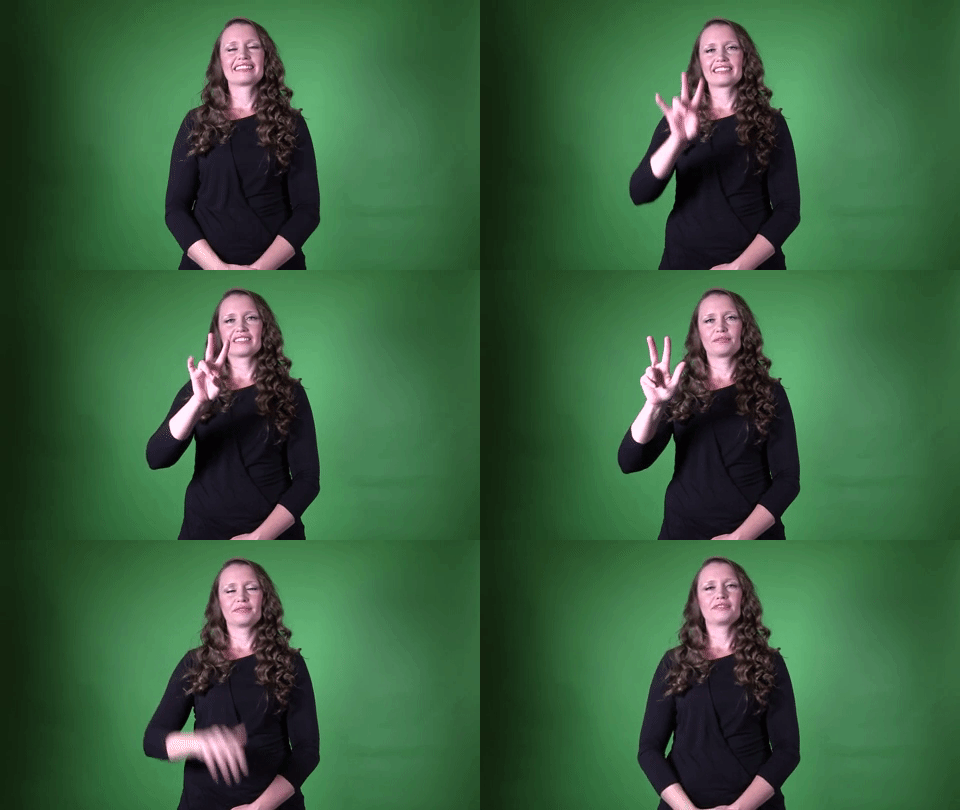
Definition: The number seventy-three.
Sign for 73 in ASL

Practice Activities:
To practice the sign for 73 in ASL, start by isolating the movement and handshape. Repeatedly sign 73 while paying close attention to the palm orientation and flicking motion. Try signing it in front of a mirror to self-correct or record yourself to compare with ASL resources.
Use number sequences to integrate the sign for 73 in ASL naturally. Practice counting from 70 to 75 or mix it with other two-digit numbers, such as 63, 83, or 93. For an added challenge, have a partner call out random numbers so you can sign them quickly and accurately.
Apply the sign in real-world contexts by using it in sentences. Sign phrases like “My grandmother is 73 years old” or “The address is 73 Maple Street.” You can also practice by pretending to talk about scores, money, or ages to get comfortable using the sign for 73 in ASL.
Engage in a storytelling activity where you incorporate the sign naturally. Tell a story about a 73-year-old character or create a fictional scene where you need to use the number. If working with a partner, ask about their random “age” and respond with a signed number.
Turn practice into a game by using flashcards or a quick-response challenge. Write numbers on index cards, shuffle them, and then sign each number as you pick them. This will help reinforce recognition and rapid signing of numbers like 73 in ASL.
Cultural Context:
The sign for 73 in ASL is an important part of American Sign Language, helping signers communicate numbers easily and efficiently. Numbers play a major role in everyday conversation, including discussing age, addresses, phone numbers, and more. Learning the sign for 73 in ASL contributes to fluency and enhances numerical literacy in sign language.
In ASL, numbers follow specific handshape and movement patterns, making them distinct and easy to recognize. The sign for 73 in ASL follows the general number rule for the 70s, using a twisting motion between specific handshapes. Understanding these patterns improves comprehension and makes communication smoother in conversations involving numbers.
Numbers in ASL also reflect cultural aspects of the Deaf community, as they are used in personal introductions, addresses, and dates. Knowing the sign for 73 in ASL ensures clarity when discussing years, prices, and quantities. Many signers memorize these numbers early in their learning journey to develop confidence in conversations.
ASL numbers often have a regional or personal variation based on fluency level and signing community. The sign for 73 in ASL follows standard number conventions but may have slight differences based on signer preference. Exposure to various signing styles helps improve recognition and communication skills in different contexts.
Using the sign for 73 in ASL correctly is necessary when interpreting or translating information. ASL teachers and interpreters emphasize precision in number signs to prevent miscommunication. A strong understanding of ASL numbers, including 73, strengthens overall signing accuracy.
Fluency in ASL numbers supports everyday interactions like ordering food, discussing dates, or solving math problems. The sign for 73 in ASL is useful when giving personal details, making bank transactions, or filling out forms in ASL. Practicing number signs regularly helps strengthen communication skills in daily life.
Mastering ASL numbers, including the sign for 73 in ASL, is essential for math lessons, storytelling, and describing sequential instructions. Many ASL learners focus on numbers early to build a strong foundation in signing. Since numbers appear in so many conversations, knowing them well enhances confidence in both formal and casual exchanges.
The Deaf community frequently uses ASL number signs in storytelling and jokes, adding expressive elements to conversations. The sign for 73 in ASL, along with other numbers, is necessary for discussing time, measurements, and other quantity-based topics. Consistent practice with different number signs improves recognition speed and fluency.
Numeric
Extended Definition:
The sign for 73 in ASL is part of the unique numbering system in American Sign Language. This number is formed using a specific handshape and movement pattern that follows ASL numerical rules. It is important to practice this sign correctly to ensure clarity in communication.
Numbers in ASL rely on handshapes, palm orientation, and movement. The sign for 73 in ASL is a combination of the digits 7 and 3, signed in a fluid motion. It follows the standard pattern of ASL number signs, making it easy to learn once you understand the structure.
This number is often used in various contexts, including ages, addresses, and monetary values. When signing the number, proper finger placement and movement are essential to maintain accuracy. Hand orientation can influence the meaning, so it’s crucial to use the correct positioning.
ASL numbers from 67 to 99 typically follow a twisting motion as you transition between digits. The sign for 73 in ASL involves transitioning smoothly between the 7-handshape and the 3-handshape. Mastering this movement helps improve fluency when signing numbers.
Learning numbers in ASL is useful for everyday conversations, math-related discussions, and exchanging personal details. The sign for 73 in ASL is part of this essential skill set. Practicing regularly helps build confidence in number signing.
When signing for an audience, maintaining clear hand movements ensures better understanding. The sign for 73 in ASL should be signed with precision to avoid confusion with similar numbers. Small adjustments in wrist motion can make a difference in how the number is perceived.
ASL number signs are used in both formal and informal settings. Whether discussing a sports score, a price, or a year, the sign for 73 in ASL appears in many different situations. Mastering this and other number signs can enhance your communication skills in ASL.
For beginners, it helps to practice in front of a mirror or with a fluent signer. Observing how others sign the number can improve your accuracy. The sign for 73 in ASL, like other two-digit numbers, may take time to perfect but is an important part of learning the language.
ASL fluency involves both expressive and receptive skills, so recognizing numbers is just as crucial as signing them correctly. The sign for 73 in ASL is an example of how small changes in movement can affect meaning. Watching videos or practicing with a tutor can reinforce proper technique.
Synonyms: seventy-three, number seventy-three, number 73, the number 73, the number seventy-three
Educational resources: Find related learning materials in our course bank!
Want more? Check out some of our popular learning activities on the homepage!
Need to look up a sign? Use our highly rated dictionary: https://aslinteractive.com/best-asl-dictionary/
Follow us on tiktok: https://www.tiktok.com/@aslinteractive. More social media links at the bottom of this page!
Long-tail Keywords: what is the sign for 73 in ASL, how do you sign 73 in ASL, 73 in American Sign Language
Categories: Numbers – Basics, Numbers 71-80, cardinal numbers
tags: Numbers 71-75, Numbers, Language Learning, Mathematics, Education
Parameters
*Handshape*:
The sign for 73 in ASL uses a unique handshape that transitions fluidly. The dominant hand starts in a “7” handshape, with the thumb and ring finger touching while the index, middle, and pinky fingers remain extended. The hand then shifts into a “3” handshape, where the thumb, index, and middle fingers are extended, and the ring and pinky fingers curl in. This movement is done smoothly to maintain clarity.
*Palm Orientation*:
the palm orientation for the sign for 73 in ASL faces outward, away from the signer. The movement involves transitioning from the number 7 to the number 3 in a fluid motion, maintaining consistent palm direction. The hand starts with the thumb and ring finger touching for 7, then smoothly shifts to an open-handed 3. This outward-facing orientation ensures clear visibility and proper execution of the sign for 73 in ASL.
*Location*:
the sign for 73 in ASL is produced in the neutral space in front of the body, slightly to the dominant side. The movement occurs at chest level, ensuring clear visibility. The hand remains within a comfortable range, avoiding exaggerated motions. Keeping the hand steady and fingers distinct enhances clarity. Proper positioning in this area ensures that the sign for 73 in ASL is easily recognizable and correctly executed.
*Movement*:
To sign for 73 in ASL, start with the number 7, forming a “7” handshape with the thumb and ring finger touching while the other fingers extend. Then smoothly transition to the “3” handshape, where the thumb, index, and middle fingers remain extended, while the ring and pinky curl in. The movement should be fluid, with the numbers blending seamlessly for a natural and accurate representation of the sign for 73 in ASL.
*Non-Manual Signals*:
Facial expressions remain neutral or slightly focused when signing the sign for 73 in ASL. The eyebrows may be slightly furrowed, showing attentiveness, especially if clarifying the number. The head may tilt slightly forward to emphasize accuracy, and eyes stay on the hands to ensure clarity. If used in a question, the eyebrows might raise slightly to indicate inquiry. Mouth movements stay minimal, though slight pursing of the lips can enhance precision. ️
*Prosody, Dominant/Non-Dominant Hand*:
The sign for 73 in ASL uses the dominant hand in a “7” handshape, with the thumb and ring finger touching. Start by holding the hand up, palm facing outward. Transition smoothly from a “7” to a “3,” extending the index, middle, and thumb while curling the ring and pinky. The movement should be fluid to indicate the correct number sequence when signing the sign for 73 in ASL.
Tips for Beginners:
Mastering the sign for 73 in ASL requires attention to movement and handshape. This sign is part of the 70s number pattern, which involves a twisting motion of the hand. To ensure accuracy, start with the number 7 handshape, then smoothly transition to the number 3 while twisting your wrist slightly outward. This fluid motion makes the sign distinct and easy to recognize.
One of the most common pitfalls when learning the sign for 73 in ASL is making the movement too choppy. The transition between 7 and 3 should be smooth, not abrupt. Keep your fingers steady and avoid unnecessary pauses between the digits, as this can cause confusion. Practicing in front of a mirror can help you perfect the shape and movement.
Finger positioning is also crucial for clarity. Make sure your index and middle fingers are extended for 7 while your thumb touches your ring finger, then smoothly shift into a 3 with your thumb, index, and middle fingers extended. If your fingers are too close together or incorrectly positioned, the sign may look like a different number, leading to miscommunication.
Speed should be gradual, not rushed. Start slow to ensure the accuracy of the movement, then build up to a natural speed. Watching native ASL users sign numbers in sequences can help you develop confidence and fluency. The more you expose yourself to ASL number patterns, the easier they will become.
Consistency is key when signing numbers. Memorize the 70s number pattern and practice frequently so that signing the sign for 73 in ASL becomes second nature. With time and repetition, you will be able to use it effortlessly in everyday conversations.
Connections to Other topics:
The sign for 73 in ASL is part of the larger system of numbering in American Sign Language, which follows distinctive patterns based on handshapes and movement. Numbers in ASL often follow a logical structure, with certain numbers grouped based on how the hand moves or changes orientation. The sign for 73 in ASL falls into a pattern where the hand transitions between two specific handshapes, making it visually distinct from other numbers in the same range.
ASL numbers have connections to concepts like age, money, address numbers, and years, where the structure of number signs remains consistent. When listing ages, for example, signing numbers from the chin indicates a person’s age, while the same numbers signed in a neutral space indicate quantity or numerical values. The sign for 73 in ASL could be used when stating a birth year, prices, or statistics, making it a useful part of everyday numerical communication in ASL.
Numbers in ASL are also essential for conveying time-related information, such as specifying durations or setting appointments. The influence of signed numbers extends into non-manual markers, such as raised eyebrows for questions about a number or slight tilts in hand movement for emphasis. The sign for 73 in ASL, like all number signs, benefits from clear hand articulation and proper formation to ensure accuracy and clarity in conversation.
ASL also uses numerical incorporation to modify certain signs, such as “months” or “years,” where changing the handshape to include a number affects meaning. Though the sign for 73 in ASL is not typically incorporated into other signs, understanding how number signs influence ASL grammar is critical for fluency. Recognizing numerical sequences also aids in fingerspelling recognition, helping learners distinguish numbers from similar-looking letter combinations.
Summary:
The sign for 73 in ASL follows a pattern seen in other two-digit numbers in American Sign Language. It is produced using the dominant hand in a movement that reflects both numerical value and visual distinction. For clarity, this number is articulated with careful attention to the formation and origination of each digit within the sequence.
In executing the sign for 73 in ASL, start with the number 7 handshape. The thumb and ring finger should touch while the remaining fingers extend upward. From this position, transition smoothly into the number 3, keeping the gesture fluid to maintain clarity.
The transformation from 7 to 3 should be clear and distinct, avoiding hesitation. Some fluent signers may make the transition quickly, but clarity must be prioritized for accessible communication. Numbers in ASL depend on well-defined movements, so practicing each transition helps ensure accuracy.
Context plays an important role when using the sign for 73 in ASL. In rapid conversation, sometimes signers articulate numbers quickly, but precision remains key. Miscommunication can occur if numbers are muddled, particularly in contexts like addresses or financial exchanges.
Numbers between 60 and 89 in ASL often exhibit a “twist” or “slide” depending on regional and individual preferences. The sign for 73 in ASL has a distinct opening and closing of the fingers, making it one of the more visually dynamic two-digit numbers. Maintaining consistency in handshape is crucial for legibility.
Visual distinctions in numerical signing are important for understanding in both formal and informal settings. The way numbers are formed in ASL reflects linguistic efficiency, ensuring that numbers are signed clearly with an economy of movement. The hand transition in the sign for 73 in ASL is representative of that practical structure.
ASL numbers are signed differently than spoken language numbers, which are linear and sequential in form. The sign for 73 in ASL visually represents both digits while incorporating movement unique to ASL. This highlights the spatial efficiency of the language, especially in numerical expression.
Understanding the sign for 73 in ASL requires recognizing number patterns in ASL numbering conventions. Once the patterns are understood, learning additional numbers in the sequence becomes easier. Practice helps internalize the structure, enabling more fluent transitions between numbers.
The numbering system in ASL is iconic, meaning it visually represents the concept rather than being abstract. In spoken languages, 73 is simply spoken, but in ASL, its form is created by tangible movement. This makes numerical representation in ASL a visual and kinesthetic experience.
ASL numerical signs align with the principles of signed languages globally, though variations exist between sign languages. The sign for 73 in ASL belongs to a system developed from manual communication methods across Deaf history. Its precise form reflects the structure embedded in ASL’s grammatical foundation.
Just as spoken languages have dialectical variations, ASL numbers, including the sign for 73 in ASL, may exhibit differences based on region or signer preference. While standard number signs exist, subtle differences in articulation can emerge. Understanding these variations enhances fluency in signed communication.
In Deaf culture, number signs are frequently used in daily interactions. Whether sharing addresses, phone numbers, or prices, numbers are essential to effective signed communication. The sign for 73 in ASL is one of many numerical expressions that facilitate everyday exchanges.
Numbers are used in various grammatical structures in ASL, such as measurements and rankings. The sign for 73 in ASL can function in quantities, lists, and even personal identification numbers. Recognizing how it integrates into larger ASL structures strengthens comprehension.
Counting sequences in ASL rely on rhythm and consistency to maintain clarity. When signing multiple numbers, keeping a smooth flow is essential. The sign for 73 in ASL follows this principle, ensuring numbers are signed efficiently without confusion.
Education in ASL includes structured lessons on number formation, recognizing grouping patterns, and practicing articulation. Learning the sign for 73 in ASL supports the broader goal of numerical literacy in sign language users. ASL curriculum teaches both individual numbers and their contextual usage.
Linguistic research on signed languages explores the cognitive processes behind number representation. Studies show that ASL signers process numerical information visually and spatially rather than sequentially. The sign for 73 in ASL embodies this concept by integrating spatial transitions in one coherent movement.
Signed numbers are influenced by principles of visual perception, making clarity and movement integral to effective communication. Because of this, ASL number signs differ from spoken numbers in their spatial execution. The sign for 73 in ASL exemplifies this unique linguistic property.
In practical application, number signs often adapt depending on context. Some situations demand slow, deliberate signing, while informal exchanges may allow for faster articulation. The sign for 73 in ASL shifts fluidly between these contexts, depending on signer familiarity and comprehension needs.
Fluency in ASL
Want more? Check out some of our popular learning activities!
ASL Interactive Resources
ASLInteractive YouTube Channel
Follow us on tiktok: @aslinteractive.com
Follow us on Instagram: aslinteractive
Facebook page: aslinteractive
Facebook group: aslinteractive
LInkedIn: ASL Interactive LLC
Twitter: @ASL_interactive
*Some information on this page is AI-generated. AI can make mistakes. Please check the information.


Responses