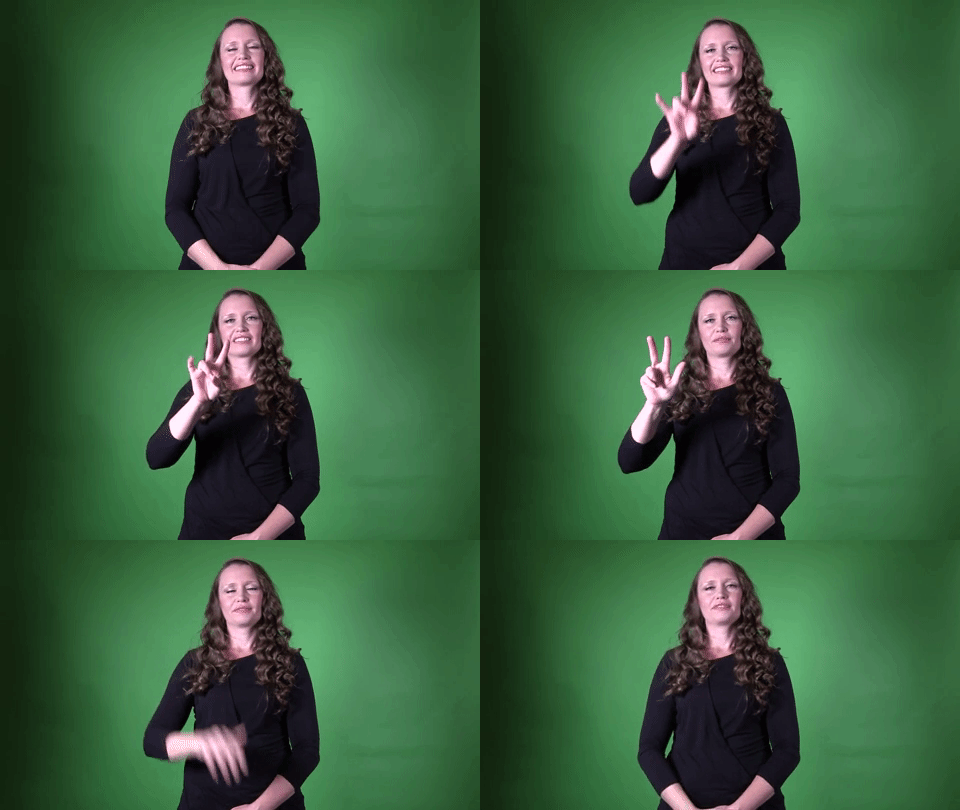
Sign for THE NUMBER 73 in ASL | 🔢 ASL Dictionary

Definition: Refers to the number seventy-three

Sign for THE NUMBER 73 in ASL 

YouTube player

Practice Activities:

To practice the sign for the number 73 in ASL, start by isolating the movement. Hold your dominant hand in a 7-handshape, then smoothly transition to a 3-handshape. Repeat this several times while focusing on fluidity and accuracy. Use a mirror or record yourself to check your hand positioning.

Try speed drills to improve fluency. Sign the number sequence 70, 71, 72, 73, 74, keeping transitions smooth. Mix it up by signing random numbers in the 70s to reinforce recognition. Pair with a partner to take turns signing numbers and identifying them.

Use the sign for the number 73 in ASL in real-world contexts. Count aloud while signing, such as “I saw 73 birds in the sky” or “There were 73 people in line.” Create example sentences using numbers in different settings, like talking about scores, prices, or ages.

Practice the sign in a storytelling exercise. Imagine you are describing a scene where the number 73 appears. It could be “A race with 73 runners” or “A store sale with 73 percent off.” Sign the full story while emphasizing the number naturally within the context.

For interactive practice, play a number-guessing game with a friend. One person picks a number between 70 and 80, and the other signs it. Use a timer to see how many numbers can be correctly signed in one minute for a fun challenge.

Engage in daily practice by incorporating the sign into routine activities. When seeing numbers in headlines, addresses, or receipts, sign them out. Making the sign for the number 73 in ASL a natural part of your conversations will reinforce retention and boost confidence.

Cultural Context:

American Sign Language is a rich and expressive language that relies on hand shapes and facial expressions to convey meaning. When signing the number 73 in ASL, it’s important to use the correct hand movements and orientation to ensure clarity. Numbers in ASL are integral to daily conversations, from discussing age to sharing addresses and phone numbers.

The sign for the number 73 in ASL follows the common pattern for multiple-digit numbers. It uses a unique twisting motion that maintains consistency with the number system in ASL. This movement allows fluent signers to quickly recognize and understand numerical values in conversations.

ASL numbers have cultural importance within the Deaf community, as they are frequently used in education, sports, and storytelling. Knowing how to sign the number 73 in ASL correctly ensures that communication remains clear in discussions involving statistics, finances, or historical dates. Learning and practicing number signs is essential for fluency in ASL.

Numbers are sometimes modified in ASL for emphasis, depending on the context. The sign for the number 73 in ASL is straightforward, but facial expressions can influence how it is received. In casual conversation, numbers may be signed more quickly, while formal settings may require clearer articulation.

Deaf culture values precision in signing, especially with numbers, because small changes in movement or orientation can alter meaning. Using the correct sign for the number 73 in ASL ensures accuracy when signing personal data, prices, or times. Mastering numerical signs improves overall ASL proficiency and confidence.

Technology has made learning ASL easier, with online resources providing videos and descriptions of sign variations. Watching videos of the number 73 in ASL helps learners understand the proper handshape and motion. Practicing regularly increases fluency and makes everyday communications more natural.

In American Sign Language, numbers are used in a variety of ways beyond counting. The ability to sign the number 73 in ASL is useful for many real-life situations, such as sports scores, measurements, or statistics. Understanding number signs enhances interaction within the Deaf community and supports clear conversations.

Because ASL is a visual language, signing numbers correctly requires attention to detail. The sign for the number 73 in ASL should be performed with confidence and proper hand positioning. Mistakes in signing numbers can lead to misunderstandings, so consistent practice is key.

ASL learners and signers of all levels benefit from mastering number signs to improve communication skills. The number 73 in ASL is an

Extended Definition:

The sign for the number 73 in ASL follows the standard pattern for forming two-digit numbers in American Sign Language. This number is signed using a combination of movements that incorporate both the 7 and 3 handshapes. Proper hand positioning and fluid motion ensure clarity when communicating the number 73 in ASL.

To form the sign, start with the handshape for 7, where the thumb and ring finger touch while the other fingers remain extended. Then, smoothly transition into the handshape for 3 by extending the thumb, index, and middle fingers. The motion between these two handshapes should flow naturally to maintain the rhythm of ASL number signs.

Hand orientation and movement are important for signing clearly. The palm generally faces outward while making the transition between the 7 and 3 handshapes. Speed and fluidity are key factors in making the sign for the number 73 in ASL easily recognizable.

Numbers in ASL follow a logical pattern, and recognizing these patterns helps with fluency. Since 73 includes a descending movement while changing handshapes, practicing the transition can improve accuracy. Native signers often sign numbers quickly, so mastering this sign can contribute to better comprehension in signed conversations.

The sign for the number 73 in ASL is useful in various contexts, including counting, giving addresses, discussing ages, and referring to years. Knowing how to sign numbers correctly is essential for effective communication in ASL. Consistency in handshape transition ensures that the number is perceived accurately by the viewer.

Some variations in signing numbers exist based on regional differences or signing style. However, the general structure of moving from the 7 to the 3 remains consistent across most ASL users. Observing native signers and practicing regularly can help reinforce the correct technique.

When signing the number 73 in ASL, maintaining steady handshape transitions will improve clarity. Watching videos of fluent signers demonstrating numbers can help with mastering the timing and movement. Repetition is key to developing confidence and accuracy in signing numbers in ASL.

ASL number signs, including 73, are commonly used during transactions, storytelling, and everyday conversations. Learning these numerical signs enhances overall ASL fluency and comprehension. The ability to sign numbers smoothly contributes to effective and natural communication.

Fingerspelling is sometimes used for clarification, but the sign for the number 73 in ASL is a distinct numerical gesture. Practicing in front of a mirror or with a signing partner can improve

Synonyms: seventy-three, number seventy-three, number 73, the number 73, the number seventy-three

Educational resources: Find related learning materials in our course bank!

Want more? Check out some of our popular learning activities on the homepage!

Need to look up a sign? Use our highly rated dictionary: https://aslinteractive.com/best-asl-dictionary/

Follow us on tiktok: https://www.tiktok.com/@aslinteractive. More social media links at the bottom of this page!

Long-tail Keywords: what is the sign for the number 73 in ASL, how do you sign the number 73 in American Sign Language, learn the ASL sign for the number 73

Categories: Numbers – Basics, Numbers 71-80, cardinal numbers

tags: Numbers 71-75, Numbers, Language Learning, Mathematics, Education

Parameters

*Handshape*:

The sign for the number 73 in ASL uses a two-handed numeral formation. Start with the dominant hand in the “7” handshape, thumb extended and touching the ring finger, while the non-dominant hand holds steady or remains at rest. Transition smoothly into the “3” handshape by extending the index, middle, and thumb while retracting the ring and pinky. This numerical transition is done with a slight wrist movement, maintaining clarity in the sign for the number 73 in ASL. ✋

*Palm Orientation*:

The palm orientation for the sign for the number 73 in ASL begins with the palm facing outward. The signer forms the number 7 by extending the index and middle fingers while keeping the ring and pinky fingers folded. The thumb touches the ring finger. Then, to transition into 3, the signer moves the hand slightly while extending the thumb, index, and middle fingers. The palm remains outward throughout the sign for the number 73 in ASL.

*Location*:

The sign for the number 73 in ASL is made in the neutral space in front of the body, around chest level. It starts with the palm facing outward as the number 7 is formed, with the thumb and ring finger touching. The hand transitions smoothly to form the number 3, extending the first three fingers while the thumb and pinky fold down. The movement is fluid and slightly bounces between the two numbers.

*Movement*:

To sign for the number 73 in ASL, start with the palm facing outward and form the number 7 by extending the index and middle fingers while keeping the ring and pinky fingers down. Then smoothly transition into the number 3 by pulling the thumb, index, and middle fingers apart while curling the ring and pinky fingers down. The motion flows naturally from 7 to 3 without pause, maintaining a steady rhythm. ✋

*Non-Manual Signals*:

When signing the sign for the number 73 in ASL, maintain a neutral or slightly attentive facial expression. Keep your eyebrows in a natural position unless emphasizing or clarifying. Eye gaze should remain on the hands to ensure clear communication. If emphasizing the number, slightly raise your eyebrows or tilt your head forward. A small nod may be used if confirming or repeating the sign for the number 73 in ASL.

*Prosody, Dominant/Non-Dominant Hand*:

The sign for the number 73 in ASL is produced using the dominant hand only. Start with the number 7, where the thumb and ring finger touch while the other fingers extend. Then smoothly transition to the number 3 by bringing the thumb, index, and middle fingers up while tucking in the ring and pinky fingers. The movement should be fluid, maintaining clear transitions between the numbers for clarity.

Tips for Beginners:

When learning the sign for the number 73 in ASL, focus on maintaining smooth finger transitions. The sign requires you to start with the number 7 handshape and smoothly transition to the number 3 handshape in one fluid motion. Make sure your palm faces outward throughout the movement to ensure clarity.

A common mistake is stiff or choppy movement when shifting from 7 to 3. To prevent this, keep your fingers relaxed and allow the transition to flow naturally. Practicing in front of a mirror can help you refine the movement and ensure accuracy.

Hand orientation is crucial when signing the number 73 in ASL. If your palm faces the wrong way, the number may be misinterpreted. Be sure your palm consistently stays forward so others can recognize the number easily.

Finger positioning should be precise to avoid confusion with similar numbers. Ensure that the thumb and ring finger connect properly for 7, and that the shift to 3 is clearly defined with the thumb, index, and middle fingers extended. Keeping your hand steady will help make the sign more visible.

When practicing the sign for the number 73 in ASL, try signing other numbers in the 70s series to improve your fluency. Transitioning between numbers like 71, 72, and 74 will strengthen your ability to sign with fluidity. Engaging in drills with a partner can also help reinforce muscle memory.

Always sign at a comfortable pace to maintain clarity. Speeding up before mastering fluidity can make your numbers harder to read. The goal is a smooth, confident transition before increasing speed.

If you’re struggling with the sign for the number 73 in ASL, break the movement into two steps: forming the 7, then forming the 3 separately. Over time, work on blending them together seamlessly. With consistent practice, your signs will become natural and fluid.

Connections to Other topics:

The sign for the number 73 in ASL is part of the broader system of number signs, which includes cardinal numbers, ordinal numbers, and number incorporation in other signs. The movement and handshape used in this sign follow the pattern of other two-digit numbers in the 70s, specifically transitioning smoothly from 7 to 3. Understanding number signs like the sign for the number 73 in ASL helps develop fluency in numerical concepts, which are used frequently in dates, quantities, and mathematical discussions.

Number signs in ASL are often integrated into time-related concepts, such as years and ages. The sign for the number 73 in ASL can appear in contexts like stating an age, referencing a historical year, or discussing financial figures. In addition, numbers play a crucial role in topics like sports scores, addresses, and phone numbers, where clear and consistent articulation is necessary. Mastering this number helps with recognizing similar variations in related sequences.

Ordinal numbers, which incorporate movement shifts, relate to the category of cardinal numbers like the sign for the number 73 in ASL. Ordinal numbers are commonly used in ranking, such as placing in competitions or sequential instructions. Recognizing these patterns makes it easier to count in ASL and apply numerical information to everyday conversations. Since ASL has different variations of number signs based on region and signing style, learning multiple stylistic variations helps enhance comprehension in diverse signing communities.

Incorporating the sign for the number 73 in ASL into larger conversations helps with expressing complex numerical data. Signing fluency with numbers improves communication in educational settings, financial discussions, and storytelling. Since ASL uses number incorporation in concepts like time and measurements, understanding multi-digit numbers supports accurate and efficient signing. Expanding knowledge of number patterns strengthens both receptive and expressive ASL skills over time.

Summary:

The sign for the number 73 in ASL follows the standard pattern of number formation using the dominant hand. It falls into the category of two-digit numbers where the hand moves in a specific way to denote both digits clearly. This sign is part of the broader numerical system in ASL that requires fluidity and accuracy for proper comprehension.

To sign for the number 73 in ASL, start with your dominant hand displaying the number 7. The thumb and ring finger should be touching, while the rest of the fingers remain extended. Then swiftly transition to the number 3 by extending the thumb, index, and middle fingers while closing the ring and pinky fingers.

This number, like others in ASL, incorporates a movement that indicates the transition between digits. The 7-to-3 movement typically follows a downward and outward flick of the hand, making the sign visually distinct. The transition should be smooth to ensure that both digits are recognized instantly by the viewer.

Since ASL is a visual-spatial language, clarity in handshape and movement is essential. The sign for the number 73 in ASL requires precise finger positioning and a controlled motion. Improper execution can lead to misinterpretation, especially given the similar handshapes used in numerical signs.

ASL numbers are based on a logical and systematic approach. The numbers 70 through 79 share an initial handshape of 7 but differ in their second number transition. This pattern allows for quick recognition and efficient signing in conversations involving numerical data.

The sign for the number 73 in ASL has practical applications in daily life. It might be used when discussing prices, ages, scores, addresses, or other numerical data. Knowing the correct way to sign double-digit numbers expands a signer’s ability to convey information fluently.

Numbers play a significant role in ASL grammar and everyday signing. The numerical system in ASL is distinct from English’s spoken numerical form, making direct translation impractical. Instead, numbers in ASL often incorporate specific movement patterns that reflect native signing conventions.

Linguistically, ASL numbers exhibit classifier-like properties in certain contexts. While the sign for the number 73 in ASL remains a standalone number, it might also appear embedded within larger numerical sequences or classifier constructions. This characteristic aligns ASL closely with other signed languages in terms of numerical expression.

In applied linguistics, ASL number signs provide insight into cognitive processing. Number recognition and production in visual-spatial languages like ASL engage different areas of the brain compared to spoken languages. Mastering numerical sequences enhances language competency and fluency in deaf and signing communities.

The numbering system in ASL differs from spoken English but offers unique advantages. Signers can convey numbers quickly and efficiently using distinctive movements that eliminate reliance on spoken articulation. This feature is particularly beneficial in noisy or silent environments where signing is preferred.

In discussions about ASL history, numerical signs reflect the language’s evolution. The sign for the number 73 in ASL adheres to the modern formatting of numerical representation, shaped by years of language development within the Deaf community. The consistency of number signs across different regions enables broad comprehension among ASL users.

Culturally, numbers hold significance within the Deaf community. Whether discussing age, historical events, or statistical data, numerical precision is essential. The sign for the number 73 in ASL becomes particularly relevant in settings that require accurate numerical communication.

The use of numbers in ASL extends beyond casual conversations. In educational environments, teaching students the sign for the number 73 in ASL reinforces numerical literacy among Deaf learners. Mathematical concepts rely on these number signs for proper instruction and understanding.

Sign variation can occur with numbers depending on regional or generational differences. However, the sign for the number 73 in ASL generally follows a universally accepted standard. Uniformity in numerical signs allows for effective communication among diverse signers.

ASL grammar incorporates numbers fluidly within sentence structures. Unlike English, where numbers are spoken in sequential order, ASL sometimes contextualizes them differently. The sign for the number 73 in ASL is used in a way that aligns with Deaf cultural and linguistic norms.

Number incorporation in ASL often influences sentence rhythm and pacing. A signer might adjust movement speed or hand placement to emphasize a numerical value. This natural variation ensures that signed numbers remain visually clear while fitting seamlessly into dialogue.

Technology has enhanced the teaching and learning of ASL numbers. Online resources and mobile apps provide interactive methods for practicing numerical signs, including the sign for the number 73 in ASL. Increased accessibility supports both Deaf and hearing learners in acquiring more signing proficiency.

In Deaf sports and gaming, numerical signs are frequently used. Whether tracking scores or keeping time, the sign for the number 73 in ASL has practical applications. Clear numerical communication remains fundamental in competitive and recreational activities within the community.

The sign for the number 73 in

Want more? Check out some of our popular learning activities!

ASL Interactive Resources

ASLInteractive YouTube Channel

Follow us on tiktok: @aslinteractive.com

Follow us on Instagram: aslinteractive

Facebook page: aslinteractive

Facebook group: aslinteractive

LInkedIn: ASL Interactive LLC

Twitter: @ASL_interactive

*Some information on this page is AI-generated. AI can make mistakes. Please check the information.

Sign for THE NUMBER 73 in ASL 

Responses