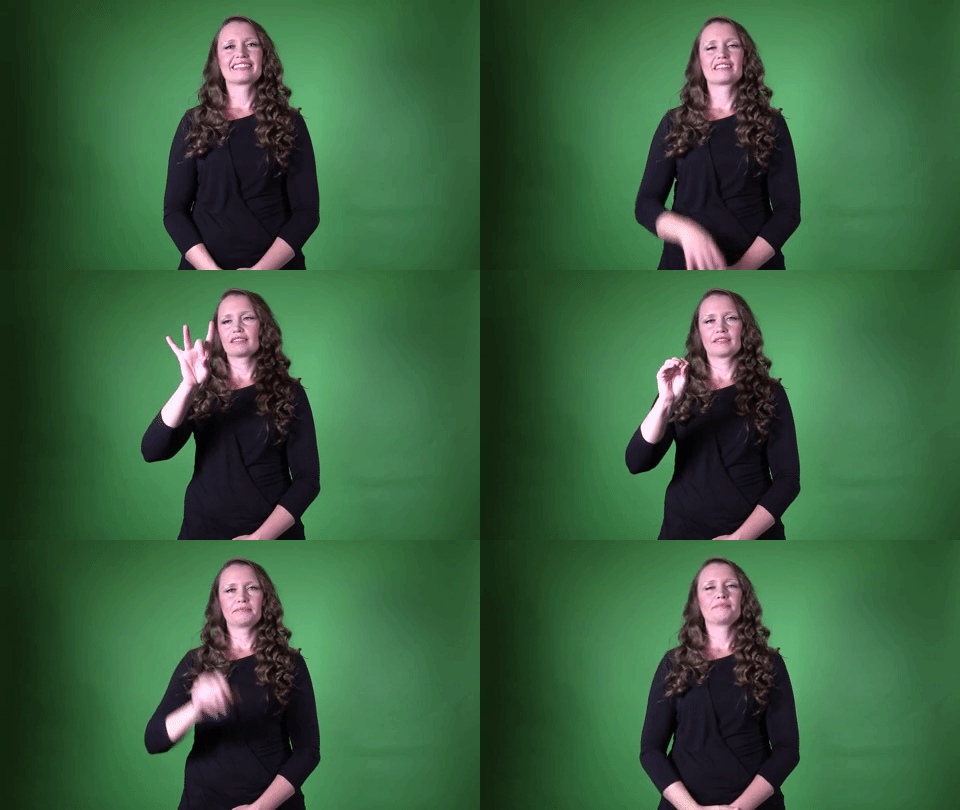
Definition: Refers to the number eighty
Sign for THE NUMBER 80 in ASL

Practice Activities:
To practice the sign for the number 80 in ASL, start by signing it in isolation. Repeat the motion multiple times while looking in a mirror to ensure handshape accuracy. Try signing 80 at different speeds, first slowly to build muscle memory, then faster to develop fluency.
Incorporate the sign for the number 80 in ASL into number sequences. Sign a series like 70, 75, 80, 85, 90, or count by tens from 10 to 100, emphasizing 80 each time. Another effective drill is signing random numbers and pausing to make sure you sign 80 correctly when it appears in the sequence.
Practice using the number in context by signing sentences such as: I saw 80 birds at the park. My grandmother is 80 years old. There are 80 students in my class. Sign each sentence slowly at first, then increase speed as you become more confident.
For a partner activity, take turns signing numbers between 70 and 90 while the other person guesses the number. Mix in the sign for the number 80 in ASL frequently to reinforce proficiency. You can also describe quantities such as 80 dollars, 80 books, or 80 minutes and have your partner sign back the correct number.
Storytelling is another great way to reinforce the sign. Create a short story that includes the number 80, such as describing a person celebrating their 80th birthday or an athlete running 80 miles. Practice signing the story smoothly while maintaining consistent handshapes.
For daily reinforcement, look for real-world opportunities to use the sign. When you see the number 80 on a speed limit sign, receipt, or clock, take a moment to sign it. Consistent daily practice will help you become comfortable signing the number fluently.
Cultural Context:
The sign for the number 80 in ASL is part of the numbering system used in American Sign Language. Numbers play an essential role in daily communication, from counting objects to discussing dates, money, and measurements. Learning to sign numbers accurately helps improve fluency and comprehension.
The ASL community values clear and consistent signing, making the sign for the number 80 in ASL an important part of communication. Numbers in ASL often follow specific handshape patterns, and mastering them ensures better understanding among signers. The number 80 follows the pattern of other multiples of ten, making it easier to learn once you understand similar signs.
When signing the number 80, pay attention to handshape and movement to maintain clarity. Proper hand positioning helps differentiate the number from other similar signs. Many ASL learners find it helpful to practice numbers in sequence to reinforce memory.
In Deaf culture, numerical signs are frequently used to discuss ages, addresses, and quantities. The sign for the number 80 in ASL may be seen in conversations about years, prices, or group counts. Being able to sign numbers fluently connects signers to more accurate and effective communication.
ASL numbers have variations in different contexts, but the main structure remains the same. The sign for the number 80 in ASL follows the consistent pattern seen in American Sign Language counting. Watching fluent signers and practicing often helps learners develop confidence in using numbers naturally.
Learning numbers enhances overall ASL comprehension and expands communication abilities. The sign for the number 80 in ASL, along with other numerical signs, is essential for both everyday conversations and formal settings. Numbers support discussions in education, business, and social interactions, making them a fundamental part of ASL fluency.
Mastering number signs, including the sign for the number 80 in ASL, allows signers to engage in more detailed discussions. Whether talking about quantities, measurements, or finances, numbers appear frequently in ASL conversations. Practicing regularly ensures accuracy and confidence.
Watching native signers demonstrate the sign for the number 80 in ASL can help learners understand proper movement and handshape. Videos and in-person practice sessions are great ways to reinforce learning. Observing how numbers are signed in context improves both comprehension and production skills.
Understanding how to sign numbers strengthens overall ASL communication skills. The sign for the number 80 in ASL is useful in many situations, from casual chats to formal discussions. Consistent practice
Extended Definition:
The sign for the number 80 in ASL is a combination of the numbers 8 and 0. It follows a consistent pattern used for signing multiples of ten in American Sign Language. This sign is commonly used in various contexts, from counting to indicating monetary values or ages.
To sign for the number 80 in ASL, start with the handshape for 8, where the thumb and middle finger touch while the other fingers remain extended. Then transition into the 0 handshape, forming an “O” with all fingers touching. The movement should be smooth and clear for proper communication.
The sign for the number 80 in ASL is useful in both casual and formal settings. It may be used when stating prices, sports scores, or discussing historical dates. Mastering number signs helps improve fluency and enhances numerical communication.
Like other numbers in ASL, the sign for the number 80 in ASL follows regular number patterns. This makes it easy to learn when combined with other multiples of ten. Understanding numerical signs allows for more efficient conversations in various topics.
Learning the sign for the number 80 in ASL is beneficial for students and interpreters. It allows for precise communication, especially in educational and financial contexts. Practicing number signs regularly strengthens overall ASL proficiency.
The sign for the number 80 in ASL is often used in business settings. It appears in discussions about percentages, weights, and measurements. Many signers also use it in everyday conversations related to shopping and budgeting.
Fluent ASL users recognize the importance of properly forming number signs. Misusing the sign for the number 80 in ASL could lead to miscommunication. Numbers play a crucial role in conveying information accurately and efficiently.
Using visual cues like facial expressions can help clarify numerical signs. The sign for the number 80 in ASL is straightforward but needs proper hand positioning. Practicing in front of a mirror or with a partner can improve accuracy.
When fingerspelling isn’t necessary, number signs simplify communication. The sign for the number 80 in ASL eliminates the need to spell out numbers in longer conversations. Quick and clear number signs make ASL more effective for everyday use.
Many students learn the sign for the number 80 in ASL early in their ASL studies. It becomes particularly important in math-related discussions. Developing strong number sign skills ensures effective interaction in both personal and professional environments.
Synonyms: eighty, number eighty, number 80, the number 80, the number eighty
Educational resources: Find related learning materials in our course bank!
Want more? Check out some of our popular learning activities on the homepage!
Need to look up a sign? Use our highly rated dictionary: https://aslinteractive.com/best-asl-dictionary/
Follow us on tiktok: https://www.tiktok.com/@aslinteractive. More social media links at the bottom of this page!
Long-tail Keywords: what is the sign for the number 80 in ASL, how do you sign the number 80 in ASL, ASL sign for the number 80
Categories: Numbers – Basics, Numbers 71-80, cardinal numbers
tags: Numbers, Numbers 76-80, Numbers 76 78 79, Rocking Numbers, Language Learning
Parameters
*Handshape*:
The sign for the number 80 in ASL uses an “8” handshape, where the thumb touches the tip of the middle finger while the other fingers remain extended. The hand moves slightly outward as the fingers maintain their position. This sign is part of the number system in ASL and follows a fluid, natural motion.
When signing, ensure the palm faces forward to clearly display the number. The sign for the number 80 in ASL is commonly used in counting, mathematics, and everyday conversations. Precision in finger positioning helps maintain clarity and accuracy.
*Palm Orientation*:
The palm orientation for the sign for the number 80 in ASL starts with the palm facing forward as the number 8 is formed. The thumb and middle finger come together while the remaining fingers are extended. As the transition to 0 happens, the fingers close into an “O” shape while maintaining the forward-facing palm. This movement ensures clarity when expressing the sign for the number 80 in ASL.
*Location*:
The sign for the number 80 in ASL is produced in the neutral space in front of the body. The dominant hand starts in the shape of the number 8 (thumb touching the tip of the middle finger) and transitions into a 0 (fingertips touching the thumb in a closed shape). This movement happens near chest level, ensuring visibility. The hand remains in a comfortable, relaxed position while forming the number.
*Movement*:
To sign for the number 80 in ASL, start with the dominant hand in the “8” handshape, where the thumb touches the middle finger. Then, smoothly transition into a “0” handshape by bringing the fingertips together while maintaining a fluid motion. This sign is performed with a slight forward movement to emphasize the transformation from “8” to “0.” Ensure the motion is clear and controlled for accurate communication.
*Non-Manual Signals*:
When signing the sign for the number 80 in ASL, maintain a neutral yet focused facial expression . Your eyebrows should remain relaxed unless you are asking a clarifying question, in which case they may lift slightly . Mouth movements can include a slight pursing of the lips to reinforce precision. Avoid exaggerated head movements, keeping your focus on clear handshape formation. Engaging eye contact ensures clarity and enhances communication.
*Prosody, Dominant/Non-Dominant Hand*:
The sign for the number 80 in ASL uses the dominant hand in the “8” handshape . Begin with the palm facing outward, then smoothly transition into a “0” handshape by bringing the fingertips together. This movement is fluid and occurs in one motion. The non-dominant hand is not used. When producing the sign for the number 80 in ASL, maintain a relaxed wrist and steady hand positioning for clarity.
Tips for Beginners:
When learning the sign for the number 80 in ASL, it’s important to focus on handshape and movement. The number 80 uses the “8” handshape, where the thumb touches the middle finger while the other fingers remain extended. Then, transition smoothly into the “0” handshape by closing the fingers together to form an “O.”
A common mistake when signing the number 80 in ASL is failing to maintain clear and distinct handshapes. Ensure that the “8” is well-formed before moving into the “0.” Sloppy handshapes can cause confusion, especially when signing quickly in conversation.
Practice fluidity in the movement between the two numbers. The transition from the “8” to the “0” should be a natural and continuous motion rather than a jerky one. Repetition in front of a mirror or recording yourself can help refine this skill.
Finger and wrist positioning play a key role in clarity. Keep your hand steady with your palm facing outward as you sign the number 80 in ASL. Avoid unnecessary movements that could make the sign less recognizable.
Watching native signers or ASL teachers demonstrate numbers can provide a clearer understanding of how to form and transition between handshapes. Online videos and ASL number drills are great tools for improving consistency.
If you struggle with memorizing numbers, try counting in ASL from 70 through 90 repeatedly to reinforce the handshapes. Signing in numerical sequences helps your hands become accustomed to the movements, making it easier to recall the sign for the number 80 in ASL during conversations.
Patience and frequent practice are key to building confidence and fluency. Keep your movements smooth, your handshapes precise, and your wrist relaxed to ensure an accurate and natural representation of the number.
Connections to Other topics:
The sign for the number 80 in ASL is closely related to other numbers in the 80s series, such as 81, 82, and so on. In ASL, numbers with the same root often share similar handshapes and patterns, making it easier to remember them as a group. Recognizing patterns like these can help learners efficiently acquire number-related vocabulary and apply the knowledge when signing higher numbers.
The sign for the number 80 in ASL follows a pattern found with other decades in ASL numbers, such as 20, 30, and 40. These numbers often involve a repeated or modified handshape, demonstrating how ASL organizes numeric concepts efficiently. This patterned structure reinforces how American Sign Language expresses numerical concepts in a logical and visually intuitive manner.
Numbers play a significant role in signing dates, ages, money, and other measurable quantities. For example, when discussing historical events from the 1980s, a signer might use the number 80 in conjunction with a sign like “YEAR” to specify “the 80s.” Understanding how numbers integrate into everyday conversation is vital for fluency, as numbers frequently appear in time-related discussions, percentages, and rankings.
The sign for the number 80 in ASL also highlights the importance of handshape transitions. Many numbers in ASL require fluid movement between handshapes, emphasizing precision and clarity. Practicing numbers in sequence, such as counting from 70 to 90, can improve dexterity and help learners recognize the systematic nature of numbering in ASL.
Ordinal and cardinal numbers both influence how numbers are used in sentences. While the sign for the number 80 in ASL is primarily used for counting or stating a quantity, numbers can take on ordinal meanings with slight modifications. This connection to numerical ordering is essential for discussions about lists, rankings, and sequential events.
Summary:
The sign for the number 80 in ASL is made using a combination of numerical handshapes that follow a logical pattern in ASL number formation. To produce this sign, the dominant hand forms the number 8 handshape, with the thumb and middle finger touching while the other fingers remain extended. Then, the hand transitions smoothly into the number 0 handshape, where the fingers close into a circular shape.
This sign follows the standard pattern of ASL number conventions, where multiples of ten typically involve a transition between two number handshapes. The movement is fluid, ensuring clarity and proper distinction from nearby numbers like 81 or 18. The numerical system in ASL relies heavily on handshape accuracy, palm orientation, and movement to prevent ambiguity.
The sign for the number 80 in ASL is part of a broader numerical framework that aligns with ASL’s logical structure. Unlike spoken languages, which use auditory sounds for numbers, ASL relies on visual-kinesthetic representation. The efficiency of this numerical structure allows quick and natural counting.
In ASL numerical syntax, the number 80 is often used for quantification, age, and monetary values. Context plays a crucial role in determining whether the number refers to a quantity, a year, or a measurement. The correct non-manual markers may also provide additional meaning to the number when necessary.
Number signs in ASL are integral to proper communication across various domains such as commerce, mathematics, and casual conversation. The sign for the number 80 in ASL is useful when discussing historical dates, large quantities, and distances. Because of ASL’s spatial nature, numbers can be modified slightly based on additional classifiers for further precision.
Numerical fluency in ASL is fundamental to everyday exchanges within the Deaf community. People use the sign for the number 80 in ASL when discussing financial transactions, birthdays, and addresses. Mastering numerical signs enhances communication fluidity and efficiency.
The ASL number system operates within a decimal framework similar to spoken English. However, fingerspelling is not typically used for numbers because ASL has dedicated number signs. This ensures quick and clear numerical representation without spelling out individual digits.
Numbers in ASL exhibit variations depending on regional influences and signing speed. Some signers will make larger movements for clarity, while others will transition swiftly between handshapes. The sign for the number 80 in ASL maintains consistency in form, but fluidity in motion may differ based on context.
Another essential aspect to consider is the change in formation between numbers under 20 and those in multiples of ten. While numbers like 8 and 80 share the same root handshape, the transition to 0 differentiates them. Recognizing this transition is crucial to avoiding misinterpretation in signed discourse.
The handshapes used in the sign for the number 80 in ASL stem from the standard ASL number system. The number 8 handshape consists of the thumb and middle finger making contact, while the other fingers are extended. The hand closes into a circular 0 handshape to complete the sign.
Number signs within the tens (10, 20, 30, etc.) transition between two specific handshapes in a patterned sequence. This numerical consistency aids in learning and distinguishing numbers quickly. ASL’s reliance on patterns ensures efficient communication in numerical contexts.
In historical and cultural contexts, the number 80 may appear in conversations about decades, such as discussing events from the 1980s. Social conversations often require this number when referring to age, time periods, or financial discussions. The sign for the number 80 in ASL is crucial for discussing large-scale concepts efficiently.
ASL number conventions differ slightly from other sign languages, including British Sign Language (BSL) and French Sign Language (LSF). The way numbers are represented varies due to linguistic evolution and cultural developments within each signing community. Standardization of ASL numbers has allowed for increased consistency across different Deaf communities.
Numbers often play a significant role in educational settings where Deaf students learn mathematical concepts through sign. Knowing how to correctly use and recognize the sign for the number 80 in ASL empowers students in numerical understanding. Mathematical fluency in ASL bridges the gap between abstract concepts and visual-kinesthetic learning.
In ASL storytelling and signed poetry, numbers may be used artistically to enhance meaning. The number 80 could symbolize longevity, abundance, or generational heritage, depending on context. Skilled signers can integrate number signs into creative expressions seamlessly.
Some advanced number signs in ASL use slight modifications to encode additional meaning, such as emphasis or specificity. While the basic form of the sign for the number 80 in ASL remains consistent, its execution can indicate emphasis depending on signing speed or facial expressions. Non-manual markers may also add nuance to numerical expressions.
Mathematical concepts in ASL require a deep understanding
Want more? Check out some of our popular learning activities!
ASL Interactive Resources
ASLInteractive YouTube Channel
Follow us on tiktok: @aslinteractive.com
Follow us on Instagram: aslinteractive
Facebook page: aslinteractive
Facebook group: aslinteractive
LInkedIn: ASL Interactive LLC
Twitter: @ASL_interactive
*Some information on this page is AI-generated. AI can make mistakes. Please check the information.


Responses