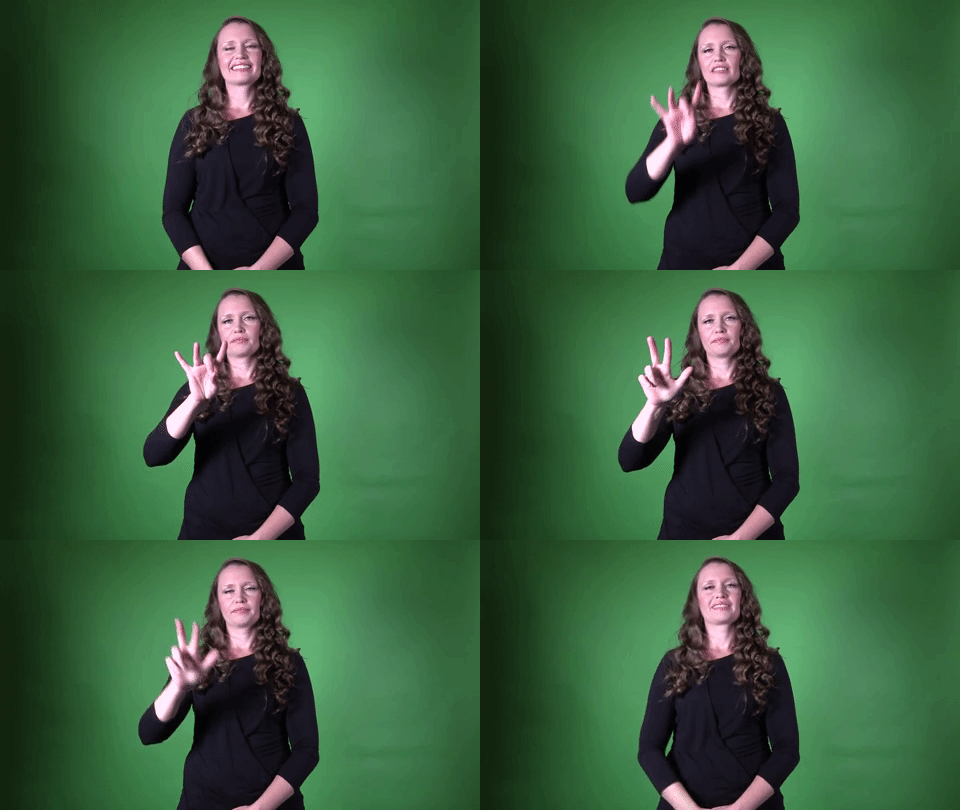
Sign for THE NUMBER 83 in ASL | 🔢 ASL Dictionary

Definition: Refers to the number eighty-three

Sign for THE NUMBER 83 in ASL 

YouTube player

Practice Activities:

To practice the sign for the number 83 in ASL, start by signing it repeatedly in front of a mirror. Pay attention to your handshape and movement to ensure accuracy. Try signing slowly at first, then gradually increase your speed while maintaining clarity.

Incorporate the sign for the number 83 in ASL into real-life scenarios. Practice signing it while counting items, such as coins, playing cards, or steps as you walk. Challenge yourself by signing other numbers around it, such as 82 and 84, to reinforce numerical sequences.

Work with a partner and take turns signing and recognizing the number. One person can sign a random number, and the other has to state it in spoken English. Reverse roles to improve both receptive and expressive skills.

Use storytelling exercises by creating a short scenario where 83 appears. For example, describe a classroom with 83 students or a store receipt that totals $83. Signing numbers in context will strengthen your fluency and confidence.

Flashcard drills are a helpful way to reinforce recognition of the sign for the number 83 in ASL. Create a set of number flashcards and randomly select one to sign. Your practice partner can check your accuracy and provide feedback.

For an advanced challenge, sign a sequence of numbers including 83 at various speeds. Try signing birth years, addresses, or sports scores to make the numbers feel more natural in conversation. The more exposure you have to signing numbers within real situations, the stronger your ASL number skills will become.

Cultural Context:

The sign for the number 83 in ASL is an essential part of communicating numbers in American Sign Language. Numbers play a crucial role in daily conversations, whether discussing ages, addresses, or quantities. The ability to sign numbers smoothly helps improve fluency and understanding in ASL communication.

Understanding the sign for the number 83 in ASL requires knowledge of number patterns in the language. In ASL, numbers from 70 to 99 follow a specific movement pattern that combines individual digit signs. Mastering these patterns makes signing more natural and efficient.

The deaf community frequently uses the sign for the number 83 in ASL in various contexts. It may appear in conversations about years, statistics, prices, or any situation that requires numerical precision. Being comfortable with ASL numbers ensures effective communication in both casual and formal settings.

Number signs, including the sign for the number 83 in ASL, rely on consistent handshapes and movements. Proper finger positioning and motion ensure clarity, reducing the risk of miscommunication. Facial expressions and context also help reinforce meaning when using ASL numbers.

Learning the sign for the number 83 in ASL aids in developing stronger ASL skills. Practicing number sequences improves recall and signing speed, making the language more accessible. Exposure to number signs enhances overall confidence when engaging in ASL conversations.

The sign for the number 83 in ASL follows the standard rules for two-digit numbers. The transition from one digit to the next should be smooth to maintain fluid communication. Practicing with other two-digit numbers helps strengthen overall number-signing proficiency.

Many ASL learners struggle with number signs, including the sign for the number 83 in ASL. Watching native signers and using ASL resources can make learning easier. Repetition and real-world application help improve signing accuracy and speed.

Understanding the sign for the number 83 in ASL contributes to effective deaf culture communication. Numbers are commonly used in storytelling, discussions, and everyday exchanges. Mastering number signs shows respect for ASL conventions and ensures clear interaction.

Teachers and interpreters emphasize the importance of accuracy when signing numbers, including the sign for the number 83 in ASL. Precise hand movements ensure that numerical information is conveyed correctly. Fluent ASL users recognize when number signs are unclear and adjust accordingly.

The sign for the number 83 in ASL is part of a broader system of numbering in American Sign Language. Learning these structured signs allows for

Extended Definition:

The sign for the number 83 in ASL is a combination of hand movements that represent the digits 8 and 3. American Sign Language uses a unique numbering system that allows numbers to be expressed efficiently with one hand. Learning to sign numbers correctly is essential for effective communication in ASL.

To form the sign for the number 83 in ASL, start with the number 8 handshape, where the thumb touches the tip of the middle finger while the other fingers stay extended. Then, smoothly transition to the number 3 handshape, with the index and middle fingers extended along with the thumb, while the ring and pinky fingers curl down. A clear transition between handshapes ensures accuracy in signing numbers.

Numbers in ASL follow a consistent pattern, making it easy to recognize and sign different number combinations. The sign for the number 83 in ASL is performed with one hand, like most cardinal numbers. Practicing number signs regularly helps build fluency in signing and improves overall communication skills.

When signing numbers, the palm orientation plays a crucial role in clarity. The sign for the number 83 in ASL is typically signed with the palm facing outward. This presentation aligns with the standard way of signing multi-digit numbers in ASL.

Fingerspelling and number signs differ in ASL, with numbers having distinct handshapes for efficiency. Learning the sign for the number 83 in ASL allows signers to express quantities, addresses, and other numerical information. Mastering number signs is essential for conversations involving numbers.

Numbers in ASL can be used in various contexts, such as counting, addresses, and phone numbers. The sign for the number 83 in ASL follows the logical sequence of transitioning from an 8 to a 3. Clear hand movements make it easier for others to recognize the intended number.

Practicing ASL numbers, including the sign for the number 83 in ASL, helps improve signing speed and accuracy. Watching native signers can provide valuable insight into natural transitions between numbers. Using numbers frequently in daily conversations reinforces learning.

ASL number signs are an important part of fluency in American Sign Language. The sign for the number 83 in ASL is commonly used when discussing ages, prices, and measurements. Learning number signs opens the door to better communication in both casual and professional settings.

Numbers in ASL follow structured handshape transitions for clarity. When signing the number 83 in AS

Synonyms: eighty-three, number eighty-three, number 83, the number 83, the number eighty-three

Educational resources: Find related learning materials in our course bank!

Want more? Check out some of our popular learning activities on the homepage!

Need to look up a sign? Use our highly rated dictionary: https://aslinteractive.com/best-asl-dictionary/

Follow us on tiktok: https://www.tiktok.com/@aslinteractive. More social media links at the bottom of this page!

Long-tail Keywords: what is the sign for the number 83 in ASL, how do you sign the number 83 in American Sign Language, learn to sign the number 83 in ASL

Categories: Numbers – Basics, Numbers 81-90, cardinal numbers

tags: Numbers, Numbers 81-90, Math, Language Learning, Educational Content

Parameters

*Handshape*:

The sign for the number 83 in ASL uses a two-part movement. First, the dominant hand forms the number 8 with the thumb touching the tip of the middle finger while the other fingers remain extended. Then, the hand transitions smoothly into the number 3, where the thumb, index, and middle fingers are extended, and the ring and pinky fingers are folded down. This fluid motion ensures clarity when signing the number.

When executing the sign for the number 83 in ASL, maintain a steady transition between the two handshapes to improve readability. The movement should be natural and fluid, without pauses. Keeping your palm facing outward while forming both numbers enhances visibility. Clear hand positioning and consistent motion are essential for effectively conveying the number in ASL.

*Palm Orientation*:

The palm orientation for the sign for the number 83 in ASL faces forward, with the hand positioned in a comfortable, natural way. The sign for the number 83 in ASL starts with the number 8, where the thumb touches the middle finger while the other fingers extend. Then, it transitions into the number 3 by forming a “W” shape with the thumb, index, and middle fingers extended while the ring and pinky fingers fold down.

*Location*:

The sign for the number 83 in ASL is formed in the neutral signing space in front of the body, typically at chest level. The dominant hand starts by forming the number 8 and then transitions smoothly into the number 3. The movement is minimal, and the fingers shift positions fluidly while keeping the hand steady in the same location. This sign stays within the natural signing space for clarity and visibility. ️

*Movement*:

To make the sign for the number 83 in ASL, begin by forming the number 8 with your dominant hand, where the thumb touches the tip of the middle finger while the other fingers remain extended. Then, smoothly transition into the number 3 by extending the index, middle, and thumb while the ring and pinky fingers close down. This movement should be fluid and natural, maintaining clear handshapes for both numbers.

*Non-Manual Signals*:

Facial expression remains neutral or slightly focused when forming the sign for the number 83 in ASL . Eyebrows may be relaxed, and the mouth remains closed or slightly open in a natural resting position. There are no significant head movements required, but a slight nod can reinforce clarity.

The eyes should stay engaged with the conversation, directing attention to the handshape. If emphasizing or clarifying, a subtle forward movement of the head may be used. Avoid exaggerated facial expressions, as they are unnecessary for conveying the numerical value.

*Prosody, Dominant/Non-Dominant Hand*:

The sign for the number 83 in ASL uses the dominant hand. Begin with the palm facing out, forming the number 8 by touching the tips of the thumb and middle finger while the remaining fingers extend. Then, transition smoothly to the number 3 by extending the thumb, index, and middle fingers while curling the ring and pinky fingers down. Keep the motion fluid to clearly convey the sign for the number 83 in ASL. ✋

Tips for Beginners:

When learning the sign for the number 83 in ASL, focus on handshape precision and finger movement. Start with the number 8 handshape—thumb touching the middle finger. Then transition smoothly into the number 3 handshape, extending the thumb, index, and middle fingers while curling the ring and pinky fingers. Keeping the movements fluid will help ensure clarity.

A common mistake is rushing the transition between digits, leading to unclear handshapes. Take your time forming each number distinctly before transitioning to the next. Avoid stiff fingers by keeping your hands relaxed, which will make the sign more natural and readable. Practicing in front of a mirror can help identify any inconsistencies in form.

Ensure that your palm faces outward while signing to maintain proper orientation. If your fingers curve inward too much, the numbers may become unclear. Consistency in palm orientation is crucial across all number signs for readability and uniformity. Watching native ASL users sign can reinforce proper technique and flow.

When signing the number 83 in ASL during conversations, maintain eye contact and use a neutral facial expression unless emphasizing quantity or importance. Overemphasizing hand movements can seem unnatural. Keeping your signing smooth and at a natural pace will enhance clarity and reduce confusion.

Finger dexterity is key for signing numbers efficiently. Stretching and warming up your hands before practicing can prevent stiffness. If transitioning between numbers feels awkward, break the sign into separate digits, perfect each shape, then practice the fluid movement between them. With daily repetition, the motion will become second nature and easier to recall in conversations.

Practice counting sequences that include 83 to reinforce muscle memory. Reciting random numbers can also help improve recall and handshape speed. Whether in casual conversations or formal settings, ensuring clarity in number signs will make communication smoother. Keep practicing consistently for better accuracy and confidence.

Connections to Other topics:

The sign for the number 83 in ASL is part of a structured numerical system used in everyday conversations, dates, money, and measurements. Numbers from 80-89 follow a consistent pattern, making it easier to recognize and remember them in sequences. Learning the sign for the number 83 in ASL helps with understanding larger numerical concepts such as percentages, pricing, and statistics.

Recognizing number patterns is essential for discussing math-based topics like time, addresses, and scores. The sign for the number 83 in ASL follows the same rhythm as other numbers in the 80s, reinforcing a predictable transition between digits. This predictability helps when signing other numerical sequences, such as phone numbers or sports statistics.

Number signs often connect with classifiers in ASL, providing additional meaning when describing quantities, rankings, or dimensions. The sign for the number 83 in ASL can be combined with classifiers to express ideas such as measurements (e.g., 83 inches long) or amounts (e.g., 83 people in attendance). Understanding numerical classifiers improves fluency when signing about sizes, weights, and proportions.

Ordinal numbers are another related topic because they turn cardinal numbers into rankings or sequence indicators. While the sign for the number 83 in ASL represents a quantity, adding an ordinal structure can indicate position, such as “83rd place” in a competition. Ordinals are useful in discussing historical years, rankings in contests, and step-by-step instructions.

Mastering numerical signs improves comprehension in financial and statistical discussions. The sign for the number 83 in ASL can be used when discussing prices, salaries, and percentages, making it useful in work and academic settings. Practicing with monetary amounts such as $83 or 83% helps reinforce contextual applications of numbers in daily life.

Summary:

The sign for the number 83 in ASL follows a structured pattern that aligns with the general numbering system in American Sign Language. To form this number, start by signing the number 8, which is created by touching the pad of the middle finger to the tip of the thumb while the other fingers remain extended. Then, transition smoothly into the number 3, where the index, middle fingers, and thumb remain extended, while the ring and pinky fingers curl down.

The movement connecting these two numbers should be fluid, ensuring a natural transition that is easy to recognize. Most native signers perform this combination without separating the numbers too distinctly. The hand should maintain a consistent palm orientation, which is usually facing outward during counting signs in ASL.

ASL uses a unique system for numbering, integrating handshapes that must be memorized for fluency. Numbers in ASL often follow the logical sequence found in spoken languages, though they sometimes rely on specialized movements. The sign for the number 83 in ASL is part of a broader system that includes rules for forming double-digit numbers efficiently.

When signing double-digit numbers like 83, the movement should be clear but not overly exaggerated. Fluent signers perform it quickly, whereas beginners may need more deliberate articulation. The transition between the “8” and the “3” should not be jerky, as smoothness enhances clarity.

The sign for the number 83 in ASL belongs to the numerical system frequently used in everyday conversation, finance, education, and beyond. Numbers are integral to ASL, appearing in contexts such as sports scores, addresses, phone numbers, and academic contexts. Mastering numerical signs allows signers to engage in a variety of communication settings with greater ease.

One of the fascinating aspects of ASL numbers is how they differ from English-based numerical concepts. Though written numbers appear universal, ASL’s representation of 83 relies on distinct handshapes and visual cues. This demonstrates the rich, visual-spatial nature of the language.

ASL number signs follow rules that help maintain consistency and clarity across different signing communities. The structure of forming the number 83 adheres to these principles, ensuring that different ASL users recognize it easily. This consistency makes ASL numbers efficient for both personal and professional use.

Numbers in ASL are often influenced by context, especially when referencing financial amounts or dates. For example, signing 83 might take on different meanings if used for a year, a temperature, or a quantity. Awareness of situational context ensures precise communication.

Linguistically, numbers in ASL showcase a deep connection between visual representation and meaning. The sign for the number 83 in ASL highlights this by maintaining logical numerical sequences while using handshapes that visually correspond to English numerals. This emphasizes how ASL incorporates cognitive processing of numerical concepts in a visual form.

Sign linguistics recognizes numerical signs as an essential aspect of ASL’s grammar. Unlike spoken languages that rely on auditory cues, ASL requires both spatial arrangement and hand configurations. The efficiency of signing 83 showcases how movement-based expressions replace spoken-word articulations.

Applied linguistics explores how ASL users acquire numerical fluency. Learners often start with single digits before advancing to complex numbers like 83. Mastery comes with practice, ensuring fluid, quick execution over time without hesitation.

Numbers serve various purposes, and the sign for the number 83 in ASL frequently appears in tallying, mathematics, and statistical reporting. Signers use numerical signs in business transactions, academic settings, and even casual discussions such as talking about sports team records. The ability to navigate numerical expressions fluently strengthens overall ASL proficiency.

Cultural perspectives on ASL numbers emphasize their frequent presence in Deaf educational settings. From childhood, Deaf students learn numerical signs as part of foundational ASL education. Understanding the sign for the number 83 in ASL fits within this broader educational framework.

Historical aspects of ASL numbering systems show that early sign languages incorporated numerical gestures. Modern ASL preserves many historical influences while refining efficiency. The sign for the number 83 in ASL reflects these linguistic adaptations that have evolved over time.

Social interactions among Deaf individuals often require number signs in everyday conversations. Whether discussing time, age, prices, or scores, numerical fluency is essential. The sign for the number 83 in ASL is one of many numerical signs that enable clear, efficient communication in different scenarios.

Technology has introduced new ways of using numbers in ASL, particularly in digital communication. Video chats, online learning, and ASL-based applications incorporate number signs regularly. Signing numbers effectively remains crucial for face-to-face and virtual ASL conversations.

A common challenge for ASL learners is distinguishing similar-looking numbers when transitioning between digits. Numbers like 83 require smooth transitions so that they are not confused with other numbers, such as 38. Developing muscle memory for number signs helps prevent such misunderstandings.

Finger dexterity plays a significant role in effectively signing

Want more? Check out some of our popular learning activities!

ASL Interactive Resources

ASLInteractive YouTube Channel

Follow us on tiktok: @aslinteractive.com

Follow us on Instagram: aslinteractive

Facebook page: aslinteractive

Facebook group: aslinteractive

LInkedIn: ASL Interactive LLC

Twitter: @ASL_interactive

*Some information on this page is AI-generated. AI can make mistakes. Please check the information.

Sign for 83 in ASL, Sign for EIGHTY-THREE in ASL, Sign for NUMBER EIGHTY-THREE in ASL, Sign for THE NUMBER EIGHTY-THREE in ASL, Sign for THE NUMBER 83 in ASL 

Responses