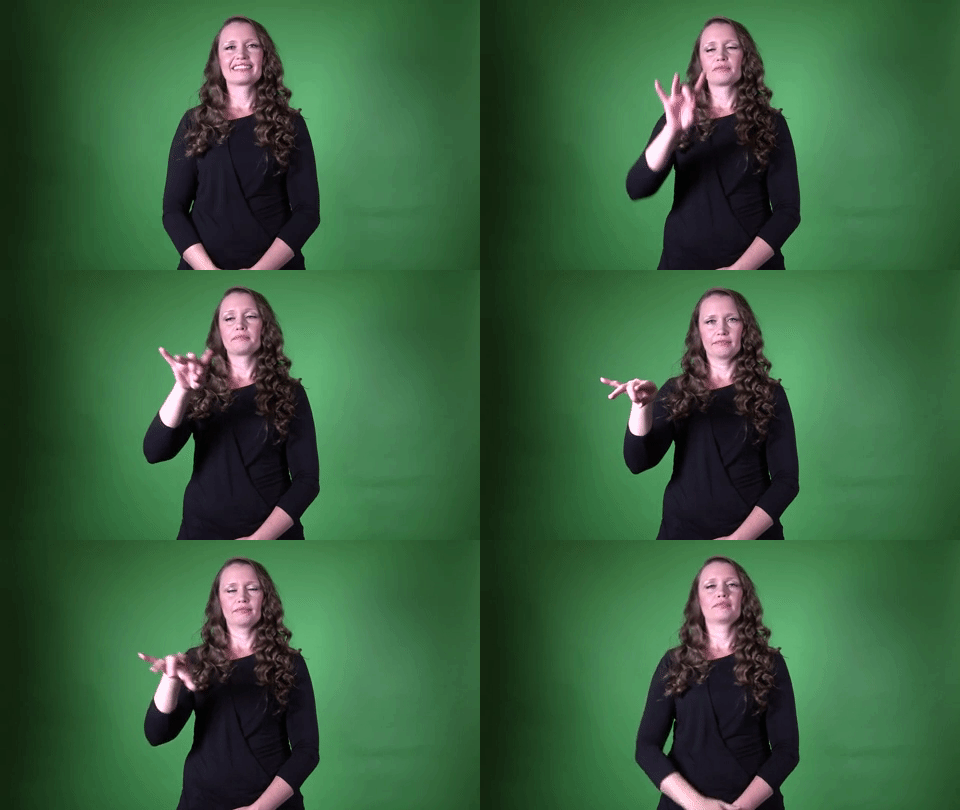
Sign for 88 in ASL | 🔢 ASL Dictionary

Definition: The number eighty-eight.

Sign for 88 in ASL 

YouTube player

Practice Activities:

Practicing the sign for 88 in ASL can be helpful for developing number fluency. Start by signing the number repeatedly in front of a mirror to ensure correct hand positioning and movement. Try alternating between signing 88 and other two-digit numbers, such as 77 or 99, to strengthen recognition and differentiation.

Use the sign for 88 in ASL within counting exercises. Count aloud while signing to reinforce the visual and auditory aspects of number learning. Practice writing the number on a piece of paper and then sign it to match. This helps bridge the connection between written numbers and their ASL representation.

Create a simple story that involves the number 88, such as talking about an athlete who scored 88 points in a game. Sign the story aloud and focus on fluently incorporating the number where appropriate. Another idea is to imagine a store sale where an item costs $88 and practice signing sentences related to making a purchase.

Engage in a partner activity where one person fingerspells a random word, and the other responds with a number that includes 88 in its value, like 188 or 288. This strengthens both fingerspelling and number recall skills. Another variation is to have a partner sign a number, and you respond with a related phrase, such as “My grandma is 88 years old!”

Use flashcards with random numbers and go through them quickly to build numeric comprehension. Challenge yourself by setting a timer and trying to sign as many numbers as possible within a minute, ensuring that 88 appears multiple times in the sequence. By consistently practicing in different contexts, you will confidently use the sign for 88 in ASL naturally and accurately.

Cultural Context:

The sign for 88 in ASL is a unique number sign that follows the general rules for signing two-digit repeated numbers. In American Sign Language, numbers like 88 involve a movement pattern that distinguishes them from single-digit numbers. Knowing how to properly form the sign for 88 in ASL ensures clarity and accurate communication.

Numbers in ASL are an essential part of daily conversations, from discussing ages to sharing addresses. The sign for 88 in ASL is commonly used when talking about years, prices, and quantities. Since ASL is a visual language, it’s important to execute the movement correctly to maintain fluency.

Deaf culture values precision in signing, especially in numbers, because slight differences in movement can change the meaning. The sign for 88 in ASL follows a rhythm that makes it instantly recognizable to fluent ASL users. Mastering this number sign helps with understanding and engaging in fluid conversations within the Deaf community.

Learning ASL numbers, including the sign for 88 in ASL, is crucial for beginners and fluent signers alike. Whether discussing historical dates or referring to specific quantities, signing numbers correctly ensures clear communication. Practicing number signs enhances overall signing ability and allows for greater confidence in ASL conversations.

When using the sign for 88 in ASL, handshape consistency is key to proper expression. This number sign is part of a pattern used for repeated-digit numbers, making it easier to learn once the pattern is understood. Becoming comfortable with these signs helps build number fluency in American Sign Language.

The Deaf community commonly uses ASL numbers, including the sign for 88 in ASL, in daily interactions. From classroom settings to casual conversations, clear number signs are essential for conveying information accurately. Understanding ASL numbers enables signers to effectively communicate numerical details in various contexts.

Developing a strong grasp of ASL numbers, including the sign for 88 in ASL, supports overall language fluency. Many ASL learners find that practicing number sequences improves their overall signing skills. Familiarity with these signs contributes to greater confidence when engaging with native ASL users.

Hands-on practice with ASL numbers, including the sign for 88 in ASL, strengthens communication skills. Repeated exposure to number signs helps with recognition and recall during real-life conversations. As with all ASL vocabulary, consistent practice leads to proficiency and fluency.

Mastering the sign for 88 in ASL is an important step in building

Extended Definition:

The sign for 88 in ASL is a two-digit number sign that follows the standard rules for ASL number formation. This sign is created using both hands in an identical movement pattern. Numbers like 88 use a unique bouncing motion to clearly distinguish them from other numeric signs.

When signing 88 in ASL, both hands form the number 8 shape with the fingers slightly spread apart. The hands bounce slightly outward once or twice in a subtle yet distinct movement. This motion helps maintain clarity, especially when signing numbers quickly in conversation.

ASL numbers follow consistent patterns, making it easier to sign multi-digit numbers efficiently. The sign for 88 in ASL follows the same structure as other double-digit numbers with repeating digits, such as 77 or 99. These numbers typically use a similar bouncing motion.

Number signs are crucial in American Sign Language because they appear in everyday conversations, money transactions, addresses, and dates. Being able to recognize and produce the sign for 88 in ASL correctly ensures smooth communication. Learning number signs in ASL also helps with understanding proper handshape formation and movement.

If fingerspelling or numeric signs are unclear, context often helps determine the intended meaning. The sign for 88 in ASL can sometimes be confused with similar-looking numbers if signed too quickly or without proper movement. Paying close attention to handshape and repetition ensures accuracy.

Number signs vary slightly depending on region and signing style, but the general structure remains the same. Most ASL users follow standardized number signs to promote clarity and consistency. The sign for 88 in ASL is widely recognized across different signing communities.

Practicing number signs regularly helps improve fluency and confidence in ASL communication. Watching native signers and using mirrors can help refine handshape and movement accuracy. Mastering the sign for 88 in ASL is a small but important step in becoming more proficient in number signs.

ASL numbers are an essential part of daily interactions, from discussing prices to giving phone numbers. Understanding numeric signs like the sign for 88 in ASL makes communication smoother and more efficient. Developing strong number-signing skills improves overall ASL comprehension.

Using ASL numbers correctly requires awareness of movement, shape, and repetition. With practice, the sign for 88 in ASL becomes second nature, making it easier to sign and recognize numbers in conversations. Becoming comfortable with number signs helps build confidence in sign language communication.

Synonyms: eighty-eight, number eighty-eight, number 88, the number 88, the number eighty-eight

Educational resources: Find related learning materials in our course bank!

Want more? Check out some of our popular learning activities on the homepage!

Need to look up a sign? Use our highly rated dictionary: https://aslinteractive.com/best-asl-dictionary/

Follow us on tiktok: https://www.tiktok.com/@aslinteractive. More social media links at the bottom of this page!

Long-tail Keywords: what is the sign for 88 in ASL, how do you sign 88 in ASL, ASL sign for 88

Categories: Numbers – Basics, Numbers 81-90, cardinal numbers

tags: Numbers, Numbers 81-90, Math, Language Learning, Educational Content

Parameters

*Handshape*:

The sign for 88 in ASL uses both hands in an “8” handshape, with the thumb and middle finger touching. The movement involves a slight bouncing motion as both hands are held in front of the body, palms facing outward. This numerical sign is visually distinct due to the repetition of the “8” handshape.

When signing numbers, consistency in handshape and movement ensures clarity. The sign for 88 in ASL maintains symmetry, making it easy to recognize. Precision in finger placement helps convey the correct number efficiently in conversation.

*Palm Orientation*:

The palm orientation for the sign for 88 in ASL is typically palm-down. Both hands form the number 8 handshape with the thumb and middle finger touching. The movement consists of a slight bounce as the hands repeat the shape slightly apart. The sign for 88 in ASL should maintain clear finger positioning to ensure accuracy. Keep the palms facing downward throughout the motion for proper execution. ️

*Location*:

The sign for 88 in ASL is produced in the neutral space in front of the body, typically at chest level. Both hands form the number 8 handshape, with the thumb and middle finger touching. The hands move slightly side to side in a small bouncing motion. The sign for 88 in ASL is clear and distinct, making it easily recognizable in conversation. Proper positioning helps ensure accurate communication of the number.

*Movement*:

To make the sign for 88 in ASL, form the number 8 on both hands by bending the middle finger to touch the thumb while keeping the other fingers extended. Hold both hands in front of you, slightly apart, with palms facing downward. Then, bounce both hands slightly outward once, maintaining the handshape. This motion clearly differentiates the sign from similar number signs, ensuring accurate communication.

*Non-Manual Signals*:

Facial expression remains neutral or slightly focused when performing the sign for 88 in ASL. The eyebrows should be in a natural position unless emphasizing the number in a specific context. Eye contact with the conversation partner is recommended to maintain engagement. Head movement should be minimal, avoiding unnecessary tilting or nodding. A slight mouth movement may occur if the number is emphasized, but no exaggerated mouthing is required. The overall posture remains relaxed yet intentional.

*Prosody, Dominant/Non-Dominant Hand*:

The sign for 88 in ASL uses the dominant hand in a flat “8” shape, with the thumb touching the middle finger. The hand bounces slightly to repeat the number, moving once to the side. There is no involvement of the non-dominant hand. The motion should be fluid and natural, ensuring clarity in conveying the sign for 88 in ASL. Proper hand positioning and movement are key for accurate expression.

Tips for Beginners:

When learning the sign for 88 in ASL, it’s crucial to maintain the correct handshape to ensure clarity. The number 88 is made using both hands in an “8” handshape, where the fingertips touch and bounce slightly. Keep your movements small and controlled to avoid confusion with similar numbers like 86 or 87.

A common mistake beginners make when signing the sign for 88 in ASL is using an unclear or inconsistent bounce. The bouncing motion should be subtle and not exaggerated, as excessive movement can lead to misunderstandings. Additionally, ensure your handshapes remain in the “8” position without drifting into a different number formation.

Building muscle memory is essential for mastering the sign for 88 in ASL. Practicing regularly with a mirror or recording yourself can help check for accuracy. Watching videos of fluent signers can also assist in refining your technique and understanding the natural flow of the movement.

Finger dexterity plays a significant role in signing numbers fluently. If the “8” handshape is difficult to maintain, practice stretching and strengthening your fingers to improve flexibility. Keeping your hands relaxed, rather than stiff, will also help produce smoother signs.

Context matters when using the sign for 88 in ASL, especially in rapid conversations. Ensure your facial expression and signing speed remain natural so that the number is easily recognized. If needed, slow down slightly to maintain accuracy and avoid misinterpretation.

Engaging with native signers or practicing in real-life situations will make signing numbers more intuitive. If you’re unsure, don’t hesitate to ask for feedback from experienced ASL users. With consistent practice and focus on proper handshape and movement, you’ll become more confident in using the sign for 88 in ASL correctly.

Connections to Other topics:

The sign for 88 in ASL is part of the broader system of number signs, which follow specific patterns in handshape and movement. Two-digit numbers that repeat the same numeral, like 88, 99, and 77, often share a similar movement pattern. These signs generally use a bouncing motion or slight repetition of the handshape, reinforcing the concept of numerical consistency in ASL. Understanding the sign for 88 in ASL also helps with learning similar number sequences and recognizing how numerical handshapes function in counting and listing.

ASL numbers connect directly to concepts such as time, money, and measurements. For example, knowing how to sign numbers accurately is crucial for expressing ages, years, prices, and addresses. The sign for 88 in ASL is useful when discussing events like someone’s 88th birthday or historical references, such as an event from the year 1888. Having strong number fluency in ASL also improves understanding of dates and statistics, leading to effective communication in various contexts.

Numbers in ASL often blend with other signs to form compound expressions. For instance, signing 88 alongside “DOLLAR” indicates a monetary value, while pairing it with “YEAR” refers to the year 1988. Additionally, number incorporation appears in certain signs, such as those for weeks or months, where the number is embedded into the movement. Learning the sign for 88 in ASL enhances the ability to form complex numerical expressions, demonstrating how handshape consistency allows for fluid communication.

Fingerspelling and numerical signs often go hand in hand, especially in contexts where specific numbers appear in names or labels. In business and sports settings, knowing the sign for 88 in ASL is beneficial when referring to player numbers, room numbers, or addresses. Recognizing repeated digits like 88 helps with fluency in reading and signing complex numerical data, showing the interplay between numerical signs and broader ASL concepts.

Summary:

The sign for 88 in ASL follows a common numerical pattern used in American Sign Language for double-digit numbers. It is formed using the number 8 handshape on one hand and then tapping or making a slight movement to repeat the sign. The movement creates a visual distinction that makes it clear that both digits in 88 hold significance.

Numbers play an essential role in ASL, and the sign for 88 in ASL follows a predictable rule that applies to other double-digit numbers like 77, 99, and 66. This type of repetition in number signs helps maintain a consistent and efficient way of communicating complex numerical concepts. The repetitive tapping enhances clarity and prevents misinterpretation.

ASL is a visual-spatial language that relies on handshape, movement, and positioning to encode meaning. The sign for 88 in ASL benefits from a clear and easy-to-recognize pattern that reflects this linguistic principle. When signed correctly, the motion makes the number unmistakable, which is crucial in fast-paced communication.

The use of repetition in signing numbers like 88 plays an important role in creating natural rhythm in ASL. This type of movement-based repetition appears in other areas of the language as well, such as classifier constructions and reduplication in certain verbs. It contributes to how ASL visually and spatially organizes information.

In conversation, the sign for 88 in ASL is often used in addresses, ages, prices, and historical dates. With many numbers looking similar, correct placement of the hands and consistent motion are essential for clear and effective communication. In many contexts, numbers are signed distinctly to ensure they are not confused with similar-looking numbers.

The number system in ASL is derived from visual clarity and efficiency. The sign for 88 in ASL, like other numbers, is structured logically to ensure effortless comprehension. Because ASL is based on movement and space rather than sound, such number patterns are designed for maximum visual distinction.

In everyday scenarios, the sign for 88 in ASL might be used for financial transactions, sports scores, or even storytelling. Consistently using a distinct movement when repeating the 8 ensures that the sign is recognizable even from a distance. Signers often emphasize number signs by slightly changing movement speed or intensity when needed.

The cultural significance of numbers in ASL extends beyond simple counting. Specific numbers sometimes carry relevance in ASL storytelling, Deaf community history, or unique linguistic patterns. The sign for 88 in ASL is no different, serving as both a basic numerical sign and a key part of broader numerical structures.

Numbers in ASL are highly formulaic, and the sign for 88 in ASL aligns with the systematic way double-digit numbers are structured. This structured approach benefits learners who can apply a consistent rule across multiple numbers rather than memorizing each separately. By following a visible and logical pattern, the number system in ASL supports intuitive learning.

Handshape precision matters when forming numerical signs correctly. The sign for 88 in ASL requires an 8 handshape, meaning the thumb touches the extended middle finger. Any variation in handshape can lead to misunderstandings, as numbers rely on specific forms for clarity.

The motion used in the sign for 88 in ASL is as important as the handshape itself. The repetition of the 8 handshape ensures that the meaning stays clear. This predictable and standardized approach to numbers reinforces ASL’s efficiency as a visual language.

Historically, number signs in ASL have evolved for speed and clarity. The sign for 88 in ASL reflects adaptations that have streamlined number signs over time. While older variations of some number signs have shifted, the logic behind numerical structuring in ASL has remained consistent.

ASL grammar and structure influence how numbers are incorporated into sentences. The sign for 88 in ASL might be used within a larger numerical phrase, or it might stand alone depending on context. Because ASL relies on visual structure rather than linear syntax like spoken language, signed numbers integrate smoothly into expression.

The movement repetition seen in the sign for 88 in ASL is common in other aspects of ASL grammar as well. For example, plurals in ASL sometimes rely on repetition for emphasis. This overlap between number sign patterns and general linguistic structures highlights the interconnected nature of ASL grammar.

Visual contrast helps differentiate similar-looking signs, and the sign for 88 in ASL benefits from movement to distinguish it from single-digit numbers. The visual distinction is particularly valuable in rapid communication or in situations where clear signing is essential. Number signs are designed with unique movement features for this reason.

For ASL learners, mastering number signs like the sign for 88 in ASL requires attention to small details. Even minor adjustments in movement or handshape will impact clarity. The consistency of numerical rules helps learners quickly acquire and apply new number signs.

Advanced ASL users often sign numbers

Want more? Check out some of our popular learning activities!

ASL Interactive Resources

ASLInteractive YouTube Channel

Follow us on tiktok: @aslinteractive.com

Follow us on Instagram: aslinteractive

Facebook page: aslinteractive

Facebook group: aslinteractive

LInkedIn: ASL Interactive LLC

Twitter: @ASL_interactive

*Some information on this page is AI-generated. AI can make mistakes. Please check the information.

Sign for 88 in ASL 

Responses