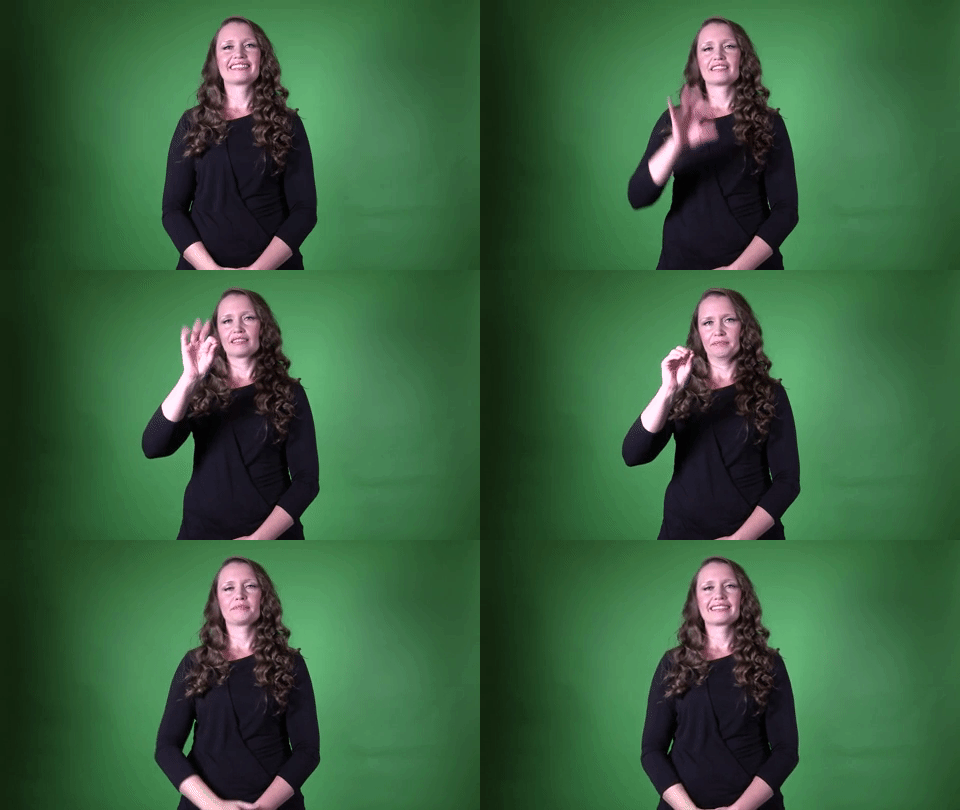
Sign for THE NUMBER NINETY in ASL | 🔢 ASL Dictionary

Definition: Refers to the number ninety

Sign for THE NUMBER NINETY in ASL 

YouTube player

Practice Activities:

Practicing the sign for the number ninety in ASL can be done in isolation and within number sequences. Start by signing the number on its own multiple times to build muscle memory. Say the number aloud as you sign it to reinforce the connection between the visual sign and its meaning.

Next, try incorporating the sign for the number ninety in ASL into counting sequences. Begin by signing the numbers in increments, such as eighty-eight, eighty-nine, ninety, ninety-one, ninety-two. Repeat this multiple times at varying speeds to improve fluency.

Use the sign for the number ninety in ASL in real-world contexts. For example, practice stating a price: “This jacket costs ninety dollars.” Another example is discussing age: “My grandfather is ninety years old.” Saying these sentences while signing helps reinforce understanding.

Engage in partner exercises by quizzing each other. One person says a number, and the other signs it. For an extra challenge, mix the numbers randomly instead of sequentially. This improves recall and accuracy.

In a storytelling exercise, create a short paragraph that includes the number ninety. For example, describe a scenario where someone is counting items: “There were ninety balloons at the party.” Signing while telling a story builds expressive skills.

Play a quick number recognition game. Write numbers on index cards and shuffle them. Pick a card and sign the number as quickly as possible. This exercise strengthens recall under time pressure.

Practice large numbers that include the sign for the number ninety in ASL. For example, sign large amounts such as 190, 990, or 1990. Breaking these numbers into smaller parts helps with overall number fluency.

Incorporate the sign while watching ASL videos or in conversations about numbers. Challenging yourself to use it naturally in context will improve retention and confidence. Keep practicing regularly for better fluency.

Cultural Context:

In American Sign Language, numbers play a vital role in daily communication. The sign for the number ninety in ASL is commonly used in various contexts, from discussing prices to giving quantities. Understanding number signs is essential for fluency in ASL conversations.

The number system in ASL is unique because it uses handshape modifications and palm orientation to differentiate between similar numbers. The sign for the number ninety in ASL follows a natural pattern consistent with other numbers in the tens. Mastering ASL numbers helps improve overall comprehension and communication skills.

When discussing age, money, or measurements, the sign for the number ninety in ASL is frequently used. Deaf people rely on number signs in both formal and informal settings to share important details. Numbers enhance clarity, making conversations in ASL more precise.

ASL is a visual language that depends on hand movements and facial expressions. The sign for the number ninety in ASL demonstrates the efficiency of the language by enabling quick numerical expression. Learning numeric signs helps build a solid foundation for ASL proficiency.

In sports, business transactions, and storytelling, the sign for the number ninety in ASL is useful. Numbers in ASL follow a logical pattern, making them easy to learn and remember. Consistently practicing number signs improves both speed and accuracy when signing.

Many beginners find ASL numbers challenging at first, but consistent practice makes them easier to recall. The sign for the number ninety in ASL is part of a structured numbering system that aids in effective communication. Mastering ASL numbers allows for smoother interactions within the Deaf community.

Understanding the cultural importance of ASL numbers helps signers communicate more naturally. The sign for the number ninety in ASL is not just a number; it represents a way to efficiently share information. Learning number signs helps bridge communication gaps between Deaf and hearing individuals.

Using number signs correctly can enhance conversations in educational and professional settings. The sign for the number ninety in ASL is just one of many numeric signs that are essential for school, work, and everyday life. Improving number fluency in ASL leads to better communication experiences.

ASL numbers are used in phone numbers, addresses, and dates. The sign for the number ninety in ASL allows signers to share numeric information quickly and accurately. Practicing ASL numbers boosts confidence in everyday interactions.

Fluency in numbers enhances overall ASL communication. The sign for the number ninety in ASL, along with other numeric signs

Extended Definition:

The sign for the number ninety in ASL is part of the numerical system used in American Sign Language. It follows the standard pattern for signing numbers in the nineties, making it easy to learn and recognize. This sign is useful for discussing quantities, prices, years, and more in everyday conversations.

To form the sign for the number ninety in ASL, start by making the sign for the number nine. Then, transition smoothly into a movement that represents the zero, similar to other numbers in the nineties. The motion should be clear and fluid to ensure proper communication.

Numbers in ASL, including the sign for the number ninety, are typically shown using one hand. This makes them quick and efficient for signing in fast conversations. Like other numbers, it is important to use the correct handshape and movement for clarity.

The sign for the number ninety in ASL is commonly used in many situations. It is useful when talking about someone’s age, counting money, or giving addresses. Knowing how to sign numbers properly can improve fluency and understanding in ASL communication.

When teaching numbers in American Sign Language, it helps to practice them in order. Starting with smaller numbers before learning the sign for the number ninety in ASL can make the learning process smoother. Repetition and real-life application are key to mastering ASL numbers.

Some regional variations may exist, but the standard sign for the number ninety in ASL remains widely recognized. For accuracy, it’s best to learn from credible ASL resources or native signers. Watching videos or working with an instructor can help perfect the movement.

The sign for the number ninety in ASL is used in both casual and professional settings. Whether in a classroom, a business meeting, or social events, it is an essential part of numerical communication. Learning it can help signers engage in conversations more effectively.

Numbers play an important role in daily communication, and knowing the sign for the number ninety in ASL is useful for anyone learning American Sign Language. It builds confidence when discussing numerical values quickly and correctly. With practice, signing numbers becomes second nature.

Synonyms: ninety, number ninety, number 90, the number 90, the number ninety

Educational resources: Find related learning materials in our course bank!

Want more? Check out some of our popular learning activities on the homepage!

Need to look up a sign? Use our highly rated dictionary: https://aslinteractive.com/best-asl-dictionary/

Follow us on tiktok: https://www.tiktok.com/@aslinteractive. More social media links at the bottom of this page!

Long-tail Keywords: what is the sign for the number ninety in ASL, how do you sign the number ninety in ASL, learn how to sign the number ninety in American Sign Language

Categories: Numbers – Basics, Numbers 81-90, cardinal numbers

tags: Numbers, Numbers 81-90, Math, Language Learning, Educational Content, rocking numbers, 86, 87, 89 rocking numbers

Parameters

*Handshape*:

The sign for the number ninety in ASL uses a handshape that begins with the number nine, which is formed by extending the thumb and index finger while keeping the other fingers folded. The thumb and index finger create an open circular shape . To complete the sign for the number ninety in ASL, the hand transitions into the number zero, where all fingers curve in to form an “O” shape. This movement smoothly shifts from the nine to zero, maintaining hand clarity.

*Palm Orientation*:

The palm orientation for the sign for the number ninety in ASL starts with the palm facing outward. The hand initially forms the number nine with the index finger and thumb touching in an “O” shape while the other fingers remain extended. As the movement progresses, the hand transitions into a closed zero shape, maintaining the same outward palm orientation. This fluid motion is essential for clarity when signing the number.

*Location*:

The sign for the number ninety in ASL is produced in the neutral signing space in front of the body. The dominant hand begins in the “9” handshape, with the thumb and index finger touching to form a circle while the other fingers remain extended. The hand then transitions into a “0” handshape by bringing all fingers together. This movement happens in a smooth, fluid motion without significant arm movement.

*Movement*:

To produce the sign for the number ninety in ASL, begin with the number nine handshape, where the thumb and index finger form a circle while the remaining three fingers extend upward. Then, smoothly transition into the number zero handshape by bringing all fingers together into an “O” shape. The movement should be fluid, without hesitation, to clearly convey the number. Keep the hand in a neutral location, typically in front of the shoulder.

*Non-Manual Signals*:

Facial expressions remain neutral or slightly affirmative when signing the sign for the number ninety in ASL, depending on context. If emphasizing or clarifying, raised eyebrows and a slight forward head tilt may be used. If asking about the sign for the number ninety in ASL, a questioning expression with slightly furrowed eyebrows is appropriate. Mouth movements may mirror the number being signed, but are typically subtle to maintain clarity.

*Prosody, Dominant/Non-Dominant Hand*:

The sign for the number ninety in ASL uses the dominant hand in an “9” handshape , with the thumb and index finger touching to form a circle while the other three fingers remain extended. The hand moves slightly forward or in a small arc as the “9” handshape transitions into a “0” handshape, where all fingers come together. The non-dominant hand is not typically used in this sign.

Tips for Beginners:

When learning the sign for the number ninety in ASL, focus on handshape and movement. The sign typically starts with the number nine handshape, where the thumb and index fingers touch in an “O” shape while the remaining fingers extend upward. Then, transition smoothly into a zero handshape, closing the fingers together to form the number ninety. Practicing this motion with a relaxed wrist helps maintain fluidity.

One common mistake beginners make when signing the number ninety in ASL is forming the nine incorrectly. Ensure that the thumb and index finger meet at the fingertips rather than pressing too hard or curling inward too much. Another issue is an abrupt or choppy transition into the zero handshape. Make the change smooth by maintaining a steady hand position and allowing the fingers to close naturally.

Consistency in hand placement is key for clarity. Keep the sign at chest or shoulder height to maintain visibility. Avoid signing too close to the body or too far away, as this can make the motion harder to recognize. Practicing in front of a mirror or recording yourself can help spot inconsistencies.

Finger dexterity plays a big role in making the sign for the number ninety in ASL accurate. If transitioning between the handshapes feels awkward, warm up by stretching your fingers or practicing other number signs like ten, twenty, or fifty. Building confidence with number sequences strengthens fluidity over time.

Lastly, watch native ASL signers whenever possible. Observing their rhythm and hand placement can provide valuable insights. When in doubt, ask a fluent signer or instructor for feedback to refine your technique. Daily repetition and mindful corrections will help reinforce proper signing habits.

Connections to Other topics:

The sign for the number ninety in ASL is part of the broader category of number signs, which follow a systemic pattern in ASL. It belongs to the group of multiples of ten, such as twenty, thirty, and forty, which use a similar movement pattern. Recognizing this pattern can help learners quickly internalize the signing system for numbers, making numerical expressions in ASL more intuitive.

Numbers in ASL are essential for counting, telling time, discussing ages, and giving measurements. The sign for the number ninety in ASL can appear in contexts such as talking about temperatures, high scores, and prices. Additionally, it connects with ordinal numbers when discussing rankings or placing events in chronological order, as in “the ninetieth anniversary.”

Ordinal numbers in ASL often adapt from cardinal numbers by adding a twisting or shaking movement. This transformation is useful when ranking items or discussing sports scores, such as “the ninetieth minute” in a game. Understanding these adaptations can help learners navigate ASL fluently in relevant conversations.

The sign for the number ninety in ASL also connects to classifiers, which are essential in ASL storytelling and description. Classifier 9 (CL:9) is commonly used to represent small round objects, such as buttons or beads. Recognizing how certain number signs can transform into classifiers allows for richer, more descriptive signing.

When fingerspelling numbers in addresses or IDs, ASL users must differentiate between fluid number signs and single-digit indications. The sign for the number ninety in ASL follows number fluency rules, meaning it should be signed clearly but smoothly in continuous sequences. Mastering such details ensures effective communication, especially in formal settings like banking or job applications.

Summary:

The sign for the number ninety in ASL follows a pattern similar to other numbers in the nineties series. It typically involves forming the number nine handshape, where the thumb and index finger meet to create a circular shape while the remaining fingers extend outward. Then, the hand moves into the zero handshape, closing the fingers together to form a rounded shape.

This sign is part of the ASL numerical system, which exhibits a high degree of visual efficiency. The transition from nine to zero occurs smoothly in a single movement. This makes it distinct from signs in spoken language, where a speaker might have to verbalize two separate syllables.

ASL numbers, including the sign for the number ninety in ASL, follow a systematic structure. Many numbers incorporate handshape transformations to indicate transitions, with ninety maintaining the expected linguistic conventions. By following this format, ASL ensures clarity when communicating numerical data.

Numbers in ASL often use a consistent movement trajectory. The sign for the number ninety in ASL articulates meaning concisely through precise finger positioning. Because ASL relies heavily on sight and motion, these numeric representations must be visually distinct.

The role of the number ninety extends beyond basic counting. It is used in contexts such as time, measurements, ages, and percentages. Because numbers carry substantial meaning, ASL ensures that they are signed in a way that minimizes ambiguity.

ASL numbers are generally one-handed, following the dominant-hand rule. This consistency allows for faster comprehension when signing numbers in quick succession. The sign for the number ninety in ASL follows this principle, ensuring that it can be easily combined with other numerical signs.

Understanding the number ninety in ASL is valuable when discussing financial figures, sports scores, and statistical data. It prevents miscommunication when relaying precise values. This is particularly crucial in contexts where accuracy is essential, such as business transactions or academic discussions.

Numbering systems in ASL align with broader linguistic principles. Like spoken languages, ASL has standardized numerical representations that increase efficiency. The sign for the number ninety in ASL reflects these linguistic patterns, demonstrating the language’s structured approach to numerical communication.

ASL numbers often incorporate palm orientation as a distinguishing feature. The palm generally faces outward when signing the number ninety. This convention prevents confusion when interpreting numbers, particularly when signing rapidly or in group conversations.

The transition between the nine and zero handshapes needs to be fluid. An abrupt or unclear motion could cause the sign to be mistaken for a different number. This smooth progression demonstrates ASL’s emphasis on visual clarity and gesture transitions.

Similar to other number signs, the sign for the number ninety in ASL connects to broader cultural and linguistic themes. It is used in education when teaching mathematical concepts. Additionally, it plays a role in everyday communication when discussing quantities or placing numerical values on events.

Numbers in ASL sometimes vary slightly depending on regional dialects or stylistic preferences. However, the fundamental aspects of the sign for the number ninety in ASL remain consistent nationwide. This ensures that deaf individuals across different communities can understand numerical signs without confusion.

The sign for the number ninety in ASL also relates to linguistic discussions about numerical cognition. The human brain processes numbers differently across spoken and sign languages. ASL’s reliance on spatial and gestural input highlights the cognitive adaptability of sign language users when interpreting numerical information.

A connection can be drawn between signed and written forms of numbers. The gestural representation of the number ninety correlates with written numerical notation. This linkage makes alternative communication methods, such as digital representations of numbers, accessible to deaf individuals.

The number ninety has cultural significance in various fields. It is commonly discussed in life expectancy statistics, sports achievements, and milestone anniversaries. ASL users rely on clear numerical signing techniques when referencing such culturally relevant figures.

In sports, players’ jersey numbers often exceed ninety, making the sign for the number ninety in ASL relevant when discussing players or game statistics. Similarly, in academic settings, percentages frequently use this sign when referring to student grades or test scores.

The role of hand dominance is an important factor in signing ninety. Right-handed signers will typically perform the sign with their right hand, while left-handed signers will use the left hand. This principle ensures natural movement and fluidity in number signing.

Numbers in ASL also have connections to mathematical discussions. When solving equations or giving numerical explanations, signers may rely on the sign for the number ninety in ASL. This reinforces ASL’s ability to support complex academic subjects through structured number signs.

ASL users often rely on spatial placement when signing numbers in sequences. The number ninety may appear in a list or within a numerical range. When multiple numbers are signed, clear positioning and pacing are crucial for maintaining comprehension.

Because ASL is a visual language, numerical signs must be adaptable for clarity in various settings. Whether signing in a one-on-one setting or in a group discussion, signers adjust signing speed and precision to ensure the number ninety

Want more? Check out some of our popular learning activities!

ASL Interactive Resources

ASLInteractive YouTube Channel

Follow us on tiktok: @aslinteractive.com

Follow us on Instagram: aslinteractive

Facebook page: aslinteractive

Facebook group: aslinteractive

LInkedIn: ASL Interactive LLC

Twitter: @ASL_interactive

*Some information on this page is AI-generated. AI can make mistakes. Please check the information.

Sign for 90 in ASL, Sign for NINETY in ASL, Sign for NUMBER NINETY in ASL, Sign for THE NUMBER NINETY in ASL 

Responses