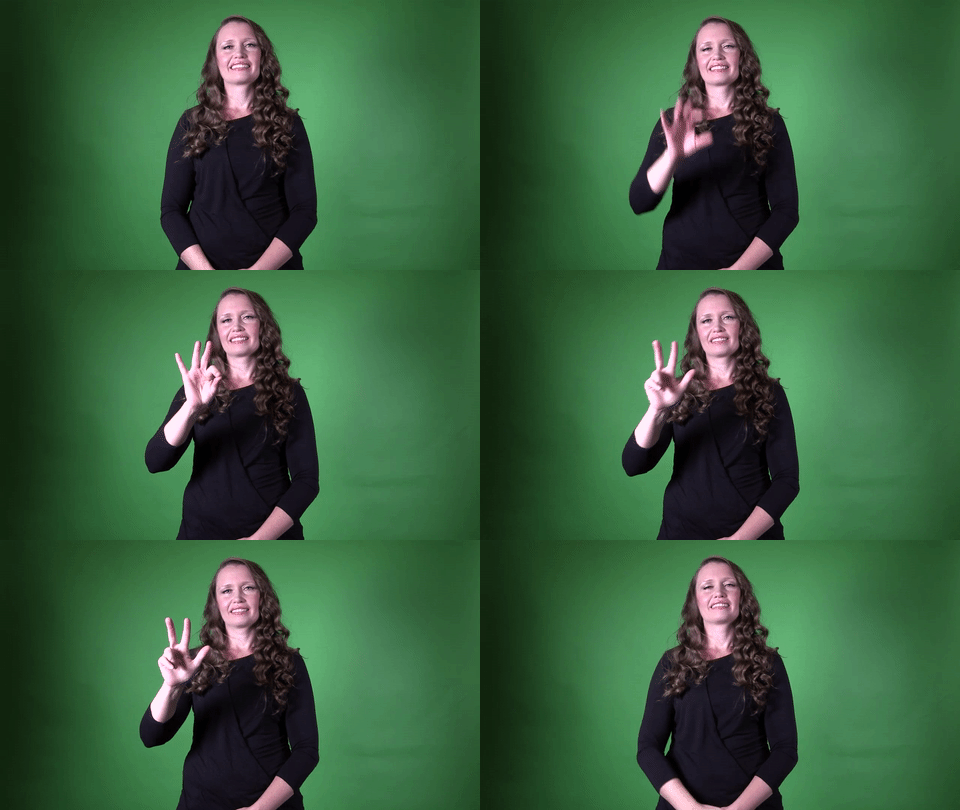
Sign for 93 in ASL | 🔢 ASL Dictionary

Definition: The number ninety-three.

Sign for 93 in ASL 

YouTube player

Practice Activities:

To practice the sign for 93 in ASL, begin by forming a “9” handshape with your dominant hand, then smoothly transition into a “3” handshape. Repeat this motion multiple times to build muscle memory. Try practicing in front of a mirror to ensure smooth transitions between numbers.

Use the sign for 93 in ASL by counting from 90 to 95, making sure each number is distinct. Say the number out loud while signing to reinforce the connection. Alternate your speed, going slow at first and then increasing your pace as you get more comfortable.

Create flashcards with the numbers 90 through 100 written on them. Shuffle the cards and sign each number as you pick them. Test yourself by signing numbers at random instead of in numerical order.

Practice using the sign for 93 in ASL within full sentences, such as “My grandmother is 93 years old” or “I saw 93 birds at the park.” Sign these sentences in front of a friend or record yourself to check for accuracy.

Work with a partner and take turns signing numbers while the other person identifies them. You can also quiz each other by signing numbers quickly and seeing who recognizes them first. This helps with speed and comprehension.

Challenge yourself by incorporating the sign for 93 in ASL into a number sequence like a grocery list or a sports score. For example, you can say, “The winning team had 93 points” or “My total bill was 93 dollars.” Adding context makes the signing more meaningful.

Try storytelling where the number 93 plays a role. You might describe a historical event that happened in 1993 or talk about counting to 93 for a specific reason. The more you use the number in different scenarios, the more confident you will become.

Cultural Context:

The sign for 93 in ASL is a combination of two numerical handshapes that flow smoothly from one to the next. Numbers in American Sign Language follow specific patterns that make them easy to remember and recognize. Learning the sign for 93 in ASL helps build number fluency for everyday communication.

Number signs in ASL are an essential part of daily interactions, from telling age to giving addresses or phone numbers. The sign for 93 in ASL follows the standard structure used for two-digit numbers in the language. Each number is formed with a distinct handshape and movement, ensuring clarity in conversation.

In Deaf culture, numbers play a crucial role in storytelling, sports discussions, and education. Understanding the sign for 93 in ASL allows signers to communicate dates, scores, and statistics accurately. Being able to express numbers quickly is a valuable skill for fluid ASL conversations.

ASL numbers are used in both formal and informal settings, making them important for students and native signers alike. The sign for 93 in ASL is useful in school settings, workplaces, and everyday exchanges. Mastering number signs improves overall confidence and clarity in signing.

When signing numbers in ASL, hand orientation and movement must be precise to ensure correct interpretation. The sign for 93 in ASL, like other two-digit numbers, requires smooth transitions between digits. Proper hand positioning helps avoid confusion and ensures understandable communication.

Learning ASL numbers enhances fluency and comprehension for both Deaf and hearing individuals. The sign for 93 in ASL is one of many numerical signs that contribute to effective nonverbal communication. Practicing number signs regularly can improve speed and accuracy in signing.

ASL is a visual language that relies on facial expressions, hand movements, and body language. The sign for 93 in ASL, like all number signs, should be performed clearly and confidently. Expressing numbers accurately is key to natural ASL conversations.

Using ASL numbers provides accessibility and inclusion for the Deaf and hard-of-hearing community. The sign for 93 in ASL is commonly used in personal, academic, and professional settings. Knowing how to sign numbers correctly makes communication more efficient and inclusive.

Fingerspelling plays a role in ASL but is not typically used for numbers since specific number signs exist. The sign for 93 in ASL follows the established numerical pattern, reducing the need for fingerspelling. Using correct number signs ensures smoother, faster

Extended Definition:

The sign for 93 in ASL follows the standard number pattern used in American Sign Language. It is a combination of the individual signs for 9 and 3, smoothly transitioned in a single movement. This sign is often used when discussing numbers in daily conversations, financial transactions, or age-related contexts.

To form the sign for 93 in ASL, you start by making the handshape for 9, extending the thumb and index finger while keeping the other fingers folded. Then, without lowering your hand, transition into the handshape for 3 by extending the thumb, index finger, and middle finger. This movement should be fluid and natural to maintain clarity in communication.

ASL number signs follow a logical sequence, making it easy to sign numbers quickly. The sign for 93 in ASL is part of the broader number system where patterns help signers recognize and produce numbers efficiently. This consistency makes it easy for both beginners and experienced signers to communicate numbers accurately.

Numbers in ASL are commonly used in everyday life, from telling the time to discussing prices or exchanging personal details. Knowing the sign for 93 in ASL can be useful in conversations involving age, addresses, or specific quantities. Mastering number signs ensures smooth interaction in personal and professional settings.

Context is essential when signing numbers in ASL, especially for clarity in larger numbers. The sign for 93 in ASL is clear and direct, but in rapid signing or conversation, it’s best to ensure deliberate movements for understanding. Practicing number signs often can improve signing speed and accuracy.

ASL numbers are influenced by regional variations, though the sign for 93 in ASL remains consistent in most ASL communities. Some signers may add slight modifications based on personal preference or comfort. However, the core structure of the sign remains the same across different signing styles.

Learning number signs like the sign for 93 in ASL enhances overall fluency in American Sign Language. It builds confidence in numerical discussions and helps in understanding ASL conversations that involve figures. Regular practice, combined with real-world usage, strengthens familiarity with ASL numbers.

For those learning ASL, watching experienced signers demonstrate number signs can be helpful. Online videos, ASL courses, and live practice are great ways to refine finger movements. Observing how fluent signers use the sign for 93 in ASL in context can aid retention and accuracy.

Numbers are fundamental in ASL conversations, making them

Synonyms: ninety-three, number ninety-three, number 93, the number 93, the number ninety-three

Educational resources: Find related learning materials in our course bank!

Want more? Check out some of our popular learning activities on the homepage!

Need to look up a sign? Use our highly rated dictionary: https://aslinteractive.com/best-asl-dictionary/

Follow us on tiktok: https://www.tiktok.com/@aslinteractive. More social media links at the bottom of this page!

Long-tail Keywords: What is the sign for 93 in ASL, How do you sign 93 in American Sign Language, Learn how to sign 93 in ASL

Categories: Numbers – Basics, Numbers 91-100, cardinal numbers

tags: Numbers, Numbers 91-100, Math, Language Learning, Educational Content

Parameters

*Handshape*:

The sign for 93 in ASL uses a combination of number handshapes. Start with the number 9 handshape, where the thumb and index finger form a circle while the remaining fingers stay extended. Then transition to the number 3 handshape by extending the thumb, index, and middle fingers while closing the ring and pinky fingers. This movement is fluid, maintaining a consistent palm orientation. The sign for 93 in ASL follows the standard number pattern in ASL counting.

*Palm Orientation*:

The palm orientation for the sign for 93 in ASL starts with the number 9, where the palm faces outward and the thumb and index finger form an open circle while the other fingers remain extended. Then, the hand transitions to the number 3, with the palm still facing outward, the index, middle, and thumb extended while the ring and pinky fingers stay folded. The motion is fluid, ensuring the numbers 9 and 3 are shown clearly in sequence.

*Location*:

The sign for 93 in ASL is formed in the neutral space in front of the body. The dominant hand starts by signing 9 with the thumb and index finger touching while the other fingers are extended. It then transitions smoothly to a 3 by extending the thumb, index, and middle fingers. The movement happens at chest level, keeping the hand steady and ensuring clarity while signing the number fluently.

*Movement*:

To produce the sign for 93 in ASL, start with the number 9 by extending the thumb and index finger in an open “L” shape while touching the tip of the index finger to the pad of the thumb. Then, smoothly transition to the number 3 by extending the index, middle, and thumb while keeping the ring and pinky fingers curled. The movement should be a continuous flow from 9 to 3, maintaining a steady hand position.

*Non-Manual Signals*:

When signing the sign for 93 in ASL, maintain a neutral or slightly focused facial expression to demonstrate accuracy. Your eyebrows should remain relaxed, as numbers generally do not require raised or furrowed brows unless part of a question. Eye gaze should be directed towards the hand to ensure clarity, especially when signing for beginners or in instructional settings. A steady head position enhances visibility and comprehension.

*Prosody, Dominant/Non-Dominant Hand*:

The sign for 93 in ASL is produced using the dominant hand. Start with the number 9, where the index finger and thumb form an open circle while the other fingers remain extended. Then, smoothly transition to the number 3 by extending the thumb, index, and middle fingers while closing the ring and pinky fingers. The movement is fluid, maintaining a steady rhythm to clearly distinguish each number in the sign for 93 in ASL.

Tips for Beginners:

When learning the sign for 93 in ASL, it’s important to recognize that ASL numbers are signed in a fluid motion. This number is formed by signing “9” followed by “3” in a continuous movement. Keep your palm facing outward and maintain a steady transition between the two numbers to ensure clarity.

A common mistake beginners make when signing the sign for 93 in ASL is hesitating between the numbers or twisting the wrist unnecessarily. The movement should be smooth and natural, with no extra flicks or unnecessary motions. Practicing in front of a mirror can help build confidence and ensure that your transitions are clean.

Finger positioning is key when forming each individual number. For “9,” touch your thumb to the tip of your index finger while keeping the other three fingers extended. For “3,” clearly extend the thumb, index, and middle fingers while closing the ring and pinky fingers. Avoid lazy or unclear hand positioning, as this can lead to misunderstandings.

Speed and rhythm are essential when signing ASL numbers, including the sign for 93 in ASL. Don’t rush the movement, but also don’t let the transition between the numbers be too slow. A steady pace will make your signing look more natural. If you struggle with fluidity, practice counting from 90 to 99 repeatedly.

Remember that consistency is crucial when signing numbers. The structure of ASL numbers remains logical, and mastering patterns will improve your accuracy. Pay close attention to how fluent signers move from one digit to another when signing the sign for 93 in ASL, and try to replicate their smooth transitions for a more natural and effective presentation.

Connections to Other topics:

The sign for 93 in ASL connects to broader concepts in number signing and counting. ASL numbers from 90 to 99 follow a pattern where the handshape for 9 transitions smoothly into the handshape for the next digit, in this case, 3. This fluid motion is a key feature of ASL number signs, as it helps with clarity and efficiency when expressing multi-digit numbers in conversation.

Understanding the sign for 93 in ASL also reinforces numeral incorporation, which is common in time, money, and age-related signs. For instance, in age signs, numbers are incorporated into the chin location, while money signs can include subtle modifications of number handshapes. Mastering numbers like 93 helps improve fluency when discussing specific quantities in various contexts, such as prices, addresses, and dates.

Another important connection involves cardinal versus ordinal numbers. While signing 93 as a cardinal number is straightforward, ordinal numbers—such as 93rd place in a race—might involve additional movement, such as a slight twist or a flicking motion. ASL learners should practice both forms to ensure clarity, especially in contexts like ranking or sequencing.

Multi-digit numbers like 93 also link to larger numerical expressions, such as years (1993), phone numbers, and mathematical references. When signing years, number pairs are often separated to improve legibility, while phone numbers are typically signed in distinct groupings. Recognizing these patterns ensures consistency across different uses of numbers in ASL.

The sign for 93 in ASL provides opportunities to practice number flexibility and the importance of transitions between different handshapes. It plays an essential role in financial discussions, sports scores, and statistics. Developing confidence in these multi-digit numbers enhances overall signing fluency, making everyday conversations involving numbers more natural and fluid.

Summary:

The sign for 93 in ASL follows a logical pattern based on American Sign Language’s number system. ASL numbers generally rely on a combination of handshape, movement, and palm orientation. For the sign for 93 in ASL, the signer must express both digits separately in sequence.

To produce the number 9, extend the thumb and index finger while curling the other fingers into the palm. The handshape resembles an “F” in ASL but with a downward orientation. Then, smoothly transition to 3 by extending the thumb, index finger, and middle finger while keeping the ring and pinky fingers folded.

In ASL, numbers from 90 to 99 are generally signed with a movement pattern called the “rocking numbers.” Rocking numbers involve a slight tilting motion to indicate the transition between two digits. For the sign for 93 in ASL, the 9 moves slightly while shifting into the 3 to maintain clarity.

ASL numbers are signed with the palm facing outward for consistency. However, some regional variations exist where signers may slightly adjust the palm orientation based on comfort or fluency. In formal settings or when teaching the sign for 93 in ASL, clarity is emphasized by exaggerating the transition between 9 and 3.

Numbers play a crucial role in ASL because they are used in everyday communication, including dates, addresses, prices, and age. When signing the sign for 93 in ASL in different contexts, signers adjust their rhythm and emphasis. For example, signing “93 years old” follows the pattern of age incorporation, where the number is connected to the age sign.

Fingerspelling is sometimes used instead of number signs when clarifying complex numerical sequences. However, for common numbers like the sign for 93 in ASL, it is always preferred to use the fluid number sequence rather than spelling them out. Proper number incorporation enhances visual processing and comprehension for fluent signers.

Numbers in ASL follow a pattern that helps with memorization and recognition of larger values. The transition from 90 to 99 involves a consistent rocking motion that prevents confusion with numbers in the 30s, 40s, or other similar ranges. The sign for 93 in ASL follows this rocking rule, ensuring immediate recognition by the receiver.

The grammatical rules for signing numbers are strict in ASL linguistics. Some contexts allow variations in speed or fluidity for efficiency. However, when signing the sign for 93 in ASL in teaching environments, it is beneficial to slow down for beginners to grasp the formation.

ASL numbers differ from spoken English numbers because they rely heavily on visual and spatial expressions. The sign for 93 in ASL is understood through movement rather than vocal intonation or syllables. This visual structure aligns with ASL’s overall reliance on spatial grammar rather than auditory cues.

Linguists studying ASL acknowledge number patterns as an essential component of the language’s structure. Because ASL is a complete language with its own syntax and rules, number signs like the sign for 93 in ASL are carefully studied for accuracy and fluency. Researchers analyze handshape transitions to ensure optimal efficiency in communication.

ASL number signs also connect with broader language learning concepts, including the cognitive processing of visual information. The sign for 93 in ASL exemplifies how signers manipulate handshapes and transitions to create seamless and comprehensible signs. Cognitive studies show that fluent ASL users process numerical signs as quickly as spoken language users process verbal numbers.

ASL learners often practice number sequences separately to master each transition. The sign for 93 in ASL is part of a larger set that learners drill to ensure fluency in producing different number combinations. Mastering number patterns strengthens overall ASL proficiency and signing speed.

Cultural relevance plays a significant role in how numbers are used in ASL. The Deaf community frequently incorporates numbers into conversations for time, measurements, money, and personal identifiers like addresses. The sign for 93 in ASL might appear in discussions about years, historical events, or numerical identifiers.

Some signers develop personalized number shortcuts for specific contexts. However, in formal ASL interpretation, signs like the sign for 93 in ASL remain standardized to ensure broad comprehension. Consistency in number signing is particularly important in professional interpreting, education, and legal communication.

Numbers in ASL also appear in storytelling, poetry, and signed music. The sign for 93 in ASL might be used artistically to reference a significant year or event. In ASL poetry, numbers can be emphasized with expressive facial cues to add depth to their significance.

Facial expressions and non-manual markers can accompany number signs for clarity. While the sign for 93 in ASL is primarily conveyed through the handshape transition, slight eyebrow movements or head tilts sometimes enhance meaning. Expressiveness in signing adds emotional depth and intention

Want more? Check out some of our popular learning activities!

ASL Interactive Resources

ASLInteractive YouTube Channel

Follow us on tiktok: @aslinteractive.com

Follow us on Instagram: aslinteractive

Facebook page: aslinteractive

Facebook group: aslinteractive

LInkedIn: ASL Interactive LLC

Twitter: @ASL_interactive

*Some information on this page is AI-generated. AI can make mistakes. Please check the information.

Sign for 93 in ASL 

Responses