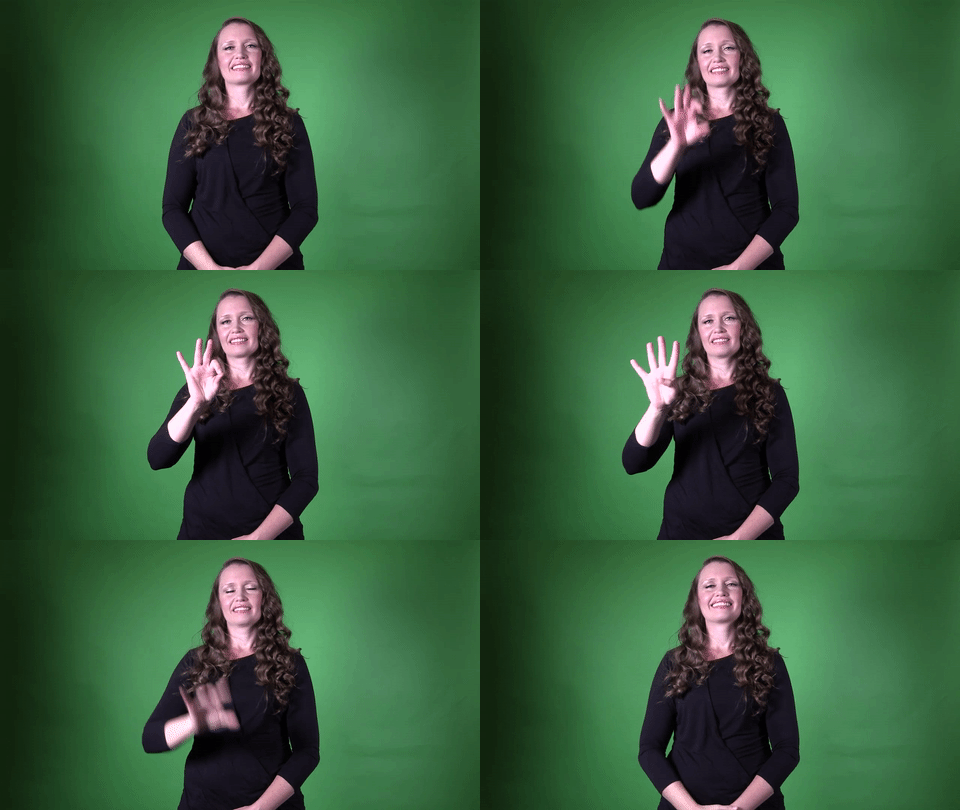
Definition: Refers to the number ninety-four
Sign for NUMBER 94 in ASL
Practice Activities:
To practice the sign for number 94 in ASL, start by signing the number in isolation repeatedly. Focus on shaping your hand correctly as you transition from 9 to 4. Try signing the number slowly at first and then gradually speed up while maintaining accuracy.
Practice incorporating the sign for number 94 in ASL into different sequences. Count from 90 to 100 while emphasizing 94. Mix different numbers together, such as signing random numbers in the 90s and ensuring that 94 is included. This helps reinforce muscle memory and recognition.
Use the sign for number 94 in ASL within sentences to build fluency. Try signing phrases like “My grandfather is 94 years old” or “There are 94 chairs in the hall.” Practice translating written sentences into ASL, focusing on number placement within context.
For a fun storytelling activity, create a short scenario where the number 94 is important. Imagine you’re shopping and see a price tag of 94 dollars or that a sports player you admire wears the number 94. Sign these scenarios while keeping good handshape and movement transitions.
Pair up with a practice partner and quiz each other with number-related questions. One person signs a number from the 90s, and the other identifies it correctly. Switch turns and specifically highlight 94 multiple times to reinforce recall.
Play a number-matching game with flashcards. Write different numbers on cards, shuffle them, and take turns drawing and signing the number aloud. Focus on recognizing and correctly signing 94 whenever it appears.
For additional practice, sign the number when reading addresses, phone numbers, or any real-life scenarios where it appears. Challenge yourself to identify and sign the number whenever you see it in daily life.
Cultural Context:
The sign for number 94 in ASL follows the general rules of number formation in American Sign Language. When signing number 94 in ASL, it is important to maintain clear handshape transitions for accuracy. ASL numbers are used frequently in daily communication, including counting, addresses, and phone numbers.
In the Deaf community, numbers play an essential role in expressing age, dates, and financial transactions. The sign for number 94 in ASL is part of a structured numeric system that allows for quick and efficient communication. Mastering number signs helps improve fluency in ASL conversations.
ASL numbers, including the sign for number 94 in ASL, can be slightly modified depending on context. Some regions may have slight variations in signing numbers due to dialect differences within the Deaf community. However, the core handshape and movement remain consistent across most ASL dialects.
Expressing numbers correctly in ASL includes proper palm orientation and movement. When signing number 94 in ASL, the hand transitions smoothly from 9 to 4 in a fluid motion. Misplacing a number sign can change the meaning and lead to confusion in conversations.
Numbers in ASL follow a logical structure that makes them easy to learn with practice. Deaf and hard-of-hearing individuals rely on accurate number signs, including the sign for number 94 in ASL, in everyday interactions. Signing numbers correctly demonstrates strong ASL proficiency and cultural awareness.
Many ASL learners focus on mastering number signs early in their learning journey. The sign for number 94 in ASL is commonly used when discussing prices, addresses, and sports scores. Numbers are an essential part of both casual and formal ASL conversations.
Understanding the numerical system in ASL improves overall communication skills. The sign for number 94 in ASL is just one of many number signs that contribute to clear and effective signing. Practicing number signs regularly helps ensure smooth and confident ASL communication.
Fingerspelling and number signs work together in ASL to convey detailed information. Learning the sign for number 94 in ASL along with other numbers enhances the ability to participate in discussions that require numerical details. Many ASL users appreciate the simplicity and efficiency of number signs.
Students often practice signing numbers by playing games or counting exercises. Using the sign for number 94 in ASL in different contexts helps reinforce memorization. Competence in ASL numbers builds a strong foundation for advanced ASL learning.
De
Extended Definition:
The sign for number 94 in ASL is made using one hand, following standard number-signing rules in American Sign Language. This sign combines the handshapes for the digits 9 and 4, transitioning smoothly to indicate the full number. ASL numbers follow a logical structure, making them efficient for communication.
When signing number 94 in ASL, start by forming the number 9 with your dominant hand. The number 9 is made by touching the tip of the thumb to the tip of the index finger while the other fingers remain extended. Then, smoothly transition into the number 4 by spreading the four fingers apart while keeping the thumb tucked.
ASL numbers from 67 to 98 incorporate a slight twisting motion for clarity. The sign for number 94 in ASL includes this transition, ensuring the numbers remain distinct. Mastering these transitions helps signers communicate numbers quickly and accurately.
Number signs in ASL are essential for conveying addresses, phone numbers, and other numerical information. Learning the sign for number 94 in ASL ensures that you’re prepared to use this number in conversations. It also enhances your overall fluency in signing numerical values in daily communication.
Different regions may show slight variations in number signs, but the method for signing number 94 in ASL remains consistent. Most signers follow the standard way of transitioning between 9 and 4 without exaggerated movements. Keeping the sign smooth and natural ensures clarity for the listener.
Finger dexterity plays an important role when practicing ASL numbers. The sign for number 94 in ASL requires controlled finger movements to switch between the two digits seamlessly. Practicing in front of a mirror or with a partner can help improve fluency.
Numbers in ASL function differently than in spoken languages, where tone and stress convey meaning. The sign for number 94 in ASL relies purely on handshape, movement, and consistency. Keeping movements precise helps avoid confusion with similar numbers.
Learning number signs is beneficial for both beginner and advanced ASL users. Mastering the sign for number 94 in ASL is a great way to build comfort with signing numerical values. As you gain confidence, you can sign numbers in longer sequences more naturally.
Using ASL for numbers helps maintain fluid communication in various settings. The sign for number 94 in ASL is useful in classroom environments, meetings, and casual conversations. A strong understanding of ASL numbers supports stronger overall signing skills.
Watching
Synonyms: ninety-four, number ninety-four, number 94, the number 94, the number ninety-four
Educational resources: Find related learning materials in our course bank!
Want more? Check out some of our popular learning activities on the homepage!
Need to look up a sign? Use our highly rated dictionary: https://aslinteractive.com/best-asl-dictionary/
Follow us on tiktok: https://www.tiktok.com/@aslinteractive. More social media links at the bottom of this page!
Long-tail Keywords: what is the sign for Number 94 in ASL, how do you sign Number 94 in American Sign Language, learn to sign Number 94 in ASL
Categories: Numbers – Basics, Numbers 91-100, cardinal numbers
tags: Numbers, Numbers 91-100, Math, Language Learning, Educational Content
Parameters
*Handshape*:
The sign for NUMBER 94 in ASL uses a two-part movement. It begins with the number 9 handshape, where the thumb and index finger form a circle while the other three fingers extend outward. Then, it transitions into the number 4 handshape, with the thumb tucked in and all four fingers extended. The hand rotates slightly between these positions. The sign for NUMBER 94 in ASL is a fluid motion, ensuring clarity and ease of recognition. ️
*Palm Orientation*:
The palm orientation for the sign for NUMBER 94 in ASL starts with the dominant hand facing outward, forming the number **9** with the thumb and index finger touching in a circular shape, while the other fingers remain extended. The hand then smoothly transitions to the number **4**, with the thumb tucked in and the four fingers extended, still facing outward. This movement maintains clarity and fluidity, ensuring the sign for NUMBER 94 in ASL is accurately conveyed. ✋
*Location*:
The sign for number 94 in ASL is produced in the neutral space in front of the body at chest level. The dominant hand forms the number 9 by extending the thumb and index finger while curling the other fingers inward. Then, in a smooth motion, the hand transitions to the number 4, extending the index, middle, ring, and pinky fingers with the thumb tucked in. The movement stays within the signing space, ensuring clarity and visibility.
*Movement*:
To produce the sign for number 94 in ASL, begin by forming the number 9 with your dominant hand—extend the index finger and curl the thumb inward to touch the tip of the index finger. Then, smoothly transition to the number 4 by extending the index, middle, ring, and pinky fingers while keeping the thumb tucked. The movement should be fluid, maintaining a natural transition between the two handshapes.
*Non-Manual Signals*:
When signing the sign for number 94 in ASL, maintain a neutral or slightly focused facial expression to ensure clarity. The eyebrows remain relaxed, and there is no exaggerated mouth movement since numbers are typically signed with a straightforward demeanor. If emphasizing or clarifying, a slight nod or raised eyebrows may be used. Consistently keep eye contact with the recipient to enhance communication and understanding.
*Prosody, Dominant/Non-Dominant Hand*:
The sign for number 94 in ASL uses the dominant hand in a fluid motion. Begin with the number 9, formed by touching the tip of the thumb to the tip of the index finger while the remaining fingers stay extended. Then, smoothly transition to the number 4 by extending the index, middle, ring, and pinky fingers while tucking the thumb in. This motion should be natural and continuous to convey the correct numerical sequence.
Tips for Beginners:
When learning the sign for NUMBER 94 in ASL, focus on transitioning smoothly between the numbers 9 and 4. The number 9 is made by forming a circle with the thumb and index finger while the other fingers remain extended. Then, shift to the number 4 by extending the index, middle, ring, and pinky fingers while keeping the thumb tucked in. Practicing these numbers separately before combining them can make the transition easier.
One of the most common mistakes beginners make with the sign for NUMBER 94 in ASL is improper finger positioning. Ensure your thumb and index finger touch correctly when forming the 9, and keep your fingers straight and together when signing 4. Avoid rushing the transition, as clarity is more important than speed. Smooth, controlled movements will help make your numbers more readable.
Hand orientation is also crucial for the sign for NUMBER 94 in ASL. The palm should face outward for both numbers so that they are clear to the viewer. Some learners tend to rotate their hands slightly, which may cause confusion. Keep your hand steady and practice in front of a mirror to ensure proper positioning.
Consistent practice is key to mastering the sign for NUMBER 94 in ASL. Try incorporating number sequences into your daily routine, whether by signing addresses, prices, or phone numbers. Repetition will build confidence and fluency, making number signs feel more natural. If possible, practice with a fluent signer to receive constructive feedback.
Building muscle memory is important for smooth transitions between numbers. Finger exercises and warm-ups can improve dexterity, making it easier to sign numbers accurately. Over time, your hands will become more flexible and responsive, allowing you to sign numbers quickly and fluidly.
Connections to Other topics:
The sign for NUMBER 94 in ASL is part of the broader category of number signs that follow a structured pattern. ASL uses a combination of handshapes and movement to express numbers, making them essential for counting, telling time, and conveying addresses. The number 94 follows the standard pattern of transitioning from nine to four with a smooth wrist rotation. Understanding how numbers function in ASL is crucial since they are often incorporated into dates, prices, and mathematical equations.
Numbers in ASL connect to multiple linguistic concepts, such as classifiers, quantifiers, and numeral incorporation. Some signs incorporate numbers within them to add specificity, like age signs where a number is combined with the sign for “old.” The sign for NUMBER 94 in ASL may also appear when discussing historical events, statistics, or street addresses. In sports and team discussions, jersey numbers and player statistics often use ASL number signs in fast-paced conversation.
ASL number signs follow unique grammatical rules when used in different contexts. For example, when citing addresses or phone numbers, each number is signed clearly and separately. In contrast, when signing years, the numbers may be split or blended differently depending on the era. The sign for NUMBER 94 in ASL is useful when discussing years in the 1900s, often signed as “nineteen” followed by “ninety-four” rather than signing each number individually. Understanding these structural differences helps with fluency and natural communication.
Many numerical concepts in ASL are influenced by ordinal and cardinal numbers. The sign for NUMBER 94 in ASL could be used ordinally when ranking or listing top scores or achievements. When discussing math or financial transactions, these number signs become more dynamic, including currency notation. Learning number signs enhances overall ASL proficiency and connects to broader topics like time, measurements, and statistics.
Summary:
The sign for number 94 in ASL follows a structured numerical pattern used in American Sign Language to represent numbers clearly and efficiently. This sign is part of the broader ASL number system, which uses distinct handshapes and movements to convey numerical values. Understanding the sign for number 94 in ASL requires familiarity with the signs for 9 and 4 individually before they are combined into a single fluid motion.
To produce the sign for number 94 in ASL, first form the number 9 by creating an “O” shape with the thumb and index finger while the other three fingers remain extended. Then, smoothly transition into the number 4 by extending the index, middle, ring, and pinky fingers while the thumb remains tucked in. This transition should be a fluid movement without unnecessary pauses to maintain the natural rhythm of ASL.
ASL has a strong linguistic structure that relies on efficiency and clarity in signing, and numbers are no exception. The sign for number 94 in ASL exemplifies this economy of motion, ensuring that numbers can be quickly expressed in conversations. The movement between digits follows the natural progression of handshapes, reinforcing ASL’s visual and kinetic nature.
Grammatically, numbers in ASL can stand alone or modify nouns, depending on context. The sign for number 94 in ASL may be used to reference a specific quantity, a year, or a ranking, depending on the surrounding signs. When paired with time-related concepts, such as “year” or “age,” this sign conveys chronological information clearly.
Culturally, number signs in ASL are fundamental for daily interactions, including dates, addresses, prices, and statistics. The sign for number 94 in ASL plays a role in conveying specific numerical information in various settings, such as education, business, and personal conversations. It also demonstrates how ASL users efficiently incorporate numbers into dialogue through sequential handshapes.
Linguistically, ASL numbers follow predictable patterns, allowing signers to quickly learn and reproduce numerical sequences. The sign for number 94 in ASL fits within the overall structure that governs ASL’s numerical system, making it easy for proficient users to recognize and use. Mastery of number signs helps in expanding overall fluency and understanding of ASL grammar.
A comparison with spoken languages reveals that ASL expresses numbers visually instead of vocally, which creates a different cognitive processing experience. Many ASL users develop a keen spatial awareness, as signing numbers requires tracking motion, position, and handshape simultaneously. The sign for number 94 in ASL highlights this unique visual and spatial aspect of signed languages.
One fascinating feature of ASL is its numeral incorporation, where certain number signs blend seamlessly into sign phrases. While the sign for number 94 in ASL stands alone, similar numbers can be incorporated into larger expressions. This efficiency in number incorporation demonstrates ASL’s adaptability and grammatical flexibility.
From a learning perspective, practicing ASL numbers improves fine motor skills and finger dexterity. Signing the number 94 strengthens recognition of numerical transitions, as learners must smoothly switch between two distinct handshapes. Repeated practice with numbers enhances overall signing confidence and fluency.
Historically, ASL number signs have evolved alongside Deaf culture and linguistic development. The sign for number 94 in ASL follows conventions established through community consensus, ensuring consistency across users. Standardized number signs maintain clarity, preventing miscommunication in numerical exchanges.
In the digital age, ASL numbers retain their importance for video communication, enabling signers to quickly relay numerical data through visual means. The sign for number 94 in ASL, like other number signs, is easily recognizable in video calls, social media captions, and educational content. Technology enhances accessibility by allowing wider communication through sign language.
Sign variations exist depending on regional and generational influences, but the standard method for signing number 94 remains widely understood. Some signers may slightly modify hand transitions due to personal signing styles, but the fundamental handshapes remain consistent. This flexibility reflects the natural variations that occur across all languages.
Connections between ASL and other sign languages reveal similarities and differences in numerical representation. While the sign for number 94 in ASL follows a specific structure, other signed languages might have unique number-signing conventions. Comparing number systems provides insight into linguistic diversity among Deaf communities worldwide.
The cognitive benefits of signing numbers include improved memory and mental mapping of spatial movements. The sign for number 94 in ASL requires recalling two distinct hand formations in rapid succession, reinforcing cognitive connections between numerical concepts and hand positioning. Enhancing number fluency in ASL strengthens overall language processing abilities.
For ASL learners, breaking numbers down into smaller components simplifies the learning process. First focusing on numbers 1-10 builds a foundation, making it easier to recognize patterns like those used in the sign for number 94 in ASL. Structured learning methods support retention and
Want more? Check out some of our popular learning activities!
ASL Interactive Resources
ASLInteractive YouTube Channel
Follow us on tiktok: @aslinteractive.com
Follow us on Instagram: aslinteractive
Facebook page: aslinteractive
Facebook group: aslinteractive
LInkedIn: ASL Interactive LLC
Twitter: @ASL_interactive
*Some information on this page is AI-generated. AI can make mistakes. Please check the information.


Responses