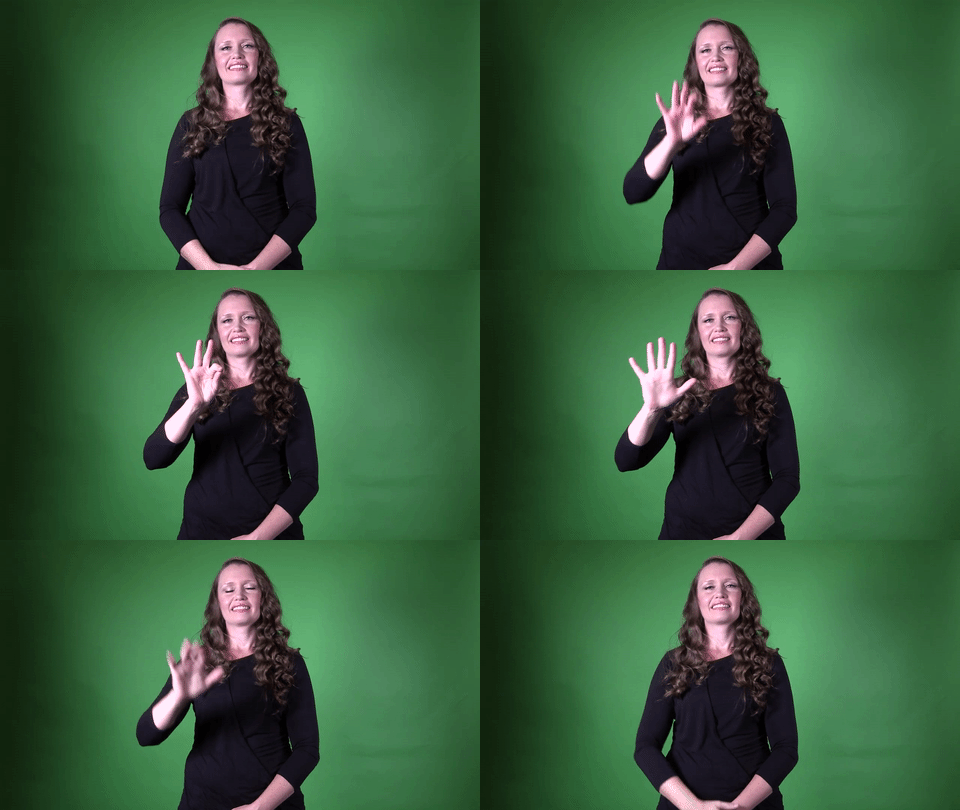
Sign for THE NUMBER 95 in ASL | 🔢 ASL Dictionary

Definition: Refers to the number ninety-five

Sign for THE NUMBER 95 in ASL 

YouTube player

Practice Activities:

To practice the sign for the number 95 in ASL, start by signing it in isolation multiple times. Focus on the movement and handshape to ensure accuracy. Use a mirror or record yourself to check consistency.

Try incorporating the sign for the number 95 in ASL into simple sequences counting up from 90 to 100. This will help reinforce fluidity and transition between numbers. You can also mix up numbers randomly and challenge yourself to sign them quickly and correctly.

Practice using the sign for the number 95 in ASL within everyday contexts. For example, sign “$95” while discussing prices or sign “I saw 95 birds outside today” to describe an observation. This helps reinforce the sign in real-life applications.

Engage in a partner activity where one person signs a number and the other has to respond with the number that is 5 more or 5 less. For instance, if your partner signs 90, respond with 95. Switch roles to keep practice interactive and fun.

Create a short story or description that includes the sign for the number 95 in ASL. For example, describe a situation where you counted 95 objects, someone ran 95 miles, or a store had 95 items in stock. This encourages expressive signing and storytelling skills.

Play a game where a partner fingerspells random numbers, and you respond by signing them correctly. When the number 95 appears, emphasize smooth signing and accuracy. Increase speed and complexity as you improve.

Challenge yourself with real-world applications by spotting instances where 95 is relevant, such as road signs, prices, dates, or scores. Sign the number each time you encounter it to reinforce recognition and fluency.

Cultural Context:

The sign for the number 95 in ASL is an important part of American Sign Language, especially when discussing numbers in daily conversations. Numbers play a key role in signing dates, addresses, prices, and quantities. Learning the sign for the number 95 in ASL helps improve fluency and understanding in various contexts.

Number signs in ASL follow a specific pattern, helping signers recognize and express numerical values accurately. The sign for the number 95 in ASL follows a natural handshape movement used in numbering sequences. Mastering these number signs is crucial for both basic and advanced ASL communication.

Deaf culture relies heavily on fluent number signing for everyday interactions. Whether discussing ages, financial amounts, or sports scores, the sign for the number 95 in ASL ensures clear and effective communication. Correctly using number signs enhances conversations within the Deaf community and supports accessibility.

ASL number signs, including the sign for the number 95 in ASL, incorporate movement and handshape consistency. Signers must maintain precision in their fingers and motion to ensure accuracy. Learning to produce number signs fluidly helps build confidence in signing and comprehension.

Numbers are integral to expressing time, measurements, and calculations in ASL. The sign for the number 95 in ASL may appear in conversations about years, percentages, or statistics. Understanding the correct form of ASL numbers prevents misinterpretation and promotes seamless communication.

Educators and interpreters use the sign for the number 95 in ASL to teach number recognition in various learning environments. Mastery of ASL numbers helps students, professionals, and community members engage effectively in conversations. Practicing the movement for each number reinforces proper technique and muscle memory.

Whether signing to discuss historical dates, financial figures, or counting objects, the sign for the number 95 in ASL fits into a broader system of numerical expressions. Numbers are fundamental to many discussions, making them a significant part of ASL education. Strengthening signing skills through consistent practice ensures clarity and accuracy.

Technology and social media have increased the visibility of ASL, making proficiency in number signs even more beneficial. The sign for the number 95 in ASL can be used in video content, online tutorials, and virtual learning platforms. Exposure to ASL numbers in digital spaces supports language growth and cultural understanding.

Deaf and hard-of-hearing individuals use signs like the sign for the number 95 in ASL to navigate professional and personal environments.

Extended Definition:

The sign for the number 95 in ASL is a combination of the numbers 9 and 5. It follows the standard pattern for signing two-digit numbers in American Sign Language. The movement and handshape are important to ensure clarity when communicating.

When signing the number 95 in ASL, begin with the hand in a 9 handshape. The thumb and index finger form a circle while the other three fingers remain extended. Then, transition smoothly into the 5 handshape by spreading out all five fingers with the palm facing outward.

Facial expressions and hand positioning play a key role in conveying numbers accurately in ASL. Ensuring that the transition between the 9 and 5 is fluid will help make the sign clear and easy to understand. Proper finger placement prevents confusion with similar-looking numbers.

American Sign Language follows specific number patterns, and 95 fits into the structure for numbers in the 90s. The sign for the number 95 in ASL is useful for discussing quantities, prices, dates, and other numerical information. It is commonly used in everyday conversations, classrooms, and professional settings.

When learning to sign the number 95 in ASL, practicing in front of a mirror or with a sign language partner can be helpful. Repetition builds muscle memory, making the movement more natural. Watching native signers demonstrate the sign can provide additional guidance.

Numbers in ASL are an essential part of communication, allowing signers to express mathematical concepts, addresses, and more. The sign for the number 95 in ASL is one example of how numerical signs follow a predictable pattern. Mastering number signs improves overall fluency in American Sign Language.

Finger placement and palm orientation are crucial elements of ASL numbers. Keeping the palm facing outward when transitioning from 9 to 5 ensures clarity. Paying attention to these details will improve communication and prevent misunderstandings.

Signing numbers correctly in ASL requires precision and practice. The sign for the number 95 in ASL should be performed smoothly to maintain fluency. Watching video tutorials and practicing regularly will build confidence in using number signs effectively.

Understanding how to sign numbers in ASL enhances communication skills for both beginners and advanced signers. Learning the sign for the number 95 in ASL is part of developing a broader vocabulary in American Sign Language. Regular practice will make signing numbers second nature.

Mastering numerical signs ensures clear and effective communication in ASL. Whether discussing math, age

Synonyms: ninety-five, number ninety-five, number 95, the number 95, the number ninety-five

Educational resources: Find related learning materials in our course bank!

Want more? Check out some of our popular learning activities on the homepage!

Need to look up a sign? Use our highly rated dictionary: https://aslinteractive.com/best-asl-dictionary/

Follow us on tiktok: https://www.tiktok.com/@aslinteractive. More social media links at the bottom of this page!

Long-tail Keywords: what is the sign for the number 95 in ASL, how do you sign the number 95 in ASL, learn to sign the number 95 in American Sign Language

Categories: Numbers – Basics, Numbers 91-100, cardinal numbers

tags: Numbers, Numbers 91-100, Math, Language Learning, Educational Content

Parameters

*Handshape*:

The sign for the number 95 in ASL uses a changing handshape. Start with the number 9 handshape, where the thumb and index finger touch to form a small circle while the other fingers remain extended. Then, transition to the number 5 handshape, where all fingers spread open. This motion smoothly shifts from the number 9 to 5, maintaining a steady movement. The sign for the number 95 in ASL is performed with one hand and typically stays at chest level.

*Palm Orientation*:

The palm orientation for the sign for the number 95 in ASL starts with the palm facing outward while forming the number nine. The thumb and index finger touch to create a circular shape, with the other fingers extended. Then, the hand transitions to the number five, keeping the palm facing outward. The movement should be smooth and fluid to indicate the shift between the digits in the sign for the number 95 in ASL.

*Location*:

The sign for the number 95 in ASL is produced in the signing space in front of the body, typically at chest or shoulder level. The dominant hand forms the number 9 with the thumb and index finger touching while the other fingers extend, then transitions smoothly to the number 5 by spreading all fingers out. The movement happens in a fluid motion with the palm facing forward.

*Movement*:

To produce the sign for the number 95 in ASL, start with the number 9 handshape—extend the thumb and index finger while keeping the other fingers curled. Then transition smoothly to the number 5 handshape, spreading all fingers apart with the palm facing outward. This movement should be fluid, ensuring the shift between handshapes is clear and distinct. Keep the hand steady, and maintain an even pacing while signing.

*Non-Manual Signals*:

When demonstrating the sign for the number 95 in ASL, maintain a neutral or slightly focused facial expression . The eyebrows remain relaxed, and the mouth may be slightly open as if naturally counting. Your head stays steady, though slight nodding can indicate emphasis. Eye gaze follows the movement of the hand to ensure clarity . If signing in a list format, you might raise your eyebrows slightly to indicate an item in a sequence.

*Prosody, Dominant/Non-Dominant Hand*:

The sign for the number 95 in ASL uses the dominant hand. Begin with the number 9 handshape, where the thumb and index finger form a circle while the other three fingers remain extended. Then, transition smoothly into the number 5 handshape by extending all fingers outward. The motion should be fluid, with a slight bounce to indicate the numeric transition. Keep the palm facing outward throughout the movement.

Tips for Beginners:

When learning the sign for the number 95 in ASL, it’s essential to master both number formation and hand movement. This sign follows the pattern of number signs in ASL, where 9 is formed with the thumb and index finger touching in an “open” circle, while the remaining fingers are extended. Then, the hand transitions into the number 5 by spreading all fingers apart. The shift should be smooth and controlled to maintain clarity.

A common mistake when signing the number 95 in ASL is failing to maintain handshape consistency. Beginning signers sometimes allow their fingers to relax too much, creating an unclear or sloppy transition between the numbers. Be mindful of the movement and avoid bending or retracting the fingers more than necessary. Slight hesitations or overly rapid changes can also make the sign harder to understand, so practice at a steady pace.

Another tip for mastering the sign for the number 95 in ASL is ensuring your palm orientation remains consistent. The palm should face outward toward the person receiving the sign. If your palm rotates inward or downward, it may be misinterpreted as a different number. Practicing in front of a mirror or recording yourself can help catch any errors in palm direction.

In real-world signing, fluency is key, so practice transitioning smoothly between multiple numbers. Try signing 91 through 99 consecutively to develop fluidity and confidence. If you struggle with handshape changes, warming up your fingers with simple stretches can improve flexibility. Regular practice and slow, deliberate movements will help build accuracy over time.

By keeping your hand steady, focusing on clear handshapes, and gradually increasing speed, you’ll improve your ability to correctly sign the number 95 in ASL. Engaging with fluent signers can also provide valuable feedback and reinforcement.

Connections to Other topics:

The sign for the number 95 in ASL is part of the broader ASL numbering system, which includes cardinal numbers, ordinal numbers, and number incorporation. This system follows a structured pattern, allowing for consistency when signing various numerical sequences. Mastering numbers like 95 helps with fluency in everyday conversations, including discussing ages, dates, and financial amounts.

The sign for the number 95 in ASL connects with concepts like quantity, percentages, and time references. For example, numbers can be used in combination with signs like “percent” or “years old” to indicate percentages or ages. Understanding how to appropriately modify number signs helps clarify meaning, such as differentiating 95 dollars from 95 minutes.

Number signs, including the sign for the number 95 in ASL, are often incorporated into larger numerical expressions. For instance, phone numbers, measurements, and statistics rely heavily on fluent number signing. Additionally, context sometimes affects the way numbers are signed, such as when discussing sports scores or street addresses.

Another important connection to the sign for the number 95 in ASL is related to classifiers and numeral incorporation. Some classifiers use specific number handshapes to indicate groups or arrangements. Being comfortable with signing numbers smoothly allows for ease in describing scenes, measurements, and rankings.

In fast-paced conversations, number signs must be clear and distinct to avoid confusion. Practicing the sign for the number 95 in ASL alongside similar structured number patterns, like counting by fives or signing years, enhances overall fluency. Additionally, comprehending number variations used in financial, mathematical, and statistical contexts strengthens comprehension for real-world applications.

Summary:

The sign for the number 95 in ASL follows a structured numerical pattern used in signing two-digit numbers. It is created by forming the number 9 with the dominant hand, followed by transitioning smoothly into the number 5. Each digit is signed in sequence, ensuring clarity in communication.

The number 9 is made by forming a circular shape with the thumb and index finger, while the remaining fingers extend outward. This handshape resembles the letter “F” in ASL but is distinct due to its movement and context. The transition from 9 to 5 requires a fluid motion, ensuring that both digits remain visible to the viewer.

The number 5 in ASL involves spreading all five fingers apart with the palm facing outward. This is one of the most basic number signs and is easily recognizable. When combined with the number 9, the movement should be smooth to clearly represent 95 without confusion.

Numbers in ASL follow a logical pattern, and higher numbers like 95 adhere to this structure. Signs for numbers above 10 are typically produced using sequential or twisting motions. The sign for the number 95 in ASL maintains numerical consistency, preventing misinterpretation in signed conversations.

The importance of signing numbers clearly cannot be overstated. Numbers play an essential role in everyday communication, such as discussing ages, addresses, prices, and dates. Ensuring accuracy helps maintain effective dialogue, especially in discussions requiring numerical precision.

The sign for the number 95 in ASL is commonly seen in financial contexts, including money transactions and price discussions. When discussing amounts in dollars, a slight forward motion or change in palm orientation can indicate currency. This reinforces how numerical signs are adapted based on context.

Numbers in ASL are influenced by regional and generational variations. While the foundations remain the same, some Deaf communities may emphasize different stylistic elements. Understanding these subtle differences ensures smoother communication across different signing groups.

The sign for the number 95 in ASL also connects to fingerspelling principles. Although numbers and fingerspelled words are distinct, both require clear handshapes and transitions. Mastering number sequences improves overall fluency in ASL.

ASL employs a unique numerical system that differs from spoken languages in structure and expression. The sign for the number 95 in ASL aligns with this system, reinforcing the grammatic and linguistic rules governing numbers. Numbers must be signed in an order that maintains logical parsing for the viewer.

One linguistic feature of ASL numbers is the emphasis on clarity. Unlike spoken numbers, which can sometimes be ambiguous due to similar sounds, ASL numbers rely on distinct handshapes and transitions. This visual distinction enhances the language’s precision.

The number 95 also appears in years, ages, and numerical sequences. In storytelling or historical discussions, the sign for the number 95 in ASL helps convey timelines and specific periods. This makes numerical fluency essential in both casual and academic settings.

A common mistake when signing the number 95 involves unclear transitions between the 9 and 5. If the handshape is not properly formed during the switch, it can cause the number to be misinterpreted. Practicing each digit separately before combining them helps with accuracy.

When using the sign for the number 95 in ASL within a larger numerical sequence, maintaining a steady rhythm is key. Breaking down numbers into digestible parts aids comprehension when communicating large values. This technique is particularly useful in mathematical or instructional discussions.

Numerical signs in ASL are also influenced by hand dominance. Right-handed signers lead with their dominant hand, while left-handed signers mirror the motion. The sign for the number 95 in ASL, like all number signs, should be performed with the dominant hand to ensure consistency.

In educational environments, ASL numbers become a crucial part of mathematics instruction. Teachers who sign use the number system to explain equations and calculations. Signing 95 within math lessons showcases how ASL adapts to numerical thinking.

Technology has influenced the visibility of signed numbers. With video communication increasing, signing accuracy is more crucial than ever. The sign for the number 95 in ASL should be positioned clearly within the signing space to maximize understanding.

Fingerspelling and numerical fluency improve hand dexterity, benefiting ASL learners. The smooth transition between 9 and 5 strengthens motor skills. Developing precision in signing numbers aids overall ASL competency.

The sign for the number 95 in ASL can be seen in sports scores, event counts, and quantity-based conversations. Whether discussing statistics or simple numerical facts, mastering number signs broadens conversational range. Knowing how to confidently sign numbers enhances exchanges in daily and professional interactions.

A deeper understanding of numerical structure in ASL reveals its visual grammar. The way numbers are expressed reflects ASL’s reliance on spatial consideration and comprehensible movements. The sign for the number 95 in ASL is a prime example

Want more? Check out some of our popular learning activities!

ASL Interactive Resources

ASLInteractive YouTube Channel

Follow us on tiktok: @aslinteractive.com

Follow us on Instagram: aslinteractive

Facebook page: aslinteractive

Facebook group: aslinteractive

LInkedIn: ASL Interactive LLC

Twitter: @ASL_interactive

*Some information on this page is AI-generated. AI can make mistakes. Please check the information.

Sign for 95 in ASL, Sign for NINETY-FIVE in ASL, Sign for NUMBER NINETY-FIVE in ASL, Sign for THE NUMBER NINETY-FIVE in ASL, Sign for THE NUMBER 95 in ASL 

Responses