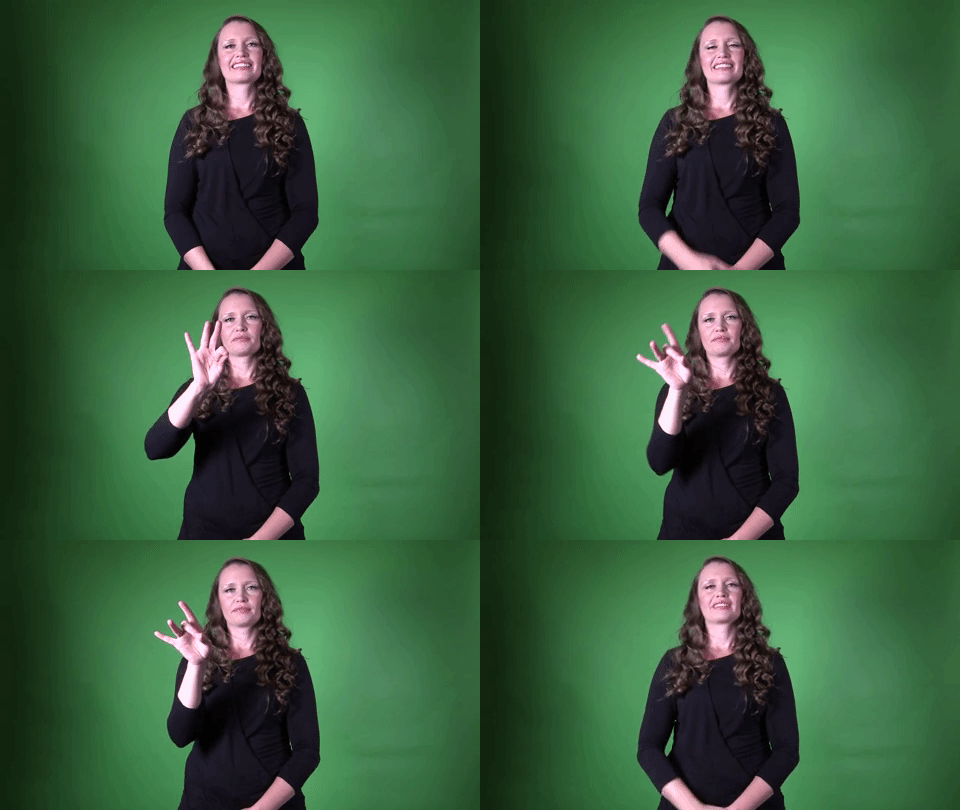
Definition: Refers to the number ninety-eight
Sign for THE NUMBER 98 in ASL
Practice Activities:
To practice the sign for the number 98 in ASL, begin by isolating the movement. Form the number 9 on your dominant hand, then quickly change to the number 8. Repeat this motion slowly, ensuring clarity in the transition. Practice in front of a mirror to check for accuracy and fluidity.
Once comfortable with the motion, try signing the number 98 in sequence with other numbers. Count backwards from 100 to 90, emphasizing the shift between 99 and 98. Record yourself signing numbers to evaluate consistency. Ask a partner to quiz you by fingerspelling random numbers, including 98, so you can sign them correctly.
Use the sign for the number 98 in ASL within real-world contexts. Pretend to give someone a total price, such as “The bill is 98 dollars.” Try incorporating the number into descriptions like “98 people attended the event.” Create a scenario where you’re reading a speed limit sign or stating a score in a competition that includes 98.
Practice storytelling that incorporates 98 in a meaningful way. Describe a situation in which an item costs 98 cents, or describe an event that occurred in the year 1998 by isolating and signing 98 clearly. Work with a friend to create short dialogues where 98 appears in different conversational settings.
Engage in number recognition games. Have a partner sign various numbers, including 98, and respond by writing them down or repeating them in ASL. Play a rapid number recognition drill, where numbers are signed quickly, and you respond as fast as possible. Regular engagement will build confidence in recognizing and signing 98 fluently.
Cultural Context:
American Sign Language is deeply connected to Deaf culture, and numbers play a significant role in daily communication. Learning the sign for the number 98 in ASL helps build fluency and confidence when signing dates, prices, and quantities. Numbers are an essential part of conversations, whether discussing age, money, or sports scores.
In the Deaf community, accuracy in signing numbers is important for clear communication. The sign for the number 98 in ASL follows a consistent pattern based on numerical handshapes. Mastering number patterns makes signing smoother and helps avoid misunderstandings.
Numbers in ASL are often used in storytelling, education, and casual conversation. The sign for the number 98 in ASL can appear in discussions about history, competitions, or personal achievements. Understanding numerical signs enhances overall sign language comprehension.
The sign for the number 98 in ASL is structured using the standard rules of ASL number formation. Recognizing the handshape and movement is crucial for signing fluency. Consistently practicing numbers improves both receptive and expressive skills.
Educators and interpreters frequently use the sign for the number 98 in ASL when teaching math, discussing percentages, or interpreting phone numbers. Clear number signs ensure effective communication in classrooms, business settings, and social interactions. Learning number signs helps bridge communication gaps between Deaf and hearing individuals.
Sports discussions often involve numbers, making it useful to know the sign for the number 98 in ASL when referencing team jerseys, statistics, or game scores. Signers who follow sports frequently use number signs in conversations. Numbers play a key role in expressing excitement and sharing information accurately.
Historical references might also require knowing how to sign the number 98 in ASL, particularly when discussing events, anniversaries, or important milestones. Years and dates are commonly signed, making numerical clarity a valuable skill in ASL. Signing dates correctly ensures effective storytelling and factual accuracy.
Deaf professionals rely on accurate number signs when handling data, taking orders, or organizing schedules. The sign for the number 98 in ASL may come up during meetings, presentations, or financial discussions. Business communication in ASL requires precision, especially when using numerical signs.
Children learning ASL need to grasp number signs early to engage in counting activities and basic math. Knowing the sign for the number 98 in ASL supports early language development and math comprehension. Parents and educators incorporate number signs into lesson plans to strengthen learning.
Fluency in ASL includes the ability to sign numbers effortlessly.
Extended Definition:
The sign for the number 98 in ASL follows the standard pattern for signing two-digit numbers between 67 and 98. This sign uses a combination of hand movements and number orientation to represent 98 clearly and correctly in American Sign Language. Knowing how to sign numbers accurately is essential for ASL fluency, especially in conversations involving age, money, addresses, or dates.
To sign the number 98 in ASL, start with the number 9 handshape, which uses the thumb and index finger touching while the other fingers remain extended. Then transition smoothly into the number 8 handshape, where the thumb and middle finger touch while the other fingers stay extended. The movement should be fluid and natural to maintain clarity and efficiency in communication.
When signing the number 98 in ASL, palm orientation is important. The palm generally faces outward, but in some contexts, slight variations may occur depending on regional or personal signing styles. Practicing the movement consistently ensures that it becomes second nature during conversations.
Numbers play a crucial role in ASL, and mastering them improves overall communication skills. The sign for the number 98 in ASL is commonly used for prices, statistics, sports scores, and historical dates. Accuracy in signing numbers prevents confusion and ensures that the message is received correctly.
In ASL, facial expressions and context help clarify numerical signs. While signing the number 98 in ASL, keeping a neutral expression or adding emphasis when necessary can enhance understanding. For example, when discussing a large amount or an exact figure, slight changes in facial expression can emphasize the importance of the number.
Many ASL learners find that numbers can be tricky at first, especially with transitions between digits. Practicing the sign for the number 98 in ASL regularly helps improve speed and confidence in signing. Watching native ASL users sign numbers can also provide valuable insights into natural expressions and movement flow.
Consistent finger dexterity and hand positioning ensure that numbers are easy to understand. The sign for the number 98 in ASL involves movement that becomes easier with practice. Regular repetition reinforces muscle memory, making it quicker and more automatic in everyday signing situations.
Numbers in ASL are often used in educational settings, financial discussions, phone numbers, and measurements. Knowing how to sign the number 98 in ASL allows for seamless communication in these areas. Since ASL relies heavily on visual clarity, keeping movements sharp and precise helps maintain effective conversations.
Learning ASL
Synonyms: ninety-eight, number ninety-eight, number 98, the number 98, the number ninety-eight
Educational resources: Find related learning materials in our course bank!
Want more? Check out some of our popular learning activities on the homepage!
Need to look up a sign? Use our highly rated dictionary: https://aslinteractive.com/best-asl-dictionary/
Follow us on tiktok: https://www.tiktok.com/@aslinteractive. More social media links at the bottom of this page!
Long-tail Keywords: what is the sign for the number 98 in ASL, how do you sign the number 98 in American Sign Language, learn to sign the number 98 in ASL
Categories: Numbers – Basics, Numbers 91-100, cardinal numbers
tags: Numbers, Numbers 91-100, Math, Language Learning, Educational Content, 96 97 98 rocking numbers, rocking numbers
Parameters
*Handshape*:
The sign for the number 98 in ASL uses a two-stage handshape transition. It starts with the number 9 handshape—an open ” ” where the thumb and index finger form a circle while the other fingers stay extended. Then, the hand shifts into the number 8 handshape—similar to 9, but with the thumb and middle finger touching instead. This smooth transition makes the sign for the number 98 in ASL visually distinct.
*Palm Orientation*:
The palm orientation for the sign for the number 98 in ASL starts with the palm facing outward. The number is formed by transitioning from a “9” handshape to an “8” handshape in a smooth motion. The fingers remain slightly curved, and the thumb and opposing fingers touch briefly. The movement stays within a small space, ensuring clarity and precision. Keep the palm steady and the transition fluid for proper execution.
*Location*:
The sign for the number 98 in ASL is produced in a neutral signing space at chest level. The movement starts with the extended number 9 handshape, where the thumb and index finger create a small circle while the other fingers remain extended. It then transitions into the number 8 handshape by touching the tip of the thumb to the tip of the middle finger. The sign for the number 98 in ASL remains in front of the torso, ensuring visibility.
*Movement*:
To sign for the number 98 in ASL, start with the dominant hand in the number 9 handshape—thumb and index finger touching, remaining fingers extended. Then, transition smoothly into the number 8 handshape by bringing the middle finger to touch the thumb while the other fingers remain extended. The movement should be fluid, maintaining a steady hand position without excessive movement. This transition clearly represents the number sequence visually.
*Non-Manual Signals*:
When signing the sign for the number 98 in ASL, maintain a neutral or slightly focused facial expression. Your eyebrows should remain relaxed, as numbers typically do not require exaggerated movements unless used in a question or emphasizing quantity. Keep your lips naturally closed or slightly parted, avoiding unnecessary mouth movements. If clarifying or emphasizing, you may slightly nod your head. Be sure to maintain direct eye contact when signing the sign for the number 98 in ASL to ensure clear communication.
*Prosody, Dominant/Non-Dominant Hand*:
The sign for the number 98 in ASL uses the dominant hand only. Start with the number 9 handshape (thumb and index finger touching in an open “O” shape, the remaining fingers extended). Then, smoothly transition to the number 8 handshape (tip of the middle finger touching the thumb, with the index finger and other fingers extended). The movement should be fluid to indicate the two-digit number clearly.
Tips for Beginners:
When learning the sign for the number 98 in ASL, it’s important to maintain a steady handshape transition. Start with the number 9 handshape—thumb and index finger touching in an “O” shape while the other fingers extend upward. Then smoothly shift to the number 8 handshape by keeping the thumb in contact with the middle finger while the index finger lifts.
A common mistake is rushing the transition between 9 and 8, leading to unclear movement. Make sure each handshape is distinct before shifting to the next. Practicing slowly at first will help build muscle memory and confidence in forming the sign for the number 98 in ASL correctly.
Hand orientation matters—both numbers should be forward-facing, meaning your palm should face outward. If your palm faces sideways or inward, it may confuse the viewer. Keeping your wrist steady and fingers relaxed helps avoid an awkward or rigid appearance.
Finger dexterity plays a key role in signing numbers fluidly. If transitioning between 9 and 8 feels difficult, practice forming each number separately before putting them together. Strengthening hand coordination will improve your ability to sign the number 98 in ASL smoothly and naturally.
Be mindful of your signing space; keeping your hand near chest level ensures clear visibility. If you move your hand too high or too low, it can make recognition harder for those watching. Staying within the natural signing zone keeps communication comfortable and effective.
Finally, eye contact and facial expressions remain essential even when signing numbers. Engaging with your communication partner ensures clarity and connection. When using the sign for the number 98 in ASL in everyday conversations, maintaining clear and confident movements will make your signing more precise and effective.
Connections to Other topics:
The sign for the number 98 in ASL is part of the broader category of number signs, which follow a structured pattern in ASL. Cardinal numbers from 90 to 99 generally follow a unique transition that combines elements of the base number 9 with the second digit. This helps create a smooth numerical system that moves fluidly on the hand, allowing fast and efficient number recognition. Understanding this signing pattern makes it easier to grasp other two-digit numbers and broader mathematical concepts in ASL.
Numbers, including the sign for the number 98 in ASL, are essential in dates, addresses, and counting. For example, years like 1998 require signing each number separately to maintain clarity. This is similar to phone numbers, where each number is signed distinctly rather than using numerical shortcuts. Using numbers in context, such as sports scores, classroom discussions, or money transactions, reinforces the application of numbers in daily communication.
The sign for the number 98 in ASL connects with ordinal numbers, which indicate position or order. By twisting the hand slightly outward, a cardinal number like 98 changes to an ordinal form, signifying “ninety-eighth” in a sequence. This transformation highlights the importance of spatial movement in ASL grammar. Similarly, fractions and percentages rely on number signs to convey proportional relationships, such as 98% being signed using the number followed by the percent sign.
A strong grasp of numerical patterns, including the sign for the number 98 in ASL, aids in learning larger numbers and financial calculations. Signing currency values, such as $98, requires using the number followed by the dollar sign. Mastering numerical concepts also supports fingerspelling clarity for similar-looking handshapes, enhancing overall signing fluency. Understanding these connections strengthens both expressive and receptive ASL skills for effective communication.
Summary:
The sign for the number 98 in ASL follows the standard pattern for forming numbers in the 90s series. It is created using one hand, with the palm facing outward. The signer begins by forming the number 9, which involves extending the index finger and thumb while curling in the remaining fingers.
After displaying the number 9, the hand transitions smoothly to the number 8. This is done by touching the tip of the thumb to the tip of the middle finger while extending the other fingers. This shift should be fluid, maintaining the natural rhythm of number signing in ASL.
The sign for the number 98 in ASL observes the linguistic principles of ASL numeral incorporation. Unlike signed words, numbers have a specific handshape, palm orientation, and movement that must remain consistent for clarity. Ensuring a crisp transition between 9 and 8 helps maintain the integrity of the sign.
In ASL, numbers are frequently used within sentences, and their placement depends on context. For example, the sign for the number 98 in ASL might appear in conversations about age, dates, or quantities. In such cases, it is essential to position the number correctly within the signing space for visual coherence.
Numbers in ASL often follow an intuitive pattern that makes them easy to learn. The transition from 9 to 8 follows the same structure as other numbers in the 90s series, reinforcing consistency. This systematic structure helps both native signers and ASL learners recognize and recall numerical patterns efficiently.
When signing the number 98, facial expressions might not be necessary unless added emphasis is required. If discussing a significant event from 1998, the signer might add a slight head nod or raise their eyebrows for clarity. The same applies if the number relates to a price, score, or statistic requiring particular stress.
Cultural and historical contexts can also influence the interpretation of numeric signs. The sign for the number 98 in ASL could reference a specific year, such as 1998, which might carry personal or historical significance. This showcases the importance of numbers in storytelling, recounting events, and sharing experiences in ASL.
Unlike English, ASL does not use vocalized counting, relying instead on visual clarity. The number 98 must be signed with precision to avoid misinterpretation, especially if discussing closely related numbers like 88 or 89. Misplacing fingers or hesitating during the sign can lead to confusion, emphasizing the importance of confident execution.
ASL number signs, including 98, align with broader themes of accessibility and linguistic diversity. ASL users rely heavily on visual information, making clear hand positioning and movement essential. The structured form of number signs ensures that communication remains efficient and universally understood among signers.
Learning ASL numbers also introduces learners to manual dexterity and muscle memory. Numbers like 98 require smooth transitions, reinforcing finger coordination over time. This skill carries over to other number-related signs, such as addresses, phone numbers, and counting systems in ASL.
When teaching the sign for the number 98 in ASL, instructors emphasize handshape accuracy and transition control. Practice often involves signing 90 through 99 consecutively to enhance fluency. This sequential repetition strengthens recall and builds confidence in numerical expression.
In conversations, numbers are sometimes combined with classifiers to indicate more specific quantities. The sign for the number 98 in ASL might be accompanied by a classifier for money, rankings, or groups. Classifiers provide additional information that gives context beyond just the number itself.
ASL preserves spatial organization by using consistent locations for numbers within a sentence. If discussing a sequence, the signer utilizes space to order numbers logically. This spatial structuring aids clarity, especially when signing statistics, addresses, or detailed numerical data.
Some signers incorporate slight stylistic variations when signing numbers, depending on regional or generational differences. However, the sign for the number 98 in ASL remains largely standardized across ASL communities. Maintaining consistency in number signs ensures seamless communication between signers from different backgrounds.
When fingerspelling a multi-digit number, signers often slightly shift their hand between digits for emphasis. The number 98 is not fingerspelled but follows a number formation pattern that remains distinct from regular fingerspelling. Such distinctions differentiate numerical expressions from letter-based words in ASL.
Another interesting aspect of numerical signs in ASL is how they integrate into time-related concepts. The sign for the number 98 in ASL may appear in discussions about a specific year or an age. When referencing historical events from 1998, numbers are often incorporated smoothly into broader narratives.
Within academic and professional settings, numbers play a key role in data representation. The sign for the number 98 in ASL might be used in math problems, scientific presentations, or statistics. Clarity in numerical signing ensures that complex information remains visually accessible in professional environments.
For learners
Want more? Check out some of our popular learning activities!
ASL Interactive Resources
ASLInteractive YouTube Channel
Follow us on tiktok: @aslinteractive.com
Follow us on Instagram: aslinteractive
Facebook page: aslinteractive
Facebook group: aslinteractive
LInkedIn: ASL Interactive LLC
Twitter: @ASL_interactive
*Some information on this page is AI-generated. AI can make mistakes. Please check the information.


Responses