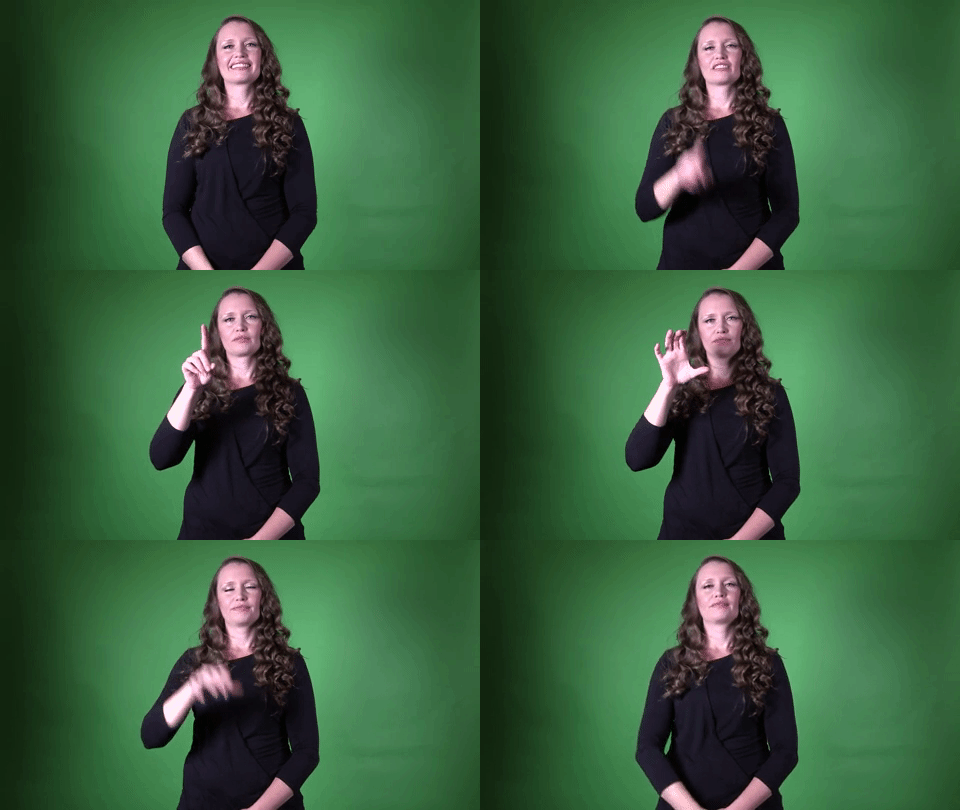
Definition: Refers to the number one hundred
Sign for NUMBER 100 in ASL
Practice Activities:
Practicing the sign for number 100 in ASL can be fun and engaging with a variety of exercises. Start by signing it repeatedly in front of a mirror to ensure correct handshape and movement. Once comfortable, try signing different numbers leading up to 100, such as 90 or 99, to practice smooth transitions.
Use the sign for number 100 in ASL in everyday counting activities. Count by tens and end at 100 to reinforce recognition and recall. Try pointing at random objects in your home and signing “100” to describe a quantity, even if exaggerated, to get used to incorporating it naturally.
Incorporate the sign into example sentences for better retention. Practice saying “That costs 100 dollars” while signing, or “I have 100 books” to practice quantity descriptions. Work with a partner by taking turns asking and answering “How many?” questions to enhance fluency in real conversations.
Write and perform a short story that involves the sign for number 100 in ASL. You can describe a character collecting 100 coins or running 100 miles to add creativity to the learning process. Challenge yourself to sign the entire story in ASL without speaking to build confidence.
For an interactive activity, play a countdown game. One person signs random numbers leading up to 100, and the other must recognize and sign the correct response. Use flashcards with different numbers written on them, and when you pick 100, quickly sign it to practice speed and accuracy.
Practicing daily will help reinforce muscle memory and improve fluency. Challenge yourself to use the sign for number 100 in ASL in conversations, games, and storytelling to make your learning experience engaging and effective. Happy signing!
Cultural Context:
The sign for number 100 in ASL is an essential part of numerical communication in American Sign Language. Numbers play a vital role in daily conversations, from telling time to counting money and giving measurements. Understanding how to correctly form and use the sign for number 100 in ASL helps improve fluency and clarity in conversations.
Numbers in ASL follow specific patterns based on handshapes and movement. The sign for number 100 in ASL uses a combination of the numeral one and a changing handshape to represent the full hundred. This method is consistent with other number signs in ASL, simplifying large numbers while maintaining visual clarity.
In Deaf culture, knowing and using numbers accurately is crucial for effective communication. The sign for number 100 in ASL is used frequently in financial discussions, sports scores, and academic settings. Being able to quickly express large numbers helps make interactions smoother and more efficient.
Many ASL students find that learning numbers can be challenging at first but easier with practice. The sign for number 100 in ASL is part of a logical numerical system that builds on smaller numbers to create larger ones. Practicing number signs regularly helps with memorization and improves overall signing skills.
Number signs in ASL can vary slightly depending on regional dialects or individual signing preferences. The sign for number 100 in ASL generally follows a standard form, but slight variations may exist in different communities. Exposure to a variety of signers helps learners recognize and understand these differences.
ASL numbers are incorporated into daily life in many ways, from ordering food to discussing prices in stores. The sign for number 100 in ASL is useful when talking about money, large quantities, or historical years. Learning number signs enhances a signer’s ability to engage in conversations that involve numerical information.
Mastering numbers is an important part of becoming fluent in ASL. The sign for number 100 in ASL, along with other large number signs, allows for more detailed and precise communication. Confidence in using numbers in ASL contributes to greater fluency and ease in conversations.
Understanding numbers in ASL also supports better comprehension of math-related topics. The sign for number 100 in ASL is commonly used in school settings where math and counting concepts are taught. Deaf students and interpreters rely on clear and accurate number signs to convey mathematical ideas.
Signing numbers quickly and clearly is an important skill in both casual and professional settings. The sign for number 100 in ASL
Extended Definition:
The sign for number 100 in ASL is an essential part of numerical expressions in American Sign Language. Understanding how to sign numbers correctly helps with communication in various contexts, from everyday conversations to academic and financial discussions. Learning this sign is useful for expressing large numbers clearly and efficiently.
To sign number 100 in ASL, start by forming the number 1 with your dominant hand. Then transition into the sign for 100, which commonly involves moving from the number 1 to a modified “C” handshape. This movement represents the concept of one hundred while maintaining fluidity in signing.
Numbers in ASL follow consistent patterns, making it easier to learn related signs after understanding the sign for number 100 in ASL. Once familiar with this sign, recognizing and using numbers up to 1,000 becomes much easier. Many numerical signs in ASL incorporate visual patterns that help reinforce meaning.
Certain variations of the number 100 exist depending on regional influences or signing preferences. Some signers may slightly modify the movement or positioning based on community usage. Recognizing these variations can improve comprehension and adaptability when signing with different individuals.
The sign for number 100 in ASL is frequently used in everyday life, such as when discussing prices , quantities, or measurements. It appears in conversations about percentages, business transactions, and historical dates. Practicing this sign helps improve fluency and confidence in ASL communication.
Using correct facial expressions and hand movement when signing the number 100 ensures clarity. In ASL, expressive movements contribute to the overall meaning of a sign. Maintaining precise handshapes prevents confusion between similar numerical signs.
When teaching ASL, instructors often introduce the sign for number 100 alongside other rounded numbers. This approach helps learners recognize patterns in numerical signs and retain information efficiently. Repetition and context-based learning further solidify understanding.
Deaf communities rely on numerical signs like the sign for number 100 in ASL for a variety of interactions. From discussing daily expenses to giving specific directions, accurate number signing plays a vital role in communication. Mastery of numerical signs enhances both casual and formal conversations in ASL.
For students learning sign language, incorporating the sign for number 100 in ASL into daily practice builds confidence. Signing numbers fluently improves overall communication skills and prepares learners for advanced ASL concepts. Watching native signers demonstrate number signs also enhances accuracy.
Signing numbers correctly is critical in math-related discussions and financial transactions.
Synonyms: century, one hundred, 100, hundred percent, 1 hundred
Educational resources: Find related learning materials in our course bank!
Want more? Check out some of our popular learning activities on the homepage!
Need to look up a sign? Use our highly rated dictionary: https://aslinteractive.com/best-asl-dictionary/
Follow us on tiktok: https://www.tiktok.com/@aslinteractive. More social media links at the bottom of this page!
Long-tail Keywords: what is the sign for Number 100 in ASL, how do you sign Number 100 in ASL, learn how to sign Number 100 in American Sign Language
Categories: Numbers – Basics, Numbers 91-100, cardinal numbers
tags: Numbers, Numbers 91-100, Math, Language Learning, Educational Content
Parameters
*Handshape*:
The sign for NUMBER 100 in ASL uses a handshape transition. It begins with the number “1” handshape—an extended index finger while the other fingers stay curled against the palm. As the motion completes, the hand transitions into the “C” handshape, where the fingers curve to form a semi-circle. This change from “1” to “C” visually represents “100.” The movement is smooth to maintain clarity in the sign for NUMBER 100 in ASL. ️
*Palm Orientation*:
Palm faces forward at the start of the sign for number 100 in ASL. The index finger and thumb form an “L” shape while the other fingers remain extended. As the motion progresses, the hand moves slightly and transitions into a “C” shape, with the palm gradually turning inward. This change in handshape completes the sign for number 100 in ASL, maintaining fluidity and clarity throughout.
*Location*:
The sign for number 100 in ASL is produced in the neutral signing space in front of the torso. It starts with the dominant hand forming the number 1 near shoulder level and then transitions into a C-shape as it moves slightly downward. The motion is smooth and fluid, ensuring clarity in expressing the number 100 while staying within the central space of ASL articulation.
*Movement*:
To produce the sign for number 100 in ASL, start with the number 1 handshape, extending the index finger upward while the remaining fingers remain curled. Then, transition into a C handshape by curving the index finger and thumb together while the other fingers remain curved. This movement smoothly connects the numeral representation with the centennial concept, ensuring clarity. The motion should be fluid, transitioning directly from 1 to 100 for natural and efficient signing.
*Non-Manual Signals*:
When signing the sign for NUMBER 100 in ASL, maintain a neutral or slightly serious facial expression, as numbers are typically conveyed with minimal emotional exaggeration. Slightly raise your eyebrows when introducing the number to ensure clarity, especially in rapid counting or listing. If the number is emphasized or part of an important figure, a small head nod can add emphasis.
If asking a question involving the sign for NUMBER 100 in ASL, slightly furrow your brows for a wh-question or raise them for a yes/no question. Keep your lips relaxed but slightly parted if the number requires additional clarification. Maintaining steady eye contact ensures the number is clearly communicated and perceived correctly.
*Prosody, Dominant/Non-Dominant Hand*:
The sign for number 100 in ASL uses the dominant hand. Start by forming the number 1 with the index finger extended upward while the other fingers are curled into the palm. Then, smoothly transition into a “C” handshape by curving the index finger and thumb while the other fingers remain relaxed.
This movement should flow naturally without abrupt pauses. The non-dominant hand is not typically involved. The sign for number 100 in ASL should be clear and deliberate, ensuring accuracy in numerical representation.
Tips for Beginners:
When learning the sign for NUMBER 100 in ASL, start by mastering the number signs 1 through 10 with clear handshapes. The sign for 100 uses the number 1 followed by a transition into the C handshape. Pay attention to the fluidity of this movement to make the sign look natural rather than robotic.
Finger positioning is crucial when signing the sign for NUMBER 100 in ASL. Keep your index finger extended for the number 1, ensuring it points straight up before smoothly shifting to the C shape. If your fingers bend incorrectly or the transition is too abrupt, it can confuse the meaning. Practicing in front of a mirror helps refine this movement.
One common mistake is turning the hand awkwardly or making an abrupt, jerky transition between the number 1 and the C shape. The motion should be smooth. Try exaggerating the shift at first and then refining it as you get comfortable. Slow and deliberate movements build muscle memory.
Pay attention to palm orientation when signing the sign for NUMBER 100 in ASL. The number 1 should generally face forward rather than inward, and as you transition to C, your hand stays relaxed. Tension in your fingers can make the transition look stiff, so keep your hand loose.
Practice signing in context to reinforce learning. Try counting from 1 to 100 in ASL, incorporating this sign naturally in sequences. Using repetition in everyday signing will improve fluency. Watching native ASL signers use numbers can also help you refine your technique.
If you’re struggling with fluidity, break the sign down into steps before putting it together in one smooth motion. With regular practice, muscle memory will develop, making your numbers clearer and more expressive. Keep your fingers relaxed, and soon, signing the sign for NUMBER 100 in ASL will feel effortless.
Connections to Other topics:
The sign for NUMBER 100 in ASL is part of the broader numerical system in the language, which follows specific structural rules for forming large numbers. Understanding how to sign 100 helps learners become more fluent with numbers in general, making it easier to express dates, prices, measurements, and years. For example, after mastering the sign for NUMBER 100 in ASL, learners can begin combining it with other number signs, such as 200, 300, and beyond, using similar handshapes and movements.
This sign also connects to mathematical and financial vocabulary in ASL. Many signs for money and measurements rely on a solid foundation in numbers, so knowing how to form 100 properly prepares a signer to express amounts like $100, 100 pounds, or 100 degrees. In educational settings, students use this number when discussing historical events, statistics, or even percentages like 100%.
A significant connection exists between the sign for NUMBER 100 in ASL and classifiers, which are often used to represent quantities, dimensions, or groupings. For instance, a signer could pair 100 with a classifier representing people to indicate 100 individuals. This reinforces ASL’s visual nature, helping convey information more efficiently than relying solely on individual number signs.
The use of numerical incorporation in ASL also connects to ordinal numbers such as “100th.” Though ASL does not always follow English’s grammatical structures, it offers ways to represent order and ranking using numbers. Numbers also integrate into commonly used phrases, like “100 percent sure,” which may require facial expressions and contextual modifications to fully convey meaning.
Mastering the sign for NUMBER 100 in ASL strengthens a signer’s ability to count, categorize, and describe numerical concepts, making their overall communication more clear and dynamic. Understanding numbers also aids in everyday interactions, such as discussing speed limits, test scores, or large quantities of objects. Learning this sign builds confidence in handling numerical expressions in ASL.
Summary:
The sign for NUMBER 100 in ASL combines numerical handshapes with a smooth movement to convey the concept of one hundred. It begins with the “1” handshape, an extended index finger while the other fingers remain curled into the palm. This handshape moves directly into the “C” handshape, representing the zeroes in 100.
This transition from the “1” to the “C” is fluid, ensuring clarity and natural flow. The movement is essential for accurately depicting the sign for NUMBER 100 in ASL, as it maintains linguistic integrity within ASL numbering conventions. This pattern mirrors similar numerical transitions, such as 200 or 300, where the second digit influences final handshape selection.
ASL follows a structured system of numerical construction, ensuring efficiency and visual accessibility. Unlike English, which utilizes vocalized words, ASL numbers must visually reflect place values. The sign for NUMBER 100 in ASL exemplifies this efficiency, using a single-motion transition rather than signing “one” and then fingerspelling “hundred.”
Numbers in ASL rely on distinct grammatical rules that differ from spoken languages. The handshape change in the sign for NUMBER 100 in ASL is not arbitrary but follows ASL morphological processes. The “C” handshape at the end indicates numerical categorization in a way that deaf signers instantly recognize.
This sign is useful in many different contexts, including counting, currency, measurements, and statistics. Understanding how to sign numbers properly is essential for effective communication in academic, financial, and everyday social interactions. The sign for NUMBER 100 in ASL helps maintain numerical consistency across various signed expressions.
Historical influences have shaped ASL number signs through time. The transition from finger-counting systems to streamlined one-handed number signs increased efficiency. The sign for NUMBER 100 in ASL reflects the evolution of numerical gestures into standardized and widely recognized forms.
ASL incorporates numerical structuring that aligns with spatial cognition and visual communication strategies. The sign for NUMBER 100 in ASL demonstrates this visually driven linguistic adaptation. Efficiently condensing three digits into one smooth movement benefits the overall functionality of ASL.
Other numbers in ASL follow a similar logic, reinforcing predictable language patterns. The sign for 200 follows the same structure, using a transition from “2” to “C.” This linguistic consistency is crucial for effective sign production and comprehension.
Numbers play a critical role in daily interactions and formal settings. Mastering number signs, including the sign for NUMBER 100 in ASL, enhances fluency in financial transactions, addresses, and statistical discussions. Signers must maintain clarity in handshapes to avoid misinterpretation.
Handshape variation can impact sign readability, especially when dealing with numerical concepts. The transition from “1” to “C” must be precise to prevent confusion. The sign for NUMBER 100 in ASL should maintain strong handshape integrity throughout execution.
Cultural significance also influences how numbers are used in ASL discourse. Deaf communities frequently rely on structured counting methods to ensure accurate information exchange. The sign for NUMBER 100 in ASL plays a key role in maintaining this clarity, allowing efficient numerical expression.
Grammatical placement of numbers in ASL sentences follows a logical flow. When signing monetary values or quantities, 100 may be used within a broader numerical framework. The sign for NUMBER 100 in ASL fits seamlessly into price-related phrases and numerical lists.
ASL learners often struggle with larger number formations, requiring practice in transitions. The movement between the “1” and “C” must remain controlled yet natural. The sign for NUMBER 100 in ASL serves as a foundational numerical sign that aids in mastering larger figures.
This number integrates seamlessly with other numerical expressions, such as 101 or 150. When adding additional values, signers incorporate modifications while preserving the base handshape. The sign for NUMBER 100 in ASL acts as a building block for extending numerical expressions.
Fluency in ASL numbering enhances accessibility in professional and personal communication. Deaf individuals rely on accurate number signs for appointments, addresses, and banking transactions. A clearly produced sign for NUMBER 100 in ASL supports linguistic precision in these critical interactions.
The linguistic structure of ASL numbers aligns with cognitive processing principles. Signers develop spatial awareness when forming these numerical signs. The sign for NUMBER 100 in ASL requires efficient movement planning, reinforcing visual-motor coordination.
Children learning ASL often pick up numbers early due to their iconic representation. Numeric structures involve systematic handshape transitions, making them easier to recall. The sign for NUMBER 100 in ASL introduces young signers to structured number sequencing.
Mathematical discussions in ASL rely on clear numerical articulation. Signers discussing percentages, statistics, or equations require consistent number usage. The sign for NUMBER 100 in ASL appears frequently in such academic and professional contexts.
Numeric
Want more? Check out some of our popular learning activities!
ASL Interactive Resources
ASLInteractive YouTube Channel
Follow us on tiktok: @aslinteractive.com
Follow us on Instagram: aslinteractive
Facebook page: aslinteractive
Facebook group: aslinteractive
LInkedIn: ASL Interactive LLC
Twitter: @ASL_interactive
*Some information on this page is AI-generated. AI can make mistakes. Please check the information.


Responses