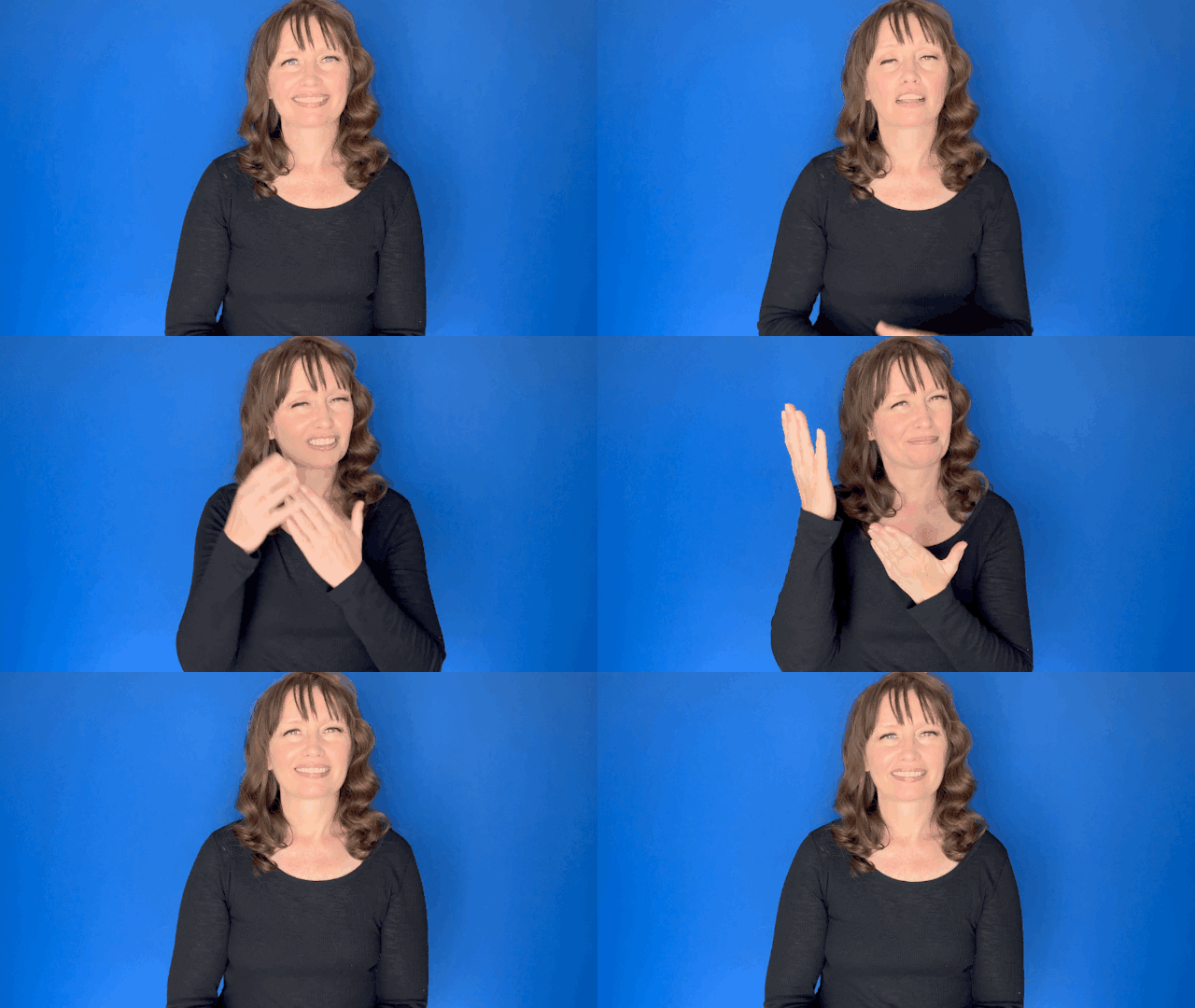
Definition: Services designed to make facilities usable for disabled people.
Sign for ACCESSIBILITY SERVICES ACCESS SERVICES in ASL

Practice Activities:
Practicing the sign for accessibility services access services in ASL can start with isolated repetitions. Begin by signing the phrase slowly while focusing on handshape, movement, and placement. Gradually increase your speed and fluency while ensuring clarity in each movement. Use a mirror or record yourself to analyze accuracy.
To build confidence, practice signing accessibility services access services in ASL in different contexts. For example, pretend to work in an office or school setting where you discuss available services. Use phrases like “Do you offer accessibility services access services here?” or “She needs accessibility services access services for the event.”
Engage in storytelling activities where accessibility services access services in ASL plays a key role. Imagine helping a friend find appropriate services for their needs, explaining how to access them and their importance. Keep the narrative flowing by including different sign transitions and expressions to add clarity.
Partner activities enhance fluency. Work with a friend to role-play conversations about accessibility services access services in ASL. One person can ask about access options in a school, workplace, or event, while the other provides details. Switch roles to get comfortable signing and understanding responses.
Try a scavenger hunt-style activity by finding information about accessibility services access services in ASL online or in real-life locations. Sign what you find in full sentences, reinforcing your understanding of vocabulary related to access. This strengthens comprehension and real-world application.
Watch videos where deaf individuals discuss accessibility services access services in ASL. Try copying their signing style, paying attention to pacing, facial expressions, and sentence structure. Repeating natural examples helps refine signing fluency.
By practicing regularly in isolation, conversations, role-playing, and storytelling, you will become more confident using the sign for accessibility services access services in ASL in everyday communication.
Cultural Context:
accessibility services and access services are essential for ensuring equal opportunities for Deaf and hard-of-hearing individuals. These services break down communication barriers and provide full participation in education, employment, healthcare, and social settings. In ASL, having a clear sign for accessibility services and access services promotes inclusion and empowerment within the Deaf community.
Deaf and hard-of-hearing individuals rely on accessibility services and access services such as sign language interpreters, captioning, and assistive listening devices. These services help ensure effective communication in public spaces, workplaces, and events. By using ASL to express accessibility services and access services, the Deaf community can easily request and advocate for their communication needs.
When businesses and organizations provide accessibility services and access services, they demonstrate a commitment to inclusivity. Offering ASL interpreters, video relay services, and other communication support makes spaces more welcoming for Deaf individuals. Understanding the ASL sign for accessibility services and access services helps spread awareness and encourage businesses to implement these essential resources.
Educational settings benefit greatly from accessibility services and access services. Deaf students require equal access to learning through ASL interpreters, CART captioning, and other accommodations. The ability to sign accessibility services and access services in ASL enables students to communicate their needs to teachers and administrators effectively.
Healthcare providers must ensure accessibility services and access services are available to Deaf patients. Without interpreters and captioning, medical care can become inaccessible, leading to miscommunication and inadequate treatment. Knowing the ASL sign for accessibility services and access services supports equitable healthcare access for Deaf individuals.
Government agencies and public services must also prioritize accessibility services and access services. ASL interpreters, visual alerts, and captioned announcements ensure that Deaf individuals receive important information. Learning the ASL sign for accessibility services and access services strengthens advocacy for inclusive policies and legal protections.
Technology continues to expand accessibility services and access services for the Deaf community. Video relay services, real-time captioning, and text-based communication tools have improved daily interactions for Deaf individuals. Using the ASL sign for accessibility services and access services highlights the importance of ongoing technological advancements in accessibility.
Events, performances, and conferences must provide accessibility services and access services to accommodate Deaf attendees. Sign language interpretation, captioning, and assistive devices create an inclusive experience for all participants. Knowing how to sign accessibility services and access services in ASL encourages event organizers to prioritize accessibility.
Promoting awareness of accessibility services and access services benefits the entire community.
Extended Definition:
The sign for accessibility services access services in ASL is essential to know when discussing resources available to individuals with disabilities. These services help ensure equal access to information, communication, and physical spaces. Learning how to sign this term correctly can improve conversations about inclusivity.
Accessibility services access services in ASL typically refer to a range of support options, including closed captioning, sign language interpreters, assistive listening devices, and mobility accommodations. These services provide individuals with disabilities the tools they need to participate fully in various environments. Using the correct sign helps emphasize the importance of accessibility in everyday interactions.
When signing accessibility services access services in ASL, handshape and movement play an important role. Proper facial expressions also help convey the intended meaning. Practicing this sign with fluent ASL users can ensure accuracy and understanding.
Many organizations provide accessibility services access services to enhance communication and participation. Schools, workplaces, and public venues often offer resources to accommodate different needs. Knowing how to request these services in ASL can help individuals advocate for equal access.
The Americans with Disabilities Act (ADA) mandates that public institutions provide accessibility services access services. This law protects the rights of individuals with disabilities and requires equal opportunities for communication and participation. Understanding these regulations helps promote a more inclusive society.
Technology plays a significant role in improving accessibility services access services. Many apps and devices now offer real-time captioning, speech-to-text conversion, and video relay services. These advancements make communication more seamless for Deaf and hard-of-hearing individuals.
The need for accessibility services access services extends to online spaces as well. Websites should include captions, alt text, and accessible design to accommodate all users. Ensuring digital content is accessible promotes inclusivity in virtual interactions.
Interpreters are a key component of accessibility services access services for Deaf individuals. Certified ASL interpreters help bridge communication gaps in educational, professional, and medical settings. Their presence ensures that Deaf individuals receive the same information as their hearing counterparts.
When attending public events, individuals may request accessibility services access services to ensure full participation. Many venues provide ASL interpreters, assistive listening devices, and reserved seating for individuals with disabilities. Planning ahead and communicating needs can help secure the necessary accommodations.
Advocacy groups work to expand accessibility services access services for diverse communities. These organizations promote awareness, create resources, and push for policy changes. Supporting these efforts encourages greater accessibility for all individuals.
Sign language education plays a vital role in
Synonyms: accessibility support, assistive services, inclusive access, disability services, accessible assistance
Educational resources: Find related learning materials in our course bank!
Want more? Check out some of our popular learning activities on the homepage!
Need to look up a sign? Use our highly rated dictionary: https://aslinteractive.com/best-asl-dictionary/
Follow us on tiktok: https://www.tiktok.com/@aslinteractive. More social media links at the bottom of this page!
Long-tail Keywords: what is the sign for accessibility services access services in ASL, how do you sign accessibility services access services in ASL, learn how to sign accessibility services access services in American Sign Language
Categories:
tags: accessibility services in ASL, access services for the deaf, ASL for accessibility services, American Sign Language access services, inclusive communication in ASL
Parameters
*Handshape*:
The sign for ACCESSIBILITY SERVICES ACCESS SERVICES in ASL uses a combination of handshapes that emphasize access and support. Typically, one hand forms an open relaxed “5” handshape, representing a service or pathway, while the dominant hand moves with a modified “V” or “1” handshape, indicating an approach or access. The movements are fluid and deliberate, reinforcing the concept of ease and inclusion. This sign effectively conveys accessibility and support within the community. ✋
*Palm Orientation*:
The palm orientation for the sign for accessibility services access services in ASL depends on the specific variation used. Typically, both hands are open with palms facing slightly outward or forward. If initialized, the dominant hand may form an “A” or “S” shape with the palm facing outward. For access-related signs, the dominant hand may move forward with the palm down or slightly angled. Hand orientation shifts based on context to ensure clarity and meaning.
*Location*:
The sign for accessibility services access services in ASL is produced in the neutral signing space in front of the body. The hands typically move around chest level and may extend slightly outward. The dominant and non-dominant hands interact to convey the concept clearly. Depending on regional or organizational variations, different signs may be used to represent accessibility and access services while keeping the signing space within a comfortable and visually clear area.
*Movement*:
To sign for accessibility services access services in ASL, begin with both hands forming the “5” handshape, palms facing down. Move the dominant hand in a small circular motion forward while the non-dominant hand remains steady. Then, transition into the sign for “services” by placing the non-dominant hand palm up and moving the dominant “S” hand side to side above it. The movement should be smooth and fluid, emphasizing assistance and availability.
*Non-Manual Signals*:
Facial expressions play a key role when signing the sign for accessibility services access services in ASL. A neutral or slightly raised eyebrow expression is typical, conveying clarity and openness. If emphasizing importance or urgency, eyebrows may raise higher, and lips may purse slightly.
Head movement complements the sign for accessibility services access services in ASL by slightly tilting forward to show engagement. A small nod can reinforce confirmation, while a neutral head position keeps the meaning straightforward. Eye contact should be maintained to ensure clear communication.
*Prosody, Dominant/Non-Dominant Hand*:
The sign for accessibility services access services in ASL uses both hands. The dominant hand, in an open “C” shape, moves forward while the non-dominant hand remains steady in a similar shape. This motion represents the idea of an accessible path or service. The sign may incorporate the concept of “help” or “support” by modifying hand placement. Facial expression adds clarity, emphasizing ease of access and support systems.
Tips for Beginners:
When learning the sign for ACCESSIBILITY SERVICES ACCESS SERVICES in ASL, start by ensuring that your handshapes and movement are precise. Many signs related to “access” or “services” involve directional movement or classifiers, so pay close attention to how space is used. Watching native signers and signing in front of a mirror can help ensure that your movement is fluid and natural.
One common mistake beginners make when signing ACCESSIBILITY SERVICES ACCESS SERVICES in ASL is using unclear or incomplete handshapes. Keeping your fingers properly aligned and using consistent palm orientation is essential for clarity. If the sign involves movement, make sure the path is smooth and intentional rather than rushed or sloppy.
Facial expressions and body language can add meaning to the sign for ACCESSIBILITY SERVICES ACCESS SERVICES in ASL, especially when discussing services available to different people. Modifying signs with slight changes in movement or facial expression can help convey different shades of meaning, such as whether something is broadly accessible or specific to a group. Practicing in front of a fluent signer can help ensure you’re using the sign in the correct context.
If fingerspelling is a component of the sign for ACCESSIBILITY SERVICES ACCESS SERVICES in ASL, focus on proper spacing between letters. Avoid bouncing your hand unnecessarily, as it can make your fingerspelling harder to read. Smooth, steady fingerspelling with a controlled pace improves readability and comprehension.
When using the sign for ACCESSIBILITY SERVICES ACCESS SERVICES in ASL in conversations, be mindful of how the concept fits into the sentence structure. ASL follows a topic-comment structure, so you may need to adjust your phrasing to ensure your message is clear. Signing with confidence, appropriate pace, and clear movement will help you communicate more effectively.
Connections to Other topics:
The sign for accessibility services access services in ASL connects to broader concepts of inclusion, accommodations, and equal opportunity. Since accessibility is a key theme in disability rights, this sign links to terms like “DISABILITY,” “INCLUSION,” and “SUPPORT.” Many organizations and institutions provide access services, so this sign is often used alongside “INTERPRETER,” “CAPTIONING,” and “ASSISTANCE.” Understanding how this sign fits within ASL helps reinforce awareness of communication access in different settings.
Some ASL signs related to accessibility services include “BARRIER,” “EQUAL,” and “RIGHTS,” since these are central to discussions on accessibility and accommodations. The concept of services is also connected to signs like “HELP,” “PROVIDE,” and “RESOURCE.” This helps clarify context in conversations about available accommodations for individuals who are deaf or hard of hearing. The combination of accessibility and services in a single phrase highlights the importance of ensuring equal access, particularly for communication and physical access in public spaces.
In some discussions, the sign for accessibility services access services in ASL may be used with related terms like “COMMUNICATION ACCESS,” “ASSISTIVE TECHNOLOGY,” and “LAW” when referring to legal protections. For instance, mentioning “ADA (FS)” in connection with services reinforces legal obligations under the Americans with Disabilities Act (ADA). This can be useful in professional or advocacy discussions. Additionally, compound phrases like “EDUCATION SERVICES” and “MEDICAL SERVICES” may adapt the same sign for accessibility services to focus on different contexts.
Signs like “ADVOCATE,” “SUPPORT,” and “INFORMATION” often accompany accessibility-related discussions, emphasizing the need for awareness and resources. The sign for accessibility services access services in ASL is valuable in conversations about disability rights, ensuring equal opportunity, and promoting inclusive environments. Learning this sign enhances communication for discussing accessibility and advocacy efforts in both social and professional spaces.
Summary:
The sign for accessibility services access services in ASL is deeply tied to the concepts of inclusivity and equal access. In ASL, this phrase typically combines the signs for “access” and “services,” sometimes incorporating movement or directional modification to show assistance. The meaning of accessibility is directly connected to ensuring people with disabilities have appropriate resources, making it a core value in Deaf culture.
The sign for “access” often involves a dominant hand moving through or around a stationary non-dominant hand, symbolizing the act of gaining entry or being able to use something. This movement reflects the broader goal of accessibility services access services in ASL, which is to remove barriers for individuals who rely on different modes of communication. Language access plays a critical role in this discussion, making it essential to fully understand the visual and conceptual structure of the sign.
“Services” is usually signed using both hands in an alternating forward and back motion, symbolizing the exchange or provision of support. This sign conveys the idea of organized efforts to aid a group or individual. When combined with access, it highlights a broader societal role in ensuring fair and necessary accommodations for accessibility services access services in ASL.
Culturally, the discussion around accessibility services access services in ASL is vital within the Deaf and hard-of-hearing communities. Many deaf individuals advocate for improved sign language interpreters, captioning, and technological accessibility as part of their rights. The sign itself represents societal responsibility in ensuring Deaf people can navigate the world with equitable resources and communication.
ASL syntax allows for directional movement to emphasize who is providing or receiving access. By modifying the movement of the sign for accessibility services access services in ASL, signers can show that services are directed toward a specific group. This modification makes ASL particularly effective at communicating nuances in access and inclusion.
In applied linguistics, the ways ASL users sign accessibility services access services in ASL reveal the structural nature of how sign languages categorize verbs and nouns. The sign incorporates classifier principles, movement dynamics, and spatial grammar to reflect real-world relationships. The visual-spatial aspects of ASL make it a particularly powerful medium for discussing access-related topics.
The linguistic structure involved in signing accessibility services access services in ASL demonstrates the efficiency of ASL in conveying complex concepts simply. The fusion of “access” and “services” into a fluid sign phrase reflects how ASL users can compact meaning into concise movements. This efficiency stands in contrast to spoken languages, which often require multiple words to articulate the same idea.
From a grammatical perspective, topicalization is often used when discussing accessibility services access services in ASL in a sentence. A signer may first establish the topic by signing “accessibility” before following with a statement about “services” provided. This structure ensures clarity in communication and conforms with ASL grammar rules.
Related signs to accessibility services access services in ASL include “help,” “support,” and “accommodations.” These signs often appear together in conversations about resources for disabled individuals. Such signs share thematic connections and are used interchangeably depending on context.
Broader themes connected with accessibility services access services in ASL center on disability rights and social inclusion. ASL users frequently engage in activism to promote the expansion of accessibility services, ensuring that workplaces, education systems, and public spaces offer appropriate accommodations. The sign itself embodies these broader conversations about fairness and equity in various societal spheres.
Visual elements in ASL, such as facial expressions and body movement, enhance the sign’s overall meaning. A more forceful motion in signing accessibility services access services in ASL can indicate strong advocacy, while a softer approach may imply an inquiry or casual reference. ASL’s dynamic expression allows signers to imbue more meaning into signs based on context.
Technology plays a growing role in discussions around accessibility services access services in ASL, with video relay services, captioning, and tactile signing expanding accessibility options. The shift toward more accessible digital resources has influenced how people discuss and sign topics related to accessibility. The evolving nature of ASL ensures that signing around modern accessibility keeps pace with technological advancements.
Cognitively, the way ASL frames accessibility services access services in ASL influences how Deaf individuals conceptualize support systems. In spoken languages, access and services are often discussed in abstract ways, while ASL allows for more direct representation. This direct visual representation reinforces the clarity and immediacy of accessibility concerns.
Socially, using the sign for accessibility services access services in ASL signifies a commitment to inclusivity. Awareness of this sign reflects an individual’s recognition of the needs of the Deaf community and the broader disability rights movement. In professional and educational settings, knowledge of this sign emphasizes the importance of providing equitable resources.
Historical discussions about accessibility services access services in ASL coincide with the broader fight for disability rights. The Americans with Disabilities Act (ADA) was a major milestone for improving accessibility protections for Deaf and disabled individuals
Want more? Check out some of our popular learning activities!
ASL Interactive Resources
ASLInteractive YouTube Channel
Follow us on tiktok: @aslinteractive.com
Follow us on Instagram: aslinteractive
Facebook page: aslinteractive
Facebook group: aslinteractive
LInkedIn: ASL Interactive LLC
Twitter: @ASL_interactive
*Some information on this page is AI-generated. AI can make mistakes. Please check the information.


Responses