Sign for AFTER THAT_FINISH in ASL | ⏰ ASL Dictionary

Definition: An expression indicating the completion of an action.

Sign for AFTER THAT_FINISH in ASL 

YouTube player

Practice Activities:

Practicing the sign for AFTER THAT_FINISH in ASL starts with isolation drills. Sign it slowly while saying the English phrase in your head. Then, increase speed and fluidity. Try alternating between signing it alone and incorporating it into simple phrases like “After that, I eat” or “After that, we leave.” Mimic natural conversation by signing it in response to a partner’s sentence.

Use the sign for AFTER THAT_FINISH in ASL while describing daily routines. For example, list out your morning habits: “Wake up. Shower. After that, eat breakfast.” You can also practice with sequencing cards, placing events in order and signing this phrase in between. Record yourself signing a set of instructions or steps to check for smooth transitions.

Create a storytelling prompt where you describe a sequence of events using the sign for AFTER THAT_FINISH in ASL. A fun activity is narrating a cooking process or a trip you recently took. Practice telling a partner about a movie plot using the phrase for each new event. Switch roles to encourage fluid signing.

Engage in a role-play activity where one person asks what happens next, and the other responds using the sign for AFTER THAT_FINISH in ASL. You can ask, “What do you do after school?” and answer with a sequence of activities. Playing memory games with actions can also help reinforce the phrase in context.

Practice signing the phrase in different sentence structures. For beginners, stick to short statements like “I work. After that, go home.” More advanced signers can try complex sentences like “First, I study. After that, meet my friends and eat dinner together.” Consistent use will build confidence and fluency.

Cultural Context:

The sign for AFTER THAT_FINISH in ASL is commonly used in conversations to show sequence or order of events. This sign helps clarify timelines, making it easier to structure stories, plans, or instructions. It’s a useful way to indicate something has been completed and what will happen next.

Deaf culture values clear communication, and the sign for AFTER THAT_FINISH in ASL ensures smooth transitions in signed conversations. Instead of using lengthy explanations, this sign efficiently shows what follows after a certain action. It is frequently used in both casual chats and formal storytelling.

In ASL storytelling, transitions like the sign for AFTER THAT_FINISH help maintain a natural flow. Signers use it to smoothly connect different parts of a narrative, keeping their audience engaged. It’s especially important in long explanations, where clear sequencing is needed.

This sign is widely used in daily interactions, whether talking about past events or future plans. Deaf and hard-of-hearing individuals rely on it to make conversations more structured and easier to understand. Even ASL students quickly recognize its value when learning how to organize their thoughts in sign language.

The sign for AFTER THAT_FINISH in ASL is part of a larger system of sequencing markers. Other signs, such as BEFORE or NEXT, help create a complete timeline in ASL communication. Understanding these signs improves fluency and ensures clarity when discussing events.

ASL is a visual language, and transitions like the sign for AFTER THAT_FINISH make signed conversations more engaging. Using proper sequencing ensures the message is understood clearly without confusion. Mastering this sign enhances conversational skills in various settings.

This sign is essential for discussions related to schedules, instructions, or storytelling. Whether explaining a process or narrating a personal experience, ASL users frequently incorporate this transition sign. It’s a fundamental part of structuring complex ideas in ASL.

Learning how to use the sign for AFTER THAT_FINISH in ASL improves both comprehension and expressive skills. It allows signers to communicate timelines fluently without unnecessary repetition. As a result, conversations become smoother and more natural.

ASL students and interpreters benefit from mastering sequencing signs like the sign for AFTER THAT_FINISH. It enhances their ability to relay information accurately and naturally. Practicing these transitions strengthens overall ASL proficiency.

Fluency in ASL includes understanding how to connect ideas seamlessly. The sign for AFTER THAT_FINISH in ASL plays a major role in that process. Whether in casual conversation or

Extended Definition:

The sign for after that_finish in ASL is commonly used to indicate sequence or progression in a conversation. This phrase helps clarify the order of events, making it useful for storytelling, instructions, or explanations. The concept of “finish” in ASL often signals completion before moving on to what happens next.

To sign after that_finish in ASL, you typically use the sign for “finish” followed by a transition indicating the next event. The movement and facial expressions help emphasize the progression from one event to the next. This sign is essential for structuring sentences clearly in ASL.

The sign for after that_finish in ASL is widely used in both casual and formal conversations. It allows for smooth transitions between ideas, making communication more fluid. Signing it correctly involves appropriate pauses and facial expressions to ensure clarity.

When discussing daily routines, schedules, or narratives, the sign for after that_finish in ASL helps establish a clear sequence. It clarifies what happens next without needing extra words. This makes signing more efficient and natural in conversations.

In ASL grammar, the placement of the sign for after that_finish can vary depending on context. Sometimes, it appears before the next event, while in other cases, it acts as a bridge between two phrases. Understanding this flexibility improves fluency in ASL.

Learning the sign for after that_finish in ASL is beneficial for beginners and advanced signers alike. It enhances the ability to describe processes, stories, or step-by-step actions. Signers often incorporate body shifts or directional signs to add further clarity.

The sign for after that_finish in ASL is commonly used in educational and professional settings. Teachers, interpreters, and presenters use it to connect ideas logically. It ensures that listeners follow along and understand complex information in sequence.

For ASL learners, practicing the sign for after that_finish improves sentence structure and storytelling skills. Watching native signers use this phrase in context helps with mastering the correct movements. Combining it with expressive facial grammar makes the meaning even clearer.

Using after that_finish in ASL adds fluidity to conversations, making interactions smoother. Whether discussing past events, future plans, or instructions, this phrase is an essential tool. Mastering its use can significantly improve overall ASL proficiency.

Understanding how to sign after that_finish in ASL allows for greater engagement in the Deaf community. Clear transitions between ideas make communication more effective. By incorporating this sign naturally, signers can enhance both clarity and

Synonyms: afterward, subsequently, then, following that, next

Educational resources: Find related learning materials in our course bank!

Want more? Check out some of our popular learning activities on the homepage!

Need to look up a sign? Use our highly rated dictionary: https://aslinteractive.com/best-asl-dictionary/

Follow us on tiktok: https://www.tiktok.com/@aslinteractive. More social media links at the bottom of this page!

Long-tail Keywords: What is the sign for After That Finish in ASL, How do you sign After That Finish in ASL, After That Finish ASL sign meaning

Categories:

tags: Actions, Sequence, Language Learning, Verbs, Everyday Activities

Parameters

*Handshape*:

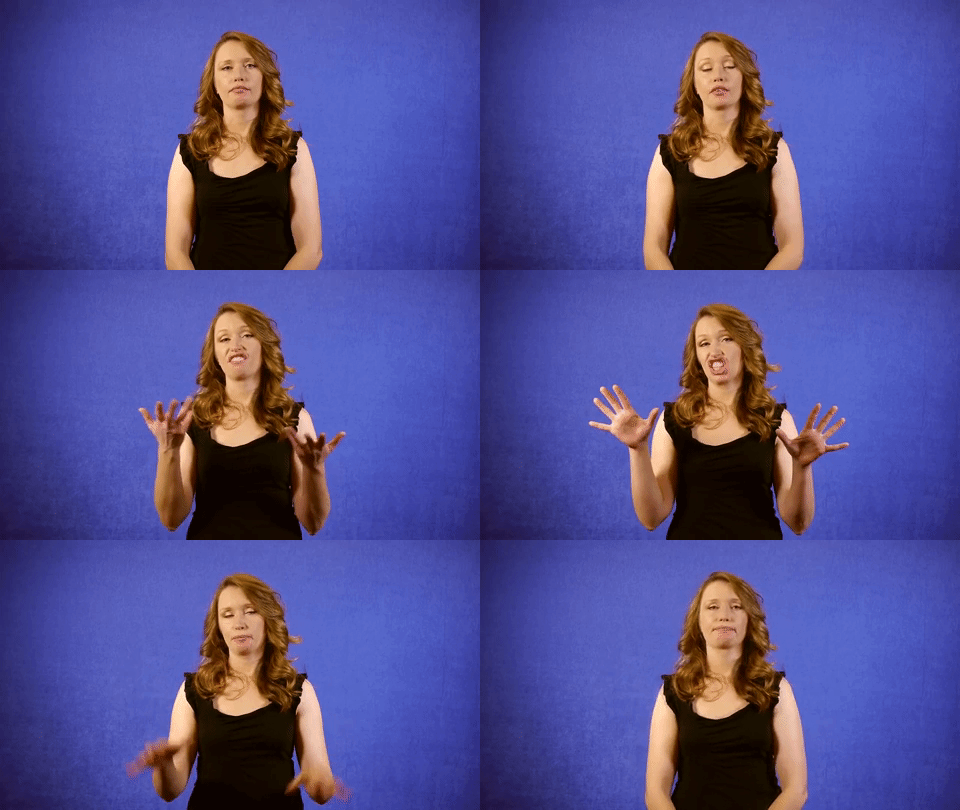
The sign for AFTER THAT_FINISH in ASL uses an open “B” handshape for “after” and a “5” handshape for “finish.” The dominant hand, held in a “B” position, moves forward past the non-dominant hand, which remains stationary. For “finish,” both hands use a “5” handshape, starting palm-in and flipping quickly outward. This sequential movement conveys the meaning of an event following another. The sign for AFTER THAT_FINISH in ASL emphasizes a clear transition. ✋

*Palm Orientation*:

The sign for AFTER THAT_FINISH in ASL involves a change in palm orientation for each part of the phrase. For AFTER, the dominant hand starts palm facing sideways as it moves past the stationary non-dominant hand. THAT is typically signed with the dominant Y-handshape, palm facing downward or slightly outward. FINISH involves open hands with palms facing inward, followed by a quick outward rotation. Each sign maintains clarity through distinct palm orientations, ensuring smooth communication. ✋

*Location*:

The sign for AFTER THAT_FINISH in ASL takes place in the neutral space in front of the body. The first part, AFTER THAT, is signed with one hand moving past the other, typically at chest level. The FINISH part is signed near the chest or slightly outward, with both open hands flipping outward to indicate completion. The location remains within a comfortable, natural signing space for clarity and ease of movement.

*Movement*:

To produce the sign for AFTER THAT_FINISH in ASL, begin with the sign for AFTER. Position the dominant hand in a flat “B” shape and move it forward over the non-dominant hand, which stays stationary in a similar shape. Then transition smoothly into THAT by forming a “Y” shape with the dominant hand and dropping it downward. Finally, for FINISH, open both hands and flick them outward with a slight wrist twist. This combination fluidly expresses the sign for AFTER THAT_FINISH in ASL.

*Non-Manual Signals*:

When signing the sign for AFTER THAT_FINISH in ASL, raise your eyebrows slightly and maintain a neutral or slightly affirmative facial expression. Your mouth may form a slight “mm” shape to indicate sequence or completion. A small head nod can help reinforce the order of events. If emphasizing finality, you might briefly widen your eyes or slightly tilt your head. The non-manual signals should match the context of transitioning from one action to another.

*Prosody, Dominant/Non-Dominant Hand*:

The sign for AFTER THAT_FINISH in ASL uses both hands in distinct movements. The dominant hand starts with a flat palm and moves forward in a smooth motion, indicating “after that.” Then, the FINISH sign follows by flicking open hands outward to emphasize completion. The non-dominant hand remains stable during the first part but is not needed for the FINISH portion. This sequence fluidly conveys “after that, it is finished.”

Tips for Beginners:

Mastering the sign for AFTER THAT_FINISH in ASL requires a clear understanding of sequencing in ASL grammar. The concept combines signs that indicate completion and ordering of events. Pay attention to fluidity, ensuring a natural movement when transitioning between the two components of the sign. Practice combining them smoothly rather than pausing in between to maintain fluency.

A common mistake when signing AFTER THAT_FINISH is hesitating between the two signs, which can make the meaning unclear. Be sure to use a fluid motion, with your hands moving naturally from one sign to the next. Over-exaggeration can also be a problem, so keep the movements controlled and precise.

Facial expressions are a crucial element when signing AFTER THAT_FINISH in ASL. Your face should indicate the transition from one event to the next, which helps reinforce the meaning. Subtle head movement forward or a slight raising of the eyebrows can add natural emphasis. Maintaining eye contact while signing improves clarity and engagement in conversation.

Repetition is key to mastering this phrase effectively in conversations. Try using it in real-life scenarios where you describe sequences, such as telling a story or explaining a process. Practicing with native signers or watching fluent signers in videos can provide helpful insight into natural timing and pacing.

If you’re learning the sign for AFTER THAT_FINISH in ASL for the first time, recording yourself can be useful. play back your signing to check for smooth transitions and proper facial expressions. Watching your own progress can help identify areas for improvement. Keep practicing, stay patient, and focus on making your signs both precise and fluid.

Connections to Other topics:

The sign for AFTER THAT_FINISH in ASL connects closely to the broader concept of sequencing events in time. In ASL grammar, time-related transitions are important for structuring narratives and clarifying when actions take place. The sign for AFTER THAT_FINISH in ASL helps signal the completion of one event before the next begins, making it useful in conversations about order, instructions, and storytelling.

This sign is particularly useful when discussing schedules or providing step-by-step directions. It can be combined with other signs, such as BEFORE, NEXT, or LATER, to create clear chronological relationships. For example, in storytelling, saying FIRST, THEN, AFTER THAT_FINISH, and FINALLY helps clarify progression in a visually structured way that is essential to ASL syntax.

AFTER THAT_FINISH in ASL is also related to the concepts of transition and cause-and-effect. It pairs well with WHY, BECAUSE, or RESULT to express what followed an event. For instance, one could sign WORK FINISH, AFTER THAT_FINISH, GO HOME to show a logical sequence of actions. This mirrors how in English one might say, “After finishing work, I went home.”

The FINISH portion of this sign is also widely used in ASL for indicating completeness. It appears in signs like ALREADY, DONE, and FINISH itself, all of which help clarify that an event has ended. Additionally, FINISH can function as a grammatical marker to indicate perfect aspect, as in EAT FINISH meaning “I have already eaten.”

Mastering the sign for AFTER THAT_FINISH in ASL is valuable for conversational fluency, as it enhances clarity when narrating events. Whether discussing past experiences or giving future instructions, this sign serves as an essential tool for structuring sentences in a way that aligns with ASL’s natural grammar.

Summary:

The sign for AFTER THAT_FINISH in ASL conveys the concept of sequential actions or events, indicating that one thing has been completed before another begins. It combines the signs for AFTER, THAT, and FINISH, each of which contributes to the overall meaning. This sign is commonly used in ASL storytelling, casual conversation, and explanations to indicate a chronological sequence.

AFTER in ASL typically involves a movement of one hand past another to indicate a later time or event. THAT is often represented by a pointing motion or a gesture that specifies something previously mentioned. FINISH is signed with open hands moving outward, signifying completion. When these signs come together, they create a clear progression of time within an ASL sentence.

ASL relies on visual spatial grammar, making the sign for AFTER THAT_FINISH an essential tool for structuring narratives. It serves a vital role in establishing timelines, organizing thoughts, and making events more comprehensible. This phrase indicates that an action is completed, followed by another, maintaining clarity in communication.

This phrase is particularly useful in daily interactions, whether giving instructions, telling stories, or recounting personal experiences. The sign for AFTER THAT_FINISH is often accompanied by appropriate facial expressions to emphasize sequence and importance. Eyebrow movement and head positioning may help further clarify the transition from one idea to the next.

The concept of sequencing is fundamental in ASL, as the language does not rely on written punctuation like commas or periods. Instead, signs like AFTER THAT_FINISH serve as natural discourse markers, allowing signers to structure their statements effectively. Pauses, eye gaze shifts, and slight body movements contribute to signaling the progression of events.

The cultural significance of this sign is evident in its frequent use in conversations, storytelling, and explanations within the Deaf community. Deaf signers often rely on clear and structured expressions to share experiences and knowledge. The sign for AFTER THAT_FINISH ensures a logical order of events, which is crucial for comprehension.

Linguistically, the sign for AFTER THAT_FINISH showcases the inflectional nature of ASL. The motion, speed, and intensity of each component can change based on the context. A deliberate and slow signing of FINISH may emphasize completion, while a quick motion signals smooth progression between events.

When discussing events in ASL, signers establish visual references or spatial locations to indicate different parts of a sequence. The sign for AFTER THAT_FINISH helps transition smoothly from one reference point to the next. This visual clarity enhances communication efficiency and minimizes misinterpretation.

Usage of the sign for AFTER THAT_FINISH is common when discussing daily routines, plans, and instructions. If someone explains a recipe, for example, they might use this sign to indicate when to move to the next step. Similarly, in educational settings, teachers use this structure to guide students through lessons or procedures.

This phrase is also relevant in ASL poetry and storytelling, where clear sequencing adds depth and structure. Signers use AFTER THAT_FINISH to enhance narratives, making them easier to follow. When used effectively, it contributes to the natural flow of signed discourse.

In casual conversations, signers often abbreviate or modify signs for efficiency. The movement in the sign for AFTER THAT_FINISH may be simplified or blended, depending on regional or individual variation. However, the meaning remains intact as a sequential marker.

The visual and spatial nature of ASL makes sequencing an integral part of how ideas are expressed. Unlike spoken languages, where words are strung together linearly, ASL allows for simultaneous expression of meaning through movement, facial expressions, and positioning. Signs like AFTER THAT_FINISH serve as anchors for clear and organized communication.

Deaf people rely on ASL’s structured use of time-related signs to avoid confusion and ensure smooth exchanges of information. The sign for AFTER THAT_FINISH clarifies when events occur in relation to each other. This is particularly vital in conversations where multiple ideas or steps are being described.

When comparing ASL with English, it becomes evident that ASL structures time differently. While English speakers use words like “then” or “afterward,” ASL relies on dedicated signs and visual markers. AFTER THAT_FINISH explicitly indicates a logical progression, making conversations and stories more cohesive.

This sign is particularly helpful in professional settings, such as meetings or presentations. Business discussions often require clear sequencing to outline projects, goals, or past accomplishments. Using the sign for AFTER THAT_FINISH helps convey structured information concisely.

In social interactions, signers may modify the sign for emphasis based on the importance of the event being described. A stronger or repeated movement in the FINISH sign can indicate a more definite transition. These subtle variations allow signers to adjust their communication dynamically.

Because ASL grammar differs significantly from English, learners often find sequencing signs like AFTER THAT_FINISH useful as they transition into ASL fluency. Mastering this structure helps with overall comprehension

Want more? Check out some of our popular learning activities!

ASL Interactive Resources

ASLInteractive YouTube Channel

Follow us on tiktok: @aslinteractive.com

Follow us on Instagram: aslinteractive

Facebook page: aslinteractive

Facebook group: aslinteractive

LInkedIn: ASL Interactive LLC

Twitter: @ASL_interactive

*Some information on this page is AI-generated. AI can make mistakes. Please check the information.

Sign for AFTER THAT_FINISH in ASL 

Responses