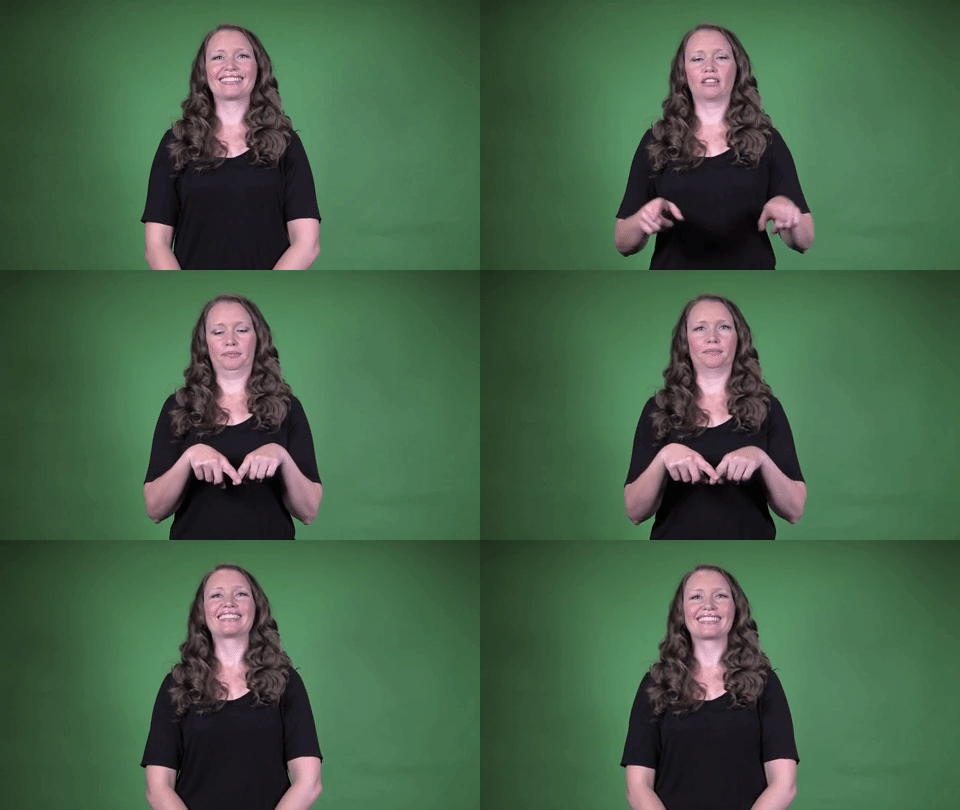
Definition: A position with the ankles crossed.
Sign for ANKLES_CROSSED in ASL

Practice Activities:
Practicing the sign for ankles_crossed in ASL can be fun and engaging through a variety of activities. Start by signing it in isolation, repeating it slowly while maintaining proper hand positioning. Try signing it in front of a mirror to check for accuracy or record yourself to compare with a reference video.
To put the sign for ankles_crossed in ASL into context, describe a sitting position using ASL. Sign sentences like “I am sitting with my ankles crossed” or “She likes to sit with her ankles crossed while reading.” Use classifiers to describe a person’s legs in different positions.
Storytelling is a helpful way to practice. Create a short story where a character sits patiently in a waiting room with ankles crossed or tell a story about a yoga instructor demonstrating different seated positions. Practice signing the story smoothly while incorporating facial expressions.
A great partner activity is a guessing game. Have a partner sit in various positions while you describe them using ASL, including the sign for ankles_crossed. Switch roles to ensure both participants practice signing and understanding.
Another interactive option is charades. Someone acts out different seated postures, and others guess the position using ASL, making sure to include proper classifiers and the sign for ankles_crossed. This helps with comprehension and expressive signing.
Challenge yourself by incorporating the sign into everyday conversations. While chatting in ASL, notice when someone’s posture changes and sign ankles_crossed when applicable. This helps reinforce learning in a natural setting.
Using these activities, learners can gain confidence in using the sign for ankles_crossed in ASL fluidly and correctly. With consistent practice, signing postures and body positions will become second nature in ASL conversations.
Cultural Context:
The sign for ankles_crossed in ASL represents the common position of crossing one’s ankles while sitting or resting. This gesture often conveys relaxation, ease, or attentiveness in different social settings. In some cases, it can also be a sign of politeness or modesty, depending on the cultural context.
Body language plays an important role in communication, and the sign for ankles_crossed in ASL reflects this subtle yet expressive aspect. In American Deaf culture, seated positions and posture can carry unspoken messages, making this sign useful in describing how someone is sitting. Whether used in casual conversation or storytelling, this sign visually represents a familiar posture.
Many people cross their ankles when sitting to indicate comfort, but it can also signal attentiveness when listening to someone speak. The sign for ankles_crossed in ASL can be helpful for interpreting body language or describing a person’s behavior. This adds depth to conversations and allows for greater detail when signing in ASL.
Throughout history, posture and sitting positions have carried different meanings in various cultures. While the sign for ankles_crossed in ASL primarily represents a physical posture, it can also suggest relaxation or formality. Understanding these nuances helps in accurately conveying context in ASL conversations.
Deaf storytelling often incorporates movement and body positioning to enhance meaning. Using the sign for ankles_crossed in ASL can help clarify a character’s body language in a narrative. This detail makes signed storytelling more visually engaging and immersive for the audience.
Some etiquette guides encourage crossing the ankles instead of the knees in formal settings. The sign for ankles_crossed in ASL allows signers to describe such etiquette-related behavior easily. This can be useful in discussions about social norms or cultural expectations.
ASL focuses on visual-spatial language, where describing physical positions is essential. The sign for ankles_crossed in ASL serves as a precise way to describe someone’s posture without confusion. This helps maintain clarity in conversations, whether casual or formal.
Non-verbal communication plays a big role in how people interact, both in spoken and signed languages. The sign for ankles_crossed in ASL captures a small but significant aspect of human body language. By incorporating such details, signers can give a more complete picture of a situation.
Using the sign for ankles_crossed in ASL can help when telling a story, giving instructions, or describing a scene. Whether explaining how someone is sitting or adding depth to a narrative, this sign provides valuable
Extended Definition:
The sign for ankles_crossed in ASL is a simple yet effective way to describe the position of the feet. This sign is commonly used in everyday conversation, especially when discussing sitting positions, yoga poses, or physical movements. Understanding how to sign ankles_crossed in ASL helps improve communication and fluency in signing.
To sign ankles_crossed in ASL, position both hands to represent the legs and imitate the motion of crossing one ankle over the other. The exact movement and hand shape may vary depending on the regional or personal signing style. Mastering this sign can help users describe seating positions or body posture with clarity.
In many situations, people cross their ankles while sitting for comfort or relaxation. This sign is useful for discussing body language, etiquette, or even certain exercises where the ankles need to be crossed. Using the sign for ankles_crossed in ASL makes conversations about body positioning more visual and descriptive.
This sign is sometimes confused with the sign for “legs crossed,” but they have distinct differences. While ankles_crossed in ASL specifically refers to the ankle area, the sign for “legs crossed” usually indicates a full-leg crossing position. Learning both signs helps build a more precise vocabulary in ASL.
Children and adults alike can benefit from learning how to sign ankles_crossed in ASL. Teachers, interpreters, and students of ASL can use this sign in various learning activities. It is especially useful when describing seating arrangements, rest positions, or storytelling actions.
Context is important when using the sign for ankles_crossed in ASL. In casual settings, it may represent sitting comfortably, while in other situations, it might indicate a formal posture. Understanding the meaning behind this sign allows for clear and accurate communication.
In ASL, body movements and non-manual markers play an essential role in expressing meaning. When signing ankles_crossed in ASL, facial expressions and posture can add subtle meaning to the message. This enhances the overall clarity and natural flow of signing.
People studying ASL often find this sign helpful when describing specific physical actions. Whether in conversations about rest positions, dance movements, or instructional settings, the sign for ankles_crossed in ASL is frequently used. Practicing and applying this sign will improve overall sign fluency.
Many ASL learners appreciate the simplicity of this sign. Since it mimics the natural movement of crossing ankles, it is easy to understand and remember. Learning to sign ankles_crossed in ASL
Synonyms: crossed ankles, ankles folded over, legs crossed at the ankles, ankles overlapped, feet crossed at the ankles
Educational resources: Find related learning materials in our course bank!
Want more? Check out some of our popular learning activities on the homepage!
Need to look up a sign? Use our highly rated dictionary: https://aslinteractive.com/best-asl-dictionary/
Follow us on tiktok: https://www.tiktok.com/@aslinteractive. More social media links at the bottom of this page!
Long-tail Keywords: what is the sign for ankles crossed in ASL, how do you sign ankles crossed in ASL, ASL sign for ankles crossed
Categories:
tags: Clothing, Body Language, Commands, Everyday Activities, Actions
Parameters
*Handshape*:
The sign for ANKLES_CROSSED in ASL uses both hands to represent the position of the ankles. The dominant and non-dominant hands use an index-finger handshape or a modified “X” shape. The fingers cross at the ankles while held near the lower legs.
The movement mimics the natural way ankles cross when sitting or standing comfortably. Facial expressions or slight shifts in movement can emphasize different contexts. The sign for ANKLES_CROSSED in ASL effectively conveys the concept visually.
*Palm Orientation*:
The sign for ANKLES_CROSSED in ASL typically involves both hands forming loose fists or relaxed flat hands while positioning them near the lower legs or ankles. The palm orientation depends on the specific variation, but commonly, the hands face downward or slightly inward, reflecting the act of crossing the ankles. Movement may involve a subtle crossing motion to clarify the concept visually. This sign effectively captures the physical stance of having one ankle over the other.
*Location*:
The sign for ANKLES_CROSSED in ASL is located in the lower part of the body, specifically at the ankles. This sign typically involves the positioning of both legs, with one ankle crossing over the other. Since ASL is a visual language, the sign for ANKLES_CROSSED in ASL may rely on body positioning rather than hand movements, making clear visibility and context essential for accurate interpretation.
*Movement*:
To produce the sign for ANKLES_CROSSED in ASL, position both hands in an S-handshape, representing the legs. Place one hand slightly in front of the other, simulating an ankle-crossing motion. Gently tap the wrists together twice, emphasizing the crossed position.
The movement is subtle yet clear, depicting the natural way ankles overlap when seated or resting. Keeping the motion controlled ensures accurate representation of the sign for ANKLES_CROSSED in ASL.
*Non-Manual Signals*:
When signing the sign for ANKLES_CROSSED in ASL, maintain a neutral facial expression unless context requires emphasis. If describing discomfort or restriction, slightly furrow your brows or tighten your lips. If showing relaxation, a slight head tilt or a soft blink can enhance meaning. Eye contact should remain natural, and body posture may subtly shift to reflect the position being described. Use slight head movements to support the visual representation of crossing ankles.
*Prosody, Dominant/Non-Dominant Hand*:
The sign for ANKLES_CROSSED in ASL involves both hands representing the lower legs and feet. The dominant and non-dominant index fingers extend downward, mimicking legs, while the fingers cross at the ankles. This movement visually conveys the ankles crossing over each other. The handshape maintains a relaxed posture, ensuring clarity. Facial expressions may emphasize the meaning further, especially in conveying comfort or casual positioning. The sign for ANKLES_CROSSED in ASL is typically used when discussing body posture or seated positions.
Tips for Beginners:
When learning the sign for ANKLES_CROSSED in ASL, focus on clear and deliberate hand positioning. Since this sign involves representing the ankles crossing, ensure that your dominant hand makes a precise movement over the other to avoid confusion. Practicing in front of a mirror can help refine hand clarity and orientation.
Maintaining proper handshape and positioning is key to making the sign for ANKLES_CROSSED in ASL look natural. Be mindful of your wrist movements, as improper angles can make the sign unclear. Keep your fingers relaxed, and don’t tense up, which can make the sign look rigid or forced.
Many beginners struggle with fluidity when signing this concept. To improve, practice slowly and then build speed while keeping movements smooth. Watching native signers or video references can help reinforce the correct motion. Recording yourself can provide useful feedback on accuracy.
Context is important when using the sign for ANKLES_CROSSED in ASL. Since body language plays a big role in ASL communication, ensure your facial expressions match your intended meaning. Using a neutral or appropriate expression will help convey the sign correctly and naturally.
Pay attention to hand placement relative to your body to avoid misinterpretation. If the motion is too small, it may be unclear to the viewer, but exaggerated movements can also warp the meaning. Finding a comfortable balance will improve clarity and comprehension.
If the sign feels difficult, break it down into smaller motions and practice each part separately. Repeating the handshape and movement helps commit it to muscle memory. Take breaks if needed to avoid strain, and revisit the sign regularly to reinforce your learning.
Connections to Other topics:
The sign for ankles_crossed in ASL connects to many body-related and movement-based signs. It shares similarities with leg-related signs such as knee, foot, and sit. Since positioning is a key element of ASL, different leg postures like standing, sitting, or crossing can modify meaning in conversations. The sign for ankles_crossed in ASL can also contribute to descriptions of body posture, which is crucial in storytelling, signing about comfort, and discussing physical states.
This sign is also useful when discussing relaxation, etiquette, or specific seating positions. For example, when explaining how someone is sitting, mentioning whether their ankles are crossed provides a clear visual image. It can also connect to signs like relax, meditative, or formal, which often involve seated positions. In social or cultural discussions, referencing the sign for ankles_crossed in ASL can indicate polite posture in formal settings or a casual, laid-back position during informal conversations.
In combination with other movement signs, this sign can express more complex ideas about balance and restriction. For example, crossing the ankles can symbolize restraint or a limited range of motion, which can be linked to signs like stuck or tied. When signing about sports or exercise, this sign could appear in discussions of flexibility, stretching, or dance moves. It also plays a role in medical or accessibility-related conversations, where crossed ankles might indicate muscle tension, circulation concerns, or specific sitting instructions for people with mobility impairments.
The sign for ankles_crossed in ASL can also be useful in storytelling and visual descriptions. When narrating a scene, emphasizing ankle positioning can show a character’s mood, comfort level, or attentiveness. In signed poetry or performance art, modifying body position can add nuance to the expression of emotions. This makes the sign highly valuable across many aspects of ASL conversation.
Summary:
The sign for ankles_crossed in ASL visually represents the position of crossing one’s ankles while seated. This sign typically involves utilizing the index and middle fingers of both hands in a crossed formation, mimicking the way ankles are placed when crossed. The motion used is often quick and fluid to maintain natural expression within ASL conversation.
In ASL, body part signs frequently incorporate visual accuracy to depict the anatomical feature or movement. The sign for ankles_crossed in ASL follows this convention, emphasizing the physical action of crossing. Positioning is also crucial, ensuring that the hands or fingers represent the lower body to align with spatial coherence in ASL.
This sign falls under the category of classifier-based signs, which enhance visual meaning by using handshapes that mimic physical characteristics. Classifiers are essential in ASL to describe bodily positions, just as the sign for ankles_crossed in ASL conveys a specific sitting posture. These types of descriptive signs contribute to the richness of spatial representation in ASL.
Grammar in ASL relies heavily on non-manual signals, such as facial expressions, to complement meaning. When using the sign for ankles_crossed in ASL, a signer may include additional facial expressions to indicate comfort, relaxation, or even tension depending on the context. These subtle cues help clarify the intended message beyond just the sign itself.
Cultural significance plays a role in how seating postures are visually conveyed in ASL. The sign for ankles_crossed in ASL can indicate formality, repose, or conversely, nervousness, depending on the situation. This reflects ASL’s ability to incorporate social and cultural meanings into its lexicon.
Some signs in ASL are influenced by common gestures used in daily life. The sign for ankles_crossed in ASL shares similarities with natural body language, making it intuitive for native signers and newcomers alike. It highlights ASL’s efficiency in representing common positions in a swift and visual manner.
When describing someone’s posture in ASL, multiple supplemental classifiers can be used. The sign for ankles_crossed in ASL may be accompanied by other signs indicating a seated position, leaning, or other contextual details. This flexibility enhances communication by providing a clear, three-dimensional depiction of posture.
Linguistically, ASL benefits from signs that visually represent their meaning, a feature known as iconicity. The sign for ankles_crossed in ASL demonstrates this principle by directly mirroring the physical action. Iconicity makes ASL highly accessible to those learning through visual recognition and comprehension.
ASL includes many adapted signs that specify different leg movements or positions. While the sign for ankles_crossed in ASL denotes a specific posture, it can be modified slightly to represent variations such as legs tightly crossed or loosely crossed. This adaptability enhances the expressiveness of ASL communication.
Language learning research suggests that visual learners benefit significantly from sign languages due to their spatial nature. The sign for ankles_crossed in ASL serves as an example of how descriptive and illustrative signing can improve retention and understanding. It aligns well with the brain’s ability to process and recall physical gestures effectively.
The sign for ankles_crossed in ASL can frequently appear in narrative storytelling. It helps to set up scenarios where a character is sitting in a relaxed or formal manner. Storytellers can modify this sign with additional movements or expressions to enhance the portrayal of a character’s posture.
In conversations, knowing how to describe sitting postures like the sign for ankles_crossed in ASL can be useful in various situations. It can aid in discussions about comfort, etiquette, or even specific seating arrangements. This demonstrates ASL’s capacity to provide visual descriptions for daily life experiences.
Applied linguistics emphasizes the importance of non-verbal context in communication. The sign for ankles_crossed in ASL exemplifies this principle by conveying an entire posture visually, eliminating the need for multiple spoken words. ASL’s spatial grammar allows streamlined yet precise descriptions of bodily actions.
Signing space is essential in ASL, guiding how different elements of language fit together. The sign for ankles_crossed in ASL must be placed appropriately in the signing space to avoid confusion with other leg-related signs. Understanding these spatial relationships helps ensure clarity in signing.
The use of classifiers in ASL extends beyond just descriptions of body parts. The sign for ankles_crossed in ASL may be incorporated into broader discussions involving relaxation, etiquette, or emotion. This classifier usage supports ASL’s dynamic, contextual approach to communication.
Because ASL incorporates hands and facial expressions together, signers can modify the sign for ankles_crossed in ASL to indicate different levels of relaxation. A tense expression might imply discomfort while crossing ankles, whereas a smile could suggest casual comfort. These variations enhance expressive detail in ASL.
Some signs evolve based on cultural and social norms. The sign for ankles_crossed in ASL may have subtle modifications depending on community usage, just as body
Want more? Check out some of our popular learning activities!
ASL Interactive Resources
ASLInteractive YouTube Channel
Follow us on tiktok: @aslinteractive.com
Follow us on Instagram: aslinteractive
Facebook page: aslinteractive
Facebook group: aslinteractive
LInkedIn: ASL Interactive LLC
Twitter: @ASL_interactive
*Some information on this page is AI-generated. AI can make mistakes. Please check the information.


Responses