Sign for ATM in ASL | 🏧 ASL Dictionary

Definition: Automated teller machine.

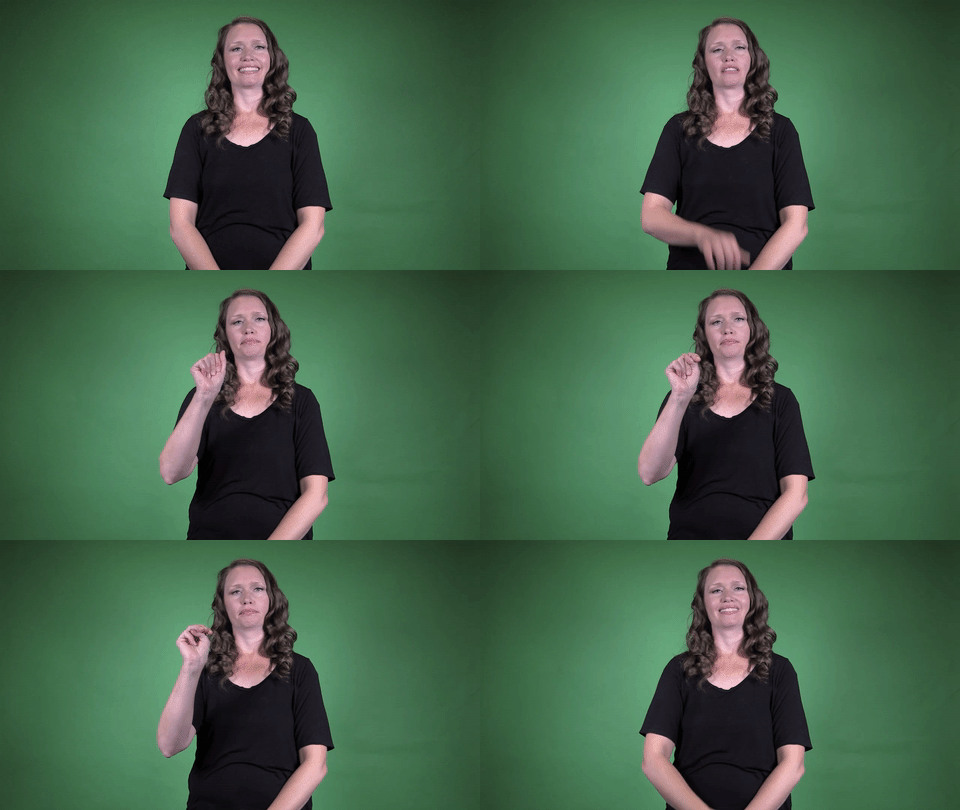
Sign for ATM in ASL

YouTube player

Practice Activities:

To practice the sign for ATM in ASL, start by fingerspelling the letters A-T-M clearly and smoothly. Focus on the correct handshapes and transitions between each letter. Repeat the fingerspelling at a slow, steady pace and gradually increase your speed while maintaining accuracy.

Try signing ATM in context by incorporating it into short phrases. For example, sign “I NEED TO FIND AN ATM” or “THE ATM IS BROKEN.” Practice these sentences while making eye contact and using facial expressions appropriate for each situation.

Create practice scenarios where you ask and answer questions involving ATM. One partner can sign “WHERE IS THE ATM?” while the other responds, “IT’S NEXT TO THE BANK.” Switch roles to get comfortable using the sign conversationally.

Use storytelling to reinforce the sign for ATM in ASL. Imagine a situation where you need cash, and you describe looking for an ATM, withdrawing money, and paying for an item. Emphasize smooth fingerspelling throughout the story.

Engage in a fingerspelling race with a partner. See who can fingerspell ATM correctly and smoothly the fastest without sacrificing clarity. This will help develop speed and confidence when using the sign naturally.

When watching ASL dialogues or videos, look out for the sign for ATM in ASL. Try to recognize when others fingerspell it and pay attention to fluency. Practice copying their pace and transitions between letters.

End your practice by mixing ATM into longer conversations. Discuss topics like money, shopping, or travel while making sure to smoothly fingerspell ATM when needed. This will help integrate the sign into everyday use.

Cultural Context:

The sign for ATM in ASL is essential for everyday banking and financial transactions in the Deaf community. Since ATMs are widely used for withdrawing cash, depositing funds, and checking balances, knowing the correct ASL sign helps ensure smooth communication. Whether at a bank, mall, or convenience store, being able to ask for or locate an ATM in ASL is a valuable skill.

Deaf individuals rely on clear and efficient signing to navigate financial services. The sign for ATM in ASL helps eliminate barriers when interacting with bank staff or other customers. When a Deaf person needs directions or assistance, using the ASL sign for ATM prevents confusion and ensures accessibility.

Understanding the sign for ATM in ASL is particularly useful when traveling. Many public places have ATMs, but not all locations have staff who understand ASL. Being able to sign ATM in ASL helps Deaf individuals independently manage their finances in various situations.

Deaf culture values visual communication, and ASL signs for common services like ATM align with that principle. The sign for ATM in ASL is a quick and effective way to indicate the need for banking services. Using accurate signs for financial terms fosters inclusion and improves everyday interactions.

Technology has made banking more accessible for the Deaf community, but in-person transactions still require ASL fluency. The sign for ATM in ASL is helpful when requesting assistance with card issues or machine malfunctions. Knowing this sign strengthens financial independence and reduces communication barriers.

In social settings, discussing money, budgeting, or financial planning often involves referencing ATMs. Using the correct ASL sign for ATM makes conversations clear and precise. Whether sharing directions or making plans, being familiar with the sign for ATM in ASL is practical and useful.

For ASL students, learning the sign for ATM in ASL is an important step in mastering financial vocabulary. This knowledge builds confidence when navigating real-world banking situations. Understanding common banking signs also helps ASL learners communicate effectively with Deaf friends or clients.

ASL evolves with technology and modern banking needs. As financial services expand, so does the importance of knowing the sign for ATM in ASL. Ensuring that financial institutions and businesses recognize ASL signs like ATM supports accessibility for the Deaf community.

Extended Definition:

The sign for ATM in ASL is essential for anyone who needs to discuss banking and financial transactions in American Sign Language. This sign is commonly used when asking for the location of an ATM, discussing withdrawing cash, or explaining banking services. It helps improve communication in both personal and professional banking situations.

When signing ATM in ASL, the movement and handshape can vary slightly depending on the signer or regional differences. Some signers spell out “ATM” using fingerspelling, while others may use a commonly recognized abbreviation sign. Understanding multiple variations can help ensure smooth conversations in different signing communities.

Knowing the sign for ATM in ASL is useful when visiting a bank or using an automated teller machine. If you’re in a public place and need to ask for an ATM, using this sign can be quicker and more effective than fingerspelling the full word. Many deaf and hard-of-hearing individuals use this sign daily while handling routine financial transactions.

Learning the sign for ATM in ASL can be beneficial for interpreters, bank employees, and anyone who interacts with deaf customers. Financial institutions that provide accessible services can improve communication with deaf clients by training staff in basic banking signs. Using ASL in these settings creates a welcoming and inclusive environment for all customers.

If you are new to signing, practicing the sign for ATM in ASL along with other banking signs can help build fluency. Pairing it with related signs such as bank, deposit, and cash can make financial conversations in ASL easier. Becoming familiar with different financial signs can be helpful when managing everyday transactions.

Whether you are a deaf individual, a student learning ASL, or a professional working in banking, knowing the sign for ATM in ASL is a valuable skill. It allows for clear and efficient conversations about money-related topics. Expanding your ASL vocabulary helps improve communication and promotes accessibility in various settings.

Synonyms: ATM, automated teller machine, cashpoint, cash dispenser, cash machine

Educational resources: Find related learning materials in our course bank!

Want more? Check out some of our popular learning activities on the homepage!

Need to look up a sign? Use our highly rated dictionary: https://aslinteractive.com/best-asl-dictionary/

Follow us on tiktok: https://www.tiktok.com/@aslinteractive. More social media links at the bottom of this page!

Long-tail Keywords: what is the sign for ATM in ASL, how do you sign ATM in American Sign Language, what is the ASL sign for ATM

Categories:

tags: ATM, facilities and other locations/needs, objects, transportation, everyday activities

Parameters

*Handshape*:

The sign for ATM in ASL is typically fingerspelled using the American Manual Alphabet. The dominant hand signs “A,” “T,” and “M” in sequence, with each letter’s handshape formed clearly. The “A” handshape is made with the thumb extended alongside a closed fist, the “T” is created by placing the thumb between the index and middle fingers, and the “M” involves the thumb tucked under the index, middle, and ring fingers.

For clarity, each letter should transition smoothly while maintaining steady hand movements. When fingerspelling the sign for ATM in ASL, keep a moderate pace and avoid excessive bouncing. The hand remains in a neutral space near the upper torso, and palm orientation typically faces forward or slightly to the side. Consistent and fluid fingerspelling ensures proper communication of this commonly used term.

*Palm Orientation*:

The sign for ATM in ASL is typically fingerspelled using the American manual alphabet. The palm orientation for fingerspelling “ATM” is generally forward, with the dominant hand facing outward for clarity. Each letter—A, T, and M—is formed individually, maintaining a consistent palm orientation toward the viewer. This ensures that the sign for ATM in ASL is easily readable by those familiar with ASL fingerspelling conventions.

*Location*:

The sign for ATM in ASL is fingerspelled, so its location is naturally in front of the body, at chest level. The hands stay within the general signing space, typically near the center of the torso. Since the letters A, T, and M are produced sequentially, each handshape transitions smoothly while remaining in the same general area. The movement remains clear and steady to ensure readability.

*Movement*:

To sign for ATM in ASL, use fingerspelling. Form the letter “A” by making a fist with your thumb on the side of your hand. Then shape a “T” by placing your thumb between your index and middle fingers. Finally, form “M” by resting your thumb between your ring and pinky fingers. Each letter should be signed smoothly in succession, keeping a steady rhythm without bouncing between letters.

*Non-Manual Signals*:

When using the sign for ATM in ASL, the facial expression should remain neutral or slightly engaged, depending on the context. If asking a question, raise your eyebrows and lean slightly forward to show curiosity. If emphasizing the need for an ATM, a slight head nod or pressing lips together can reflect urgency. Maintain eye contact to ensure clarity, especially when fingerspelling “ATM.” A relaxed posture keeps the communication natural.

*Prosody, Dominant/Non-Dominant Hand*:

The sign for ATM in ASL is typically fingerspelled as A-T-M. Use your dominant hand to form the handshape for “A,” then transition smoothly to “T,” and finally “M.” Keep your movements fluid but clear to ensure legibility. Your non-dominant hand remains inactive or in a neutral position. This method is widely understood and is the most common way to communicate the concept accurately in ASL.

Tips for Beginners:

The sign for ATM in ASL is fingerspelled, meaning you will use the ASL alphabet to spell out “A-T-M.” When forming each letter, ensure that your hand remains steady and clearly transitions from one shape to the next. Try not to rush through the letters; clarity is more important than speed.

One important tip for mastering the sign for ATM in ASL is to maintain a relaxed hand posture while fingerspelling. Tension in the hand can make your letters look unclear or inconsistent. Keep your palm facing slightly forward, and make sure each letter is well-formed before moving on to the next.

A common mistake beginners make is blending the letters together too quickly. Since “T” and “M” are formed using similar hand positions, it is easy to blur them, making it difficult to read. To avoid this, pause slightly between letters to reinforce their distinct shapes.

Another helpful technique is practicing in front of a mirror or recording yourself spelling ATM. This allows you to check the accuracy of your hand shapes and transitions. Watching fluent signers fingerspell can also improve your awareness of smooth, clear movements.

In real-life situations, context can help ensure the sign for ATM in ASL is understood. If signing to a non-fluent signer, you can add a gesture mimicking an ATM transaction to reinforce the meaning. Adjust your signing speed based on your audience’s familiarity with fingerspelling.

Consistent practice is key to improving your fingerspelling skills. Repeating the sign daily while focusing on smooth transitions will build muscle memory. As you get more comfortable, try increasing your speed while maintaining accuracy. Over time, the sign for ATM in ASL will become more fluid and natural.

Connections to Other topics:

The sign for ATM in ASL is related to other financial and banking terms in sign language. Many banking-related signs, such as BANK(FS) and DEPOSIT, are frequently used in conjunction with ATM to describe financial transactions. Understanding the sign for ATM in ASL also helps learners communicate common financial phrases like WITHDRAW MONEY or CHECK BALANCE, making conversations about money management smoother.

This sign connects to concepts involving money and currency, including CASH, CREDIT CARD, and TRANSACTION. Often, signing ATM is followed by MONEY or WITHDRAW to clarify the purpose of using an ATM machine. In some cases, signers may use additional clarification such as MACHINE to describe an ATM more specifically, reinforcing related ASL vocabulary.

Fingerspelling is commonly used when referring to specific banks or brands of ATMs. For example, one might sign ATM followed by a fingerspelled brand name like CHASE or WELLS FARGO to specify which ATM is being discussed. This practice is helpful for more precise communication, especially in conversations about locations and services.

Learning the sign for ATM in ASL also supports understanding of modern financial concepts such as ONLINE BANKING and MONEY TRANSFER. These ideas are important in conversations about digital payment methods and financial independence. The ability to sign ATM fluently allows individuals to discuss financial topics more naturally and with greater clarity.

The concept of ATMs is also linked to travel and accessibility. People frequently look for ATMs when traveling or shopping, and knowing how to sign ATM helps when asking for directions. Connecting ATM with signs like LOCATION or NEARBY enhances communication in real-life situations where access to cash is needed.

Summary:

The sign for ATM in ASL is often fingerspelled as “A-T-M.” This reflects the English acronym for “Automated Teller Machine,” which does not have a widely established lexicalized sign. Fingerspelling is commonly used for acronyms, especially those related to banking and technology.

When fingerspelling the sign for ATM in ASL, the dominant hand moves smoothly through each letter: “A,” followed by “T,” then “M.” The motion should be fluid, with each letter clearly formed to ensure readability. Many signers keep their fingerspelling compact and slightly forward for proper clarity.

Since ATM is a frequent part of everyday financial transactions, clear articulation of the letters is crucial. Some signers may abbreviate the movement slightly in casual contexts. However, over-abbreviating can make it difficult for others to recognize the term, especially for those less familiar with fingerspelling variations.

The sign for ATM in ASL fits into a broader category of financial-related signs. Other related terms like “MONEY,” “BANK,” and “CASH” often accompany it in conversation. Understanding how to transition smoothly between these signs helps improve fluency when discussing banking topics.

In some signing communities, variations of the sign for ATM in ASL can include an initialized movement using “A-T-M” while also incorporating a motion resembling inserting a card or withdrawing cash. This adds visual context, reinforcing the meaning through iconic representation.

ASL often relies on context to distinguish among fingerspelled words. In discussions about banks or transactions, the sign for ATM in ASL is easily understood. However, in unrelated topics, additional clarification may be needed to avoid confusion with other three-letter abbreviations.

Linguistically, fingerspelling plays an essential role in ASL, especially for technical terms and acronyms. While signs evolve over time, established abbreviations like ATM often remain fingerspelled. This practical approach allows signers to communicate common financial terms clearly without requiring unique signs for each.

Applied linguistics highlights how ASL adapts new words, particularly those rooted in evolving industries. Since banking continues to develop with digital and automated systems, the sign for ATM in ASL reflects the ongoing integration of technology in communication. The consistency of fingerspelling standards ensures cross-community comprehension.

Culturally, financial independence and accessibility are critical topics within the Deaf community. Knowing the correct sign for ATM in ASL allows signers to navigate banking services confidently. This aligns with broader efforts to ensure full accessibility for Deaf individuals in financial institutions.

When using the sign for ATM in ASL in conversation, expressions and sentence structures help convey additional meaning. A furrowed brow may indicate confusion about a machine issue, while a raised brow could suggest asking if someone knows an ATM location. Non-manual markers and context greatly impact how signs are received.

Technology has influenced many ASL signs, particularly in finance. While an official lexicalized sign for ATM has not emerged, fingerspelling remains the standard adaptation. Some newer banking terms have developed set signs, but abbreviations like A-T-M continue to rely on fingerspelling for accuracy.

Sign variations sometimes arise depending on geographic region or signer preference. The standard sign for ATM in ASL is A-T-M, yet some signers incorporate slight gestures related to money withdrawal. Regardless of variation, clear articulation remains the priority for effective communication.

Fingerspelling speed depends on the context and experience of the signer. In formal settings like banks, deliberate and clear fingerspelling of ATM reduces misunderstandings. In casual conversation among experienced signers, a quicker motion may be acceptable as long as recognition is maintained.

ASL grammar incorporates fingerspelled words fluidly without disrupting sentence structure. When using the sign for ATM in ASL, it often appears within questions, statements, or directions. For example, a sentence could be structured as: “WHERE ATM?” meaning “Where is the ATM?”

Banking interactions require clear sign language accessibility. Many Deaf customers rely on the sign for ATM in ASL to ask for assistance at banks. Financial institutions are encouraged to provide ASL-friendly services, ensuring Deaf customers can efficiently access ATMs and other banking technologies.

Fingerspelling in ASL follows specific articulation rules, including proper hand positioning and movement. The sign for ATM in ASL should maintain consistent spacing and flow between letters. Avoiding excessive bouncing or unclear transitions ensures clear communication.

Understanding common banking-related signs enhances overall fluency in financial conversations. Since the sign for ATM in ASL is frequently used, pairing it with signs like “DEPOSIT,” “WITHDRAW,” or “BALANCE” helps expand financial discussions. This fosters efficient and precise communication.

Broader themes of technology and accessibility impact how banking terms evolve in ASL. The sign for ATM in ASL represents not just a machine but also financial independence. Ensuring that ATM systems are accessible to

Want more? Check out some of our popular learning activities!

ASL Interactive Resources

ASLInteractive YouTube Channel

Follow us on tiktok: @aslinteractive.com

Follow us on Instagram: aslinteractive

Facebook page: aslinteractive

Facebook group: aslinteractive

LInkedIn: ASL Interactive LLC

Twitter: @ASL_interactive

*Some information on this page is AI-generated. AI can make mistakes. Please check the information.

Sign for ATM in ASL
Sign for ATM in ASL

Responses