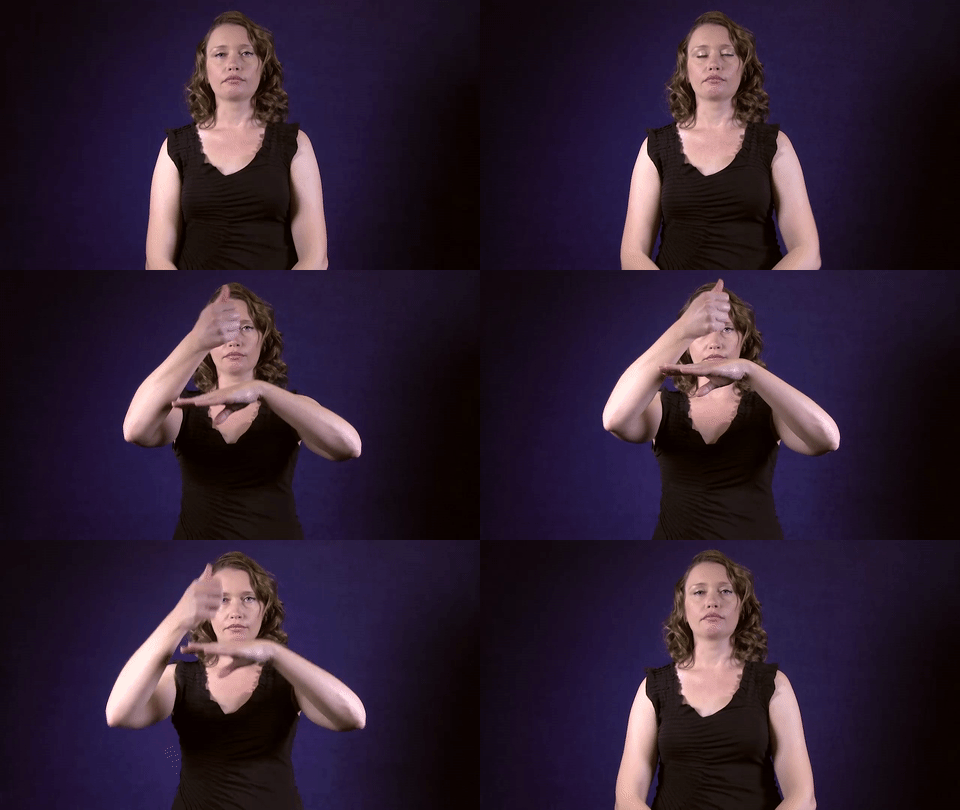
Sign for ATTIC in ASL | 🏡 ASL Dictionary

Definition: A space or room just below the roof of a building.

Sign for ATTIC in ASL

YouTube player

Practice Activities:

To practice the sign for attic in ASL, begin by signing it repeatedly while looking in a mirror. This helps with handshape accuracy and movement consistency. Try switching hands if you’re comfortable and repeat the motion multiple times to build muscle memory.

Use the sign for attic in ASL while labeling parts of a house. Walk around your home and sign objects like “door,” “window,” “roof,” and “attic” as you point to them. If possible, go near an attic entrance and practice signing it in context.

Create simple sentences using the sign for attic in ASL. Examples include: “My house has an attic,” “I put boxes in the attic,” and “The attic is hot in summer.” Sign these sentences slowly at first, then increase your speed while maintaining clarity.

Tell a short story involving an attic. Describe what might be stored there, such as old clothes, photo albums, or forgotten treasures. Try to include details about climbing up to the attic, opening boxes, and finding something special.

Practice with a partner by signing questions and answers. Ask each other: “Do you have an attic?” “What is in your attic?” and “Have you been in an attic before?” Take turns asking and responding using full ASL sentences.

Watch videos of native ASL signers using the sign for attic in ASL and try to match their sign speed and fluidity. If possible, record yourself signing and compare your technique to the video’s. Pay attention to handshape precision and movement direction.

Act out scenarios that involve an attic, such as pretending to carry a heavy box up attic stairs or searching through old decorations. This adds a real-world connection and reinforces memory through motion.

Cultural Context:

American Sign Language (ASL) includes a unique way to express the sign for attic in ASL, reflecting the cultural and linguistic heritage of the Deaf community. The sign for attic in ASL is based on a visual representation of the concept, using hand movements and space to indicate its location. In Deaf culture, using precise signs helps create clear and effective communication.

Attics are often associated with storage, old memories, or even secret hideaways, and signing this concept in ASL allows for easy discussion of these spaces. The sign for attic in ASL may vary slightly depending on regional dialects, but it retains a clear visual meaning. Understanding these variations shows respect for the nuances of ASL and the Deaf community.

When signing about homes and building features, it’s essential to use accurate ASL signs to prevent confusion. The sign for attic in ASL is commonly used when discussing house layouts, renovations, or even spooky stories about hidden spaces. Being able to sign this effectively enhances everyday conversations in ASL.

In many cultures, attics symbolize forgotten treasures or family heirlooms, making the concept important in storytelling. The sign for attic in ASL allows Deaf individuals to share their experiences, memories, or even ghost stories tied to this unique space. ASL storytelling brings visual elements to life, making signed narratives engaging and expressive.

Historic preservation and architecture discussions also frequently involve the sign for attic in ASL, especially when discussing older buildings. Many older homes have attics that serve as extra storage or even functional living areas, making this sign useful for describing home features. Whether discussing renovations or classic homes, having the right ASL vocabulary is essential.

Children’s stories and folklore often feature attics as mysterious and intriguing locations. Using the sign for attic in ASL helps Deaf children and adults engage in these stories with full visual representation. ASL enhances comprehension and connects Deaf audiences to these shared cultural experiences.

Home design and organization tips frequently include suggestions for attic storage and efficiency. The sign for attic in ASL is useful when discussing home organization strategies in ASL conversations. Being able to express such concepts in ASL supports accessibility in various discussions, from home improvement to interior design.

Seasonal conversations also make use of the sign for attic in ASL, especially when retrieving holiday decorations stored in upper spaces. It’s common to talk about packing or unpacking seasonal items, and this sign makes those discussions smoother. ASL allows for an expressive discussion of everyday tasks

Extended Definition:

The sign for attic in ASL represents the uppermost space in a house, typically used for storage. This unique sign visually conveys the concept of an attic by showing its position above the main living area. Understanding how to sign attic in ASL can help improve communication about home spaces and architecture.

Many houses have an attic that is accessible by ladder or stairs and may be used for storage or even converted into a living space. Using the correct ASL sign for attic allows for clear and effective conversation about household layouts. Whether discussing home design, renovations, or moving items into an attic, knowing this sign is useful.

To express the idea of an attic in ASL, the sign typically references its overhead location. ASL often uses spatial referencing to depict concepts visually, making the language highly expressive. The sign for attic helps clarify that it is a distinct area of the home, separate from living spaces below.

Some people may use an attic for extra storage, while others might convert it into an extra room. Learning the ASL sign for attic ensures smooth conversations about home organization plans. Whether describing home features or giving directions within a house, this sign can be extremely helpful.

Different homes have different types of attics, including unfinished spaces, crawl spaces, or fully converted rooms. The ability to sign attic in ASL allows for discussions about these variations, making it easier to describe different home designs. For those involved in real estate, construction, or moving, knowing this sign can enhance clarity in conversations.

The sign for attic can be useful when discussing home maintenance, such as fixing insulation or accessing stored items. Attics often require regular upkeep to prevent issues like mold, leaks, or inadequate ventilation. Using ASL to describe these maintenance needs makes it easier for sign language users to communicate about home care.

Many older homes have attics with unique architectural features, including exposed beams or antique design elements. Describing these details in ASL can help when sharing stories about historic homes or remodeling projects. Using ASL to talk about attic spaces makes conversations about architecture more engaging and precise.

Those learning ASL may find it helpful to practice signing different parts of a house, including attic, basement, and garage. Expanding vocabulary related to home layouts can improve fluency and confidence in ASL conversations. Understanding how to sign attic in ASL is a useful addition to everyday vocabulary.

Attics are often associated with mystery, hidden treasures, or childhood memories. Whether discussing a

Synonyms: loft, garret, upper floor, top story, roof space

Educational resources: Find related learning materials in our course bank!

Want more? Check out some of our popular learning activities on the homepage!

Need to look up a sign? Use our highly rated dictionary: https://aslinteractive.com/best-asl-dictionary/

Follow us on tiktok: https://www.tiktok.com/@aslinteractive. More social media links at the bottom of this page!

Long-tail Keywords: what is the sign for attic in asl, how to sign attic in american sign language, what does attic mean in sign language

Categories:

tags: Housing, Describing Residence, Facilities and other locations/needs, Objects in the Classroom, Language Learning

Parameters

*Handshape*:

The sign for ATTIC in ASL uses an “A” handshape, with the thumb extended and fingers folded down against the palm. The dominant hand moves in an upward circular motion near the forehead, representing the uppermost part of a house. This sign visually conveys the attic space while maintaining ASL’s spatial use. When signing the sign for ATTIC in ASL, ensure deliberate movement and proper hand positioning for clear communication.

*Palm Orientation*:

The sign for ATTIC in ASL typically uses a dominant hand in an “A” handshape with the palm facing downward. The hand moves in a small circular motion near the top of the forehead, indicating the elevated space of an attic. In some variations, both hands may be used, maintaining the same palm orientation while emphasizing the concept of an attic space. This motion helps convey the idea of an area above a home.

*Location*:

The sign for ATTIC in ASL is located in the space above your head, symbolizing the uppermost part of a house. The hand moves in a way that mimics the outline of an attic or a roof structure. Since an attic is typically positioned at the top of a building, the placement of the sign reinforces the spatial nature of its meaning in ASL.

*Movement*:

To produce the sign for attic in ASL, start with both hands in an open “5” shape. Position them above your head, palms facing downward. Move your hands slightly outward and upward, as if outlining the upper structure of a house. This motion visually represents the elevated space where an attic is typically found. The sign for attic in ASL effectively conveys the idea of a small room or storage area located at the top of a building.

*Non-Manual Signals*:

Facial expressions play an important role when using the sign for attic in ASL. Slightly raising the eyebrows can indicate curiosity or questioning, while a neutral face keeps the meaning straightforward. Tilting the head slightly upward can emphasize the elevated location of an attic.

Mouth movements may include mouthing “attic” to reinforce clarity, especially in mixed communication settings. A slight pursing of the lips can emphasize the small, enclosed space that an attic typically represents. When asking about an attic, widening the eyes can add emphasis to the question.

*Prosody, Dominant/Non-Dominant Hand*:

The sign for ATTIC in ASL uses the dominant hand in an “A” handshape, positioned near the forehead. The hand moves in a small upward motion, symbolizing the space above a house. The non-dominant hand is typically not used in this sign. Facial expression can emphasize size or depth if needed. This sign effectively captures the idea of an attic being an overhead storage area.

Tips for Beginners:

When learning the sign for ATTIC in ASL, focus on clear hand positioning and movement to ensure accuracy. The motion generally involves pointing or indicating the upper area of a house, so be mindful of where you place the sign in your signing space. Keep your movements fluid but not overly exaggerated to maintain natural, effective communication.

Beginners often struggle with spatial referencing in ASL, which is essential when signing about locations like an attic. Practice consistent placement by visualizing a house structure and positioning your hand where an attic would be. This technique helps reinforce meaning and clarity for others watching your sign.

Facial expressions play a crucial role when using the sign for ATTIC in ASL. If you’re describing a small attic, a concentrated or slightly scrunched-up face can emphasize the tight space. If it’s a spacious attic, a more neutral or open expression might be appropriate. Using facial expressions naturally will enhance comprehension.

Avoid rushing through the sign, as speed can lead to unclear hand movements. Watch yourself in a mirror or record videos to ensure precision. Compare your sign with native ASL speakers or instructional videos to refine your accuracy over time.

Context matters when using the sign for ATTIC in ASL, especially in conversation. If you’re explaining that something is stored in the attic, ensure the sign is incorporated smoothly into your sentence structure. Practicing with a language partner will help improve fluency.

Repetition and muscle memory are key to mastering any ASL sign. Incorporate the sign into daily practice by signing in front of a mirror, teaching it to a friend, or using it in casual conversation. Frequent use builds confidence and reinforces correct hand placement for effective communication.

Connections to Other topics:

The sign for ATTIC in ASL connects to the broader category of home and building-related signs. It shares similarities with signs like HOUSE, ROOF, and BASEMENT, as all relate to parts of a structure. Understanding the different signs for parts of a house helps in describing locations, home maintenance, and renovation concepts in ASL. This is particularly important for discussing home-related tasks, repairs, or storytelling about places.

In some conversations, the sign for ATTIC in ASL can be combined with other signs to form compound or descriptive phrases. For example, pairing ATTIC with the sign for STORAGE clarifies its common purpose as a place to keep extra belongings. Another common pairing is ATTIC with HOT or COLD to describe the temperature conditions of attics, which are often extreme. These combinations make descriptions more precise and relatable in everyday conversation.

Since the sign for ATTIC in ASL often functions as a spatial concept, it connects well with directional and locational signs. Using classifiers such as CL: B or CL: V in conjunction with ATTIC helps describe specific attic features like slanted ceilings or the placement of stored items. These classifiers enhance signers’ ability to provide visual and spatial accuracy in communication. Many ASL users rely on spatial language to describe the positioning of objects and areas in a house.

Additionally, ATTIC relates to storytelling and cultural references in ASL, especially in narratives that involve haunted houses or hidden treasures. Many ghost stories or childhood adventures in ASL include references to an attic, reinforcing its role as a significant location. When talking about hidden or forgotten spaces, ATTIC links to signs like SECRETS, HIDE, and OLD, which enhance the depth of a story. Mastering these connections helps build proficiency in discussing homes, structures, and spatial details in ASL.

Summary:

The sign for attic in ASL typically involves a handshape representing the roof of a house and indicating the higher location within a structure. Since an attic is an enclosed space at the top of a building, the sign often incorporates spatial awareness by raising the dominant hand above the head. This positioning reinforces the concept of something located at the uppermost part of a house.

Another possible way to convey attic in ASL is through fingerspelling, especially if the context requires specificity. Some signers may initialize the sign using the letter “A” before indicating the upper area, though this is less common. If communicating with an audience unfamiliar with the sign, fingerspelling can ensure clarity.

Since an attic is often associated with storage, old objects, and forgotten items, context plays a crucial role in signing. A signer might pair the sign for attic in ASL with other descriptive elements, such as the signs for “old,” “dusty,” or “storage.” This helps create a fuller picture of what is meant by the attic space, allowing for richer storytelling.

Classifiers are particularly effective in describing an attic in ASL. A classifier handshape, such as a bent “B” or flat “C,” may be used to illustrate the shape of an attic’s low ceiling or cramped space. The use of classifiers adds vividness to the description, making it more visually clear.

Attics are often depicted in literature and media as mysterious or nostalgic spaces. In storytelling, signers may modify their signing space to emphasize these ideas, effectively painting a mental picture for their audience. Altering facial expressions can also contribute to emphasizing whether the attic described is eerie, abandoned, or simply a storage space.

The grammatical structure of ASL allows for topic-comment sentence structure, which can help emphasize the attic. A signer might first establish the place by signing “house” and then indicate the upper space before providing more details about what is inside. This structure ensures clarity and keeps the visual elements of the storytelling strong.

The sign for attic in ASL connects conceptually to other spatial location signs such as “basement,” “roof,” and “closet.” Understanding how attics relate to these other spaces can help signers create contrasts, such as “The attic is dusty, but the basement is organized.” These comparisons enhance communication by giving a clear mental image.

The linguistic aspect of signing attic in ASL involves spatial indexing, where the location in space is crucial to the meaning. Raising the dominant hand above the head instead of signing near the chest or waist helps establish the appropriate placement in the signing space. Proper spatial referencing helps maintain coherency, especially in conversations or narratives.

Culturally, American homes often feature attics used for storage, forgotten memorabilia, or even hidden rooms. This cultural association means that signing attic in ASL may often carry connotations beyond just a simple space. Deaf storytellers and ASL users can incorporate these cultural understandings into their narratives, making their descriptions more relatable.

The sign for attic in ASL highlights the importance of perspective in Deaf storytelling. Unlike spoken language, ASL allows a signer to visually construct an entire scene, placing objects and people within the attic. This feature strengthens communication, making descriptions more immersive than simple spoken explanations.

Historical connections to attics bring rich meaning when signing the concept. For example, stories of people hiding in attics during certain historical events can influence how a signer presents this space. This may include more cautious or dramatic facial expressions, reflecting the emotional weight of the setting.

ASL’s spatial grammar enhances discussions about attics by allowing signers to build upon the concept flexibly. The attic in ASL can be signed first, followed by additional details such as pointing to where objects are placed within the attic. This use of visual-spatial techniques ensures clarity while maintaining linguistic structure.

When learning how to sign attic in ASL, practicing classifiers can be very beneficial. Since the shape, height, and function of an attic can vary, classifiers allow for detailed depictions beyond the base sign. This makes discussions more dynamic and visually interesting.

Certain regional variations may influence how attic in ASL is signed. Some Deaf communities may prefer using a specific classifier instead of a default lexical sign. Understanding regional preferences can enhance communication and ensure mutual understanding among signers.

The evolution of sign language means that new variations of attic in ASL may emerge over time. As signers develop new ways to describe specific architectural features, additional classifier-based or initialized forms of the sign might appear. This reflects ASL’s natural linguistic development.

Attics are sometimes used metaphorically in both spoken and signed language. Just as a person stores items in an attic, people may “store” memories or secrets in their minds. A signer discussing personal or metaphorical spaces may choose a modified version of attic in ASL to convey abstract meanings.

The connection between handshape and meaning in AS

Want more? Check out some of our popular learning activities!

ASL Interactive Resources

ASLInteractive YouTube Channel

Follow us on tiktok: @aslinteractive.com

Follow us on Instagram: aslinteractive

Facebook page: aslinteractive

Facebook group: aslinteractive

LInkedIn: ASL Interactive LLC

Twitter: @ASL_interactive

*Some information on this page is AI-generated. AI can make mistakes. Please check the information.

Sign for ATTIC in ASL

Responses