Sign for AUNT in ASL | 👩 ASL Dictionary

Definition: The sister of one’s father or mother.

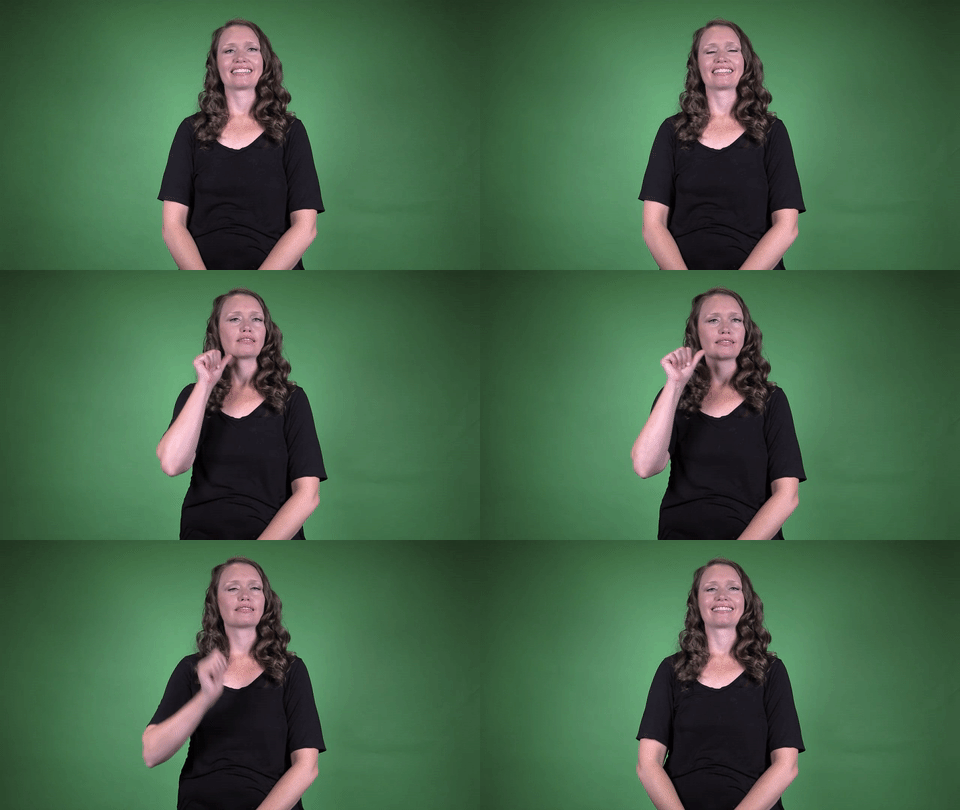
Sign for AUNT in ASL

YouTube player

Practice Activities:

To begin practicing the sign for AUNT in ASL, start by working on repetition drills in front of a mirror. Focus on the proper handshape, which is the letter “A”, and make sure you are moving the hand in a small circular motion near the side of your cheek. Practice this motion slowly at first, then increase your speed as you build confidence and accuracy.

Try using the sign for AUNT in ASL in short phrases like “my aunt”, “aunt lives far”, and “I visit my aunt”. Sign each phrase slowly, then try to increase fluency. Pay attention to facial expressions, especially when indicating emotions like love, happiness, or annoyance connected to your aunt.

Set up storytelling prompts such as, “Describe a fun memory with your aunt” or “Talk about what your aunt does for work.” Use a mix of fingerspelling and signed vocabulary, introducing family members and emotional connections. This helps reinforce context and expand your ASL expressive skills.

Practice identifying the sign for AUNT in ASL when watching ASL-focused videos or conversations. Pause and mimic the sign when you see it used. This will help with recognition and ensure appropriate hand movement and placement.

For partner activities, alternate asking and answering questions like “Do you have an aunt?”, “What’s your aunt’s name?”, or “Is your aunt funny?” Watch each other sign and provide constructive feedback on clarity, facial expression, and speed.

Use flashcards with family members and quiz yourself or a partner daily. Show the sign first and say the English word, or vice versa to test your receptive and expressive understanding. The more frequently you see and perform the sign for AUNT in ASL, the more naturally it will become a part of your everyday signing vocabulary.

Cultural Context:

The sign for aunt in ASL is more than just a gesture—it’s a representation of deep familial relationships in Deaf culture. Within Deaf communities, family connections are central to daily life, and communicating those relationships clearly is important. The sign for aunt in ASL helps convey those bonds through visual language.

This sign is typically used when referring to one’s parents’ sisters, and is often used in family storytelling or conversations about relatives. Since ASL is a visual and spatial language, the position and movement of the sign for aunt in ASL help differentiate it from signs for other relatives like uncle or cousin.

The sign for aunt in ASL is made with the dominant hand shaped like the letter “A” in fingerspelling. It is placed near the cheek and given a small twisting movement. Understanding how to use the correct motion and handshape is key to producing the sign authentically. Parents and teachers often teach this sign during early childhood to help children build vocabulary around family.

In Deaf culture, the word “aunt” often refers not only to biological or marital relations, but also to close family friends or mentors who serve in an aunt-like role. It’s common in ASL conversations to indicate closeness and respect through such signs. The sign for aunt in ASL acknowledges those deeper cultural meanings beyond biology.

Because storytelling is an important tradition in the Deaf community, using the correct sign for aunt in ASL contributes to clear and expressive communication when sharing memories or family history. The clarity of such signs enables the Deaf community to maintain strong family ties and cultural identity. Misusing or confusing signs can lead to misunderstandings, so learning the proper version of this sign is important.

From a linguistic point of view, placing the sign for aunt in ASL near the cheek connects it with other signs for female relatives. This spatial organization helps learners of ASL remember and categorize signs more efficiently. The sign for aunt in ASL is one of many signs in the visual grammar system that follows this pattern.

When Deaf children learn about their family trees in school or at home, signing terms like aunt, uncle, and grandparent becomes a central part of ASL education. Learning the sign for aunt in ASL also helps non-native signers or interpreters build a stronger vocabulary for family topics. Whether you’re learning ASL as a second language or teaching young learners at home, this sign is one of the early building blocks you’ll encounter.

For those attending Deaf events or interacting with Deaf families, using the

Extended Definition:

The sign for aunt in ASL is a common family-related sign that beginners often learn early when exploring American Sign Language. It is used to represent a female sibling of one’s parent, such as your mother’s or father’s sister. This sign fits into the larger category of family signs in ASL and helps users communicate more naturally in conversations about relatives and relationships.

To make the sign for aunt in ASL, you typically form the letter “A” from the ASL alphabet with your dominant hand. Then, move it in a small circular motion near your cheek. The location near the cheek is culturally associated with feminine family members in ASL, which helps differentiate the sign from similar male-based signs like uncle.

Because American Sign Language is a visual language, facial expressions and slight movement variations can add meaning to the sign. When signing aunt in ASL, a slight smile and a casual movement can show affection or familiarity. This nuance in expression gives life to conversations and helps express emotion, connection, and tone.

Learning the sign for aunt in ASL can help develop deeper conversations about family dynamics. Whether you’re talking about a holiday gathering, asking about someone’s relatives, or telling a story, knowing this sign increases fluency. It’s especially helpful for those working in educational or caregiving settings where family relationships frequently come up.

In ASL grammar, family members like aunt can be used both possessively and descriptively. You might sign my aunt when referring to a specific person or use the same sign in a general conversation about someone else’s relatives. Context, facial expressions, and the use of possessive signs like my or your help give complete meaning to the phrase. ‍♀️

The sign for aunt in ASL is also important for representation in storytelling and discussions involving genealogy. Many educators use it when teaching students about family trees in ASL. Parents and children learning together often find family signs like this one a bonding experience as they build their vocabulary and communication skills at home.

Including the sign for aunt in ASL in your regular practice helps reinforce memory. Some learners like to go over family signs daily using flashcards, videos, or conversational prompts. Becoming familiar with these signs also makes it easier to pick up regional variations or fingerspelled terms when used alongside the standard sign.

Understanding the grammar and structure of a phrase like sign for aunt in ASL also helps students recognize patterns in how ASL categorizes gender and relations. The visual placement of signs around the head,

Synonyms: auntie, aunty, tia, godmother, father’s sister

Educational resources: Find related learning materials in our course bank!

Want more? Check out some of our popular learning activities on the homepage!

Need to look up a sign? Use our highly rated dictionary: https://aslinteractive.com/best-asl-dictionary/

Follow us on tiktok: https://www.tiktok.com/@aslinteractive. More social media links at the bottom of this page!

Long-tail Keywords: what is the sign for Aunt in ASL, how do you sign Aunt in American Sign Language, learn how to sign Aunt in ASL

Categories:

tags: Family, Relationships, People, Language Learning, ASL

Parameters

*Handshape*:

The handshape for the sign for AUNT in ASL uses the letter “A” handshape , where the fingers are curled into a fist and the thumb is extended along the side. This handshape remains consistent throughout the motion of the sign.

To perform the sign for AUNT in ASL, position the “A” handshape near the cheek, typically on the side of the face, and make a small circular or twisting motion. This simple handshape is essential for recognizing and producing the sign accurately.

*Palm Orientation*:

The palm orientation for the sign for AUNT in ASL is typically outward, with the palm facing slightly to the side or away from the signer’s body. The dominant hand forms the letter “A” from the manual alphabet and moves in a small circular motion near the cheek.

This natural orientation ensures visibility and clarity when expressing the sign for AUNT in ASL. Maintaining consistent palm orientation enhances the sign’s effectiveness and accuracy.

*Location*:

The sign for AUNT in ASL is made at the side of the face, specifically near the cheek or jawline on the dominant side. The location is consistent with other female family signs, indicating a gender-related space in ASL grammar.

To form the sign for AUNT in ASL, make the handshape of the letter “A” and move it in small circles beside the cheek. This facial-area placement is essential for distinguishing the sign from other family-related terms.

*Movement*:

The sign for AUNT in ASL begins with the dominant hand in the “A” handshape, held near the side of the cheek, close to the jawline. The hand makes a small circular or twisting motion forward near the cheek area ‍♀️.

This sign stays in the area designated for female family signs, near the lower side of the face. The movement helps visually distinguish the sign for AUNT in ASL from other similar family-related signs.

*Non-Manual Signals*:

When using the sign for AUNT in ASL, the facial expression is typically neutral or slightly friendly, reflecting a calm or affectionate tone. There’s no exaggerated emotion involved unless context calls for additional feeling, such as excitement or sarcasm.

Maintain direct eye contact and natural posture while signing. Since the sign for AUNT in ASL relates to family, a soft, approachable demeanor helps convey warmth and familiarity .

*Prosody, Dominant/Non-Dominant Hand*:

The sign for AUNT in ASL uses the dominant hand forming the letter “A” handshape. The hand moves in a small circular motion near the side of the cheek or jawline, typically on the right side for right-handed signers. The non-dominant hand remains passive and uninvolved in this sign .

This sign is commonly produced with a subtle, friendly expression. To clearly communicate the sign for AUNT in ASL, ensure the handshape and movement near the cheek are precise and natural within the conversational flow.

Tips for Beginners:

When learning the sign for AUNT in ASL, it’s important to first focus on handshape and location. This sign uses an “A” handshape, with the thumb extended and the rest of the fingers closed. The motion happens at the side of your face near the cheek or upper jaw, which helps to distinguish it from similar signs like UNCLE, which is signed at the forehead. Make sure your hand doesn’t block your face and that the movement stays small and controlled.

Beginners often confuse the positioning or mirror the hand unintentionally. Be sure to use your dominant hand and keep the movement smooth. Practicing in front of a mirror helps adjust the angle and ensure the sign looks natural. Also, some learners tend to sign too close to the chin or jaw, which can shift the sign’s meaning or make it unclear. Keep your hand just at the cheekbone or slightly above.

To improve fluency with the sign for AUNT in ASL, try pairing it with related family signs like UNCLE, MOTHER, and GRANDMOTHER. This context helps your brain remember better and reinforces the differences. It’s also helpful to use this sign in real-life practice sentences, such as signing “My aunt is visiting” or “That is my aunt” in ASL structure.

Avoid overemphasizing the motion—small, deliberate circles or small twists work better than wide or exaggerated ones. Keep your facial expressions relaxed and appropriate to the context of what you’re signing. A warm or neutral expression often fits best when discussing family members.

Repetition and patience are key. Watch native signers and try recording yourself to compare. With enough practice, you’ll be able to use the sign for AUNT in ASL comfortably and accurately in conversations.

Sign for AUNT in ASL, Sign for AUNT in ASL learning, Sign for AUNT in ASL practice, how to Sign for AUNT in ASL, learn Sign for AUNT in ASL

Connections to Other topics:

The sign for AUNT in ASL is closely linked to the gender-specific family signs in Deaf culture and language. It taps into a larger structure of signs that distinguish relatives by both gender and location on the face. Like UNCLE, which is signed near the forehead, AUNT is signed near the chin—this spatial distinction helps users quickly identify roles and relationships.

Understanding the sign for AUNT in ASL opens up pathways to learning about other familial role signs such as COUSIN, which varies in position depending on gender, and GRANDMOTHER, which is located at a lower facial point with movement outward. The positional system used in the sign for AUNT in ASL reinforces ASL’s visual-spatial modality and shows how native signers organize concepts using the body’s anatomy. This spatial aspect is a cornerstone of ASL grammar and can be seen in classifiers and directional verbs as well.

The sign for AUNT in ASL also serves as a base component in larger, descriptive phrases that combine relational identity with modifiers. For example, signing MY AUNT FROM CALIFORNIA utilizes a blend of family vocabulary with geographic place names, enriching context. Similarly, signers might compound it with descriptors like SINGLE or DEAF to add specificity, creating more meaningful exchanges.

Learning how to recognize and produce the sign for AUNT in ASL supports better comprehension of broader family-related content and conversations. It also connects to cultural topics, such as family hierarchy and respect, which are often more explicitly demonstrated in ASL through facial expressions and non-manual markers. Knowing how to contextualize and compound signs like AUNT helps learners build more natural and fluent communication. Understanding these connections enables a deeper grasp of ASL beyond vocabulary into its richly layered syntax and storytelling techniques.

Summary:

The sign for AUNT in ASL involves using the dominant hand in the shape of the letter “A” from the ASL fingerspelling alphabet. The “A” handshape is held beside the cheek, usually near the lower side of the face, and moved in a small circular or twisting motion. This movement helps differentiate it from other familial signs that may share similar handshapes or positioning.

The location of the sign for AUNT in ASL—near the chin or cheek area—reflects how gender is encoded in ASL grammar. Signs that relate to female family members are made around the lower half of the face, while those referring to male family members are produced near the upper part of the face, typically the forehead. This spatial grammar system is a unique aspect of sign language linguistic structure.

In American Deaf culture, family signs like the sign for AUNT in ASL serve not just a grammatical purpose but carry deep relational and cultural meaning. Familial titles reflect more than just biological relationships; they often indicate closeness, roles within family units, and personal experience. ASL users may refer to close family friends as “aunt” or “uncle,” indicating a broader, more inclusive definition of kinship.

The twist of the “A” hand near the cheek not only identifies the word but also provides a mnemonic for users learning ASL. The first letter of the English word corresponds with the handshape, a helpful linguistic bridge for hearing learners or CODAs (Children of Deaf Adults). This morphological consistency is common across many family signs in ASL.

The sign for AUNT in ASL shares similarities with other family signs such as UNCLE and COUSIN. The primary differentiator between UNCLE and AUNT is their location—UNCLE is signed near the forehead using a “U” handshape, while AUNT is near the cheek with an “A.” This visual-spatial distinction supports ASL’s reliance on the three-dimensional space of signing for semantic precision.

In more animated or expressive use, native signers may modify the sign for AUNT in ASL with facial expressions or repeated motion to show fondness, surprise, or connected storytelling. This reflects the visual nature of the language where non-manual markers—facial expressions, body shifts—add depth to the lexical sign.

The sign for AUNT in ASL generally remains consistent, but there may be regional or dialectal variations. Deaf communities across different states or even neighborhoods sometimes create and pass on slight changes in a sign’s motion or position. In highly tight-knit communities, one might even see personalized signs for specific aunts, especially in storytelling or family-based narratives.

In storytelling or literary ASL, the sign for AUNT in ASL may be part of a larger sequence using classifiers and role-shifting. For example, when telling a story about spending time with an aunt, a signer might shift their body to represent the aunt’s perspective. This dynamic use of the language adds dramatic contrast and detail to the narrative.

When used in ASL sentences, the sign for AUNT in ASL follows general ASL grammar rules where topic-comment structure predominates. For instance, to say “My aunt is funny,” you would sign “MY AUNT FUNNY” in ASL order. Possessive signs or pronouns like “MY” are often used at the beginning for clarity and emphasis.

The relationship between spoken English and ASL is not always direct, but many signs for family terms, including the sign for AUNT in ASL, are initialized. Initialization refers to the practice of using a fingerspelling alphabet letter that corresponds to the English word’s first letter to form the sign. While this provides easy access for English users, some purists argue it reflects English influence on ASL grammar.

The sign for AUNT in ASL is often one of the early family signs taught to beginners. Because it uses a clear handshape and basic movement, it’s widely considered an entry-level sign suitable for language acquisition in both children and adults. It’s frequently seen in ASL curriculums, baby sign language guides, and visual flashcards.

Applied linguistics studies on ASL often examine signs like the sign for AUNT in ASL to better understand iconicity in language. The choice of “A” for aunt and its placement near the face shows a degree of iconic logic—linking form and meaning. This connection helps reinforce language memory and acquisition efficacy in Deaf education programs.

Interpreters handle the sign for AUNT in ASL in both conversational and formal interpreting settings. In religious, educational, or legal settings, consistent and culturally appropriate usage of family signs, including AUNT, is crucial. Family dynamics and labeling have significant implications in medical and therapy scenarios.

Comparing ASL to other signed languages, the concept and sign for AUNT may differ significantly. British Sign Language (BSL), for instance, does not use the exact same facial location

Want more? Check out some of our popular learning activities!

ASL Interactive Resources

ASLInteractive YouTube Channel

Follow us on tiktok: @aslinteractive.com

Follow us on Instagram: aslinteractive

Facebook page: aslinteractive

Facebook group: aslinteractive

LInkedIn: ASL Interactive LLC

Twitter: @ASL_interactive

*Some information on this page is AI-generated. AI can make mistakes. Please check the information.

Sign for AUNT in ASL

Responses