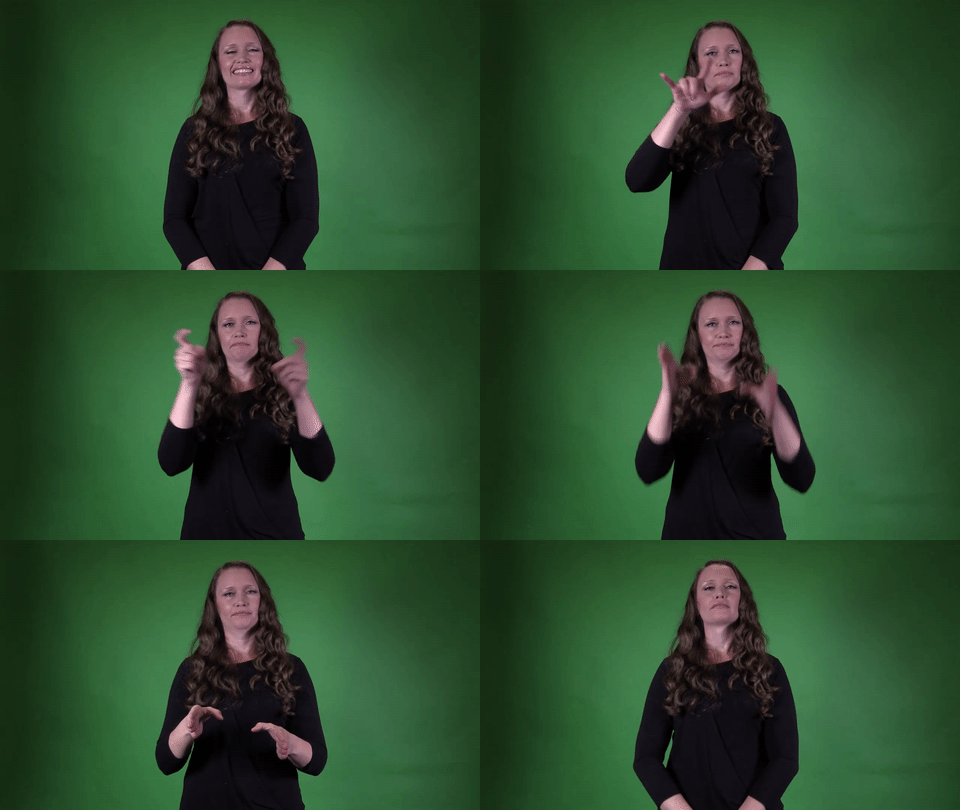
Sign for AVIATOR in ASL | ✈️ ASL Dictionary

Definition: A person who flies an aircraft.

Sign for AVIATOR in ASL

YouTube player

Practice Activities:

To practice the sign for AVIATOR in ASL, begin by isolating the sign itself. Stand in front of a mirror and repeat the sign slowly, focusing on handshape, movement, location, and facial expression. Repeat the sign ten times in front of the mirror, ensuring each repetition is clear and precise.

Next, try using the sign for AVIATOR in ASL in short phrases. For example, “My uncle is an aviator,” or “That aviator flew across the country.” Practice these phrases while signing slowly and clearly. Gradually increase your signing speed while maintaining accuracy.

Create a short storytelling prompt where an aviator is the main character. For instance, describe an aviator flying through a storm or helping with a rescue mission. This helps practice sequencing and incorporating the sign for AVIATOR in ASL into a broader narrative context. Aim to use the sign more than once throughout your story.

Partner with another learner and take turns asking and answering questions like, “Do you want to be an aviator?” or “What do aviators do?” Use role-play activities where one partner is a reporter interviewing an aviator. This encourages dynamic and conversational practice with the sign.

Watch a short video about aviation and then summarize it in ASL, using the sign for AVIATOR multiple times. Pause the video each time you spot a reference to an aviator and sign that part aloud. This reinforces comprehension and recall.

Create flashcards with occupations, including the sign for AVIATOR in ASL. Mix them up and sort the cards based on professions that involve travel. Say and sign each one as you go, then explain each occupation in a sentence using ASL.

Lastly, record yourself using the sign in a complete sentence or story and watch the clip. Self-assess clarity and fluency, or ask feedback from a teacher or fluent signer.

Cultural Context:

In American Sign Language (ASL), the sign for aviator reflects both the practical and cultural aspects of the Deaf community’s connection to air travel and aviation professions. The sign for aviator in ASL embodies more than just a job title; it signals historical representation, access, and visibility in the skies. For many in the Deaf community, using the correct and culturally accurate sign showcases respect and awareness of Deaf contributions to various fields, including aviation.

The sign for aviator in ASL often combines the sign for airplane with a personified gesture to indicate a profession. This culturally rich structure mirrors how other professions are signed in ASL. The way ASL incorporates specific roles like aviator reinforces the language’s precision and detail in presenting complex concepts visually and spatially.

Culturally, aviators have long been symbols of exploration and freedom. In the Deaf community, this translates to a powerful image of breaking barriers and overcoming communication restrictions. Seeing Deaf aviators or learning the sign for aviator in ASL not only motivates young Deaf individuals, but also highlights opportunities where Deaf professionals excel.

Representation matters. Sharing and teaching the sign for aviator in ASL on digital platforms increases access and helps reduce language barriers. It enables more inclusive classrooms, aviation programs, and professional environments for Deaf individuals interested in aerospace and flight.

Deaf culture values visual learning and expression, and the sign for aviator in ASL is a perfect example of how abstract and specialized terms can be naturally integrated into daily dialogue. Signing about careers like aviator allows young people in the Deaf community to visualize their futures in fields that once seemed out of reach due to communication limitations. Increasing familiarity with terms like aviator in ASL fosters confidence and inclusion.

For teachers and interpreters, knowing the accurate sign for aviator in ASL strengthens communication in both educational and professional settings. It also acknowledges that the aviation industry, like many others, must evolve to include Deaf professionals. This small but powerful sign becomes a means of access, advocacy, and elevation for the Deaf community.

There is also a growing population of Deaf pilots and aviation enthusiasts. Learning or using the sign for aviator in ASL affirms their presence in a space where hearing individuals typically dominate. Using culturally appropriate signs when talking about aviation gives Deaf professionals the recognition and respect they deserve.

The use of the sign for aviator in ASL also plays an educational role in media, workshops, and career counseling aimed at Deaf youth. It provides accessible content, encourages career

Extended Definition:

The sign for aviator in ASL is a unique and visually descriptive sign used to represent someone who pilots an aircraft. In American Sign Language, this sign often incorporates the concept of flying combined with the general sign for a person, making it intuitive and easy to connect with its meaning. The sign for aviator in ASL is commonly used in educational settings, aviation discussions, and when introducing job titles.

To sign aviator in ASL, you typically begin with gestures that refer to flying, such as imitating the movement of an airplane with hands extended. The sign may also include elements of goggles or a helmet, symbolizing the profession. After depicting flight, the sign is often followed by a generic person classifier to indicate that the subject is a person involved in aviation.

The sign for aviator in ASL is used across age groups and is recognized in both formal and informal conversations. When children learn signs for occupations, this sign helps them understand different roles in the community, especially in STEM-related careers. It’s also a popular sign in ASL classrooms when discussing dreams or future careers.

Cultural context can influence how the sign for aviator in ASL is used. For example, when discussing historic aviators like the Wright brothers or Amelia Earhart, the sign is enhanced with facial expressions and storytelling elements that enrich the conversation. Storytelling is an important part of Deaf culture, and using signs like aviator encourages interactive and visual learning.

ASL users benefit from learning occupational signs, not only for communication but also for building vocabulary across topics such as transportation, history, and science. The sign for aviator in ASL fits naturally in these themes and supports broader discussions. It can be paired with related signs like airplane, flight, and travel to help learners build complex sentences in ASL.

In Deaf or hard-of-hearing communities, the sign for aviator in ASL may also come up during travel plans, movie discussions, or when talking about family members who work in the field of aviation. It’s a versatile sign that helps bridge many kinds of conversations. When performed with clarity, this sign helps communicators stay precise and inclusive.

For those learning ASL as a second language, practicing the sign for aviator in ASL helps reinforce directionality and classifiers in sign language. Since the motion involves showing direction or path of travel, it can also be a great example of how verbs and nouns are visually represented in ASL. Adding it to your vocabulary widens your ability to talk about

Synonyms: pilot, airman, flyer, aviatrix, aeronaut

Educational resources: Find related learning materials in our course bank!

Want more? Check out some of our popular learning activities on the homepage!

Need to look up a sign? Use our highly rated dictionary: https://aslinteractive.com/best-asl-dictionary/

Follow us on tiktok: https://www.tiktok.com/@aslinteractive. More social media links at the bottom of this page!

Long-tail Keywords: what is the sign for aviator in ASL, how do you sign aviator in ASL, ASL sign for aviator

Categories:

tags: Aviation, Transportation, Occupations, Clothing, Accessories

Parameters

*Handshape*:

The handshape for the sign for AVIATOR in ASL typically starts with both hands forming the modified “C” handshape near the eyes, resembling aviator goggles . The fingers are curved with the thumbs and index fingers forming half circles as if outlining small round goggles.

This sign for AVIATOR in ASL uses this handshape to visually represent the iconic eyewear of a pilot. After the goggle gesture, it often transitions into the sign for “pilot” or “fly” to complete the concept.

*Palm Orientation*:

For the sign for AVIATOR in ASL, the palm orientation typically begins with both hands in a modified “C” shape, facing inward toward the head. This mimics the shape of aviator goggles and is placed near the eyes or forehead.

Following this, the hands may shift outward or transition into a sign representing “person” or “pilot,” with palms often facing down or in neutral position depending on the variation. The sign for AVIATOR in ASL emphasizes clear, consistent palm orientation to convey the concept effectively. ️

*Location*:

The sign for AVIATOR in ASL is typically located in the area around the forehead and mid-face, representing the traditional location of a pilot’s goggles or helmet. The movement may start near the eyes or temple area and incorporate gestures that simulate goggles or gear associated with flying.

When signing the concept, the signer’s hands remain close to the head to symbolize the aviator’s equipment. The sign for AVIATOR in ASL stays within the neutral space slightly in front of the face, transitioning fluidly depending on whether a classifier or related aviation sign follows. ️

*Movement*:

The sign for AVIATOR in ASL typically begins with the sign for AIRPLANE, made by extending the thumb, index, and pinky fingers of your dominant hand in a “Y”-like shape and moving it forward in a short arc to mimic a plane taking off.

Then, transition into the agent suffix by bringing both open flat hands down from the shoulder area, palms facing each other, moving downward parallel about shoulder-width apart. This combination conveys both the concept of flying and the role of the person. The sign for AVIATOR in ASL emphasizes both action and profession. ‍✈️

*Non-Manual Signals*:

The non-manual signals for the sign for aviator in ASL usually involve a focused or adventurous facial expression, often paired with slightly raised eyebrows to convey involvement or action. Depending on context, users may include puffed cheeks or a slight head tilt forward to suggest movement or flight. ️

Facial expression helps underscore the role and seriousness of an aviator. These cues are especially important to differentiate the sign for aviator in ASL from related signs like pilot or airplane.

*Prosody, Dominant/Non-Dominant Hand*:

The sign for AVIATOR in ASL typically uses the dominant hand to form the sign for “fly” followed by the sign for “person.” The dominant hand, usually in the “I-L-Y” handshape, moves forward from the mouth as if indicating a small plane taking off. The non-dominant hand often remains still or neutral during the “fly” portion, then both hands trace downward along the sides of the body in parallel to indicate a person.

This combination visually emphasizes both the act of flying and the identity of the person. The sign for AVIATOR in ASL effectively conveys the concept of someone who operates an aircraft, with clear role depiction using hand movement and body space.

Tips for Beginners:

When you’re learning the sign for AVIATOR in ASL, it’s important to focus on both clarity and context. This sign is typically a compound of the sign for FLY or PLANE and the PERSON-marker, usually represented by a downward motion of both flat hands along the sides of your body. Keep movements clean and deliberate to make sure you’re understood, especially when combining multiple concepts into one sign.

One helpful tip for beginners is to practice the first part of the sign, which represents aviation or flying. Be sure the handshape and movement are consistent with the common plane gesture—typically, the “I-L-Y” handshape mimicking a small plane moving forward. If your handshape is too loose or your motion too erratic, people may not understand you’re referencing aviation.

After establishing the flying-related component, add the person-agent marker smoothly. This helps indicate the human role associated with the action, turning “fly” into “aviator” or “pilot.” Make sure the transition between parts of the compound sign is seamless, without pausing too long between them. A choppy delivery can confuse the meaning or seem unnatural.

Facial expressions also enhance comprehension when signing complex job titles like the sign for AVIATOR in ASL. You might accompany the sign with an inquisitive face if you’re asking a question, or a proud look when talking about someone’s profession. Context in conversation and visual cues are key in ASL communication.

Another good strategy is to mirror native signers or ASL instructors. Watch how they sign the word in natural settings and mimic the confidence and flow of their delivery. Practicing regularly in front of a mirror or recording yourself can help you find areas to improve while reinforcing good habits. The more you integrate the sign for AVIATOR in ASL into daily use, the more naturally it will come to you during conversations.

Connections to Other topics:

The sign for AVIATOR in ASL is closely tied to the signs for AIRPLANE and PILOT, making it helpful to understand these foundational signs first. AVIATOR often incorporates the concept of flight and profession, commonly formed by combining the AIRPLANE handshape with the AGENT marker that denotes a person who performs an action. This mirrors how other occupational signs are created, such as TEACHER (from TEACH + AGENT) and DOCTOR (from MEDICINE + AGENT), helping learners establish a pattern in ASL structure.

Understanding the sign for AVIATOR in ASL also provides insight into the linguistic tendency of ASL to express abstract professions visually and conceptually. For instance, AVIATOR may be depicted using a brief mime of piloting motion combined with the professional suffix. This approach aligns with how signs in ASL often blend visual storytelling with linguistic markers to create a vivid, meaningful concept.

The sign’s relation to other travel and transportation terms also enriches comprehension. Signs like AIRPORT, FLIGHT, and TRAVEL all connect thematically with AVIATOR and often appear in the same conversations or narratives. When discussing someone’s job or a context involving aviation, such as describing a flight pattern or trip, AVIATOR serves as a crucial lexical element linking the discussion to a specific human role.

In storytelling or when giving biographical information in ASL, the sign for AVIATOR in ASL can be paired with location signs, like MILITARY, NAVY, or SPACE, depending on the type of aviator being referenced. This function makes the sign adaptable and reinforces the importance of context in shaping meaning in ASL. Such adaptability places the concept within a wider grammatical system of classifiers, role-shifting, and spatial referencing used throughout the language. ✈️ ‍✈️

Summary:

The sign for AVIATOR in ASL involves combining the concept of “airplane” or “pilot” with the signer’s body to embody someone who flies. Typically, it’s derived from the sign for AIRPLANE along with the AGENT marker, showing the identity of a person who flies an aircraft. This sign draws on ASL’s morphological ability to layer meanings visually.

To begin the sign, both hands form the ILY-handshape (palm out), referencing the unique hand configuration associated with aircraft or the wings of a plane. The hands are then moved forward from near the shoulders outward, mimicking the motion or silhouette of an airplane taking flight. This portion corresponds to the sign for AIRPLANE.

Following this, the AGENT marker is added: both flat hands (B-handshape) move downward from the sides of the chest, suggesting a person involved professionally. When placed after the AIRPLANE motion, it identifies someone whose job is centered around flight—an aviator. Thus, AIRPLANE + AGENT gives us the sign for AVIATOR in ASL.

The sign for AVIATOR in ASL leans into ASL’s classifier-rich nature. It allows visualization of both concept and profession. Through the use of space, handshape, and motion, the concept of flying and piloting is transformed into a personified idea. ASL naturally does this with many profession-based terms.

Grammatically, this compound sign functions as a noun, aligning with ASL’s SVO (Subject-Verb-Object) sentence structure when used in a sentence. For example, “HE AVIATOR HE” could be the start of introducing someone who flies planes. Time and facial grammar often complete the context, contributing to temporal and emotional meaning.

The cultural resonance of pilot-themed signs is strong, especially in a post-Wright Brothers world where aviation symbolizes freedom, innovation, and adventure. The sign for AVIATOR in ASL channels those same feelings through visual space. Its performance suggests a narrative that includes movement and control, both of which aviators embody.

One notable element is how ASL refrains from relying on complex derivational morphology, instead opting for modular, visual compounds. The AIRPLANE + AGENT construction is a perfect case study. Many users learn the AGENT marker through repeated exposure with signs like TEACH-AGENT (teacher), WRITE-AGENT (writer), and later understand how it extends meaning systematically.

The sign for AVIATOR in ASL connects deeply to aviation history. It evokes images of Amelia Earhart, Bessie Coleman, and Captain Sully—icons who defined their time in the sky. In Deaf culture, using aviation-related signs could symbolize not only profession but independence and courage.

Related signs include PILOT, which may be signed slightly differently depending on region or context, and AIRPLANE on its own, which is universally understood in ASL. Some signers may fingerspell AVIATOR when addressing formal topics like history, legacy, or legal documentation. Still, the compound sign remains the preferred colloquial expression.

Linguistically, the incorporation of classifiers in this sign is valuable. Both the AIRPLANE movement and the AGENT morphology speak to ASL’s strong classifier-based grammar. The performance of movement in space permits abstraction—allowing a person’s profession to be depicted, not just named.

From a language acquisition perspective, the sign for AVIATOR in ASL helps learners discover how nouns and agents are formed. By combining highly visual elements, the learner begins to understand the modular nature of ASL where concepts are built layer by layer. This aligns with cognitive theories of visual-spatial language learning.

Applied linguistics research into signs like this underscores the importance of compounding and non-manual markers. A signer communicating “AVIATOR” almost certainly adds raised eyebrows or a nod to draw focus or assert topic relevance. These cues introduce layers of pragmatic function to what might seem like a simple noun.

Deaf pilots exist and actively contribute to the aviation industry, highlighting the importance of making signs like AVIATOR accessible and widely used. Signing this concept in ASL not only conveys the profession but also affirms Deaf identity in a space traditionally dominated by hearing narratives.

The aviation metaphor has often been used in the ASL community to explain life journeys. To say someone is “an aviator” can be both literal and metaphorical. It can reflect someone who moves independently, soars high academically or socially, or who breaks norms and boundaries.

Register and formality also affect usage. While the sign for AVIATOR in ASL is understood within casual conversations, environments like legal or medical interpreting may require fingerspelling or accompanying classifiers for clarity. Context determines how much expansion is necessary.

The visual rhetorical power of this sign makes it useful in storytelling. In narratives, especially those involving war, technology, or travel, using the sign for AVIATOR in ASL allows for strong character identification. It conveys prestige, skill, and motion

Want more? Check out some of our popular learning activities!

ASL Interactive Resources

ASLInteractive YouTube Channel

Follow us on tiktok: @aslinteractive.com

Follow us on Instagram: aslinteractive

Facebook page: aslinteractive

Facebook group: aslinteractive

LInkedIn: ASL Interactive LLC

Twitter: @ASL_interactive

*Some information on this page is AI-generated. AI can make mistakes. Please check the information.

Sign for AVIATOR in ASL

Responses