Sign for B in ASL | 🅱️ ASL Dictionary

Definition: The second letter of the alphabet.

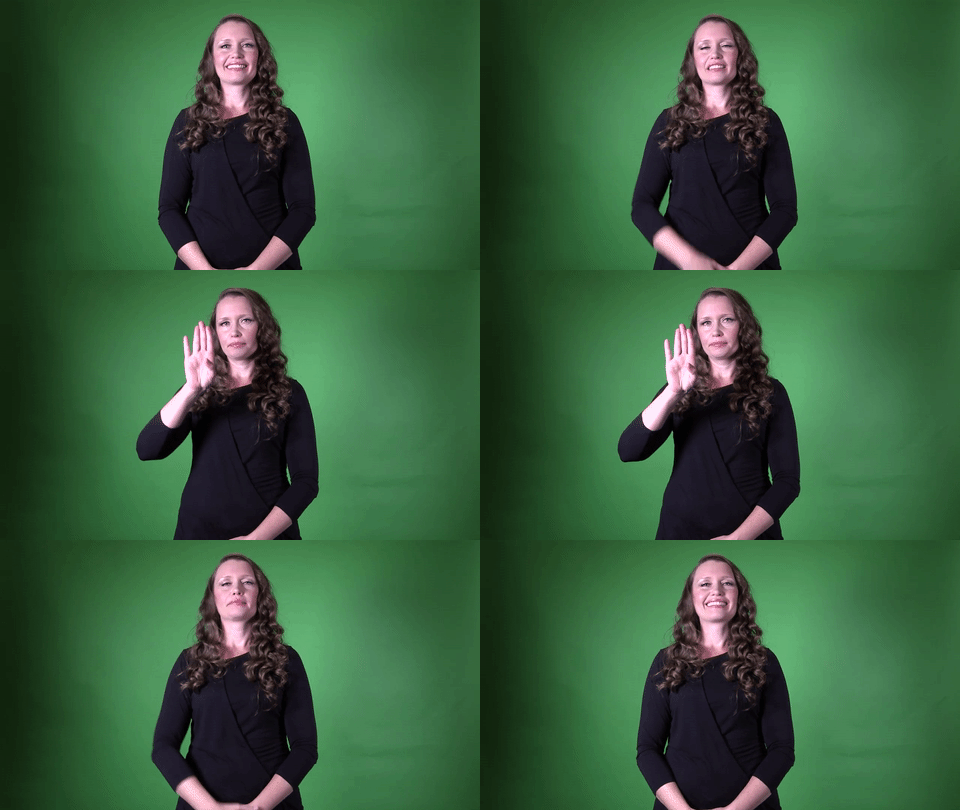
 Sign for B in ASL

YouTube player

Practice Activities:

To build fluency with the sign for B in ASL, begin with isolated handshape drills. Stand in front of a mirror and form the B handshape repeatedly, focusing on keeping your fingers together and straight with the thumb crossing the palm. Practice holding it at different angles to ensure clarity and accuracy.

Try signing the ASL alphabet from A to E with special attention to the transition from A to the sign for B in ASL. This helps reinforce fluid motion between handshapes and strengthens memory through repetition. Next, practice finger spelling simple words that begin with B, such as ball, book, and bird. Fingerspell slowly at first, and then increase speed as accuracy improves.

Use flashcards featuring pictures or words that start with the letter B. When shown one, respond by first producing the sign for B in ASL, then fingerspelling the entire word. Try this with a partner to simulate real-time communication. Turn it into a game by timing how fast each person can respond.

In a storytelling prompt, create a short narrative that includes several words that start with the letter B such as baby, bat, or bike. Introduce the story with the sign for B to emphasize its use before beginning the full description. For example, “B is for bike. A boy rides his bike to the big park.”

For group practice, form a circle where each participant takes turns fingerspelling a B-word while starting with the sign for B in ASL. This helps build group engagement and confidence under social settings. You can also include the sign in creative drawings where each element in the picture begins with B, encouraging students to pair visual cues with signs. Add expressive facial cues to make the sign even more distinct and meaningful in various contexts.

Cultural Context:

The sign for B in ASL holds both linguistic and cultural meaning within the Deaf community. Knowing individual letter signs, like the sign for B in ASL, is essential for fingerspelling names, places, or words that don’t have a standard sign. Fingerspelling plays a unique and powerful role in American Sign Language, allowing clear communication and spelling out specific terms with accuracy.

Learning the sign for B in ASL introduces new learners to the handshape alphabet used in ASL. The handshape for the letter B is commonly used not only in alphabet spelling but as a component in many compound signs. This foundational knowledge is crucial for building fluency in ASL, especially for beginners who are developing their fingerspelling skills.

In Deaf culture, being able to fingerspell accurately, including the sign for B in ASL, shows respect and a willingness to communicate clearly. Proper form, such as hand orientation and placement in the correct signing space, is a key part of using fingerspelling politely and effectively. It’s not just about making the sign—it’s about connecting with others using the same visual language.

The sign for B in ASL may also appear in name signs, which are personalized signs given to individuals who frequently interact with the Deaf community. These name signs often include the first letter of a person’s name combined with a specific movement or location on the body, so the letter B can be part of a unique identity marker. Understanding the sign for B in ASL helps when interpreting or assigning such signs within the community.

Fingerspelling, especially with correct use of letters like the sign for B in ASL, is also an important tool for bridging communication gaps. When a signer doesn’t know the sign for a word, spelling it out lets the conversation continue smoothly. This adaptability supports clear understanding between new learners, fluent signers, and hearing individuals alike.

From a cultural standpoint, mastering the sign for B in ASL shows attentiveness to spelling-based communication. In Deaf education and storytelling, fingerspelling often adds detail to meanings, signaling a deep connection to language and literacy. The gesture for B becomes more than just a letter sign—it strengthens both expression and comprehension.

Visual accuracy in forming the sign for B in ASL is key to learning the ASL alphabet correctly. The Deaf community values clear and expressive communication, and getting the letter signs right is part of that shared value. Practicing each letter allows smoother communication and better connection during everyday interactions in ASL

Extended Definition:

The sign for B in ASL is a foundational handshape used in both the manual alphabet and in many other signs throughout American Sign Language. This handshape is important for spelling words and names using fingerspelling, especially when communicating with or about people who are deaf or hard of hearing. Learning how to form the B handshape correctly is a key step in becoming fluent in ASL.

To make the sign for B in ASL, start by extending all four fingers straight up while keeping them together. Your thumb should be tucked across your palm, resting against the bottom of your hand. The fingers should be completely straight and the palm should face forward, away from the body. This handshape is static, meaning the position stays still while spelling the letter.

The B handshape appears not only in the manual alphabet but also in other commonly used signs in ASL. For example, signs like blue, bathroom, and brother all use the B handshape as part of their sign construction. This makes understanding and mastering the sign for B in ASL even more useful for daily conversations.

When teaching young children or beginners, the B handshape is often one of the first they learn. Because it’s easy to form and visually clear, it helps learners gain confidence in recognizing and producing signs. Consistent practice with fingerspelling the alphabet helps reinforce the shape and orientation of each letter, including B.

The sign for B in ASL can also be used while fingerspelling proper nouns, such as names of people, places, or brands. In these cases, B serves as a building block to form full words, allowing for accurate and respectful communication. Understanding the fingerspelling system, which includes the sign for B, adds depth to your overall comprehension of ASL.

Cultural awareness is also important when using the sign for B in ASL. Signs, including letters of the alphabet, can have different meanings depending on the region or context. Practicing with fluent signers or viewing video demonstrations can help learners grasp not just the correct handshape, but also the rhythm and flow of natural ASL use.

In ASL classes or workshops, instructors often encourage repetition of the manual alphabet to boost memory. This repetitive practice helps reinforce the sign for B in ASL and other letters. Flashcards, online videos, and mobile apps also support at-home learning and make it easier to review the alphabet on the go.

Because the sign for B in ASL is part of the standard alphabet, it is

Synonyms: Understood! Please provide your first word or phrase, and I’ll proceed with the synonyms.

Educational resources: Find related learning materials in our course bank!

Want more? Check out some of our popular learning activities on the homepage!

Need to look up a sign? Use our highly rated dictionary: https://aslinteractive.com/best-asl-dictionary/

Follow us on tiktok: https://www.tiktok.com/@aslinteractive. More social media links at the bottom of this page!

Long-tail Keywords: what is the sign for B in ASL, how do you sign B in American Sign Language, ASL letter B

Categories:

tags: Letters A-Z, Language Learning, Fingerspelling, Basic Grammar, Sign Parameters

Parameters

*Handshape*:

The sign for B in ASL is formed by raising the hand with all four fingers extended straight and together while the thumb is tucked across the palm. The fingers should be held firmly, not spread apart, and the palm faces forward.

This handshape is static and does not involve any movement. The sign for B in ASL is part of the manual alphabet used for fingerspelling and is essential when spelling names or unfamiliar words. ‍♂️

*Palm Orientation*:

The palm orientation for the sign for B in ASL is outward, meaning the palm faces away from the signer toward the viewer. The fingers are extended straight and held together, with the thumb folded across the palm. ✋

For the sign for B in ASL, keep the hand flat and the fingers vertical. Maintaining this outward palm orientation is essential for distinguishing it clearly from other letters.

*Location*:

The sign for B in ASL is made in the neutral space in front of the upper chest or slightly in front of the shoulder on the dominant side. The hand remains upright with the fingers together and extended, while the thumb tucks across the palm.

When performing the sign for B in ASL, ensure the palm is facing forward and the fingers are vertical. This location helps clearly distinguish it from similar handshapes used for other letters.

*Movement*:

To make the sign for B in ASL, hold your dominant hand up, palm facing forward ✋. Keep all four fingers extended and together, while the thumb folds across the palm, resting at the base of the fingers.

There is no movement involved in the sign for B in ASL—it’s a static handshape held in place. Make sure your fingers stay straight and close together to clearly form the letter.

*Non-Manual Signals*:

When demonstrating the sign for B in ASL, the facial expression remains neutral, with relaxed eyes and no exaggerated emotions. Keep your gaze attentive and focused on the handshape to convey clarity and precision.

Since the sign for B in ASL is part of the manual alphabet, there are no specific emotional or grammatical non-manual markers required. Maintaining a still head and neutral body posture ensures accuracy in presenting this fingerspelled sign. ️

*Prosody, Dominant/Non-Dominant Hand*:

The sign for B in ASL uses the dominant hand shaped in the flat handshape with all fingers extended and together, thumb tucked across the palm. The palm faces forward and the hand stays upright near shoulder height. The non-dominant hand is not involved in producing the sign for B in ASL. This handshape is held steady with neutral facial expression, common for fingerspelling individual letters. ️

Tips for Beginners:

When learning the sign for B in ASL, it’s important to begin by understanding the handshape and palm orientation. The sign uses a flat hand, with all fingers together and the thumb tucked across the palm. Make sure your fingers are straight and close to each other to keep the shape accurate. The palm should face forward, away from the signer.

One of the most common mistakes when signing the letter B is having the fingers slightly spread or the thumb sticking out. Practicing in front of a mirror can help you monitor finger alignment and thumb positioning. Repetition and muscle memory play a large role in developing precision with this letter. Don’t rush through learning the handshapes—quality matters more than speed.

The sign for B in ASL is part of the manual alphabet, so it’s helpful to learn it in context with the other fingerspelled letters. Spend a few minutes each day going over several letters in sequence to get comfortable switching from one to the next. Use flashcards or ASL learning apps to quiz yourself.

Make sure your wrist is relaxed and stable—tension can create awkward positioning or movement. Avoid bending the wrist too far back or forward. The goal is to present a clean, clear letter B that can be easily recognized in fingerspelling situations.

In everyday communication, the sign for B in ASL is often used in names and specific terms, so accuracy is key. Being consistent with your handshapes will help others understand your spelling. Practice slowly at first, then build speed as you become more confident. Keep your movements smooth and your hand steady to prevent confusion between similar letters like D or C.

Connections to Other topics:

The sign for B in ASL is part of the manual alphabet, which is the foundation for fingerspelling in American Sign Language. Learning the letter B helps support proficiency in fingerspelling proper nouns, loan words, and technical terms that may not have a standalone sign. It also forms the basis for recognizing and producing more complex words through fingerspelling fluency.

The handshape used in the sign for B in ASL is commonly used beyond just the alphabet. For example, many initialized signs—such as BOOK, BLUE, and BUS—begin with the B handshape and incorporate it into their motion or palm orientation. This demonstrates how fingerspelling and manual letters integrate into broader vocabulary in ASL.

Some compound signs in ASL include initial handshapes derived from the manual alphabet. For example, the sign for BIRTHDAY may be fingerspelled or, depending on the dialect, begin with the B handshape and transition into a unique movement. Understanding the sign for B in ASL helps learners visually identify these initializations and enhances reading comprehension of sign.

In discourse, the sign for B in ASL may also appear when classifying objects or serving as a classifier. The B handshape is often used as a flat surface classifier to represent flat or wide objects, like a tabletop, paper, or a book lying down. This multifunctionality reveals how the manual alphabet handshapes are foundational tools for expression in sign language.

Fingerspelling with clarity is critical in ASL, especially when communicating names or brands. Mastery of the sign for B in ASL thus strengthens clarity and confidence in spelling-based dialogue. Exposure to B as both a letter and a handshape that carries meaning gives learners a deeper appreciation for the structural elements of the language.

Summary:

The sign for B in ASL is a foundational element of the American manual alphabet. It is used to represent the letter B in fingerspelling, which is a critical component of spelling names, places, and technical words.

To form the sign for B in ASL, extend the fingers of your dominant hand straight up and together. Your thumb should tuck across your palm, creating a flat, vertical shape resembling the printed capital letter B.

This handshape is used in many other signs as a base or transitional shape, such as in signs for words like BLUE, BUS, or BOTHER. Having a clear, accurate form when signing letters ensures fluency and comprehension when using fingerspelling.

The sign for B in ASL plays an especially important role for beginners. It’s one of the first letters most learners study when acquiring the manual alphabet and often appears in personal names, brands, and acronyms.

Fingerspelling is seamlessly integrated into ASL and is typically employed when a signer needs to spell out a name or specific term without a recognized sign. In this context, the sign for B in ASL becomes more than an isolated symbol—it’s a building block for fluid communication.

Linguistically, the sign for B carries a unique palm orientation. The palm faces forward, ensuring clear visibility for the receiver and emphasizing that the sign is a letter rather than a word sign.

Culturally, the ability to produce fingerspelled letters like the sign for B accurately is valued in Deaf communities. Improper form can lead to misunderstandings or confusion with similar handshapes like those for D or C.

The sign for B in ASL appears often in educational and interpretive settings. Teachers, interpreters, and students regularly use it when introducing vocabulary, clarifying terminology, or spelling unfamiliar words.

In applied linguistics, signs like B are studied for their phonological features. ASL phonology considers handshape, palm orientation, location, movement, and nonmanual markers, and B provides a static, non-moving example that contributes to learners’ understanding of signed phonemes.

Unlike spoken phonemes, ASL phonemes are visual-gestural. The sign for B illustrates how the handshape component alone can convey specific units of meaning.

The shape of the sign for B is symmetrical and static. This makes it easier to recognize in rapid fingerspelling, helping readers distinguish it from signs for F or E, which involve slight curvature or spacing of fingers.

Grammatically, the sign for B is not a standalone concept in most ASL sentences. It functions primarily within the system of fingerspelling or as part of initialized signs—lexicalized signs that use a handshape corresponding to the initial letter of an English word.

An example of an initialized sign using the sign for B is the word BIRTHDAY, though common usage may vary by region. These initialized signs blend English and ASL elements, fueling ongoing linguistic discussions about language purity and borrowing.

The sign for B in ASL also evokes broader themes in the Deaf community, including identity and education. ASL literacy often begins with mastering the manual alphabet, making the sign for B a symbolic first step into more complex signed discourse.

For Deaf children acquiring ASL, manual alphabet signs like B serve as tactile and visual aids during word recognition. This process mirrors how sighted, hearing children learn letters and their associated sounds in spoken languages.

The muscles and coordination required to make the sign for B help promote fine motor skills among young learners. This physical engagement contributes to embodied cognition—learning rooted in physical interaction.

In cultural contexts, names spelled with B—like BEN or BOB—are often a person’s first exposure to the sign. Spelling one’s own name using signs like the sign for B can promote confidence and community identification among new language users.

Signs for letters like B stand out in public demonstrations or events promoting Deaf awareness. During sign language classes or presentations, the manual alphabet—including the sign for B—is often part of introductory materials.

In signed poetry or storytelling, the manual alphabet may be used artistically. The sign for B in ASL may appear in acrostic poems or performance-based visual representations that play on shape, movement, and rhythm.

In signed songs, especially in educational contexts, children often learn the manual alphabet through rhythmic repetition and gestures. The B handshape is clearly defined and easy to identify, creating a visual anchor in the learning sequence.

Variations in fingerspelling speed can affect how the sign for B is perceived. Experienced signers may produce it more quickly, relying on contextual clues to distinguish it from similar shapes.

Regionally, there may be minor differences in how the sign for B is produced, especially in informal contexts. However, standardization efforts in ASL education maintain a consistent form for clarity, especially in national curricula.

Advanced learners and interpreters focus on mastery of each letter in the manual alphabet, including the sign for B, to ensure accuracy in interpretation

Want more? Check out some of our popular learning activities!

ASL Interactive Resources

ASLInteractive YouTube Channel

Follow us on tiktok: @aslinteractive.com

Follow us on Instagram: aslinteractive

Facebook page: aslinteractive

Facebook group: aslinteractive

LInkedIn: ASL Interactive LLC

Twitter: @ASL_interactive

*Some information on this page is AI-generated. AI can make mistakes. Please check the information.

fingerspelled letter B | ASL dictionary, Sign for B in ASL
Bb, Sign for B in ASL

Responses