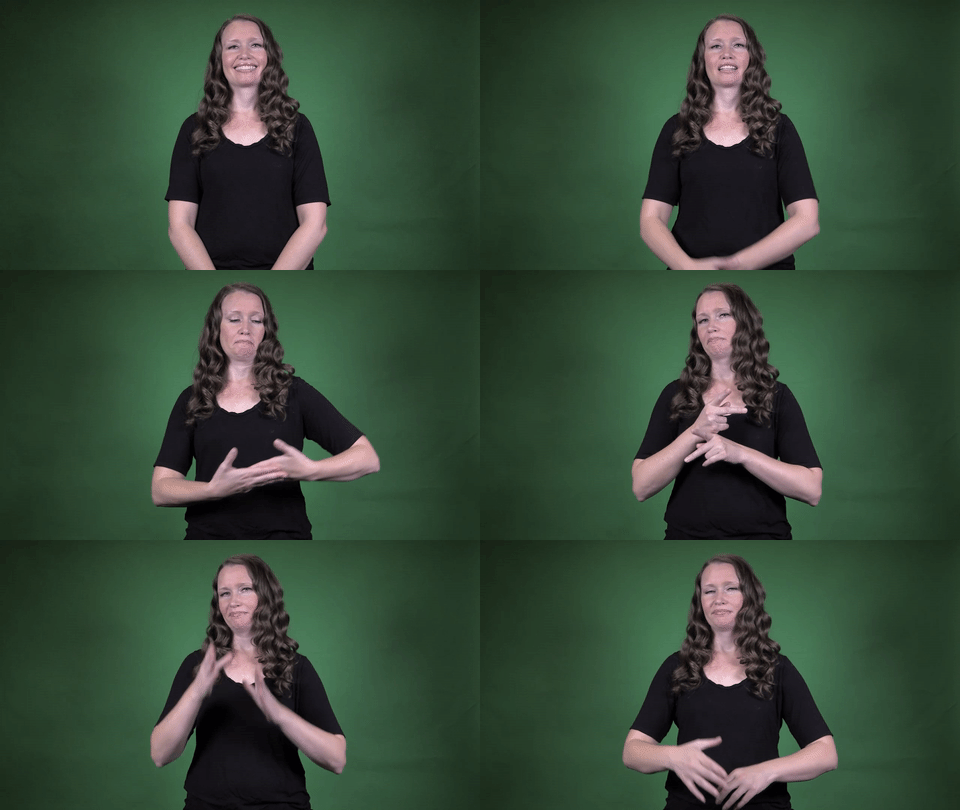
Sign for BABYSITTER in ASL | 👩‍🍼 ASL Dictionary

Definition: A person who looks after a child or children.

Sign for BABYSITTER in ASL 

YouTube player

Practice Activities:

To build confidence with the sign for BABYSITTER in ASL, begin by practicing the sign in isolation. Use a mirror to watch your handshape and movement, ensuring clarity and accuracy. Repeat the sign slowly, then gradually increase your speed while keeping it clean.

Create flashcards with other caregiver-related signs like MOM, DAD, CHILD, and FRIEND. Mix them with the sign for BABYSITTER in ASL and quiz yourself or have a partner call out a term for you to sign. This improves recall and helps contextualize the sign among related vocabulary.

Use the sign in full sentences to reinforce its meaning. Examples include “I am a babysitter,” “My sister is a babysitter,” or “We need a babysitter tomorrow.” Practice these with a friend or record yourself signing them for playback and self-assessment. Try signing while adding person markers to show who the babysitter is.

Storytelling is another effective method. Describe a day in the life of a babysitter using signs for children, toys, food, and bedtime. For instance, “The babysitter arrived, played blocks with the baby, gave snacks, read a book, then the baby slept.” Visual storytelling helps embed the sign for BABYSITTER in ASL into a meaningful context.

Role-play with a learning partner. Take turns acting as the parent and the babysitter. Ask and answer questions like “What time will the babysitter arrive?” or “Who is her babysitter today?” Use facial expressions and role-shift techniques to enhance practice.

Finally, explore community signs by observing Deaf role models, online videos, or attending Deaf events. Watching native signers use the sign for BABYSITTER in ASL naturally can improve your fluency and cultural understanding. Aim to practice daily to reinforce and retain the sign.

Cultural Context:

In American Sign Language, understanding the cultural context behind a concept can add depth to its meaning. The sign for babysitter in ASL is more than just a direct translation of the English term—it’s rooted in how the Deaf community views family, responsibility, and trust. When learning the sign for babysitter in ASL, you’re also learning how the Deaf culture conveys roles and relationships within a family or community setting.

Babysitting is a common role within families and communities, especially for teenagers or young adults. The sign for babysitter in ASL often includes components that show care and oversight, combining the concepts of baby and watcher or caregiver. This form reflects the cultural importance of safeguarding children and the high level of trust placed in the babysitter.

The Deaf community places a strong emphasis on visual communication, which naturally extends to caregiving accommodations. When someone uses the sign for babysitter in ASL, it often comes with non-manual markers like facial expressions that express responsibility, attentiveness, or seriousness. These visual cues convey much more than just the act of watching a child—they show engagement and attentiveness, which are highly valued when choosing someone to care for a child.

In Deaf culture, children often grow up with a strong sense of community involvement. It’s common for older Deaf siblings or community members to help care for younger children, making the need for a sign for babysitter in ASL essential. Because of this community integration, the role of babysitter can go beyond a paid position—it may include familial duties or obligations undertaken with pride.

Deaf families may take additional steps when choosing a babysitter, ensuring that the person is fluent in ASL for effective communication. This gives even more weight to the sign for babysitter in ASL, as it’s not just about the job itself but the ability to communicate clearly and provide a safe environment. A babysitter who can sign is more than just a caregiver—they are a bridge for communication and security.

The sign for babysitter in ASL reflects core values like trust, community, and communication. It’s a role that holds emotional weight in the Deaf community, where family bonds and visual language intersect. Using this sign correctly can show cultural respect and understanding, which is crucial when interacting within the Deaf world.

Learning the sign for babysitter in ASL can also help hearing parents with Deaf children or vice versa. It allows for better family interaction and helps everyone understand caregiving roles, no matter the hearing status of the people involved. It’s

Extended Definition:

The sign for babysitter in ASL uses a combination of signs to express the concept clearly. Typically, it starts with the sign for “baby,” made by cradling your arms as if holding an infant. This is followed by a variation of the “person” classifier or the sign for “to watch” or “to take care of,” depending on the context.

In American Sign Language, compound signs are often used to describe roles or professions like babysitter. Because the term combines both a task and a noun, the sign reflects the meaning through separate gesture elements. By signing “baby” and then “take care of” or “watch,” you convey the concept of someone who looks after babies or children.

The sign for babysitter can vary slightly depending on regional preferences or the specific age group being referred to. While the baby sign is consistent, the second part—such as “watch” versus “care for”—can be interchangeable. This flexibility allows you to adjust the sign based on the situation or formality of the conversation.

Context plays a big role in how the sign for babysitter in ASL is interpreted. For example, if you are describing a professional babysitter versus a friend helping out, facial expressions and the pace of your signing can offer additional clues. ASL is a visual language, so these non-manual markers are just as important as the hand signs.

If you want to emphasize that the babysitter is temporary or just helping out occasionally, you might use gestures that show informality. Conversely, a professional babysitter might be signed with a more formal structure, maybe adding signs related to work or responsibility. These small variations help the meaning come across more accurately.

Learning the correct way to sign babysitter in ASL is useful for both parents and caregivers. It helps promote inclusion and effective communication in both personal and professional settings. Using the correct sign supports clarity, especially in multicultural or linguistically diverse environments.

When teaching kids or adults about the sign for babysitter in ASL, practice makes perfect. Watching videos or practicing with native ASL users can help reinforce accuracy and improve understanding of the visual language. Hands-on practice goes a long way in making signs second nature.

Signing about childcare and responsibilities, like being a babysitter, is also a way to introduce ASL vocabulary related to families and daily tasks. It opens the door to more complex interactions in sign language. This builds up both vocabulary and cultural competence.

With more families using accessible communication, knowing the

Synonyms: caretaker, childminder, nanny, caregiver, au pair

Educational resources: Find related learning materials in our course bank!

Want more? Check out some of our popular learning activities on the homepage!

Need to look up a sign? Use our highly rated dictionary: https://aslinteractive.com/best-asl-dictionary/

Follow us on tiktok: https://www.tiktok.com/@aslinteractive. More social media links at the bottom of this page!

Long-tail Keywords: how to sign babysitter in ASL, what is the ASL sign for babysitter, ASL sign for babysitter

Categories:

tags: babysitter, people, relationships, family, everyday activities

Parameters

*Handshape*:

The handshape for the sign for BABYSITTER in ASL involves two distinct parts. First, both hands form the “K” handshape to sign “baby” by cradling the arms as if holding an infant. Then, the sign for “sitter” uses both hands in an “H” handshape, with one “H” tapping on top of the other, symbolizing a seated action.

In the sign for BABYSITTER in ASL, these handshapes combine fluidly to express both caring for a baby and the act of sitting. This compound sign effectively conveys the role of someone who watches over a child. The use of expressive handshapes is essential to clearly communicating the meaning. ‍

*Palm Orientation*:

The palm orientation for the sign for BABYSITTER in ASL begins with both hands in an “S” handshape, palms facing each other and slightly inward. This part represents the sign for BABY, mimicking a cradling motion.

For the second part, which represents the concept of a person or agent (as in “sitter”), the dominant hand moves into a flat “open palm” or “closed X” handshape depending on the variation, with palms generally facing down. The palm orientation remains consistent throughout the sign for BABYSITTER in ASL, supporting clear and natural visual recognition.

*Location*:

The sign for babysitter in ASL is produced in the neutral space in front of the torso, approximately at chest level. Both hands are active in forming the sign, staying fairly centered in your signing space and not touching the body.

Since the sign for babysitter in ASL is a compound of BABY and PERSON, the sign begins with the motion for BABY across the mid-chest area, followed by the PERSON classifier moving slightly downward. This location keeps the sign clear and visually accessible.

*Movement*:

To sign the concept represented by the sign for babysitter in ASL, form the sign for BABY by cradling your arms and gently rocking them side to side . Then follow it with the sign for PERSON by moving your open hands down vertically in front of your body to indicate an agent or someone who performs a role.

The combination of these two signs captures the meaning of babysitter, using BABY + PERSON-agent. The sign for babysitter in ASL typically finishes with an optional sign for SIT, done by placing fingers of one hand over the bent fingers of the other in a tapping motion.

*Non-Manual Signals*:

Facial expression for the sign for BABYSITTER in ASL typically includes relaxed eye contact, a soft or neutral mouth, and a slight tilt of the head to convey calm responsibility. These non-manual signals help convey the gentle and attentive nature of someone watching a child.

Raised eyebrows may occur if the sign for BABYSITTER in ASL is used in a question or as part of a compound sentence. Lips may purse slightly during the sign, aligning with the role-based context.

*Prosody, Dominant/Non-Dominant Hand*:

The sign for BABYSITTER in ASL typically uses both hands to first sign “BABY” by mimicking cradling a baby with dominant and non-dominant hands. Then, the sign for “PERSON” or “AGENT” is added by moving both flat hands down the sides of the body in parallel. Some variations may fingerspell “S-I-T-T-E-R” afterward, especially in formal contexts. Both hands work together fluidly in the sign for BABYSITTER in ASL.

Tips for Beginners:

When learning the sign for BABYSITTER in ASL, it’s essential to break it down into parts. Start by signing BABY — cradle your arms as if rocking an infant — and then follow with the agent marker, which typically involves both hands moving down vertically like you’re showing a person who does a job. Practicing each portion separately before combining them can help your muscle memory and confidence grow quickly.

Finger positioning and movement are key to making the sign for BABYSITTER in ASL look fluid and understandable. Make sure the “rocking arms” for BABY are soft and natural, not stiff. When adding the personifier sign at the end (representing “one who babysits”), keep your hands parallel and upright with fingers together as they move down. Practicing in a mirror helps ensure the overall clarity of your signing.

One of the most common mistakes beginners make is rushing the transition from BABY to the personifier portion. Take your time to pause briefly before moving on to the second part. Also, avoid over-exaggerating the BABY movement, which can distort the meaning or look overly dramatic.

Watching native ASL users sign this word in context can make a big difference in your fluency. Try to expose yourself to examples in videos or live settings. After seeing the sign used authentically, mimic the rhythm and smoothness of their movement. This builds both muscle accuracy and a more natural flow.

The sign for BABYSITTER in ASL may seem long at first, but with repetitive practice and careful study of native signers, you’ll notice your confidence growing. Don’t be afraid to break the sign down and build it up as your coordination strengthens. Lastly, always match your facial expressions to the situation, since non-manual markers play a crucial role in the meaning of signs.

Connections to Other topics:

The sign for BABYSITTER in ASL is closely related to the compound structure of many occupational terms. It often combines the sign for BABY with the person-agent marker SIT + PERSON, or alternately uses a classifier representing an individual providing care. This mirrors the formation of signs like TEACHER (TEACH + PERSON) or CAREGIVER (CARE + PERSON), anchoring it firmly within ASL’s morphological system for describing professions.

This sign also connects to broader family and care-giving vocabulary. Learning the sign for BABYSITTER in ASL helps reinforce signs like PARENT, GUARDIAN, and NANNY, which frequently appear in conversations about childcare. It’s also relevant when discussing childcare routines, such as FEED, CHANGE-DIAPER, or PUT-TO-SLEEP, providing learners with a practical way to expand vocabulary around daily caregiving tasks.

The sign for BABYSITTER in ASL also illustrates the concept of temporal roles or temporary professions, which can be modified using classifiers or facial expressions to indicate part-time or casual status. This makes it useful in dialogues about jobs, responsibilities, or asking someone if they are available to watch a child. It can appear in questions like WHO YOUR BABYSITTER? or YOU NEED BABYSITTER TONIGHT?

Additionally, the formation of the sign brings attention to the usage of agent suffixes in ASL. The person-marker is a common suffix in job-related signs, and understanding its role in the sign for BABYSITTER in ASL helps with recognizing patterns in signs like DOCTOR, DANCER, or FIREFIGHTER. This supports vocabulary growth across employment-related conversations.

Because babysitting is often a first job for many teens, the sign fits naturally into discussions about youth culture, allowances, and responsibility. It can connect to signs like MONEY, WORK, SCHOOL, and AFTER-SCHOOL. Practicing the sign for BABYSITTER in ASL encourages learners to explore employment themes in personal and community narratives ‍ .

Summary:

The sign for BABYSITTER in ASL reflects a compound concept, blending the ideas of “baby” and “watch” or “take care of.” The sign usually begins by performing the sign for BABY, where both arms mimic holding and rocking an infant, reinforcing the idea of caring for a small child.

Following the BABY sign, the concept of WATCH or CARE is added. Often, this is shown by mimicking eyes watching or placing flat hands on top of each other as in the sign for TAKE-CARE-OF. This forms the composite meaning of someone who watches a baby—essentially, a babysitter.

When used in full context, the sign for BABYSITTER in ASL is not a single sign, but a noun compound. This is linguistic shorthand which combines two signs into one fluid expression. This compounding process is a natural feature of ASL grammar, helping complex ideas be communicated succinctly.

The sign may also be clarified with the fingerspelled suffix (FS)-SITTER in some contexts, especially in formal or instructional settings. The decision of whether to compound, fingerspell, or use a combination depends heavily on context, regional preferences, and conversational tone.

Cultural context plays a role in the sign for BABYSITTER in ASL. Within Deaf families or communities, babysitting may imply someone with sign fluency and cultural alignment. This differs from mainstream contexts where babysitters may or may not be linguistically accessible.

The concept of a babysitter also holds social significance in the Deaf community. Babysitters are often trusted individuals, so signing BABYSITTER clearly and accurately portrays the gravity of responsibility attached to the role.

Grammatically, BABYSITTER is treated as a noun. It’s often used within broader sentence structures, such as “HAVE BABYSITTER TONIGHT ME” or “NEED FIND GOOD BABYSITTER.” Facial expression and topicalization are used to set up questions or emphasize the context.

The sign for BABYSITTER in ASL is aligned with other caregiver terms like NURSE, DOCTOR, and CAREGIVER. These share certain components of care, watchfulness, and responsibility, making them semantically related signs.

Applications in everyday life are common among Deaf families, especially when discussing childcare plans. The sign becomes a practical tool in arranging babysitting, negotiating payment, and setting expectations.

From an applied linguistics standpoint, the sign for BABYSITTER in ASL reflects how signers utilize compounding and classifiers to describe abstract roles that aren’t concrete objects. This is an important strategy for expanding the lexicon of ASL.

In regional dialects of ASL, variations of the sign may exist. Some areas may prefer to explicitly fingerspell (FS)-BABYSITTER instead of signing it as a compound. Regional use and educational background often influence this choice.

Learning the sign for BABYSITTER in ASL offers insight into how compound signs evolve through language economy. Native signers tend to reduce motion and combine concepts to increase fluency and efficiency, a hallmark of natural language.

The placement and directionality of the sign matter. For example, if referring to a specific person as a babysitter, signers may indicate the person’s location in signing space, allowing the sign to reference that person directly.

Facial expressions contribute nuanced meaning to the sign for BABYSITTER in ASL. A raised eyebrow may turn a statement about babysitting into a question, while a furrowed brow might indicate concern about a babysitter’s reliability.

Parents often become adept at using the sign for BABYSITTER in ASL to speak efficiently with childcare providers or other parents within the Deaf community. The sign is integral for conversation around children’s well-being and parental planning.

Digital media and interpreting services often use the sign for BABYSITTER in ASL in educational TV programs, signing storybooks, and walkthroughs for childcare procedures. This increases accessibility and representation for both Deaf parents and children.

When interpreting from English to ASL, professionals must choose whether to sign BABYSITTER as a compound sign or fingerspell it depending on context, fluency level of the audience, and time constraints. This judgment calls for an experienced understanding of both languages.

In Deaf culture, there’s an emphasis on shared responsibility when it comes to child-rearing. The sign for BABYSITTER in ASL is often used in community contexts—discussing group child care during meetings, events, or social gatherings.

Learning this sign also helps distinguish between casual childcare and professional daycare services. For example, a daycare might be signed differently or modified with the sign for SCHOOL or CENTER, depending on the environment.

Historical language development in ASL shows how words like babysitter, which don’t have direct visual counterparts, are created using conceptual blending. This reflects ASL’s powerful adaptability as a visual-spatial language.

The sign for BABYSITTER in ASL may also involve eye gaze and classifier use when describing the actions of a babysitter—

Want more? Check out some of our popular learning activities!

ASL Interactive Resources

ASLInteractive YouTube Channel

Follow us on tiktok: @aslinteractive.com

Follow us on Instagram: aslinteractive

Facebook page: aslinteractive

Facebook group: aslinteractive

LInkedIn: ASL Interactive LLC

Twitter: @ASL_interactive

*Some information on this page is AI-generated. AI can make mistakes. Please check the information.

Sign for BABYSITTER in ASL 

Responses