Sign for BACK DOOR in ASL | 🚪ASL Dictionary

Definition: A door located at the back of a building.

Sign for BACK DOOR in ASL

YouTube player

Practice Activities:

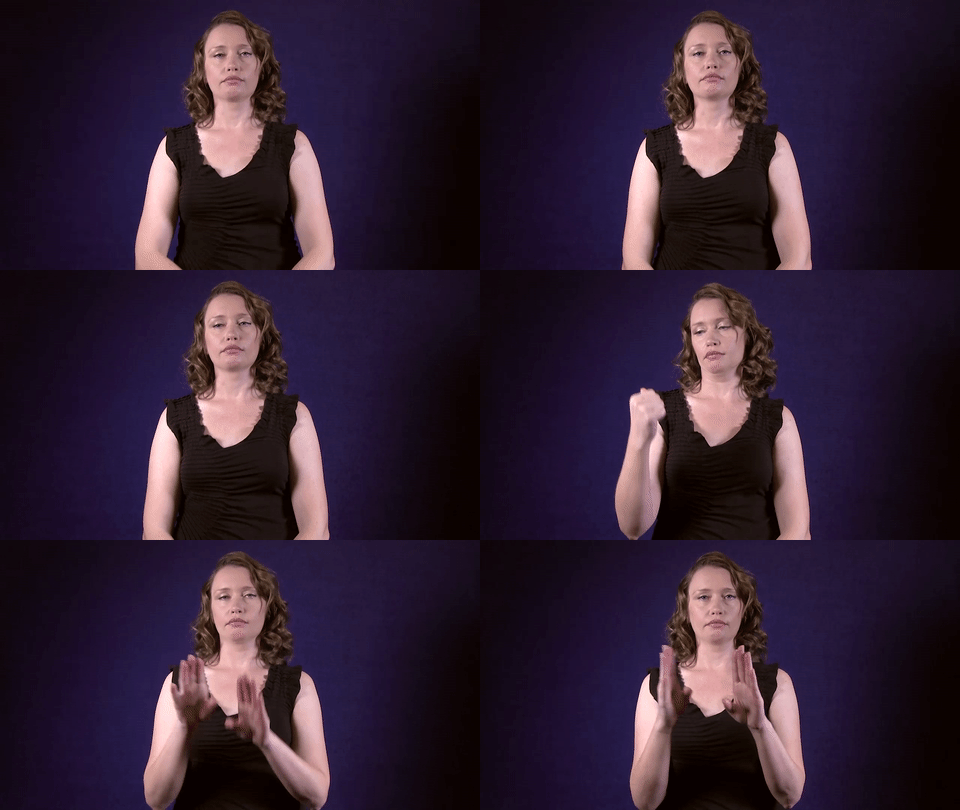
Start by practicing each part of the sign for back door in ASL individually. Use a mirror to ensure clarity and accuracy in signing BACK first, showing directionality, and then sign DOOR using the movement of both hands like opening a door. Repeat several times slowly, increasing speed and fluidity with repetition.

Sign the phrase five times while walking around your house and standing at physical doors. Emphasize the contrast between the front and back entrances by signing BACK DOOR near the back of your home. Then sign FRONT DOOR for contrast to solidify understanding of spatial referencing in ASL.

Create flashcards for different locations in your home like kitchen, living room, and back door in ASL. Practice matching these word cards to signs. Then form short sentences, such as “I go back door,” “Back door open,” or “Close back door.” Keep sentences simple and repeat aloud in sign while expressing facial grammar.

Work with a partner to play a location-guessing game. One signs while the other guesses the correct location—include the back door in ASL as one of the choices. This encourages observation, facial expressions, and accurate sign production.

Watch a video or sign a story that includes a character moving through a house. Pause and identify when the sign for back door in ASL appears. Retell the story using your own signs, or modify the story by changing the entrance or exit to the back door to get additional practice.

Go outside and act out scenarios involving using the back door. You might sign “The dog went out the back door” or “I heard a noise at the back door.” Using whole body movement with classifiers helps reinforce the visual-spatial elements of this sign.

Cultural Context:

In American Sign Language, the sign for back door in ASL reflects more than just the physical description of a house or building feature. In Deaf culture, navigation through space and identification of parts of a home are important for storytelling and daily conversation. Using signs like this one is crucial for clear understanding when giving directions or sharing experiences.

The sign for back door in ASL is typically made by combining the signs for back and door into one fluid motion. This combination lets the signer convey specific locations around a structure with ease. Because visual-spatial awareness is central to ASL, referencing areas like a back door is more than saying where something is—it’s about creating a visual map for the listener.

Conversations about entrances and exits are common in the Deaf community. When someone refers to the back door in ASL, it can indicate privacy, a preferred entrance, or even a safety route. For example, at Deaf social gatherings, knowing the layout of a venue—like where the back door is—can support accessibility and comfort for everyone.

ASL relies heavily on classifiers and spatial agreement. When signing back door in ASL, a signer might use space behind them to show the physical orientation of the door. This makes the sign not only a vocabulary word but part of a broader visual grammar that emphasizes how things relate to each other in space.

Deaf culture values direct and clear communication, so being able to precisely describe locations such as the back door in ASL improves conversations and reduces confusion. It’s common in stories or personal narratives to talk about someone entering or leaving through a back door, so knowing the sign supports rich storytelling.

The sign for back door in ASL also reflects a practical need in daily life. Whether you’re asking someone to meet you near the back door or explaining where to deliver something, using the correct ASL sign ensures you’re understood. This kind of everyday vocabulary is advanced in its precision despite being simple in concept.

Community events, schools, and homes within the Deaf community often use signs like back door in ASL to give visual directions to guests. It’s common for someone to say something like go around to the back door with both hands showing the directional path. This use of space and direction is deeply rooted in how ASL communicates visually.

For ASL learners, the sign for back door in ASL is a great example of how combining basic signs can create more complex and useful terms. It’s also a chance to practice spatial referencing and directional language, both of which are key to

Extended Definition:

The sign for back door in ASL uses a combination of signs to convey both the concept of “back” and “door.” American Sign Language often breaks down compound nouns like this into smaller parts, combining them fluently to represent the full meaning. The sign starts with the ASL sign for “back,” followed by the sign for “door” to fully express the phrase.

To sign “back” in this context, most signers use a gesture that references either the rear of the body or the direction behind. The sign can slightly vary depending on regional dialects or personal signing styles, but generally, it involves a motion indicating the area behind. This sets up the directional aspect that is essential in understanding the phrase.

For the “door” portion in the sign for back door in ASL, the typical sign mimics the motion of opening a door. This involves using flat hands held in front of you, then swinging one hand open like it’s a door opening. When signing “door” right after “back,” you show not just a physical object but a location-based concept.

When both signs are put together, the signer sequentially presents “back” followed by “door,” creating a clear and visual representation of the phrase. This combined sign illustrates not just a physical structure but helps identify a specific entry point — the door at the rear of a building or house. It’s commonly used in daily conversation when giving directions or describing locations.

Context plays a big role when using the sign for back door in ASL. For instance, if you’re explaining how to access a building or where someone exited, the concept of “back door” provides valuable details. In ASL, visual space and directionality enhance meaning, so where and how you place your signs are crucial.

Some advanced signers may incorporate classifiers or spatial referencing to give more detailed descriptions. For example, a signer may establish the layout of a house using classifiers before indicating the back door specifically. This helps the viewer create a mental map of the space being described.

Learning the sign for back door in ASL is useful for both casual and emergency situations. Whether you’re explaining a fire escape plan or telling a friend how to enter your backyard, this sign offers a clear way to communicate a specific location. It’s especially helpful in contexts where direction and placement are important.

Regional variations should also be noted. While the general sign is understood across most Deaf communities, local norms might influence the exact motion or order of signs. That’s why

Synonyms: secret entrance, hidden entry, rear entrance, covert access, secondary door

Educational resources: Find related learning materials in our course bank!

Want more? Check out some of our popular learning activities on the homepage!

Need to look up a sign? Use our highly rated dictionary: https://aslinteractive.com/best-asl-dictionary/

Follow us on tiktok: https://www.tiktok.com/@aslinteractive. More social media links at the bottom of this page!

Long-tail Keywords: what is the sign for back door in ASL, how do you sign back door in American Sign Language, ASL sign for back door

Categories:

tags: Objects in the Classroom, Housing, Facilities and other locations/needs, Describing Residence, Commands

Parameters

*Handshape*:

The handshape for the sign for BACK DOOR in ASL typically involves using a flat hand (the B handshape) to represent the door. For “back,” a modified A-handshape may be used to indicate a directional movement behind the body.

These components often come together with a smooth transition between signs. The sign for BACK DOOR in ASL uses clear handshapes to visually represent both location and object.

*Palm Orientation*:

The palm orientation in the sign for BACK DOOR in ASL involves a combination of signs. For “back,” the dominant hand, typically in an “A” handshape, starts at the front of the body and moves backward over the shoulder, with the palm facing inward toward your body. For “door,” both hands are held upright in a “B” handshape with palms facing each other, and the dominant hand swings open as if mimicking a door.

When combining the movements in the sign for BACK DOOR in ASL, the palm orientation shifts from inward during the “back” portion to facing sideways during the “door” portion. This clear transition helps visually convey the concept of a door located behind, reinforcing the meaning.

*Location*:

The sign for BACK DOOR in ASL is typically made in the area slightly behind and to the side of the signer’s dominant shoulder, representing the concept of “back.” The sign may begin with the non-dominant hand forming a flat wall shape in front of the body, while the dominant hand moves behind it and then opens like a door.

This locational setup supports the meaning of the sign for BACK DOOR in ASL by spatially referencing something behind a structure. It highlights both the position and the function of a door at the back, aligning with common signing space conventions in ASL.

*Movement*:

To sign the phrase for back door in ASL, first sign “BACK” by using a flat dominant hand, palm facing in, and move it backward over the shoulder to show direction. Then sign “DOOR” by holding both hands flat and vertical in front of you, palms facing each other, and swinging the dominant hand open like a door.

The movement for the sign for back door in ASL clearly shows the concept of a door located behind or toward the rear. These sequential motions help to visually represent the idea of entering or locating a back entrance.

*Non-Manual Signals*:

When signing the Sign for BACK DOOR in ASL, maintain a neutral facial expression, slightly shifting your eyes or head to imply the concept of “back” as a location reference. A slight backward glance or subtle chin tilt over your shoulder may be added for spatial context.

Non-manual signals may also include a brief furrow of the brows to engage clarity, especially when emphasizing the concept of placement or direction related to the Sign for BACK DOOR in ASL .

*Prosody, Dominant/Non-Dominant Hand*:

The sign for BACK DOOR in ASL typically combines two separate signs: BACK and DOOR. The dominant hand forms a flat hand and moves backward over a shoulder to indicate “back,” while both hands then create door-like shapes by facing each other with palms perpendicular and one hand opening like a door. The dominant hand performs the opening motion.

In the sign for BACK DOOR in ASL, the dominant hand leads both signs, especially during the motion to mimic a door swinging. The non-dominant hand stays more stationary during the door portion, providing structure. This sign clearly indicates location and object, using spatial referencing common in ASL.

Tips for Beginners:

When learning the sign for BACK DOOR in ASL, remember it’s usually a compound sign that combines the concepts of “back” and “door.” Start by signing “BACK” by forming an open B hand (flat hand with fingers together) and touching the back of the shoulder. Then follow with the sign for “DOOR,” which uses both hands in a vertical flat B handshape, palm out, mimicking the movement of opening a door with just the dominant hand moving outward.

Practice transitioning smoothly between the two signs to maintain natural flow. One of the most common mistakes beginners make with the sign for BACK DOOR in ASL is signing the two concepts too stiffly or pausing too long between them, making the sign feel choppy or disconnected. Instead, work on blending them with a small pause to show the compound structure while keeping rhythm and intention clear.

Facial expressions help give context. For locative signs like the sign for BACK DOOR in ASL, pointing with your index finger while looking toward the referenced back location (such as behind you) adds clarity. This non-manual signal helps the viewer understand the direction and spatial location being described.

Avoid over-exaggerating individual signs. The key is controlled, intentional motion. New learners often rotate their wrists too much when signing “DOOR” or don’t clearly show the small backward motion for “BACK,” which can confuse viewers. Record yourself practicing and compare it with trusted video sources to refine accuracy.

Use real-world practice. Point out the actual back door in your home or school while signing to reinforce context with meaning. The more you connect the sign for BACK DOOR in ASL to your environment, the easier it will be to commit its form and logic to memory. Repetition with context leads to fluency.

Connections to Other topics:

The sign for BACK DOOR in ASL is a compound sign that connects directly to other spatial and directional vocabulary used in the language. It draws from the signs for BACK and DOOR, both of which are foundational for discussing locations, architecture, and navigation in space. Understanding how these individual signs combine helps learners see patterns in ASL and apply the concept to create new compound signs.

This sign is closely related to other compound location-based signs like FRONT DOOR, SIDE DOOR, and even phrases like GO OUT BACK or COME THROUGH DOOR. Each of these uses similar directional markers and classifiers to convey how someone or something moves through or to parts of a structure. The sign for BACK DOOR in ASL also reinforces spatial referencing, showing how ASL uses the visual field to represent real-world orientation.

The sign often appears in contexts related to homes, buildings, emergency exits, or giving directions. For example, in emergency preparedness ASL conversations, a signer might describe multiple ways out of a building, using BACK DOOR to differentiate from the main entrance. It also connects to narrative storytelling, such as sharing a memory about sneaking out through the back door.

Learners who understand the sign for BACK DOOR in ASL will find it easier to construct sentences involving other structure-related vocabulary, such as BASEMENT, GARAGE, or WINDOW, which also rely on spatial indicators. These signs help build fluency in expressing more detailed descriptions of environments. Using directional verbs like GO, COME, or ENTER in combination with BACK DOOR increases expressive capability.

Additionally, classifiers are often integrated with the sign to indicate the type of door, whether it’s sliding, swinging, or part of a house versus an office. This allows for more specific and vivid descriptions in daily communication. The sign for BACK DOOR in ASL thus leads learners into broader discussions about movement, space, and context within the language.

Summary:

The sign for BACK DOOR in ASL can be thought of as a compound sign that merges the concepts of “back” and “door.” It utilizes spatial referencing, classifiers, and directional movement to clearly convey meaning. This reflects how ASL often constructs place-specific terms using layered visuals.

To form the sign, one can start by signing “BACK” using a small motion with the dominant hand in a bent “B” or “A” handshape moving backward over the shoulder. Then sign “DOOR” by placing both flat hands facing each other vertically in front of the torso and swinging the dominant hand open like a door. Combined, this sequence mimics the real-world location and function of a back door.

Facial expressions and use of signing space enhance the meaning further. For example, you might reference a house first, then indicate the back side visually before showing the “door.” This analogical approach is typical in ASL, where the physical world is often mirrored through the body and signing space.

The sign for BACK DOOR in ASL utilizes classifiers to localize objects and show spatial relationships. A common method would involve showing the house with a general classifier like “CL:3” for a building, then navigating to the rear and placing the “door” on that side. This grants the viewer a 3D visual experience.

Understanding this sign involves understanding how location in ASL influences meaning. Whether describing a house, school, or office, back doors are rarely just static objects. They’re part of a larger spatial layout that ASL captures beautifully.

The concept of combining signs to create compound ideas like “back door” is an essential feature of ASL. This is a good example of how ASL builds vocabulary from basic signs, emphasizing the language’s visual grammar. It’s not just about the word; it’s about showing the subject in its environment.

The sign for BACK DOOR in ASL can be adjusted based on context. If you’re talking metaphorically about secrecy or sneaking out, your facial expression and movement might change to reflect this intent. This shows the deep interconnectedness of grammar, emotion, and space in ASL.

Colloquially, referring to a back door can carry idiomatic or cultural meaning. In English, a “back door” might reference secret passageways or unofficial channels. ASL users often reflect these nuanced meanings through facial expressions or by pairing the sign with supporting classifiers or rhetorical questions for clarity.

Grammatically, compound signs like the sign for BACK DOOR in ASL follow a head-modifier structure. You typically list the larger idea (like a house or building), then specify elements like the front or back, and finally the entrance. This reveals insights into ASL’s visual syntax.

The notion of directional signs connects to the broader realm of ASL linguistics. Words associated with location, such as BACK DOOR, prompt a signer to utilize their entire body and signing space. Signs are not isolated gestures—they exist in relation to space and meaning.

This kind of spatial orientation explains how ASL differs from spoken language in structure. There’s less sequential order and more simultaneous layering. When signing BACK DOOR in ASL, you’re not just delivering a noun phrase—you’re conjuring a place-based narrative.

Related signs include “FRONT DOOR,” “SIDE DOOR,” and “GARAGE.” Each follows a similar structural approach using classifiers and spatial placement. Understanding one opens the door—literally and figuratively—to understanding others.

Phonologically, the component signs in BACK DOOR use common handshapes and orientations that make them accessible to new learners. By learning to combine familiar parameters, students can quickly build a larger vocabulary. Semantic breadth grows from morphological building blocks.

The sign for BACK DOOR in ASL also reflects larger cultural themes. In Deaf culture, doors are often metaphorical. A back door might imply escape, privacy, or power, just as much as it refers to a physical place. ASL can reflect those subtleties through sign variation and expressive body language.

Educationally, teaching the sign for BACK DOOR in ASL presents an opportunity to talk about spatial referencing and classifiers. It’s particularly helpful in role-play activities or storytelling, where signers describe environments. It reinforces the concept that description comes from perspective.

Children learning ASL often grasp environmental signs quickly because they relate to tangible experiences. BACK DOOR is a sign they can use to describe real settings, such as at school or home. Its concreteness makes it suitable for early language development.

Deixis plays a key role in this sign as well. When signing BACK DOOR in ASL, it’s common to point toward a physical or imagined location. This usage connects to pragmatic functions within discourse, especially when telling stories or giving directions.

The functional use of BACK DOOR in ASL also applies in navigation. Interpreters might

Want more? Check out some of our popular learning activities!

ASL Interactive Resources

ASLInteractive YouTube Channel

Follow us on tiktok: @aslinteractive.com

Follow us on Instagram: aslinteractive

Facebook page: aslinteractive

Facebook group: aslinteractive

LInkedIn: ASL Interactive LLC

Twitter: @ASL_interactive

*Some information on this page is AI-generated. AI can make mistakes. Please check the information.

Sign for BACK DOOR in ASL

Responses