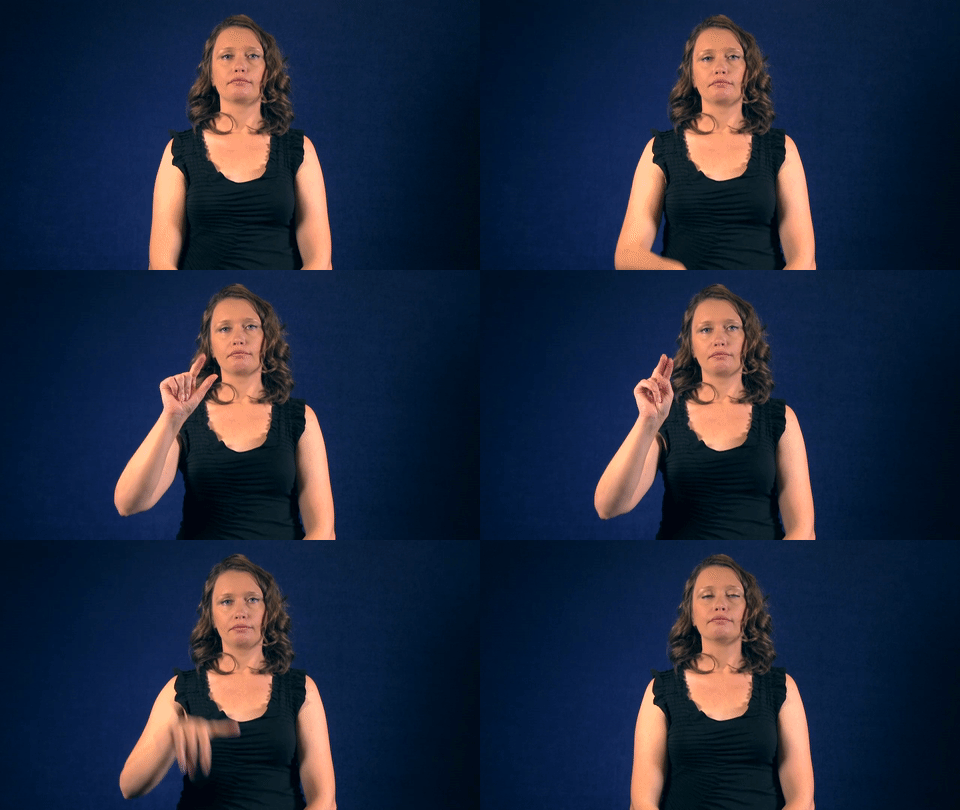
Definition: A platform projecting from the wall of a building.
Sign for BALCONY in ASL

Practice Activities:
To practice the sign for BALCONY in ASL, start by signing the word in front of a mirror slowly and then gradually at normal conversational speed. Repeat the sign multiple times, paying attention to your handshape, movement, and spatial placement to ensure accuracy.
Once you’re comfortable with the isolated sign, begin creating short phrases like “I stood on the balcony” or “The balcony is big.” Practice signing these slowly, then shift to more fluid pacing. Use a facial expression to match the meaning; for example, show excitement when talking about a beautiful view from a balcony.
Try storytelling exercises where you describe a scene from a high-rise apartment with a balcony. Visualize the setting and narrate what is seen or experienced there using relevant vocabulary alongside the sign for BALCONY in ASL. Include descriptions of weather, people, or activities that can happen on a balcony, such as drinking coffee, watching fireworks, or reading a book.
A great partner activity is to practice ASL dialogues where you invite someone to look out from the balcony or describe an event seen from one. Take turns signing and responding using the sign for BALCONY in ASL in context. This will strengthen both receptive and expressive skills.
For creativity, draw a simple house and then explain the drawing using sign language, pointing to a sketched balcony. Give a short ASL presentation about your dream home and include where the balcony would be and why it’s important to you.
Record yourself signing sentences with the keyword phrase and watch to self-assess. This helps identify areas to improve clarity and fluency while reinforcing the use of the sign for BALCONY in ASL in full context.
Cultural Context:
In American Sign Language, the sign for BALCONY in ASL reflects more than just a structure protruding from a building. It can represent a concept tied to leisure, community, and urban design. Understanding the cultural context of this sign helps deepen appreciation for how ASL interprets architectural spaces.
In Deaf culture, environments and spatial awareness are essential. The sign for BALCONY in ASL often includes elements that express height and extension from a structure, which makes it easier for signers to visualize physical space. This visual nature of ASL aligns well with how Deaf people navigate their surroundings.
Using the sign for BALCONY in ASL might occur during conversations about where someone lives, social events, or describing scenery. A balcony is often associated with relaxation or social gatherings, and describing such personal spaces using ASL can add meaningful detail to a story or conversation. It becomes more than a place—it’s part of lived experience.
The sign for BALCONY in ASL may also show up in storytelling, particularly in narratives that involve cities, buildings, or performances. Think of opera or theater stories where characters speak or sing from balconies. In such cases, the sign is essential for adding context and drama to ASL storytelling, which relies heavily on spatial and visual expression.
In educational environments, teaching the sign for BALCONY in ASL encourages students to think about how architecture and design are communicated visually. It aids in the growth of vocabulary for places and structures, and it opens the door to cultural discussions about how Deaf individuals use and experience built environments differently.
Access to outdoor spaces like balconies can significantly impact quality of life. For Deaf people, who often value strong visual contact, a balcony can provide a place for visual communication across distances. This makes the sign for BALCONY in ASL resonate with ideas of openness and connection.
In sign language interpreting, conveying concepts like balcony clearly is important for understanding lectures, tours, or events. Interpreters often use the sign for BALCONY in ASL when describing buildings, giving directions, or explaining floor plans. Accurate use of spatial signs like these ensures information remains accessible.
When using classifiers in ASL, the sign for BALCONY in ASL may be expanded with gestures that show relative position, size, or how people interact with the space. These details enable a fuller picture in conversation, especially in contexts like architecture discussions or storytelling.
Media representation might also call for the sign for BALCONY in ASL. In
Extended Definition:
The sign for balcony in ASL refers to how the concept of a balcony is expressed using American Sign Language. Since ASL is a visual language, it often uses classifiers, descriptive gestures, and spatial referencing to convey architectural features like balconies. The sign for balcony in ASL can vary slightly depending on the context, whether it’s referring to a personal apartment balcony or a theater balcony.
To express the idea of a balcony, signers may use a combination of signs such as room, outside, or building, followed by a gesture indicating an extended platform. A common interpretation involves outlining a level or shelf outside a building, sometimes with a classifier to show people standing on it. This approach helps maintain clarity and provides a visual image to the receiver.
When signing the concept of a balcony, spatial awareness plays a key role. A signer might use hands to mimic the extension from a wall or use one hand to represent the building and the other to indicate the structure sticking out horizontally. This method helps distinguish a balcony from similar features like a porch or patio.
The sign for balcony in ASL might also change slightly depending on regional sign dialects and personal signing preferences. For example, urban signers or those often referencing theater settings may have a specific sign to indicate a raised, indoor balcony where audience seats are found. In contrast, someone talking about a residential building might use signs that depict an outdoor space used for viewing or relaxing.
Because ASL is not a word-for-word representation of English, the sign for balcony in ASL is often shaped by the situation and meaning behind the sentence. That means a signer might describe the feature instead of using a single sign. This is common for architectural or design terms that do not have standardized one-word signs.
In educational or professional settings, especially in interpreting or teaching environments, it can be important to explain the context of how and when to use the sign for balcony in ASL. Teachers often encourage students to learn how to describe objects thoroughly using classifiers and spatial structure, which is a core part of understanding and being fluent in ASL.
For those newer to ASL, watching videos or practicing with fluent signers can greatly improve understanding of how abstract nouns like balcony are signed. Visual context clues and repetition help reinforce correct usage and differentiate it from similar structures. Observing how signers construct meanings for architectural elements is an effective way to build confidence in your signing skills.
Becoming familiar with the sign for balcony in ASL enhances one’s ability to describe environments, which
Synonyms: veranda, terrace, deck, platform, gallery
Educational resources: Find related learning materials in our course bank!
Want more? Check out some of our popular learning activities on the homepage!
Need to look up a sign? Use our highly rated dictionary: https://aslinteractive.com/best-asl-dictionary/
Follow us on tiktok: https://www.tiktok.com/@aslinteractive. More social media links at the bottom of this page!
Long-tail Keywords: what is the sign for balcony in ASL, how do you sign balcony in ASL, learn the ASL sign for balcony
Categories:
tags: Housing, Describing Residence, Facilities and other locations/needs, Objects, Language Learning
Parameters
*Handshape*:
The handshape for the sign for BALCONY in ASL uses both hands in a modified “C” or curved “5” shape. Fingers are extended and slightly bent, with thumbs also extended and pointing forward.
This sign for BALCONY in ASL mimics the shape and layout of a balcony railing or edge. Both hands typically move outward from the middle of the chest to represent the structure. This visual representation helps convey the architectural aspect of a balcony.
*Palm Orientation*:
The palm orientation for the sign for BALCONY in ASL typically involves both hands in a “B” handshape, palms facing slightly downward and outward to mimic the open edge of a balcony. The hands may be held in front of the torso and moved slightly outward to illustrate the structure’s extension.
When using the sign for BALCONY in ASL, the orientation of the palms helps convey the horizontal aspect of a balcony’s barrier. This positioning adds visual context to the architectural feature being described.
*Location*:
The sign for BALCONY in ASL is produced at chest level, slightly in front of the torso. Hands are typically held out from the body to mimic the shape and position of a balcony extending from a building.
When using the sign for BALCONY in ASL, the location emphasizes spatial awareness by positioning the hands outward to represent the structure’s projection. This placement helps convey the physical nature of a balcony within the visual language.
*Movement*:
To show the sign for BALCONY in ASL, begin with both hands in fist shapes (S-handshapes) at chest level, palms facing down. Then smoothly move both fists outward to the sides in a slight arc, as if outlining the front edge of a balcony.
The movement helps visually delineate the elevated, protruding structure typical of a balcony. The sign for BALCONY in ASL mimics looking out over a platform ️. This visual context reinforces the architectural meaning.
*Non-Manual Signals*:
When using the sign for BALCONY in ASL, the eyebrows are typically neutral or slightly raised, reflecting a descriptive or explanatory tone. The mouth may form a slight “mm” shape to convey spatial information or structure. Eye gaze should follow the shape or direction of the balcony being described, enhancing the visual-spatial element of the sign for BALCONY in ASL .
Facial expression remains calm and focused, helping to emphasize the architectural nature of the concept. These non-manual signals support clarity and precision when showing the sign for BALCONY in ASL during conversation or storytelling.
*Prosody, Dominant/Non-Dominant Hand*:
The sign for BALCONY in ASL uses both hands to represent a railing or ledge extending from a structure. The dominant and non-dominant hands are typically bent at the elbows with flat palms facing downward, moving outward from the chest to depict the shape and outline of the balcony.
When using the sign for BALCONY in ASL, the movement and spacing suggest a structure protruding from a wall. Depending on regional variations, some signers may also trace a small box in front of the torso to emphasize the enclosed nature of a balcony. ✨
Tips for Beginners:
When practicing the sign for BALCONY in ASL, it’s helpful to first break down the concept. Think of a balcony as an extended platform from a building. Use your space effectively—this sign is often portrayed with both arms somewhat extended to indicate a protruding structure. This spatial aspect supports comprehension, especially when you’re in a conversation that includes buildings or environments.
Focus on clarity and intentional movement when practicing this sign. Avoid rushing through it, as rushing can cause your expressive nature to come off unclear or sloppy. In the case of the sign for BALCONY in ASL, accurate hand placement and directional positioning are more important than speed. A lot of learners tend to over-exaggerate or under-extend their hands, leading to confusion with other signs.
Using facial expressions is key. Since a balcony may be important contextually—like in a hotel, apartment, or theater—your facial cues can indicate whether it’s exciting, scary, or simply descriptive. This works alongside your signing to form clearer and more engaging communication.
Don’t forget to visualize the structure as you sign. Imagine where the balcony is in space and mimic that orientation. This technique helps solidify spatial awareness and better communicates the meaning, especially with more descriptive storytelling or directional phrases.
For beginners, watching others sign in context will help tremendously. Try watching videos of native signers describing buildings or outdoor scenes and notice how the sign for BALCONY in ASL is integrated. Pausing, rewinding, and practicing along with slow-motion clips can help reinforce handshape, movement, and orientation.
Lastly, be patient with yourself. ASL fluency builds over time from consistent exposure and repetition. Practice the sign regularly, use mirrors to self-correct, and consider filming yourself to spot habits you might not notice otherwise.
Connections to Other topics:
The sign for BALCONY in ASL connects closely to concepts involving architecture, scenery, and spatial awareness. It often shares visual and structural similarities with signs like HOUSE, BUILDING, and STAGE, since all involve spatial relationships and physical structures. Understanding the sign for BALCONY in ASL can help learners interpret larger scenes or describe the setting of a story clearly .
This sign also relates to directional and locational signs in ASL, such as ABOVE, FRONT, and VIEW. Knowing how to indicate that something is on a balcony—like a person standing up high or observing a scene—requires integrating those types of spatial classifiers. The sign for BALCONY in ASL can act as a staging sign, giving context before moving into more narrative or descriptive details.
There are opportunities to build compound ideas around this sign, such as combining it with SIT, STAND, or WATCH to show someone’s activity on the balcony. For instance, signing SIT + BALCONY could describe someone relaxing above or watching a scene below. These combinations help learners use BALCONY in ASL more dynamically within real-life interactions or storytelling .
Through storytelling in ASL, balconies often play symbolic or literal roles, such as in classic scenes like Romeo and Juliet. The sign for BALCONY in ASL becomes essential in retelling these stories with clear and formal structure. Using visuals like role shift and eye gaze, signers can bring the concept of a balcony to life within a three-dimensional signing space.
Additionally, classifiers can be integrated with BALCONY to describe its shape and setting. For example, a flat hand in space to show a protruding platform connects this sign to the broader category of surface classifiers. Understanding these connections enhances fluency and helps learners move fluidly between descriptive and narrative ASL.
Summary:
The sign for BALCONY in ASL typically mimics the physical structure of a balcony itself. It uses classifiers and spatial referencing to indicate an outward or elevated platform, often imagined as part of a building façade. The dominant hand may sketch the outline of a protruding ledge from an imaginary wall in front of the signer.
A common approach is to describe the building wall using flat hands placed vertically, and then gesture a rectangular shape extending outward. This mimics the physical structure of a balcony quite effectively. The sign is often spatial and can be modified depending on the context and scale of the balcony being referenced.
There isn’t a standard, widely agreed-upon singular motion for the sign for BALCONY in ASL, so context and descriptive classifiers play an important role. ASL often relies on visual-spatial information, and the sign for BALCONY in ASL takes full advantage of this characteristic. Descriptive signing allows the signer to show where the balcony is located on an imagined architectural structure.
In more casual or conversational contexts, signers may fingerspell the word BALCONY when a specific or literal meaning is needed. This is especially common when the setting involves unique architectural features, such as in theater productions or apartment layouts. Fingerspelling helps maintain clarity.
The sign for BALCONY in ASL demonstrates a great example of how ASL uses classifier constructs to depict real-life layouts. CL:3 or CL:1 classifiers may be used to show people standing or walking on a balcony. This gives dynamic depth to communication and enables storytelling with visual clarity.
When discussing architecture or home features, classifiers are essential in ASL. The sign for BALCONY in ASL often appears in these contexts alongside other related signs such as WINDOW, DOOR, BUILDING, ROOF, or FLOOR. ASL’s visual-spatial nature supports advanced concepts in construction and design.
Linguistically, describing a balcony encourages a blend of lexical signs and classifier use. This shows the fluid nature of ASL when it comes to nouns that refer to structural or spatial objects. There’s not always a lexicalized sign for specific architecture terms, so classifiers and iconic representation take the lead.
The sign for BALCONY in ASL may vary depending on the signer’s region, background, or exposure to architecture-related lexicons. Some signers may retain a more English-influenced form through fingerspelling, while others comfortably use classifier constructs. Both methods are acceptable depending on audience comprehension and context.
The concept of a balcony spans both everyday conversation and cultural narratives. For example, discussing scenes like Romeo and Juliet involves layering romantic action over a visual concept of a balcony. The sign for BALCONY in ASL thus opens unique pathways for storytelling in Deaf drama or performance arts.
In performance settings, the sign for BALCONY in ASL becomes vital when describing set pieces or spatial blocking. For Deaf actors or interpreters, it offers a bridge between visual representation and the symbolic meaning that a balcony might hold in a plot. It also adds aesthetic value to signed storytelling.
Related signs such as STAGE, SEAT, or THEATER often occur alongside the sign for BALCONY in ASL during conversations about venues or theater layouts. ASL adapts fluidly to depict upper and lower levels through hand movements and body placement. It conveys scene relationships clearly and effectively.
The sign for BALCONY in ASL shares similarities with how ASL treats other spatial constructs like PORCH, DECK, or PLATFORM. Each requires visual imagination, spatial orientation, and often modified classifiers. These shared traits show a linguistic consistency that supports clarity in architectural discussions.
Applied linguistics illuminates how spatial grammar in ASL allows abstract and concrete ideas to coexist. A balcony isn’t just an object but a location, which influences grammar in directional verbs and locative expressions. The sign for BALCONY in ASL demonstrates these patterns clearly.
Deaf culture values spatial awareness highly due to the visual-skewed nature of communication. The sign for BALCONY in ASL reflects this by being three-dimensional and illustrative rather than linear or symbolic. This resonates deeply in educational and narrative environments.
Teaching the sign for BALCONY in ASL also opens doors to discussions about residential living in Deaf culture. Balconies may represent social gathering spots, quiet reflections, or escape spaces. Each of these cultural elements can be incorporated into how a person depicts the sign through body language and expression.
Classroom strategies for teaching the sign for BALCONY in ASL include drawing 3D models and using miniatures. Because the sign is visual and often non-standard, tactile reinforcement helps learners grasp its structure. Peer modeling and roleplaying are also effective.
Because balconies vary widely in form—from Juliet balconies to expansive terraces—ASL users may adapt the sign for BALCONY in ASL to reflect these differences. Size and shape are easily altered through the movement, length, and orientation of signs. This flexibility supports
Want more? Check out some of our popular learning activities!
ASL Interactive Resources
ASLInteractive YouTube Channel
Follow us on tiktok: @aslinteractive.com
Follow us on Instagram: aslinteractive
Facebook page: aslinteractive
Facebook group: aslinteractive
LInkedIn: ASL Interactive LLC
Twitter: @ASL_interactive
*Some information on this page is AI-generated. AI can make mistakes. Please check the information.


Responses