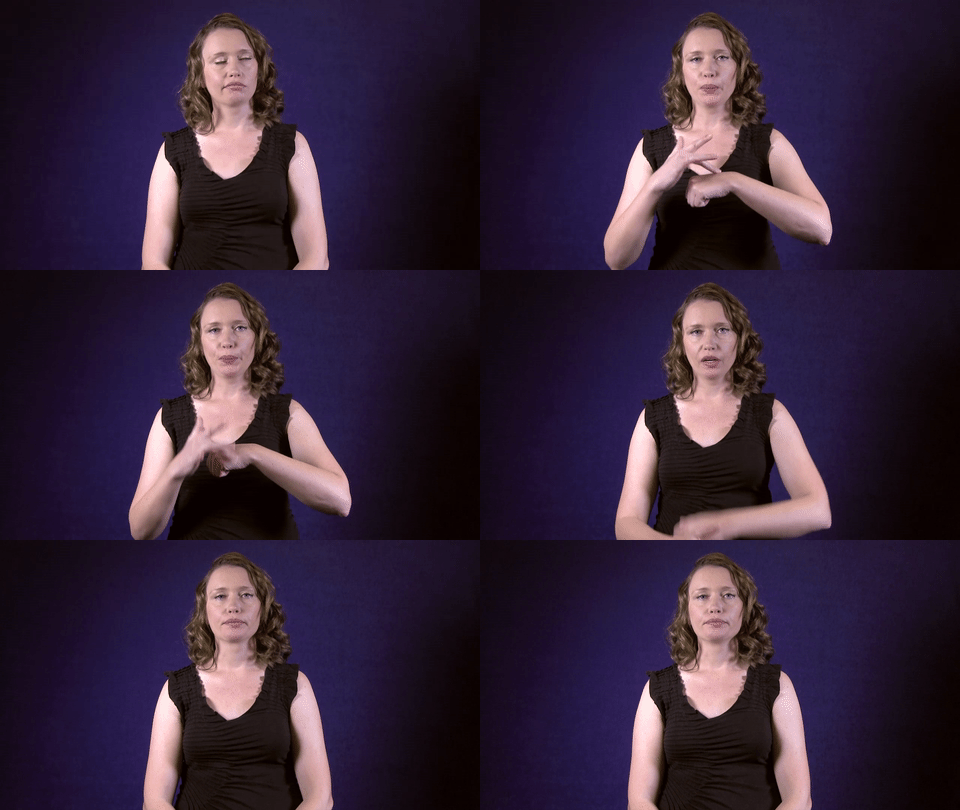
Sign for BALD – SHOWN ON BACK OF HAND- in ASL | 👨‍🦲 ASL Dictionary

Definition: Hairless spot on the back of the hand.

sign for BALD – SHOWN ON BACK OF HAND- in ASL

YouTube player

Practice Activities:

To build familiarity with the sign for BALD – SHOWN ON BACK OF HAND- in ASL, start by practicing in front of a mirror. Repeat the sign slowly, then increase speed while maintaining clarity. Focus on placement, using the back of your hand at the top of your head to mimic hair loss. This sign is visual and iconic, so precision matters.

Use flashcards with images of different hairstyles, including bald individuals. When you see a bald image, produce the sign correctly. Try alternating this with fingerspelling other hair-related terms like H-A-I-R, W-I-G, or H-A-T to increase vocabulary retention and contrast how the sign for BALD – SHOWN ON BACK OF HAND- in ASL stands out among these.

Practice using the sign in simple sentences. Examples: MY UNCLE BALD, or BALD MAN WALK. Ensure your facial expressions match the tone of each sentence. Make sentences more descriptive or humorous to help retention, like MAN BALD HEAD SHINE BRIGHT. This adds personality and anchors the sign in memory.

Try mini-storytelling exercises. Describe a character who goes from having a full head of hair to becoming bald. Use sequence vocabulary like BEFORE, THEN, and NOW when signing. Incorporating sequence and change over time enhances understanding of the sign’s context within narratives.

Pair with a partner and take turns describing celebrities or family members, using the sign for BALD – SHOWN ON BACK OF HAND- in ASL when applicable. You can act out a guessing game—one signs characteristics while the other guesses the person, encouraging natural use of the sign.

Watch ASL videos or vlogs that include people using the sign. Pause the video and replicate each occurrence of the sign precisely. Then replay to compare your version and correct as needed. Reinforcement through exposure boosts muscle memory and fluency.

Cultural Context:

In American Sign Language (ASL), the sign for BALD – SHOWN ON BACK OF HAND- in ASL represents more than just a description of someone without hair. It reflects a cultural understanding within the Deaf community that embraces diversity in appearance. Using signs that depict physical traits often comes with sensitivity and awareness, especially when discussing identity-related characteristics like baldness.

The sign for BALD – SHOWN ON BACK OF HAND- in ASL typically involves a circular motion made over the back of the hand. This movement visually represents the concept of a bare or smooth head. In Deaf culture, visual descriptions are crucial, and portraying bald individuals relies on clear, iconic movements that match lived reality.

Deaf individuals often use descriptive signs like the sign for BALD – SHOWN ON BACK OF HAND- in ASL when referring to people in casual conversation. These signs are not meant to offend, but to identify or describe in a direct and visual language. The Deaf community values clarity and embraces physical descriptions as part of fluent communication.

Using the sign for BALD – SHOWN ON BACK OF HAND- in ASL also aligns with the norms of Deaf culture, where pointing out someone’s appearance is typically not considered rude. It’s a functional part of visual communication that helps specify and describe people accurately in everyday dialogue. This increases the importance of learning and using signs like these properly.

Different variations of bald-related signs exist in ASL depending on regional differences or conversational context. However, the sign for BALD – SHOWN ON BACK OF HAND- in ASL remains one of the more common and visually intuitive ways to express the concept. Its simplicity contributes to its widespread use among both native and new signers.

The ASL sign for BALD – SHOWN ON BACK OF HAND- in ASL is often taught early in vocabulary for describing people. Learning these descriptive signs helps learners grow comfortable communicating physical traits naturally. It’s part of building fluency and understanding the cultural norms inside the Deaf world.

In media and storytelling within the Deaf community, characters described using signs like the sign for bald (shown on back of hand) in ASL help build mental images. Because ASL is a visual language, these portrayals add richness and help the audience follow along more effectively. Cultural sensitivity still applies when using appearance-related signs, especially in mixed hearing and Deaf groups.

Using the sign for BALD – SHOWN ON BACK OF HAND- in ASL also highlights how ASL builds vocabulary around real-life observation. Rather than borrowing abstract terms, ASL constructs meaning through visual analogy. The gesture made

Extended Definition:

The sign for BALD – SHOWN ON BACK OF HAND- in ASL is a specific variation that uses the back of the hand to indicate the concept of hairlessness. This version is commonly used to show that someone is bald on the top or entire surface of the head. It is mostly understood in informal, conversational situations where visual context plays a large role.

To produce the sign for BALD – SHOWN ON BACK OF HAND- in ASL, you typically start with your dominant hand open and flat. Then you move the back of your hand over the top of your head or gesture as if outlining a bald area. This shows a clear nonverbal visual metaphor of a smooth, hairless head. ‍

This sign differs from other variations of BALD in ASL which may use the fingertips or circle motion on the head. When BALD is shown on the back of the hand, the message leans more into the visual cue of smoothness, indicating either full baldness or a shiny scalp. This helps the viewer pick up the meaning quickly without misunderstanding.

Using the sign for BALD – SHOWN ON BACK OF HAND- in ASL is also a way to express differences in hair conditions or to describe someone’s physical appearance. For example, a storyteller might use this variation to show that a character is older or has a completely hair-free head, adding more visual clarity to the narrative. This enhances storytelling and everyday conversation in ASL.

The context in which this sign version is used will affect how well it is understood. It is sometimes used in deaf communities where visual storytelling and gesture precision matter greatly. The sign forBALD – SHOWN ON BACK OF HAND- in ASL reflects a natural, intuitive use of body space to describe a feature that is easily visualized.

It is helpful for learners of American Sign Language to understand these minor differences in gestures. Watching native signers and practicing with real-life examples can help reinforce the correct usage. When learning signs like this, it’s important to pay attention to hand orientation and location relative to the head.

The expressive nature of ASL makes signs likeBALD – SHOWN ON BACK OF HAND- in ASL especially effective when paired with facial expressions. A simple gesture combined with eye movement or a slight head tilt conveys even more information. This reinforces how integrated body language is in ASL communication.

When teaching or studying this variation, it may help to contrast it with other signs for bald, including ones

Synonyms: bald, hairless, smooth-scalped, no hair, clean-shaven head

Educational resources: Find related learning materials in our course bank!

Want more? Check out some of our popular learning activities on the homepage!

Need to look up a sign? Use our highly rated dictionary: https://aslinteractive.com/best-asl-dictionary/

Follow us on tiktok: https://www.tiktok.com/@aslinteractive. More social media links at the bottom of this page!

Long-tail Keywords: what is the sign for bald in asl, how do you sign bald in asl, asl sign for bald on back of hand

Categories:

tags: appearance, body parts, sign parameters, descriptors, hair

Parameters

*Handshape*:

The handshape for the sign for BALD – SHOWN ON BACK OF HAND- in ASL uses an open number 5 hand. The fingers are slightly spread and curved, resembling a claw. To form the sign for BALD (SHOWN ON BACK OF HAND) in ASL correctly, the open 5-hand circles over the back of the opposite hand, which is held flat.

This movement imitates the concept of hair loss or a bare spot. The rounded fingers help to emphasize the idea of a smooth or hairless surface on the scalp ‍ .

*Palm Orientation*:

For the sign for BALD – SHOWN ON BACK OF HAND- in ASL, the palm orientation typically involves the dominant hand in a slightly curved shape with the palm facing downward toward the back of the non-dominant hand. The movement mimics the idea of hair being absent or removed from a surface.

When performing the sign for BALD – SHOWN ON BACK OF HAND- in ASL, the palm maintains a gentle, downward angle, hovering slightly above or making light contact with the top of the non-dominant hand. This orientation helps emphasize the flat surface, symbolizing the bald area. ️

*Location*:

The sign for BALD – SHOWN ON BACK OF HAND- in ASL is typically produced in the neutral space in front of the body, at about chest height. The movement occurs directly over the back of the non-dominant hand, keeping it steady and palm down.

When performing the sign for BALD – SHOWN ON BACK OF HAND- in ASL, the dominant hand circles over the back of the non-dominant hand, mimicking a pattern of hair loss. This location helps visually convey the concept of baldness clearly for the viewer.

*Movement*:

To perform the sign for BALD – SHOWN ON BACK OF HAND- in ASL, start with your non-dominant hand in a flat B-handshape, palm facing down. Then use your dominant hand in a curved 5-handshape to make a circular motion over the back of your non-dominant hand, mimicking the shape of a bald scalp.

The sign for BALD – SHOWN ON BACK OF HAND- in ASL emphasizes the absence of hair. The circular motion visually represents a smooth scalp and is often paired with facial expressions to clarify meaning. ‍

*Non-Manual Signals*:

When demonstrating the sign for BALD – SHOWN ON BACK OF HAND- in ASL, the facial expression is generally neutral to mildly descriptive, depending on context. Eyebrows may raise slightly if emphasizing the state of being bald, especially if it’s newly noticed or surprising.

The signer’s head may tilt slightly to mimic the scalp area being shown, reinforcing the location tied to the sign for BALD – SHOWN ON BACK OF HAND- in ASL. Eye gaze is usually directed toward the area where the sign is produced, aiding clarity ‍ .

*Prosody, Dominant/Non-Dominant Hand*:

The sign for BALD – SHOWN ON BACK OF HAND- in ASL typically uses the dominant hand with an open “5” handshape, palm facing down. It moves in a small circular motion on the back of the non-dominant hand, which stays steady and flat, palm down.

This specific version of the sign for BALD – SHOWN ON BACK OF HAND- in ASL mimics the visual of hair loss across the top of the head. The prosody emphasizes the movement and placement to clearly convey the concept of being bald ‍ .

Tips for Beginners:

When learning the sign for BALD – SHOWN ON BACK OF HAND- in ASL, it’s important to start by observing handshape and palm orientation carefully. This particular variation uses the back of the non-dominant hand to represent the head, so positioning is key. Make sure your non-dominant hand is in a flat or slightly curved shape with the back facing up, creating a visual cue for the surface of the scalp.

Use your dominant hand to mime the concept of baldness by moving it in a small circular motion over the back of your non-dominant hand. Imagine mimicking the act of showing hair disappearing or not being present. This action should be smooth and intentional—do not rush the movement, as clarity comes more from consistency than speed.

Avoid common mistakes such as orienting your palm incorrectly or making contact with the back of the other hand. The sign for BALD – SHOWN ON BACK OF HAND- in ASL typically does not require touch but rather a hovering motion to illustrate concept clearly. Also, don’t exaggerate the motion too much—subtlety keeps the sign natural and more visually accurate.

Practice in front of a mirror to ensure your angles and positioning are easy to see from another perspective. This is crucial because signs need to be viewable and understandable to others. Facial expressions are not heavily used for this sign, but maintaining a neutral or slightly descriptive expression can help.

Finally, watch native ASL users or fluent signers online performing the sign for BALD – SHOWN ON BACK OF HAND- in ASL. Repetition and imitation from authentic sources will reinforce muscle memory and build your confidence. Keep practicing, and don’t be afraid to ask for feedback from more experienced signers!

Connections to Other topics:

The sign for BALD – SHOWN ON BACK OF HAND- in ASL uses a visual reference to the top of the head and the absence of hair. This sign often connects to physical descriptions in ASL, where classifiers and visual-spatial representation play a key role. When describing someone’s appearance, especially in storytelling or identification contexts, this sign might be used along with signs for facial features, age, and clothing.

This sign relates to broader topics in ASL like describing people, grooming, and medical conditions. For instance, it might be used in connection with signs like HAIR, SHAVE, HEAD, or even worn-down, depending on context. It also supports discussions of identity or when referring to someone notable for being bald, making it useful in both casual and formal language settings.

In compound or descriptive sign phrases, the sign for BALD – SHOWN ON BACK OF HAND- in ASL might follow signs like MAN, WOMAN, CHILD, or OLD to complete a clearer picture. For example, OLD MAN BALD can be a succinct yet specific phrase. It can also be paired with expressions of emotion or reaction, such as SURPRISED or IMPRESSED, if someone unexpectedly sees a bald person after a big change.

The sign also encourages learners to explore how ASL describes change over time. A person becoming bald over the years can be shown using temporal inflections or transitional signs like BEFORE, NOW, or CHANGE. This fits into broader ASL topics like aging, physical transformation, or personal stories shared within Deaf culture.

In visual storytelling, the sign for BALD – SHOWN ON BACK OF HAND- in ASL helps paint a clear mental image for the viewer, which enhances comprehension and engagement. This aligns with ASL’s rich visual and spatial grammar, where signs don’t just convey words but illustrate concepts.

Summary:

The sign for BALD – SHOWN ON BACK OF HAND- in ASL involves a unique and visually descriptive handshape. To produce it, the dominant hand moves over the back of the non-dominant hand in a circular motion, mimicking the top of a bald head.

This sign reflects how ASL often uses metaphorical or iconic representations to convey meaning. The use of the back of the hand symbolically suggests the smoothness or absence of hair typical with baldness.

Linguistically, this sign illustrates the principle of visual iconicity—a common feature in sign languages. Through circular movement and spatial orientation, the sign directly conveys the surface of a head without hair.

The formation of the hand and location of the movement also reflect elements of classifier use in ASL. While not a classifier per se, it uses similar visual-spatial logic to cue the viewer into interpreting the sign as referring to a physical attribute of the head.

In ASL grammar, the sign for BALD – SHOWN ON BACK OF HAND- in ASL functions as a descriptive adjective. It can describe someone, either temporarily or permanently bald, and is often placed after the noun in ASL sentence structure.

Facial expressions play an essential role when using this sign. Adding irony, concern, or humor with your facial affect can drastically change the sign’s intent, especially in casual or teasing contexts.

ASL is rich with visual puns and layered expression, and this sign integrates well with ASL humor and idioms. For instance, a dramatic or exaggerated circular motion may playfully overemphasize someone’s baldness.

The sign for BALD – SHOWN ON BACK OF HAND- in ASLis generally considered neutral and descriptive. However, like many signs related to appearance, tone and context matter greatly.

This sign differs from others that might describe hairstyles or lack thereof. For example, fingerspelling “B-A-L-D” carries a clinical or literal tone, while this sign is more colloquial and efficient.

The use of the back of the hand is not random—it visually approximates the dome of a person’s head. This spatial logic is a core aspect of ASL’s grammatic system and reinforces its iconic nature.

In terms of cultural significance, baldness can carry different connotations depending on the community, including associations with aging, illness, or fashion. In ASL, when using the sign for BALD – SHOWN ON BACK OF HAND- in ASL, this context is crucial.

Some Deaf community members might include humor or self-deprecation when referring to themselves with this sign. This reflects the broader Deaf cultural value of expressiveness and visual personality.

In storytelling, this sign often appears in character descriptions. ASL storytelling thrives on vivid, physical detail, and using this sign helps illustrate a character quickly.

When constructing discourse or narratives, this sign may be modified for emphasis. A signer might repeat the motion for comedic timing or layer directional movement for spatial referencing topics.

The sign occupies a unique place in ASL morphology. While not a derivational morpheme, it contributes meaning by depicting physical features, a shared characteristic of signs describing appearance.

Some regional variations may exist in how this sign is performed. For example, some signers might use a slightly different handshape or motion to localize or personalize the description.

The use of this sign in Deaf media and performance further showcases its versatility. Comedians, poets, and commentators often adapt signs like this to visually highlight cultural features of everyday people.

Children acquiring ASL might learn this sign early when describing family members or characters in books. Its visual clarity makes it accessible for young learners.

Teachers of ASL often incorporate the sign for BALD – SHOWN ON BACK OF HAND- in ASL during lessons on appearance and descriptive language. Its graphic nature aids in quick acquisition.

On a sociolinguistic level, the sign’s iconic portrayal helps bridge language barriers. Hearing people learning ASL can more easily understand signs with clear visual metaphors.

In translation contexts, interpreting this sign from English requires understanding the context and tone. Does “bald” have a casual, joking, or medical implication? The ASL version must align with that.

Some ASL users might embellish the sign when used in theatrical or performative contexts. For example, slowing the arc or exaggerating the circle underscores theatrical timing.

The interaction between non-manual signals and this sign is significant. Raising eyebrows or pursing lips can add subtle commentary without altering the core sign.

This demonstrates ASL’s characteristic layering of manual and non-manual grammar—it’s not just what is signed, but how.

Comparatively, in other sign languages, baldness may be signed differently. This highlights the cultural specificity and creativity unique to ASL.

In discussions about appearance and identity, this sign becomes more than a label—it can embody pride, humor, or even resistance to beauty standards.

Want more? Check out some of our popular learning activities!

ASL Interactive Resources

ASLInteractive YouTube Channel

Follow us on tiktok: @aslinteractive.com

Follow us on Instagram: aslinteractive

Facebook page: aslinteractive

Facebook group: aslinteractive

LInkedIn: ASL Interactive LLC

Twitter: @ASL_interactive

*Some information on this page is AI-generated. AI can make mistakes. Please check the information.

Sign for BALD in ASL, Sign for BALD - SHOWN ON BACK OF HAND- in ASL
Sign for BALD in ASL , Sign for BALD – SHOWN ON BACK OF HAND- in ASL

Responses