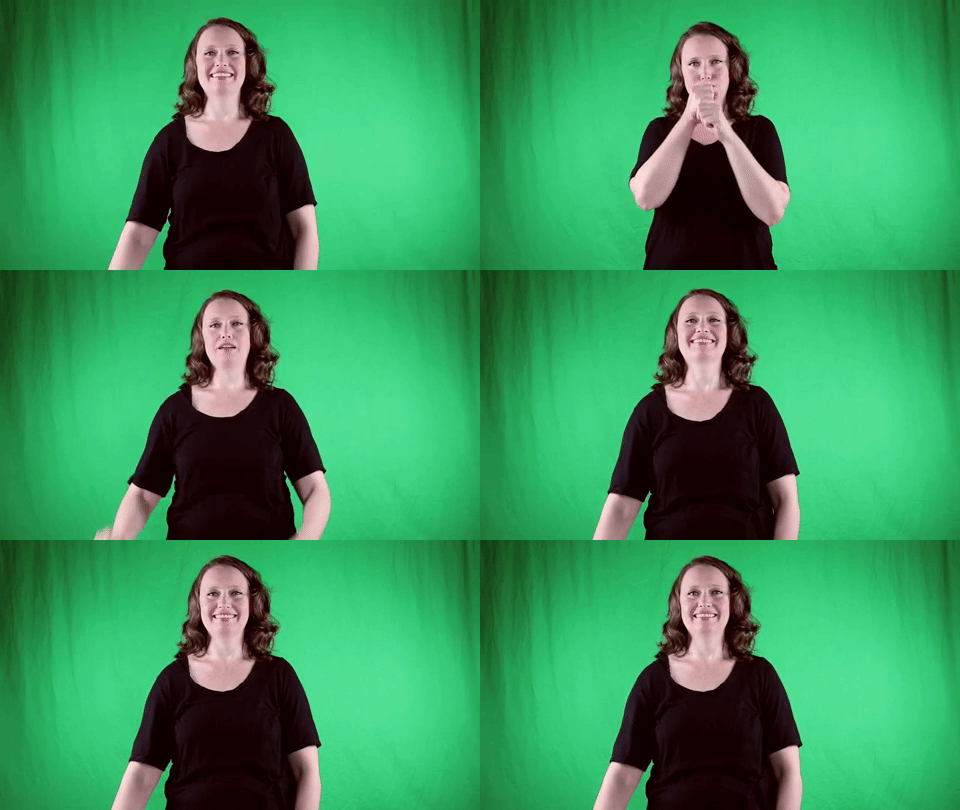
Sign for BALLOON in ASL | 🎈 ASL Dictionary

Definition: A flexible bag filled with gas.

Sign for BALLOON in ASL

YouTube player

Practice Activities:

To practice the sign for BALLOON in ASL, begin by signing the word in isolation multiple times. Look in a mirror to check your handshape, location, and movement. Try saying the word aloud while signing to help connect the concept to the physical motion. Repetition is key to building muscle memory.

Once you feel confident, create simple phrases using the sign for BALLOON in ASL, such as “red balloon” or “big balloon.” Practice these with a partner by taking turns describing different types of balloons. Use adjectives like colors, shapes, or sizes to expand your expressive vocabulary.

Move into full sentence construction, such as “I got a balloon for my birthday” or “The balloon floated away.” Sign slowly and clearly, then speed up as your confidence improves. Use facial expressions to show emotions connected to the sentence, like excitement or sadness.

For a fun activity, try telling a short story involving a balloon. Maybe the balloon gets stuck in a tree or flies to the moon. Use signs for other objects or actions along with the sign for BALLOON in ASL to build a full narrative. This can be done solo or with a peer where one tells the story and the other guesses what happened.

Use flashcards with pictures of different scenes involving balloons and sign what’s happening. For example, a party scene might lead you to sign “lots of balloons” or “the balloon popped.” You can also watch videos with balloons and try to describe what you see using ASL vocab, focusing each time on incorporating the sign for BALLOON in ASL.

Practice with children’s books that feature balloons. As you read, pause to sign key words and retell the story in ASL. This helps to reinforce both receptive and expressive skills related to this playful, visual object.

Cultural Context:

In American Sign Language, signs often reflect not only the object or concept itself but also how it’s commonly used or experienced. The sign for balloon in ASL is a great example of how the Deaf community incorporates visual and experiential ideas into everyday communication.

The sign for balloon in ASL typically mimics the act of blowing up a balloon. This motion physically represents the inflation process and connects the language to a shared human experience. Because visual representation is so critical in ASL, many signs, like this one, are intuitive and based on lived interactions.

Balloons hold different meanings across various cultures and are especially popular in celebrations, parties, and commemorations. In Deaf culture, balloons may represent joy and festivity just as they do in hearing communities, but the way they are introduced through storytelling or ASL narratives often highlights their visual beauty more than the sound they produce when popping or floating away.

When signing stories or describing events in ASL, people often use classifiers to show motion, size, or shape. For something like a balloon floating away, classifiers in combination with the sign for balloon in ASL allow the signer to vividly show how it drifts into the sky. These rich, visual depictions give depth and emotion without spoken words.

The community value placed on visual storytelling means the sign for balloon in ASL is more than a simple noun. It becomes part of elaborate stories, used in jokes, and even included in poems or songs in sign language. Balloons may symbolize celebration, surprise, or even release, and these themes can be expressed powerfully through ASL.

Children learning the sign for balloon in ASL often enjoy the exaggerated motion involved. It becomes an engaging way not just to learn a word but also to remember it through play. Parents and educators use toys like balloons to make language learning interactive and visually memorable.

In Deaf spaces, language unfolds not just through hands but also through facial expressions. While using the sign for balloon in ASL, facial cues may emphasize the excitement or surprise linked to balloons. These expressions help convey the full meaning behind the word, enriching communication far beyond words or glosses.

Because the concept of a balloon is linked to fun and emotion in most cultures, this sign often appears in conversations involving parties, birthdays, or special gatherings. The visual nature of ASL allows the sign for balloon in ASL to stand out, helping the audience instantly connect with the imagery without needing a spoken translation.

The use of the sign for balloon in ASL supports

Extended Definition:

The sign for balloon in ASL is a fun and visually expressive sign that captures the shape and feel of a balloon. This sign is typically made by mimicking the round shape of a balloon using both hands, often starting with the fingertips touching and then expanding outward to show the size or inflation process.

In American Sign Language, visual concepts are often essential to convey meaning. The sign for balloon in ASL reflects this by using handshapes and motion to directly represent the object in question. This makes it accessible and easy to remember for both children and adults learning ASL.

Since balloons are commonly associated with celebrations such as birthdays and parties, this sign is frequently used in everyday conversation. Whether you’re attending an event or describing decorations, knowing the sign for balloon in ASL is a valuable addition to your vocabulary.

The physical motion involved in the sign is also a great way to keep learners engaged. When teaching children, using the sign for balloon in ASL can help reinforce the idea through kinetic memory. This encourages better retention of both vocabulary and the concept it represents.

Parents and teachers alike often incorporate the sign for balloon in ASL into early childhood education. Activities involving balloons—real or imagined—can give learners the chance to practice in a fun and interactive setting. This makes the language learning experience more immersive.

The sign can vary slightly based on region or individual usage, but the core idea remains the same: representing the shape and nature of a balloon. Understanding these slight variations can help learners become more fluent and adaptable in real-world situations.

In storytelling or group games, the sign for balloon in ASL can bring stories to life. Visual storytelling is a strong component of ASL, and including signs like balloon adds depth and context. It also helps in developing expressive skills among learners of all ages.

Balloon-related themes are often used in ASL classrooms to teach colors and sizes. For example, describing a red or large balloon helps reinforce adjectives along with objects, building more complete and descriptive sentences. The sign for balloon in ASL is often one of the first fun vocabulary words introduced to beginners because of its recognizability and relevance.

If you’re attending or throwing a party with the Deaf community, knowing the sign for balloon in ASL can enhance communication and make interactions smoother. It’s a small, playful detail that can show cultural respect and language awareness.

Balloons are used around the world for various purposes, from entertainment to education. Being able to communicate the concept using the sign for balloon

Synonyms: inflatable, air-filled, gasbag, blimp, hot-air

Educational resources: Find related learning materials in our course bank!

Want more? Check out some of our popular learning activities on the homepage!

Need to look up a sign? Use our highly rated dictionary: https://aslinteractive.com/best-asl-dictionary/

Follow us on tiktok: https://www.tiktok.com/@aslinteractive. More social media links at the bottom of this page!

Long-tail Keywords: what is the sign for balloon in ASL, how do you sign balloon in American Sign Language, ASL sign for balloon

Categories:

tags: balloon, birthday, objects, party, occasions

Parameters

*Handshape*:

The handshape used in the sign for BALLOON in ASL involves both hands forming into loosely cupped “C” shapes. The tips of the fingers on each hand face each other, starting close together in front of the mouth or lower face.

While making the sign for BALLOON in ASL, the hands gradually pull apart as though stretching an invisible balloon. This mimics the round and inflated form of an actual balloon , giving a clear visual representation.

*Palm Orientation*:

The palm orientation for the sign for BALLOON in ASL begins with both hands in an open “C” handshape, palms facing each other. The hands are placed in front of the mouth and then slowly move apart, as if outlining the expanding shape of a balloon .

During the movement, the palms remain facing inward toward each other to suggest the round, inflated structure. The sign for BALLOON in ASL uses this orientation to clearly represent the concept visually.

*Location*:

The location for the sign for balloon in ASL is centered in front of the mouth and lower face area. Both hands move outward from a point close to the lips, showing the shape of a balloon expanding.

The sign for balloon in ASL is performed in the neutral space just in front of the face but may extend slightly forward to mimic the round shape filling with air. This placement helps illustrate the object being inflated with breath.

*Movement*:

Start with both hands in the “F” handshape, with tips of the index fingers and thumbs touching in front of your mouth, mimicking the shape of a balloon. Then gently pull the hands apart while maintaining the circular shape with your fingers, as if inflating a balloon. The hands move outward and slightly upward in a smooth, rounded motion.

The sign for balloon in ASL visually represents the expansion of a balloon as it fills with air. You can add a slight bouncing motion at the end to emphasize the roundness or floatiness, which enhances the imagery of the sign for balloon in ASL .

*Non-Manual Signals*:

Facial expression for the sign for BALLOON in ASL often includes slightly puffed cheeks to mimic the look of an inflated object. The eyes may widen slightly to emphasize the expansion, adding a playful or lighthearted tone.

Raised eyebrows combined with an amused or gentle smile help reinforce the buoyant, floating nature typically associated with a balloon. These non-manual cues enhance the visual clarity of the sign for BALLOON in ASL and support its overall meaning.

*Prosody, Dominant/Non-Dominant Hand*:

The sign for BALLOON in ASL uses both hands forming the letter “C” shape. The dominant and non-dominant hands face each other about shoulder-width apart, then move outward and slightly upward in a circular motion while maintaining the shape, as if showing the size of a balloon.

This motion mimics inflating a balloon and adds a playful, airy prosody. When demonstrating the sign for BALLOON in ASL, facial expressions and light movement enhance the visual effect .

Tips for Beginners:

When learning the sign for BALLOON in ASL, it’s important to focus on proper handshape and motion to ensure the meaning is clear. This sign typically uses both hands in a curved ‘C’ shape, starting close together at the lips and pulling apart while maintaining the round shape, mimicking the act of blowing up a balloon. The visual meaning helps reinforce the concept, so practicing in front of a mirror can help you master both the shape and movement.

A common pitfall for beginners is making the motion either too fast or not maintaining the rounded handshape. The hands should expand evenly and not fall flat, or the sign could be mistaken for something else. Since ASL relies heavily on visual accuracy, keeping your gestures smooth and intentional is key to effectively using the sign for BALLOON in ASL.

Facial expressions also play a subtle but helpful role. Try puffing your cheeks slightly when making the sign, mimicking the act of blowing air. This helps emphasize what you’re signing and can make your communication more engaging, especially with children or in educational settings.

Repetition is a great tool when building muscle memory. Practice slowly at first, and as you build confidence, increase your natural flow. Include the sign for BALLOON in ASL into short, everyday phrases or simple stories to reinforce learning. Including it in themed activities like birthday signs can make your practice more fun and purposeful .

Watching native ASL users or video demonstrations can help refine your technique. Don’t be afraid to ask for feedback or clarification if you’re unsure. Just remember that confidence comes with use—don’t worry if it’s not perfect right away. Stay consistent, and the nuances of the sign for BALLOON in ASL will become second nature .

Connections to Other topics:

The sign for BALLOON in ASL connects to a range of visual concepts that emphasize air, inflation, or round shapes. It typically involves puffed cheeks and a gesture with both hands near the mouth, mimicking blowing something up, making it closely related to signs like BUBBLE, INFLATE, and AIR. These visual similarities help learners build intuitive understandings of spatial and descriptive classifiers in ASL.

In storytelling or children’s conversations, the sign for BALLOON in ASL often appears as part of compound phrases like BIRTHDAY-BALLOON, PARTY-BALLOON, or HELIUM-BALLOON (with a preceding fingerspelled HELIUM). These combinations show how the base sign can be extended for more specific contexts. It also pairs naturally with the sign for FLOAT, enabling narratives about objects suspended or drifting in the air .

The motion and facial expression used in the sign for BALLOON in ASL also connect with classifiers that indicate size and shape. For example, when describing different sized balloons or a bunch of balloons held in hand, CL:Claw or CL:Round shape can be used to enrich the visual experience. This offers a practical application of handshape classifiers in real-life settings.

The sign also supports discussions about emotions or events tied to celebration or joy. It can act as a bridge to concepts like CAKE, PRESENT, and PARADE, often used together in themed storytelling or holiday discussions. By combining these signs, learners build not only vocabulary but also cultural context.

Furthermore, the sign for BALLOON in ASL provides an entry point for using spatial referencing and directional verbs. When describing a balloon floating away or popping, one can use signing space to illustrate the action clearly, enhancing expressive skills and reinforcing ASL’s visual grammar.

Summary:

The sign for BALLOON in ASL is iconic and highly visual, closely resembling the shape and behavior of a balloon being inflated. This sign is performed by placing the hands in a loose “C” shape in front of the mouth and then expanding outward as if mimicking the balloon filling with air. The signer often exhales slightly to enhance the illustrative nature of the sign, emphasizing the air motion.

It is a very expressive sign, often engaging facial expressions to convey the light, joyous feeling commonly associated with balloons. The puffing of cheeks or slight blowing out of the mouth can accompany the hand movement, adding to the context and precision. It aligns with a broader ASL linguistic feature where iconicity enhances communication.

The sign for BALLOON in ASL falls into a semantic category of inflated or air-filled objects, similar to signs like BUBBLE or BLOW-UP. Though they are all conceptually related, the signs differ slightly in form and are tailored to the shape or function of the object being described. ASL speakers intuitively distinguish these signs in context, using space and handshapes creatively.

This sign fits naturally in conversations about parties, celebrations, decorative planning, and even themes like childhood. Culturally, balloons are tied to festive and emotional environments, and the sign in ASL mirrors those sentiments. In Deaf culture, the emotional loading of certain signs like BALLOON holds significance during storytelling or community gatherings.

Grammatically, the sign for BALLOON in ASL can function as a noun within sentence structure or be contextually adapted to show plurality and modifying descriptors. For example, color, size, or type of balloon (e.g., balloon animal, hot-air balloon) can be clarified by combining signs. This fusion of signs points to ASL’s flexible and conceptual syntax.

In classifier structures, BALLOON can be portrayed with CL:3s or modified cylindrical classifiers, while the puffing motion conveys the expansion. Signers may transition from the standard sign into classifier constructions to show bursting, rising, or twisting balloon movements. Classifiers enhance the narrative ability of ASL, especially for dynamic scenes or playful retellings.

The visual-spatial nature of ASL means that physical motion plays a vital role in conveying not just objects but also their behaviors. The sign for BALLOON in ASL leverages this by mimicking inflation, mobility, and buoyancy. This kinetic representation matches cognitive linguistic insights into how Deaf signers process and categorize visual information.

There is a poetry to how the sign for BALLOON in ASL can be used metaphorically, not just literally. Balloons can represent dreams, fleeting happiness, or emotional inflation, and ASL storytellers often exploit this versatility. This exemplifies how ASL isn’t just a communicative tool but also an expressive and artistic medium.

The sign carries rich layers of meaning via iconicity, a hallmark of ASL lexicon. The strong resemblance between the sign and the object provides an intuitive access point for new learners. Children learning ASL often gravitate toward such signs because they link action, imagery, and concept.

There is a charm and whimsy in the way the sign unfolds from the face outward—almost like releasing a spirit or joy into the air. This gives it a theatrical and immersive quality, especially effective in ASL storytelling or children’s literature performances. The performative quality is a testament to the language’s visual richness.

Learning the sign for BALLOON in ASL often opens the door to an entire semantic field within leisure, celebration, and emotive events. Alongside signs like BIRTHDAY, PARTY, and GIFT, it becomes part of a vocabulary set deeply embedded in communal joy. These signs are commonly seen in school events, Deaf church gatherings, and social meetups.

The connection between conceptualization and gesture in ASL is tightly knit in this sign. BALLOON is not represented abstractly but physically—hands mimic roundness, growth, and air displacement. It’s a powerful example of how ASL builds vocabulary from familiar, tangible sensory experiences.

From a linguistic standpoint, the sign for BALLOON in ASL demonstrates the principle of motivated iconicity—where form maps obviously onto meaning. This contrasts with arbitrary spoken-word formations in English. Scholars in signed language linguistics often highlight such signs to illustrate the cognitive roots of visual grammar.

Learners often recall the sign with humorous facial expressions, especially since the puffing of cheeks mirrors kids pretending to blow up a balloon. This adds a kinesthetic memory component which reinforces learning through muscle engagement and mimicry. It’s learning rooted in embodiment and sensory feedback.

In applied linguistics, teaching tools often prioritize signs like BALLOON in ASL because of their mnemonic power. The link between gesture, soundless narration, and universal experiences helps lower barriers for second language acquisition. Teachers use it in thematic units celebrating holidays or storytelling sessions.

The cultural significance of balloons in the Deaf community is no less

Want more? Check out some of our popular learning activities!

ASL Interactive Resources

ASLInteractive YouTube Channel

Follow us on tiktok: @aslinteractive.com

Follow us on Instagram: aslinteractive

Facebook page: aslinteractive

Facebook group: aslinteractive

LInkedIn: ASL Interactive LLC

Twitter: @ASL_interactive

*Some information on this page is AI-generated. AI can make mistakes. Please check the information.

Sign for BALLOON in ASL

Responses