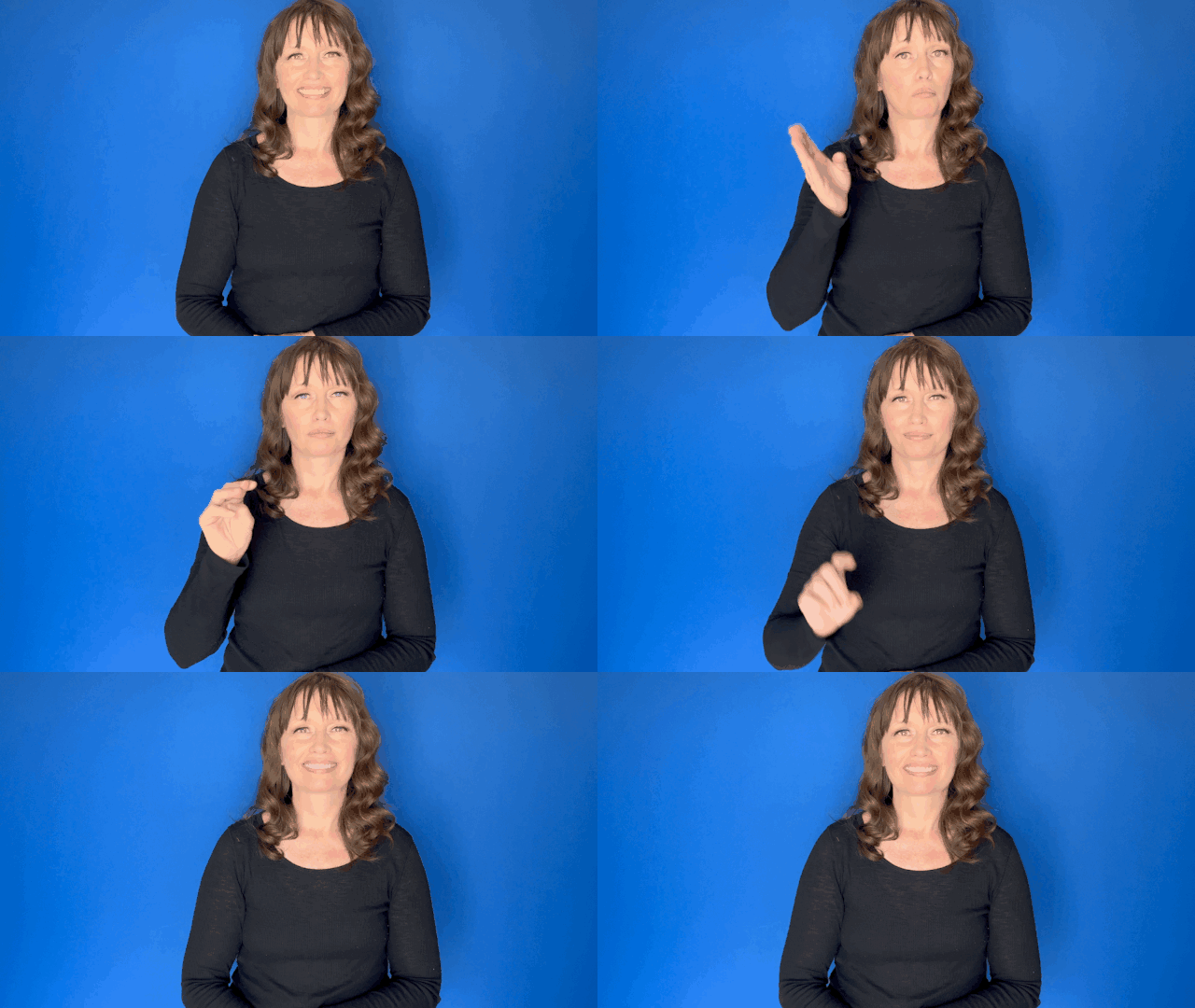
Definition: A city in Maryland, USA.
Sign for BALTIMORE MARYLAND in ASL

Practice Activities:
To practice the sign for BALTIMORE MARYLAND in ASL, begin by isolating each part. First, practice fingerspelling MARYLAND slowly and clearly, paying close attention to the correct handshape, palm orientation, and speed. Repeat until the motion becomes fluid. Next, practice the regional sign for BALTIMORE, commonly used in the mid-Atlantic area. Use a mirror or video yourself to assess accuracy.
Once you are comfortable signing BALTIMORE and fingerspelling MARYLAND separately, combine them into a short phrase. Practice saying, “I live in BALTIMORE MARYLAND,” emphasizing fluid transitions between the signs. Signing in front of a partner or tutor who can give feedback will help reinforce correct motion and expression. Try incorporating different facial expressions as you sign the full location to match conversational tone.
Write out five different sentences that include place references, such as “My family is from BALTIMORE MARYLAND” or “Have you visited BALTIMORE MARYLAND before?” Practice signing these in front of a mirror to simulate a live signing environment. You can also use facial expressions to indicate whether you are asking a question or making a statement.
Engage in a storytelling activity where you describe a trip you took or an imaginary visit to BALTIMORE MARYLAND. Include landmarks or cultural moments like eating crabs or watching a baseball game. This will help you put the sign in a broader narrative context while reinforcing vocabulary.
Partner activities can be very helpful. Take turns with a partner asking and answering questions about cities, using the sign for BALTIMORE MARYLAND in ASL repeatedly in your responses. Try a game where one person signs a U.S. location and the other has to respond using that place in a sentence. This repetition improves fluency and strengthens recall.
Cultural Context:
The sign for Baltimore Maryland in ASL reflects the deep cultural and historical identity of the city. When members of the Deaf community use this sign, it’s more than just a geographical label—it’s a way to connect with the unique spirit and heritage of Baltimore.
Baltimore is known for its rich Black American history, vibrant arts scene, and deep ties to maritime culture. The sign for Baltimore Maryland in ASL can sometimes be associated with these cultural elements, especially in storytelling and community events in ASL spaces.
In many ASL conversations, the sign for Baltimore Maryland appears when discussing famous landmarks like the Inner Harbor, Fort McHenry, or historical figures like Frederick Douglass. Because Baltimore has contributed so much to American history and culture, its name frequently comes up in discussions in ASL, making it important for users to know the proper sign.
When Deaf individuals refer to the sign for Baltimore Maryland in ASL, they’re also referencing the larger Maryland Deaf community, which has strong roots and a respected presence in education, advocacy, and arts. Baltimore itself is home to Deaf community centers, events, and schools that use ASL every day.
Variations of the sign for Baltimore Maryland in ASL may exist due to regional influences or evolving sign usage. Some signs are based on initials, like using a B-handshape, while others might be influenced by local Deaf culture or long-time community usage patterns. The sign might be slightly different in urban vs. rural settings or among older vs. younger signers.
The Maryland School for the Deaf and Gallaudet University in nearby Washington, D.C. contribute to the development and preservation of regional signs, including the sign for Baltimore Maryland in ASL. Students and alumni from these institutions often use consistent signs in academic and public settings, increasing the visibility of the proper sign across the East Coast.
ASL users value clarity and cultural relevance, so knowing the correct sign for Baltimore Maryland in ASL is important for respectful and accurate communication. Repeated exposure through conversation, media, or cultural sharing helps cement its usage within the broader signing population.
Local interpreters, educators, and community leaders often teach the sign for Baltimore Maryland in ASL when providing place-based storytelling, civic education, or event information at Deaf events. Whether at Pride parades, cultural festivals, or political rallies, mentioning Baltimore using the right ASL sign strengthens place identity and recognizes the Deaf population in and around the city.
Social media platforms have also amplified the use of city signs like the sign
Extended Definition:
The sign for BALTIMORE MARYLAND in ASL is a commonly recognized regional sign used by both Deaf and hearing members of the signing community. It’s important for learners to understand that geographic locations often have specific signs rather than being fingerspelled, especially for major cities like Baltimore.
When learning the sign for BALTIMORE MARYLAND in ASL, it’s essential to note the context in which it’s used. The sign typically features a quick movement paired with a specific handshape that reflects the local variation or agreed-upon standard among ASL users.
Regional signs can vary slightly depending on who is signing and where they learned ASL. For example, the sign used in Baltimore might look a little different from signs used in other parts of Maryland. The sign for BALTIMORE MARYLAND in ASL should be consistent with local usage when possible, making it easier to be understood by other signers in the area.
Using the correct sign for BALTIMORE MARYLAND in ASL helps reinforce community norms and shows fluency in conversational signing. By using the appropriate geographic sign rather than fingerspelling B-A-L-T-I-M-O-R-E, signers are showing a deeper understanding of the language and culture.
New learners often wonder whether they should fingerspell locations or check for a proper sign. In the case of major cities like Baltimore and regional identifiers like Maryland, learning the unique sign is preferred. The sign for BALTIMORE MARYLAND in ASL is an example of this.
If you’re introducing yourself, discussing travel plans, or describing a map in ASL, you’ll likely need to use the sign for BALTIMORE MARYLAND in ASL. Whether you were born there, visited the city, or are talking about a famous event in Baltimore, it’s important to use the localized sign correctly.
One key to using the sign for BALTIMORE MARYLAND in ASL is practicing with native signers or using reliable video dictionaries. Seeing the sign in live conversation or recorded examples supports better understanding and retention. Watching fluent signers can help you perfect the movement and handshape.
ASL is full of unique signs for cities, and Baltimore is no exception. Learning the sign for BALTIMORE MARYLAND in ASL adds another piece to your language toolkit. It allows you to navigate conversations about geography more naturally and smoothly.
Culture and language go hand in hand, especially in ASL. The sign for BALTIM
Synonyms: Baltimore City, Charm City, Baltimore MD, Port City, Monumental City
Educational resources: Find related learning materials in our course bank!
Want more? Check out some of our popular learning activities on the homepage!
Need to look up a sign? Use our highly rated dictionary: https://aslinteractive.com/best-asl-dictionary/
Follow us on tiktok: https://www.tiktok.com/@aslinteractive. More social media links at the bottom of this page!
Long-tail Keywords: what is the ASL sign for Baltimore Maryland, how do you sign Baltimore Maryland in ASL, what’s the American Sign Language for Baltimore Maryland
Categories:
tags: Cities, Geography, Travel, Landmarks, Places
Parameters
*Handshape*:
The handshape for the sign for BALTIMORE MARYLAND in ASL uses a dominant hand in the “B” handshape. With fingers together and the thumb tucked across the palm, the hand moves in a small side-to-side motion, typically at shoulder height.
Commonly used when discussing cities, this specific “B” handshape helps represent Baltimore clearly and distinctly. The sign for BALTIMORE MARYLAND in ASL often needs to be followed by fingerspelling “MARYLAND” unless regional signs are used. ️
*Palm Orientation*:
The palm orientation for the sign for BALTIMORE MARYLAND in ASL involves the dominant hand creating a B-handshape while the palm faces inward toward the body. The hand moves quickly side to side in small motions across the chest area. For the MARYLAND portion, the state name is typically fingerspelled in ASL, keeping your palm facing slightly forward for clarity and visibility .
When fingerspelling MARYLAND as part of the sign for BALTIMORE MARYLAND in ASL, keep all letters upright with a neutral forward-facing palm. Smooth transitions between the letters help maintain fluidity and precision, which enhances understanding during communication.
*Location*:
The sign for BALTIMORE MARYLAND in ASL is produced in the neutral space in front of the chest, slightly outward from the torso. The dominant hand moves in a small repeated bouncing motion, using the letter “B” handshape for Baltimore. Some signers may fingerspell MARYLAND just after signing Baltimore, keeping both signs in the same chest-level signing area .
This location allows the sign for BALTIMORE MARYLAND in ASL to remain visible and clear. Keeping the sign centered ensures that facial expressions and non-manual signals are easily seen by the viewer.
*Movement*:
To create the sign for BALTIMORE MARYLAND in ASL, use your dominant hand in the modified “B” handshape—four fingers extended and together, thumb tucked—and bounce it gently side to side twice in front of your chest. This mimics the movement typically used for some city names and is specific to Baltimore.
The word MARYLAND is fingerspelled right after the sign for Baltimore. Use smooth, clear letter formations for M-A-R-Y-L-A-N-D. The sign for BALTIMORE MARYLAND in ASL is a combination of a symbolic motion for the city and the fingerspelled name of the state, used commonly in introductions .
*Non-Manual Signals*:
When signing the Sign for BALTIMORE MARYLAND in ASL, maintain a neutral facial expression, as you’re primarily fingerspelling proper nouns. Keep your eyes focused on the dominant hand to ensure clear communication. Slight nodding can indicate affirmation or familiarity with the place. A relaxed posture and steady rhythm while fingerspelling helps convey confidence and clarity. Avoid exaggerated facial motions, since this is a location name without added emotional tone.
*Prosody, Dominant/Non-Dominant Hand*:
The sign for BALTIMORE MARYLAND in ASL typically uses the dominant hand in a “B” handshape for BALTIMORE. The hand moves in a small circular motion or taps side to side across the center of the chest, resembling how many city names are signed.
For MARYLAND, the non-dominant hand stays still while the dominant hand fingerspells M-D as an abbreviation. This fingerspelling step finalizes the sign for BALTIMORE MARYLAND in ASL, combining both city and state naturally in fluent signing.
Tips for Beginners:
When learning the sign for BALTIMORE MARYLAND in ASL, start by understanding that “Baltimore” is traditionally fingerspelled due to the lack of an established sign that is widely accepted, and the same applies to “Maryland.” Clear, fluid fingerspelling is crucial here—practice spelling each letter evenly and maintain a consistent rhythm. It’s easy to rush when fingerspelling place names, but remember that clarity always trumps speed.
For the sign for BALTIMORE MARYLAND in ASL, it’s essential to maintain proper handshape and palm orientation throughout the spelling. Keep your dominant hand slightly out from your shoulder, not too high or low, and make sure your palm is facing forward. Each letter—particularly those that are more complex like “M” and “R”—needs to be distinct, so try not to blend the fingers together when moving through the word.
One tip for beginners is to practice each state’s name independently before combining them. This helps avoid mixing the two up and ensures smoother transitions. Also, use a mirror when practicing—this helps you visually catch unclear shapes or fix awkward wrist angles. Watching fluent signers and reinforcement through video content will also help reinforce correct movement and spacing between letters.
Avoid common pitfalls like dropping your hand too quickly after the last letter or fidgeting when unsure. Patience is critical. If you don’t get it right away, slow down and refocus on one part at a time. You can use flashcards or apps to isolate problem letters.
The sign for BALTIMORE MARYLAND in ASL may seem intimidating at first, but with consistent practice and attention to detail, you’ll find that fingerspelling becomes not just easier but more automatic. Remember, local names often rely on spelling, so polish that skill to improve your overall communication.
Connections to Other topics:
The sign for BALTIMORE MARYLAND in ASL connects closely with geographical name signs and fingerspelling conventions. Like many city names in ASL, BALTIMORE is often signed with an initialized movement using the letter “B” in a specific bouncing motion, making it distinct from other signs. MARYLAND, however, is typically fingerspelled in full, reflecting a common practice with state names, especially those without standardized signs.
This combination of an initialized sign and a fingerspelled word teaches a valuable concept in ASL linguistics—how signers manage proper nouns, especially locations. The use of both methods in the sign for BALTIMORE MARYLAND in ASL reinforces the importance of recognizing which place names have recognized signs and which rely on fingerspelling. It also emphasizes how context helps determine whether a formal or informal version of the sign should be used.
Learners can connect this with other city-state combinations like CHICAGO ILLINOIS or ATLANTA GEORGIA, where the city has a sign but the state may be abbreviated or fingerspelled. These combinations often occur in narratives about travel, personal stories, or news reporting in ASL. These examples reflect how compound forms like city and state names are frequently encountered and combined in everyday ASL communication.
Knowing the sign for BALTIMORE MARYLAND in ASL also ties into directional referencing and spatial mapping in signed storytelling. For example, referencing BALTIMORE on one side and WASHINGTON D.C. on the other helps visually represent geography. These spatial techniques are crucial for setting scenes and providing clarity in ASL discourse.
Furthermore, fingerspelling MARYLAND encourages learners to develop fluency with longer or more complex words. This supports overall fingerspelling recognition and expressive skills, especially when used in tandem with standard signs like BALTIMORE. Understanding this blend is key for anyone aiming to communicate geographical information clearly in ASL. ✨
Summary:
The sign for BALTIMORE MARYLAND in ASL usually features fingerspelling for both words, especially in formal or regional contexts. BALTIMORE is most often fingerspelled due to the lack of a commonly established sign, though some communities use an initialized sign with the letter “B” moving in a small arc. MARYLAND is typically fingerspelled as well, making the full phrase a two-part fingerspelling expression.
Context determines how much gets abbreviated or simplified. In fast-paced conversation among fluent signers, cities like BALTIMORE may sometimes be shortened or signed informally with nonstandard movement. Nonetheless, in most official or widely taught situations, the full fingerspelling remains the default.
The sign for BALTIMORE MARYLAND in ASL relies heavily on the signer’s proficiency with fingerspelling. Speed, clarity, and rhythm are important. Fingerspelling city and state names can challenge new signers, so practicing repetition and muscle memory is essential.
Signers contextualize the fingerspelling with appropriate facial expressions, head nods, and contextual cues. For example, talking about hometowns or sports teams naturally supports fingerspelling BALTIMORE MARYLAND. These cues help the conversation remain fluid and understandable.
Geographic names are frequent in ASL storytelling or when describing travel, geography, heritage, or politics. The sign for BALTIMORE MARYLAND in ASL is not just about place—it represents cultural roots and regional identity. The way someone spells it can express pride, emphasis, or local nuance.
From a grammatical standpoint, when using the sign for BALTIMORE MARYLAND in ASL, it usually appears in noun position. This can be at the opening of a sentence to establish location. For instance, one might sign BALTIMORE MARYLAND, IX-me LIVE meaning “I live in Baltimore, Maryland.”
The use of mouth morphemes and pauses between the two fingerspelled segments offers rhythm and structure. Typically, a brief pause separates BALTIMORE from MARYLAND unless there’s contextual pressure to omit it. The space between hands may also shift to reset for the new word.
Culturally, BALTIMORE carries strong associations depending on the community. For Black Deaf communities and Latinx Deaf populations residing in or connected to the city, the sign for BALTIMORE MARYLAND in ASL can hold personal symbolism. It could represent food traditions, historical neighborhoods, or activism.
In the broader Deaf community, local pride often includes routinely spelling out one’s home city. Thus, BALTIMORE MARYLAND becomes part of a larger identity speech act. Signing where you’re from offers cultural belonging and shared experience, encouraging narrative-building.
Linguistically, the sign for BALTIMORE MARYLAND in ASL shows how signs for proper nouns depend less on iconicity and more on convention. There’s no iconic sign for Baltimore—a city not represented by a visual metaphor. Instead, fingerspelling allows standardization across contexts.
Applied linguistics themes include spatial grammar and referential use in conversations. For example, after establishing BALTIMORE MARYLAND, a signer may point to the leftward space as a referent for the city. Once anchored, future signs can replace the full phrase with that spatial referent.
Educators preparing curriculum often use city and state names like BALTIMORE MARYLAND as learnable examples of ASL syntax and lexical categories. It’s a good chance to practice both English-ASL translation and spatial use for referents. The shift from fingerspelled proper noun to spatial noun reflects language acquisition stages.
Language learners are encouraged to practice fingerspelling fluency, especially with place names that include common handshapes. BALTIMORE uses “B,” “A,” “L,” “T,” and so on—common forms that appear in many frequent signs. MARYLAND includes the “M,” “A,” and “D”—also high-frequency letters in fingerspelling patterns.
Professional interpreters often adapt their pacing and clarity when fingerspelling names like BALTIMORE MARYLAND. In formal interpreting for government meetings or academic presentations, accuracy takes precedence over speed. The skill is not just motoric but also linguistic in nature.
Historical linguistics research in ASL shows that some fingerspelled place names eventually evolve into abbreviated or initialized signs. Over time, a fingerspelled name like BALTIMORE might be shortened by local users. These signs gain traction through repeated social use and community validation.
The sign for BALTIMORE MARYLAND in ASL reflects variation between regional users. Users in the DMV (D.C., Maryland, Virginia) area might use a slightly more casual or abbreviated form. In contrast, someone from another state may always use the full fingerspelling with a slower rhythm.
Lexical borrowing influences how people approach the sign
Want more? Check out some of our popular learning activities!
ASL Interactive Resources
ASLInteractive YouTube Channel
Follow us on tiktok: @aslinteractive.com
Follow us on Instagram: aslinteractive
Facebook page: aslinteractive
Facebook group: aslinteractive
LInkedIn: ASL Interactive LLC
Twitter: @ASL_interactive
*Some information on this page is AI-generated. AI can make mistakes. Please check the information.


Responses