Sign for BARE-HEAD in ASL | 👨‍🦲 ASL Dictionary

Definition: Without covering on the head.

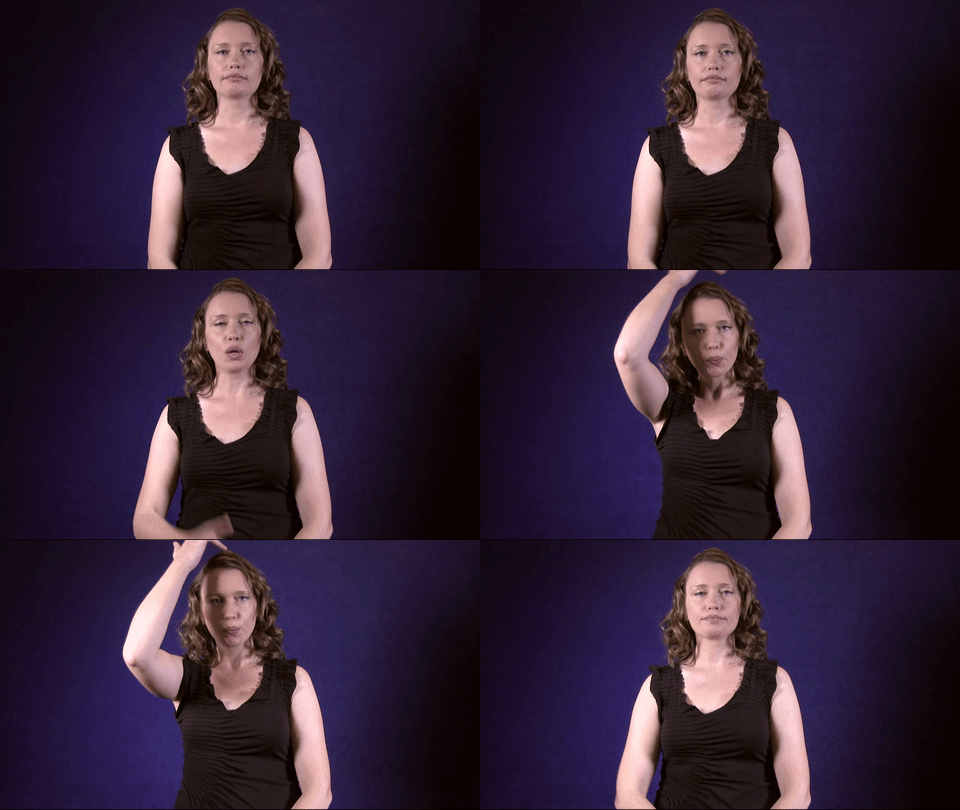
Sign for BARE-HEAD in ASL 

YouTube player

Practice Activities:

To begin practicing the sign for BARE-HEAD in ASL, try using a mirror to watch your non-dominant hand lightly tap the top or side of your bare head. Focus on facial expression to match the context—whether it’s a casual mention of not wearing a hat or referencing someone being bald. Repeat the sign five to ten times in front of a mirror to reinforce muscle memory.

Next, create simple sentences using the sign for BARE-HEAD in ASL. For example, you could sign, “I go outside bare-head” or “My dad is bare-head.” Sign each sentence slowly, then increase the speed as you feel more comfortable. This helps learners apply the sign fluidly in conversation.

To build context understanding, describe different weather situations and what you would wear. For instance, sign about a sunny day and say you forgot your hat, so you went out bare-head. This brings attention to how the sign can fit naturally in storytelling or everyday conversations.

If you’re working with a partner, take turns acting out scenes. One partner describes a character who always forgets their hat, while the other uses the sign for BARE-HEAD in ASL during the story. This is a fun and interactive way to reinforce comprehension while expanding sign vocabulary.

For a creative writing practice, write a short paragraph about someone who prefers to stay bare-head no matter the weather. Translate it into ASL and sign it to a friend or your reflection. This activity strengthens expressive skills and incorporates the sign in a personalized way.

Close your practice by watching videos in which native signers use the sign for BARE-HEAD in ASL. Observe how it’s used in different contexts to improve your fluency and comprehension. Always match your body language and facial grammar to the intent of the sentence for full clarity.

Cultural Context:

In American Sign Language, cultural context can deeply influence how signs are understood and used. The sign for BARE-HEAD in ASL has more than just a literal meaning. It’s often interpreted through a cultural lens that reflects etiquette, norms, and social expectations within the Deaf community.

The concept of “bare head” can imply being without a hat, scarf, or head covering. However, the sign for BARE-HEAD in ASL conveys more than physical appearance. It may also be associated with readiness, presentation, and sometimes even vulnerability, depending on the conversation.

In Deaf culture, appearance and presentation matter, especially in formal or respectful settings. The sign for BARE-HEAD in ASL might be used to describe someone showing respect by removing a hat when entering a building, church, or attending a solemn event. It connects with visual cues and common etiquette valued in the community.

This sign can also be significant in storytelling, where visual imagery plays a central role. In ASL narratives, describing someone with a bare head might set a specific tone or highlight emotional expression. The sign for BARE-HEAD in ASL helps paint a clearer, more vivid picture in a story.

Grooming and personal care routines may also be discussed using the sign for BARE-HEAD in ASL. Conversations about shaving the head, removing headwear, or preparing for sleep often involve this expression. The sign helps express these ideas visually and efficiently.

In modern contexts, the sign for BARE-HEAD in ASL is also used in discussions related to fashion, sports, and even religion. Whether someone removes a hat for style, policy, or tradition, the sign conveys this shift clearly. It becomes especially useful in diverse conversations involving cultural differences or identity.

The sign must always be considered in context to avoid misunderstanding. While it might seem simple, the sign for BARE-HEAD in ASL interacts with facial expressions, settings, and situations to deliver its full meaning. Without these visual and cultural cues, its interpretation could shift.

In educational and social settings, knowing how and when to use this sign respectfully is important. Teachers may use the sign to explain school rules about headwear, while students might use it to describe their morning routines. The sign for BARE-HEAD in ASL supports healthy communication socially and academically.

It’s also an example of how ASL connects physical descriptions with deeper cultural significance. The use of the sign for BARE-HEAD in ASL reflects this rich

Extended Definition:

The sign for BARE-HEAD in ASL refers to the concept of having nothing on one’s head—no hat, wig, head covering, or ornament. This sign is used when someone wants to describe a person whose head is uncovered, such as for dress code reasons, cultural practices, or simply personal style. Understanding the sign for BARE-HEAD in ASL helps convey appearance more precisely in conversation.

This ASL sign uses a flat hand that moves over the top of the head in a smooth gesture. The motion mimics removing a covering or indicating that something is bare. Expression and body language are important in ASL, and using the proper facial expression while signing can enhance clarity and meaning.

In many contexts, the sign for BARE-HEAD in ASL may be used when describing people in professions where head coverings are common. For example, it may be relevant when talking about a chef without a hat, a religious setting where head coverings are removed, or describing fashion in photo captions. It’s a useful sign when describing haircuts, baldness, or head condition, depending on the conversation.

The sign for BARE-HEAD in ASL can also carry cultural significance. In some communities, having a bare head may symbolize mourning, modesty, or freedom. ASL users may rely on this sign during storytelling or discussions about identity, gender norms, or cultural behaviors. This allows the concept to transcend its surface meaning and represent deeper ideas and experiences.

Context will affect how and when you use the sign for BARE-HEAD in ASL. If comparing people in a crowd, pointing out that one has a covered head and another has a bare head could matter, especially to clarify someone’s identity or attire. This helps keep communication accurate and efficient.

Learners of ASL should practice the movement and context of this sign to ensure they use it correctly. Because ASL is a visual language, the position, shape, and flow of the sign for BARE-HEAD in ASL all contribute to its meaning. Signing without confidence or clarity might lead to misunderstandings, so observing native signers is helpful.

In media or educational settings, this sign might appear in descriptions of characters, especially in children’s books or videos that use ASL to describe illustrations or actions. Knowing basic descriptive signs like this one is essential when teaching or learning through ASL. Visual learners often find this type of sign to be intuitive once they see it used properly.

Synonyms: bald, uncovered head, head without covering, exposed scalp, no headgear

Educational resources: Find related learning materials in our course bank!

Want more? Check out some of our popular learning activities on the homepage!

Need to look up a sign? Use our highly rated dictionary: https://aslinteractive.com/best-asl-dictionary/

Follow us on tiktok: https://www.tiktok.com/@aslinteractive. More social media links at the bottom of this page!

Long-tail Keywords: what is the sign for bare-head in ASL, how do you sign bare-head in ASL, ASL sign for bare-head

Categories:

tags: appearance, language learning, basic grammar, describing residence, people

Parameters

*Handshape*:

The handshape for the sign for BARE-HEAD in ASL uses the dominant hand in a flat “B” handshape . The fingers are together and extended, with the thumb tucked alongside the palm.

To produce the sign for BARE-HEAD in ASL, the “B” hand moves in a small arc from one side of the forehead to the other, mimicking the motion of brushing something off the head. This simple but expressive handshape clearly conveys the concept of a bare or uncovered head.

*Palm Orientation*:

For the sign for BARE-HEAD in ASL, the dominant hand begins with the palm facing in toward the center of the forehead. As the motion progresses, the palm rotates slightly outward and downward, brushing over the top and toward the back of the head.

The palm orientation emphasizes the gesture of referencing the uncovered head area, enhancing the visual concept of the sign for BARE-HEAD in ASL.

*Location*:

The sign for BARE-HEAD in ASL takes place at or near the head region, specifically around the upper side of the forehead and temple area. The movement often involves a sweeping motion across the side of the head, indicating exposed or uncovered skin.

This location emphasizes where a hat or covering might typically be, helping visually convey the meaning of “bare.” For the sign for BARE-HEAD in ASL, keeping the hand within this head-level space is essential for clarity and accuracy.

*Movement*:

The sign for BARE-HEAD in ASL uses the dominant hand in a flat “B” shape, palm facing in. Starting from the dominant side of the forehead, the hand moves in a diagonal path across the forehead and ends near the non-dominant side, indicating the absence of headwear.

This smooth, sweeping motion visually represents the concept of a head without covering. The sign for BARE-HEAD in ASL is expressive and symbolic, often accompanied by a neutral or descriptive facial expression. ‍

*Non-Manual Signals*:

When producing the sign for BARE-HEAD in ASL, the facial expression should reflect a matter-of-fact or slightly neutral demeanor, as this sign simply describes a physical state. Subtle raised eyebrows or a mildly focused look may be present to emphasize the descriptive nature of the term.

Avoid exaggerated facial reactions as they can imply unintended meanings. Keep your head steady and eyes directed forward, reinforcing the clarity of the sign for BARE-HEAD in ASL ‍ .

*Prosody, Dominant/Non-Dominant Hand*:

The sign for BARE-HEAD in ASL uses the dominant hand in a modified “A” handshape, fingers closed, thumb extended. The dominant hand taps or brushes the top side of the head near the temple area. The non-dominant hand is not used during this sign.

This gesture mimics the idea of nothing covering the head, representing the concept of bare or uncovered. The sign for BARE-HEAD in ASL visually communicates a head without a hat or head covering, aligning with its meaning.

Tips for Beginners:

When learning the sign for BARE-HEAD in ASL, it’s important to pay attention to the facial expression and the motion used for accuracy. This sign is typically made by brushing the dominant hand across the top of the head, mimicking the idea of a bare or uncovered head. Make sure the handshape is consistent with the correct form—usually a flat hand palm down—and the movement is smooth and deliberate.

A common beginner mistake with the sign for BARE-HEAD in ASL is to confuse it with signs that incorporate similar motion, like signs for “hat” or “bald.” To avoid confusion, maintain a neutral yet clear facial expression and keep the movement centered directly above the top of the head—not too far forward or to the back. Practicing in front of a mirror can help reinforce correct placement and smooth motion.

Use repetition to build muscle memory. Try signing in front of a mirror while recording yourself, so you can compare your accuracy with native signers. Watching slow-motion versions of the sign can also be a valuable way to internalize detail. Be patient with yourself—it often takes several practice sessions to feel natural using this sign fluidly in conversation.

Don’t forget to use the sign for BARE-HEAD in ASL in full sentence practice instead of learning it in isolation. This reinforces its use in context, improving both your fluency and your understanding of the meaning. Practicing with a language partner or tutor who gives feedback on handshape and facial expressions can speed up your progress.

Always confirm your sign with a trusted ASL dictionary or a Deaf signer. This will help ensure you’re learning the most accurate version of the sign for BARE-HEAD in ASL and integrating it with proper cultural respect and nuance.

bare-head sign in asl, sign for bare head american sign language, how to sign bare-head in asl, asl vocabulary bare-head, learn sign for bare head

Connections to Other topics:

The sign for BARE-HEAD in ASL connects to a range of body-related and appearance-based vocabulary in the language. It is related to signs describing clothing or lack thereof, such as HAT, HAIR, and SHAVE, since it focuses on the absence of something commonly found on the head. The sign can also tie into the sign for BALD, offering a conceptual link between visible baldness and having an uncovered or exposed head.

In narrative contexts, the sign for BARE-HEAD in ASL can interact with signs depicting weather or environmental conditions. For example, combining it with signs like SUN or HOT might describe someone walking bare-headed under the sun, emphasizing the vulnerability or exposure. Similarly, pairing it with RAIN or COLD can convey a different nuance, suggesting a person is unprotected or at risk due to the bare head.

This concept can also tie into cultural or situational specifics, especially when discussing uniforms, traditions, or settings where head coverings are expected or required. For instance, in religious contexts or military environments, BARE-HEAD could highlight non-compliance or contrast to expected dress codes. In such scenarios, the sign becomes part of a larger set of expressions used to discuss rules and customs.

Learners will find that the sign for BARE-HEAD in ASL is helpful when describing personal appearance or relating stories involving identification or disguise. It can combine with signs like HIDE or MASK to paint a picture of someone exposing or revealing themselves. This ability to combine with expressive, descriptive signs makes it a versatile tool in storytelling.

The sign also connects to visual descriptors or classifiers, especially when describing individuals in group situations or distinguishing between multiple characters. When used with role-shifting techniques, the sign can help build mental images and clarify who is being referenced, particularly when contrasting individuals based on appearance.

Summary:

The sign for BARE-HEAD in ASL involves a visual gesture that communicates the absence of a covering on the head, such as a hat or scarf. Typically, the dominant hand is used in a flat-B handshape, and it makes a light brushing motion over the crown or side of the head, emphasizing the idea of exposure or uncovered-ness.

This sign reflects physical observation directly, as ASL often uses iconic representations. The movement and location of the hand near or on the head clearly convey the concept of a head with nothing on it. This sign is not abstract; it is grounded in visual-spatial logic, which is central to the structure of ASL.

Grammatically, the sign for BARE-HEAD in ASL functions primarily as an adjective or descriptive phrase. It can be used to describe a person’s appearance or condition in moment-to-moment conversations. In certain contexts, it can also function as a predicate element when used with appropriate non-manual markers.

The sign can be used to describe states of being, such as when emphasizing purity, simplicity, or vulnerability. In Deaf culture, how one signs this can carry subtle connotations based on context. For instance, describing someone as bare-headed in a formal situation could suggest informality or relaxation, depending on tone and expression.

Linguistically, the sign for BARE-HEAD in ASL is an example of how morphology works in sign language. The handshape, location, and motion all come together to depict a concept holistically. Small changes in movement or facial markers can alter the meaning slightly, showing the form-meaning coupling that’s central to ASL linguistics.

In terms of syntax, the sign for BARE-HEAD in ASL typically follows the noun it’s describing, in keeping with adjective-noun order that’s common in ASL. For example, one might sign MAN BARE-HEAD to indicate “a man with no hat.” This syntax mirrors other adjective usage in ASL.

From a cultural perspective, the idea of being bare-headed can have layered meanings. In many religious or formal contexts, covering the head is a sign of respect. To sign bare-head may subtly indicate cultural or religious neutrality, or even rebelliousness, depending on context.

ASL isn’t merely a tool for communication—it also reflects cultural values. In the Deaf community, visibility and tactile clarity are essential. The sign for BARE-HEAD in ASL reflects this by being spatially clear and easily distinguished in conversations.

There are signs related in both form and meaning. For example, the sign for HAT involves a similar hand location but includes a tapping motion instead of a brushing one. Context and motion help clearly differentiate between covering and not covering the head.

In storytelling or narrative, using the sign for BARE-HEAD in ASL can set scenes or characterize people. A bare-headed figure in a winter setting may evoke images of hardship or eccentricity. ASL literature and poetry often use visual signs like this as metaphorical devices.

Applied linguistics considers how learners of ASL acquire signs like BARE-HEAD. Because it is visibly congruent with its meaning, it is often more accessible to beginners. Still, mastering nuance—like the degree of motion or facial grammar accompanying it—requires immersion and practice.

In educational settings, teaching the sign for BARE-HEAD in ASL can open discussions around visual literacy. Students learn not just vocabulary, but how meaning is constructed visually. This improves overall understanding of ASL grammar and morphology.

In Deaf history, appearances have often been tools of cultural identity. The sign for BARE-HEAD in ASL might occasionally serve as a descriptor in narratives about social or political conformity. Whether a person wears hats or doesn’t can reflect broader themes of assimilation or personal freedom.

In tactile ASL used by some DeafBlind individuals, the sign for BARE-HEAD in ASL can still be recognized by handshape and movement. However, it requires adaptation to maintain clarity through touch. This shows how flexible ASL structure is across modalities.

The sign also represents how gestures cross over between daily life and formal language systems. The gesture of brushing the top of the head is naturally understood even by those unfamiliar with ASL, providing a bridge between gesture and formal sign.

Idiomatic use of the sign for BARE-HEAD in ASL may develop over time. For instance, it could signify mental openness or emotional vulnerability in poetic or figurative conversations. Its adaptability stems from ASL’s rich expressive potential.

In a lexical-semantic framework, BARE-HEAD connects directly to physical referents unlike more abstract signs. This indexicality—linking form to referent—supports its role as an easy sign for semantic field studies and sign acquisition research.

Phonologically, the handshape is stable while the motion and facial expression introduce variability. The brushing action is essential, and without it, the sign could be misinterpreted as HAT or HEAD

Want more? Check out some of our popular learning activities!

ASL Interactive Resources

ASLInteractive YouTube Channel

Follow us on tiktok: @aslinteractive.com

Follow us on Instagram: aslinteractive

Facebook page: aslinteractive

Facebook group: aslinteractive

LInkedIn: ASL Interactive LLC

Twitter: @ASL_interactive

*Some information on this page is AI-generated. AI can make mistakes. Please check the information.

Sign for BARE-HEAD in ASL 

Responses