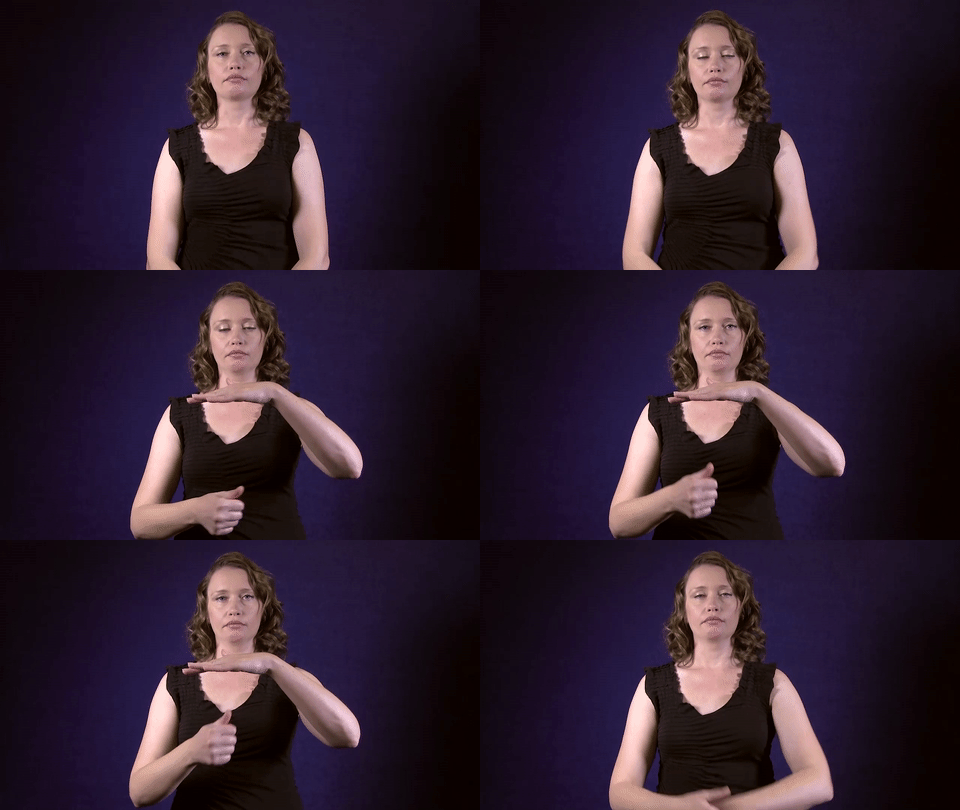
Definition: The lowest floor of a building.
Sign for BASEMENT in ASL

Practice Activities:
To practice the sign for BASEMENT in ASL, start by focusing on the handshape and movement in isolation. Repetition is key—practice signing it in front of a mirror to check that your dominant hand moves in a small circular motion under your non-dominant flat hand, representing the concept of something below ground level. Try signing it slowly and gradually build up speed while maintaining clarity.
Incorporate the sign for BASEMENT in ASL into short phrases. For example, say “my bedroom is in the basement” or “laundry is in the basement” while signing each word correctly. Practice changing the subject of the sentence to vary your use, such as “my office is in the basement” or “we store food in the basement.”
Create flashcards with household nouns like kitchen, attic, garage, and basement. Work with a partner to take turns signing each location, including the sign for BASEMENT in ASL, and ask your partner to guess which one you signed. This will build recognition and expressive skills.
For a storytelling activity, create a short story about a day spent in the basement. Include details like what the character did, saw, or stored in the basement. Use other signs such as CLEAN, DARK, STORAGE, and HOME to support your narrative. This will help deepen vocabulary and sentence fluency.
Role-play a house tour with a partner. Use ASL to show them around different rooms and include a stop at the basement. Ask and answer questions like, “What’s in the basement?” or “Is the basement finished?” Practicing in this context helps the sign become second nature.
End your practice session by filming yourself using the sign for BASEMENT in ASL in three different sentence types: statement, question, and negation. Review the video to assess clarity and fluency in your signing.
Cultural Context:
In many homes across North America, the basement serves as a storage area, a laundry room, or even an extra living space. Knowing the sign for basement in ASL helps create clear communication about household areas, especially in conversations about home layouts, renovations, or real estate.
The sign for basement in ASL often appears in discussions when giving directions inside a building or describing where certain activities happen, like watching movies in the basement or storing family heirlooms. Deaf and hard-of-hearing individuals use this sign frequently in everyday life, making it a practical addition to one’s ASL vocabulary.
Understanding how to express spatial concepts like upstairs, downstairs, and basement in ASL reflects a deeper connection to how space and orientation are conveyed visually in Deaf culture. The sign for basement in ASL often includes directional cues that align with how people physically navigate buildings.
In Deaf culture, space and environment hold special significance. When referencing physical spaces like the basement, it’s not just about the room itself, but how it’s used within the daily rhythm of life. Using the correct sign for basement in ASL ensures cultural accuracy and strengthens the effectiveness of visual language.
Storytelling in ASL is also enhanced by using signs that show where actions take place. If someone is recounting an event that occurred in the lower level of a house, the sign for basement in ASL places the narrative in the correct location, creating a clearer mental picture for the viewer.
Learning household vocabulary such as the sign for basement in ASL is especially helpful for families and educators integrating Deaf or hard-of-hearing members. Being able to give instructions like go to the basement or clean the basement in ASL enables smoother everyday communication.
Culturally, signing space-specific areas like the basement supports the rich visual-spatial nature of ASL. Deaf individuals often orient their stories, directions, and explanations using these landmarks, making the sign for basement in ASL a natural part of their linguistic landscape.
Even popular media and films sometimes reference basements in dramatic or humorous scenes. Knowing the sign for basement in ASL allows Deaf individuals to engage more fully with those narratives whether in translation or live storytelling among peers.
Whether planning emergency drills or simply navigating a home, the ability to discuss the basement without confusion can be essential. The sign for basement in ASL allows such discussions to be clear and effective in both casual and serious contexts.
By including signs like the one for basement in ASL in everyday language learning, users show respect for the expressive power
Extended Definition:
The sign for basement in ASL is a visually descriptive sign that conveys the concept of a lower level or underground floor in a building. In American Sign Language, the concept is typically expressed using a dominant hand that moves beneath the flat, non-dominant hand, symbolizing something located below a main surface.
This sign is often used when describing parts of a house, a building structure, or locations in storytelling. When using the sign for basement in ASL, facial expressions and spatial referencing may also be incorporated to give more depth and context to the conversation. Signers may indicate where the basement is in relation to the rest of the structure, which enhances clarity and adds linguistic richness.
Understanding the sign for basement in ASL is useful when discussing anything underground, such as storage spaces, living areas, or shelters. It is frequently used in everyday conversations when talking about houses, weather emergencies, or even haunted house stories around Halloween.
For young learners or those new to American Sign Language, practicing the sign for basement in ASL can be helpful when learning vocabulary related to household locations. Educators and parents can also teach this sign as part of broader lessons about homes, architecture, or safety.
This sign plays an important role in offering spatial information. Since ASL is a highly visual language, location-based signs like the sign for basement in ASL help signers convey precise meaning without needing spoken words. These signs allow for engaging communication that supports visual learners and those who rely entirely on sign language.
When used in sentence structure, the sign for basement in ASL should follow ASL grammar rules. Rather than following English order, it might come after a noun or location sign, depending on context. For example, when talking about a laundry room in a basement, the structure of the sentence might differ significantly from English.
Users searching for the sign for basement in ASL online often look for video demonstrations to help grasp the movement and positioning of the hands. Seeing the sign in action is especially helpful, as handshape, palm orientation, and movement are critical aspects of producing the sign correctly. Including visual resources is key to helping learners feel confident in their signing.
The sign itself reflects the concept of one level being under another, which is intuitive once it is seen and practiced. Since it is a commonly needed sign in home and emergency vocabulary, it appears frequently in day-to-day conversations and ASL learning materials.
In Deaf culture, the ability to clearly describe one’s living environment, including levels such as the basement
Synonyms: cellar, lower level, underground space, sublevel, foundation
Educational resources: Find related learning materials in our course bank!
Want more? Check out some of our popular learning activities on the homepage!
Need to look up a sign? Use our highly rated dictionary: https://aslinteractive.com/best-asl-dictionary/
Follow us on tiktok: https://www.tiktok.com/@aslinteractive. More social media links at the bottom of this page!
Long-tail Keywords: What is the sign for basement in ASL, how do you sign basement in ASL, ASL sign for basement
Categories:
tags: Housing, Facilities and other locations/needs, Describing Residence, Home, Rooms in a House
Parameters
*Handshape*:
The handshape for the sign for BASEMENT in ASL involves using a closed “A” handshape with the dominant hand. The non-dominant hand stays flat and horizontal, palm facing downward, representing the floor level. The dominant “A” hand moves in a small circular motion just beneath the non-dominant hand, indicating the area below the surface.
This sign clearly shows that a basement is below the main part of a building. The handshapes used in the sign for BASEMENT in ASL help convey spatial relationships with visual clarity.
*Palm Orientation*:
For the sign for basement in ASL, the dominant hand typically forms the letter “A” with the palm facing down or slightly inward. The non-dominant hand is held flat, palm facing down, to represent the floor or the main level of a building.
The dominant “A” hand moves gently in a circular or back-and-forth motion below the non-dominant hand, mimicking the concept of something beneath the main level. The palm orientation helps clearly convey the spatial relationship, enhancing the clarity of the sign for basement in ASL .
*Location*:
The sign for basement in ASL is typically produced in the neutral space in front of the lower torso. One hand, usually the non-dominant, remains flat and horizontal to represent the main floor, while the dominant hand moves under it in a small circular motion to show the concept of something beneath. This placement emphasizes the lower part of a structure, matching the meaning of the sign for basement in ASL.
Using the lower torso area reinforces the spatial reference to something below or underground. This location helps convey the layered structure that is clearly represented in the sign for basement in ASL.
*Movement*:
To show the sign for basement in ASL, start with your non-dominant hand held flat, palm facing down, representing the floor or ground. Then, form the dominant hand into the “A” handshape and make small circular motions below the flat non-dominant hand, indicating a level beneath the surface.
This motion helps visually represent the concept of something below the ground level, aligning with the meaning of the sign for basement in ASL . Make sure your dominant hand stays beneath the stationary hand throughout the movement.
*Non-Manual Signals*:
When using the sign for basement in ASL, the non-manual signals typically include a neutral or slightly downward-cast gaze to suggest something located beneath or below. The lips may form a slight pursing or may remain neutral, helping support the concept of something under the main level.
A relaxed facial expression keeps the message clear, as exaggerated emotion is not necessary. Combined with the hand movement, these subtle cues enhance the natural flow of the sign for basement in ASL ⬇️.
*Prosody, Dominant/Non-Dominant Hand*:
The sign for BASEMENT in ASL uses both hands with specific roles. The non-dominant hand is held flat and horizontal, palm facing down, to represent a ground or floor level. The dominant hand forms an “A” handshape and circles below the non-dominant hand, indicating something beneath or underneath the surface.
This motion visually conveys the concept of a basement being below the main level. The sign for BASEMENT in ASL effectively uses spatial referencing to show “below,” enhancing overall clarity.
Tips for Beginners:
When learning the sign for BASEMENT in ASL, it’s helpful to break it into two ideas: the concept of a building’s main structure and something underneath. Typically, the sign involves forming the non-dominant hand into a flat horizontal position to represent the ground level, while the dominant hand forms an “A” handshape and circles beneath the non-dominant hand. This spatial relationship helps visually convey the idea of a basement being below ground level. Practice this movement slowly and deliberately at first, paying attention to the circular motion and hand positioning.
A common mistake beginners make is placing the dominant hand too far from or too close to the base hand. The sign should stay relatively close to the underside of the non-dominant hand to maintain a clear spatial reference. Keep both hands steady and use your wrist—not your whole arm—for the circular movement. Watching fluent signers or ASL instructors can help you get a feel for the motion speed and handshape consistency.
Focusing on fluidity and clarity is essential. Don’t rush the circle or make the sign too large, as it can lose its meaning. Repeating the sign in front of a mirror can build muscle memory and increase confidence. If signing the word as part of a full sentence, remember to keep the sign for BASEMENT in ASL proportional to the rest of your signing—avoid overexaggeration unless used for expressive purposes such as storytelling.
It’s also useful to pair the sign with facial expressions when appropriate. For example, if you’re signing about a basement that’s spooky, messy, or flooded, your face should reflect that concept to add meaning. The sign for BASEMENT in ASL is simple in structure but very dynamic when used effectively in context. Keep practicing regularly and ask for feedback from fluent signers to fine-tune your technique.
Connections to Other topics:
The sign for BASEMENT in ASL is closely related to spatial and directional concepts. It integrates the idea of physical structure, similar to signs for ATTIC, FLOOR, ROOM, or BUILDING. These signs use spatial referencing and classifiers to establish the layout of a space, helping learners better understand the abstract layering of environments in ASL.
In compound signs, the sign for BASEMENT in ASL can be used alongside signs like HOUSE, APARTMENT, or GARAGE to describe specific parts of a building. For example, signing HOUSE + BASEMENT gives the clear concept of a house with a basement level, especially when paired with directional signs that indicate location under something else. This enhances descriptive skills in storytelling or giving directions.
The sign visually mimics a foundational space beneath the main structure, reinforcing concepts of grounding and layers. It aligns well with classifiers that indicate movement or structure, like using a flat hand (CL: B) for floors and layering to show vertical positioning. Understanding how the sign for BASEMENT in ASL fits within these categories helps learners understand broader architectural and spatial dialogues in ASL.
Contextually, this sign appears in emergency scenarios, real estate discussions, or storytelling about experiences within parts of the home. In dialogues such as “the tornado forced us to hide in the basement,” it is paired with directional or emotional signs to add depth. When discussing flooding or storage, the sign emphasizes the lower elevation, often using downward body language or eye gaze.
Learning the sign for BASEMENT in ASL can enrich a student’s understanding of relational spaces. It naturally aligns with other signs for components of a home or building, encouraging the development of visual-spatial thinking. This makes the sign a meaningful part of learning how ASL describes the environment in a layered, detailed way ⬇️.
Summary:
The sign for BASEMENT in ASL involves a spatial concept and a simple but expressive motion. Typically, the dominant hand makes a small circular movement under the palm of the non-dominant hand, which remains flat and horizontal. This mimics the idea of something being underneath or beneath a structure.
The non-dominant hand in this sign represents the floor or structure above ground, like the main level of a house. The dominant hand moves below it, suggesting the area underneath. This spatial arrangement parallels how buildings are constructed with a basement area beneath the foundation.
This concept is deeply rooted in how ASL uses space in three-dimensional ways. Instead of only using abstract symbols, the sign for BASEMENT in ASL mirrors the layout of physical environments. This approach helps Deaf users visualize and conceptualize real-world spaces linguistically.
When describing houses or buildings in ASL discourse, the sign for BASEMENT frequently comes up. It’s often paired with signs like HOUSE, BUILDING, or GARAGE. This pairing creates a broader picture of the architectural components of a place.
The grammatical use of the sign fits within locative and descriptive contexts. For example, one might sign MY BEDROOM BASEMENT or STORAGE ROOM BASEMENT, sequencing spatial and possession indicators before the sign for BASEMENT in ASL. This order mirrors ASL syntax, which typically places location descriptors after the main noun or topic of the sentence.
Many ASL signs are built on conceptual metaphors, and the sign for BASEMENT in ASL uses one of the simplest—above and below. This up/down configuration is intuitive and aligns with many cross-linguistic tendencies in sign languages for dealing with verticality and space.
The sign doesn’t change much for different types of basements: finished, unfinished, creepy. Additional descriptors are added before or after to clarify the kind of basement in question. For example, DARK BASEMENT or FINISHED BASEMENT would each be visually distinct with facial expressions and added signs.
Facial expression and non-manual markers can shift how the sign for BASEMENT in ASL is understood. A wider motion or a squinted facial expression could suggest a deep or eerie basement. In contrast, a more casual expression suggests a common, everyday basement.
Children often learn the sign in early years when discussing parts of a house. In classroom settings, storytelling, or home description projects, the sign helps reinforce spatial language. The interactive nature of the motion also makes it fun and memorable for young learners.
Teaching the sign in ASL classes often pairs it with drawings or 3D models of buildings. That way, students link the spatial dynamics of the sign for BASEMENT in ASL to real-world architecture they already understand. It serves as a practical application of visual-spatial learning.
In Deaf culture, it’s not uncommon to describe homes or meeting spaces with strong visual detail. Mentioning the basement becomes part of that cultural preference for depth and context. Whether describing a church basement, a friend’s home, or a tornado shelter, the sign supports storytelling.
The sign branches into conceptual extensions. In abstract conversations, BASEMENT might metaphorically stand for a foundation, underlying cause, or something below the surface emotionally. While not as common, such metaphorical usage showcases versatility in ASL as a dynamic, expressive language.
From a linguistic point of view, the sign is iconic and highly motivated. Its form is not arbitrary; it depicts the actual spatial relationship with hands playing representative roles of spaces. This contrasts with more abstract signs where form and meaning are less obviously linked.
The morphology of the sign is relatively simple—uninflected and consistent. There are limited variations or derivations from the base form. While dialectical differences may exist regionally, the most commonly accepted form remains fairly stable nationally.
In terms of syntax, the sign most naturally follows nouns it modifies. Like other location-related signs, it comes post-nominally in many sentence structures. For example, in ASL, one would say “STORAGE ROOM, BASEMENT” rather than leading with the location.
The sign for BASEMENT in ASL connects closely with signs for LEVEL, UPSTAIRS, and DOWNSTAIRS. Each of these constructs uses similar spatial orientation rules. These parallels provide a cohesive system for describing vertical space in homes and buildings.
Common collocations in ASL might include BASEMENT FIRE, BASEMENT FLOOD, or BASEMENT STAIRS. These reflect real-life scenarios where the sign plays an important communicative role. Emergency personnel, construction workers, or real estate agents in the Deaf community may use this vocabulary extensively.
In narratives, describing a journey into a basement often includes added movement and body role shift. The signer may lean forward, mimic stairs, or increase the motion space closer to the torso. This embodied storytelling enhances the engagement and paints a vivid picture.
The concept of basement often evokes certain associations like mystery or storage. When used creatively, the sign for BASEMENT in ASL becomes part of ghost
Want more? Check out some of our popular learning activities!
ASL Interactive Resources
ASLInteractive YouTube Channel
Follow us on tiktok: @aslinteractive.com
Follow us on Instagram: aslinteractive
Facebook page: aslinteractive
Facebook group: aslinteractive
LInkedIn: ASL Interactive LLC
Twitter: @ASL_interactive
*Some information on this page is AI-generated. AI can make mistakes. Please check the information.


Responses