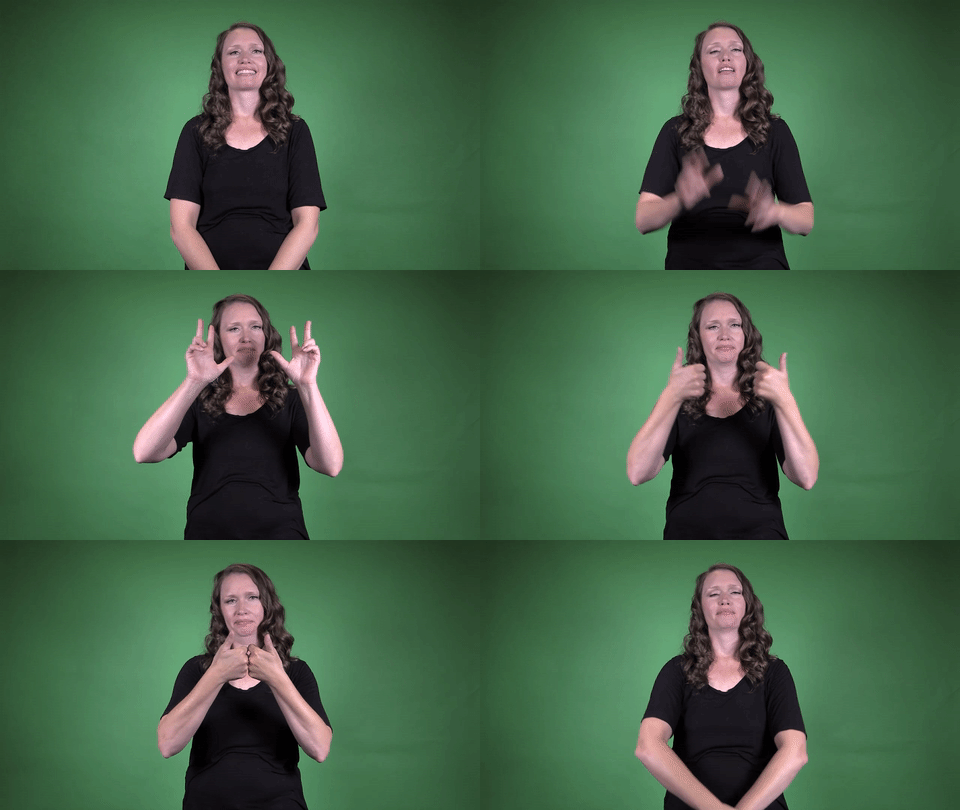
Definition: A game of basketball.
Sign for BASKETBALL GAME in ASL

Practice Activities:
Practice using the sign for BASKETBALL GAME in ASL by first isolating each concept. Begin with the sign for BASKETBALL alone, practicing the dominant hand motion that mimics shooting a basketball. Then sign GAME separately, using both hands in a clasping motion. Repeating these signs individually helps build muscle memory and confidence.
Once comfortable with the isolated signs, move into combining them smoothly. Practice signing BASKETBALL GAME together several times while saying the phrase aloud to reinforce the connection. Try filming yourself and watching it back to evaluate your fluency and hand placement. Pay attention to facial expressions and ensure the signs are performed clearly and at a steady pace.
Use the sign for BASKETBALL GAME in ASL in simple sentences like: “TODAY BASKETBALL GAME SCHOOL” or “I LOVE WATCH BASKETBALL GAME.” Sign these slowly at first and then increase speed as you gain fluency. Practice with a friend or classmate and take turns asking and answering questions such as “WHAT TIME BASKETBALL GAME?” or “YOU GO BASKETBALL GAME SATURDAY?”
Try storytelling practice by describing a BASKETBALL GAME experience. Start with a sentence such as “I PLAY BASKETBALL GAME LAST NIGHT” and add details about who won, how you felt, and what happened during the game. This helps increase comfort using the sign in narrative context.
In a group activity, take turns acting out different sporting events and guessing the signs. When your turn comes, make sure to include the sign for BASKETBALL GAME in ASL in your scenario. This helps develop receptive and expressive skills while having fun.
For a creative challenge, illustrate your dream BASKETBALL GAME scenario using only ASL, including team names, players, and game highlights. This engages imagination while reinforcing vocabulary and grammar.
Cultural Context:
In Deaf culture, sports play a significant role in building community, promoting inclusion, and encouraging physical activity. The sign for basketball game in ASL is not just a way to communicate about a sport, but also reflects how deeply integrated sports are in the lives of Deaf individuals. Whether watching a local tournament or participating in team sports, the basketball game becomes more than entertainment—it creates opportunities for social gathering and cultural pride.
The sign for basketball game in ASL often comes up in school settings, Deaf sports leagues, and casual conversations. Many Deaf schools have strong basketball teams, and games are well-attended by the community. Attending or discussing a basketball game in ASL offers a meaningful way to connect with others and express team spirit.
Basketball itself has a long-standing history in the Deaf community. From the founding of Deaf basketball leagues to national tournaments, there’s a legacy of participation and competition. Knowing the correct sign for basketball game in ASL is essential for discussing game strategies, favorite teams, and community events.
ASL vocabulary often stems from everyday concepts, and sports are no exception. Using the sign for basketball game in ASL allows Deaf individuals to fully engage in conversations about players, plays, scores, and upcoming events. This makes it easier for everyone to be included in the excitement surrounding the sport.
In Deaf culture, visual accessibility is always prioritized, and sports like basketball are easily followed visually. This makes the sport especially popular in Deaf communities. Announcements, plays, and even refereeing can be adapted for visual communication, and the sign for basketball game in ASL helps enhance that experience.
Fans use the sign for basketball game in ASL when talking about professional games, school matches, or even pickup games at the park. Whether you’re chatting about the NBA or a local Deaf school’s home game, the sign is essential vocabulary. It adds authenticity and relevance to discussions around the sport.
Deaf athletes often become cultural icons within their communities. Sharing their achievements is an important part of maintaining cultural pride. Using the sign for basketball game in ASL shows not only linguistic knowledge but also respect for these cultural milestones.
Young learners are often introduced to the sign for basketball game in ASL in schools or through ASL video content. This helps build both vocabulary and interest in sports as a form of social bonding. It encourages kids to get involved in group activities early on.
Many Deaf events feature basketball games as highlights—drawing large crowds and fostering a sense of unity. Being able to use the sign
Extended Definition:
The sign for basketball game in ASL combines elements of both the sport and the concept of competition, making it a visually dynamic phrase. To express this phrase clearly in American Sign Language, signers typically use the ASL sign for basketball followed by the sign for game or match. This combination shows both the activity and the context in which it happens — a structured and competitive environment.
The sign for basketball is often performed by mimicking the motion of shooting a basketball into a hoop, using both hands in a curved motion. This sign immediately conveys the idea of the sport. When combined with the sign for game, which is made by bringing two closed fists together with a tapping motion, the concept of an actual match or event becomes clear.
When learning the sign for basketball game in ASL, it’s important to understand the context and flow of the phrase in conversation. Rather than signing each English word separately, ASL emphasizes conceptual accuracy and efficient visual representation. This means that depending on the context, a signer might modify or emphasize certain parts of the phrase to match the situation being discussed.
Facial expressions and body posture also enhance the meaning of the phrase. When talking about a thrilling or competitive basketball game, the signer might show excitement through raised eyebrows or an energized motion. These non-manual signals are important for full expression in American Sign Language, helping to capture the tone and emotional context of a sentence.
Watching videos or interacting with fluent signers can help new learners master the sign for basketball game in ASL. It’s helpful to repeatedly view the sign in natural conversations or practice dialogues to better understand how it’s used in real-life settings. Resources that include native ASL users or certified interpreters can offer accurate and culturally appropriate demonstrations.
The phrase sign for basketball game in ASL is especially useful in school settings, youth programs, and community sports discussions. Whether discussing past games, organizing future ones, or simply talking about interests, this phrase is frequently used. It can also be a valuable addition to vocabulary for interpreters working in sports settings or recreational environments.
Because basketball is such a popular sport across American communities, the ability to communicate about games in ASL helps to build inclusion. It’s a great example of how expressive and accessible American Sign Language can be when describing concepts that are culturally significant. From professional games to casual neighborhood matches, knowing the sign for basketball game in ASL opens up more chances for connection and communication within the Deaf and hard-of-hearing community.
To practice the phrase correctly
Synonyms: basketball match, basketball contest, hoops game, basketball competition, basketball event
Educational resources: Find related learning materials in our course bank!
Want more? Check out some of our popular learning activities on the homepage!
Need to look up a sign? Use our highly rated dictionary: https://aslinteractive.com/best-asl-dictionary/
Follow us on tiktok: https://www.tiktok.com/@aslinteractive. More social media links at the bottom of this page!
Long-tail Keywords: What is the sign for basketball game in ASL, How do you sign basketball game in American Sign Language, Learn how to sign basketball game in ASL
Categories:
tags: sports, activities, objects, verbs, throwing items
Parameters
*Handshape*:
The handshape used in the sign for BASKETBALL GAME in ASL involves using both hands in a claw or “5” curved handshape, mimicking the grasping motion associated with handling a basketball . The fingers are spread and slightly curved as if gripping a ball, and the motion reflects the act of dribbling or shooting.
For the “game” part, both hands form the “A” handshape (fists with thumbs extended outward), and the knuckles tap each other. The combination of these handshapes effectively conveys the meaning of the sign for BASKETBALL GAME in ASL in a clear and visual manner.
*Palm Orientation*:
In the sign for BASKETBALL GAME in ASL, the palm orientation for BASKETBALL involves both hands in a curved “3” handshape, palms facing each other slightly forward, and fingers loosely spread to mimic gripping a ball. The hands move in a small bouncing motion in front of the chest, suggesting the motion of dribbling a basketball .
For the GAME portion of the sign for BASKETBALL GAME in ASL, both hands form the “A” handshape with palms facing towards each other and knuckles angled slightly outward. The knuckles tap together twice in front of the chest, symbolizing a matchup or competition.
*Location*:
The sign for BASKETBALL GAME in ASL is made in the neutral space in front of the upper torso. Both signs—BASKETBALL and GAME—are produced at chest level, slightly away from the body to allow for clear movement and articulation.
BASKETBALL uses bent “5” handshapes bouncing as if shooting a ball, while GAME is signed by bringing two “A” handshapes together at the knuckles. The location remains steady for clarity in expressing the sign for BASKETBALL GAME in ASL .
*Movement*:
The sign for BASKETBALL GAME in ASL includes a combination of two signs. First, for “basketball,” both hands form the number 3 handshape and simulate a shooting motion, wrists flicking upward as if throwing a ball toward a hoop. Move the hands slightly in front of the body as you simulate the jump shot.
Then for “game,” form two A-handshapes and bring the knuckles together with a firm double tap. This mimics two teams or forces coming together. Together, the sign for BASKETBALL GAME in ASL moves smoothly from the bouncing-shooting motion into the connecting hands, showing the concept of a basketball match.
*Non-Manual Signals*:
When expressing the sign for basketball game in ASL, use an excited or engaged facial expression to reflect the high-energy nature of the event. Slight raised eyebrows and open eyes help emphasize anticipation or enthusiasm.
Tilt your head slightly forward or to the side as if focused on action. A slight smile or a look of concentration may be appropriate, depending on context. These non-manual signals help reinforce the dynamic nature of the sign for basketball game in ASL .
*Prosody, Dominant/Non-Dominant Hand*:
The sign for BASKETBALL GAME in ASL uses both the dominant and non-dominant hands in different phases. For “basketball,” both hands form the number 3 handshape and mimic the motion of shooting a basketball into a hoop. The dominant hand leads slightly in the motion, showing control and direction .
For “game,” both hands form the letter A and come together forcefully at the knuckles in front of the body. The dominant hand often emphasizes the contact, showing assertiveness and importance of the event. The sign for BASKETBALL GAME in ASL flows naturally, using prosody to highlight intensity and engagement.
Tips for Beginners:
When learning the sign for BASKETBALL GAME in ASL, it’s important to first break it down into two parts: “basketball” and “game.” The sign for “basketball” involves mimicking the motion of holding and shooting a basketball, with your hands placed as if you’re gripping a ball and making a short push-away motion. For “game,” touch the knuckles of both closed hands together repeatedly. Practicing both parts independently before combining them will help build muscle memory.
Begin by focusing on the shape and orientation of your hands. For the “basketball” portion, keep your hands curved as if holding an actual ball — don’t flatten your palms. Make sure both hands move outward simultaneously to show the action clearly. Some beginners accidentally make the motion too high or too far out, which can distort the sign and cause confusion. Stay within your signing space, roughly from your chest to your head.
When signing “game,” make sure the contact between knuckles is firm but not forceful. A light consistent rhythm helps communicate the meaning with clarity and confidence. Don’t rush through it — take your time to ensure each movement is deliberate. Clarity matters more than speed when you’re just starting out.
One helpful tip is to practice in front of a mirror or record yourself. This allows you to check your hand shapes, location, and motion to ensure you’re performing the sign for BASKETBALL GAME in ASL correctly. Pair signs with the corresponding facial expression — this adds emphasis and gives your communication authenticity.
Try using the sign in different contexts to build fluency. Whether you’re asking someone if they watched a basketball game or telling a story about one you played in, repetition helps retain both the vocabulary and confidence to use it naturally. Consistent practice is key to mastering the sign for BASKETBALL GAME in ASL.
Connections to Other topics:
The sign for BASKETBALL GAME in ASL combines concepts of sports, competition, and common handshape representations used in athletic contexts. The sign for “basketball” typically uses a mime-style motion showing the action of shooting a basketball, while “game” is signed by bringing two A-hands together, representing opposing sides coming together. This pairing reflects how ASL builds compound signs through contextual linkage of ideas.
Understanding the sign for BASKETBALL GAME in ASL can help learners connect with other sports-related signs, such as “football,” “soccer,” and “volleyball,” each with its own unique iconic representation. These signs often utilize handshapes and movement to mirror actual gameplay, making them easier to remember and more meaningful. The concept of games or matches extends to broader ideas like tournaments, competitions, and team dynamics in ASL vocabulary.
This sign also relates to activity-based concepts such as “play,” “team,” and “win,” which frequently appear in discussions about sports. The sign for “team,” for instance, uses the T-handshape in a circular motion, emphasizing group unity, a key concept in any basketball game. Learning signs like “score,” “coach,” or “referee” can enhance the ability to describe or narrate a full game in ASL, making storytelling richer and more detailed.
The sign for BASKETBALL GAME in ASL also supports conversational skills around school events, community leagues, and personal interests. For students, it can tie in with signs like “school,” “PE,” or “practice.” In social settings, it may connect with phrases for watching a game, inviting friends, or expressing team loyalty. This integration helps learners use ASL naturally across a variety of contexts.
By working with the sign for BASKETBALL GAME in ASL, learners can also improve their understanding of temporal sequencing for past or upcoming events, using signs such as “happen,” “yesterday,” or “next week.” These time-frame markers enrich narrative structure and reinforce fluency.
Summary:
The sign for BASKETBALL GAME in ASL is typically formed by combining the sign for BASKETBALL with the sign for GAME. Each part of the sign has a unique motion that conveys its meaning. When combined, they represent the broader cultural and recreational concept of a basketball game.
To sign BASKETBALL, both hands are shaped into the number 5 handshape with fingers loosely spread. The hands are held in front of the chest and simulate the motion of shooting a basketball. This movement captures the rhythmic and familiar action from the sport.
The sign for GAME involves both hands in the A-handshape. The knuckles of both hands tap together moving slightly forward, symbolizing challenge and competition. This handshape and motion emphasize interaction between opponents.
When used together, the sign for BASKETBALL GAME fluidly combines the physical essence of the sport with the structure of an event. This combination mirrors how signed languages often concatenate signs to form compound phrases. Each component retains its core meaning even in composite form.
Culturally, basketball has deep roots in many Deaf communities. It serves as an accessible and unifying team sport, especially within Deaf schools and community centers. Numerous Deaf athletes have contributed to raising awareness and pride in both sports and Deaf identity.
The sign for BASKETBALL GAME in ASL often appears in contexts like sporting events announcements, flyers, or conversations about school competitions. It’s useful in everyday discussions among students, fans, and staff. ASL users often adapt the tonality and speed of the sign to reflect excitement or competitiveness.
Grammatically, the sign is often placed within time-topic-comment sentence structures. For example, “TODAY NIGHT BASKETBALL GAME, YOU GO?” is a typical format. Time indicators usually precede the event, followed by the main topic and a comment or question.
The lexicon of ASL operates differently from English, relying heavily on visual cues and spatial structuring. The sign for BASKETBALL GAME in ASL emphasizes how two conceptual ideas integrate non-linearly to form one meaningful phrase. This showcases the spatial-temporal advantage of ASL grammar.
Related signs include BASEBALL GAME and FOOTBALL GAME, which are structured similarly. Each sport sign can be paired with the GAME sign to indicate a specific event. This modularity of ASL makes it efficient for building and understanding related concepts.
Another key linguistic feature in the sign for BASKETBALL GAME in ASL is classifier usage. When retelling past games, signers might use classifiers to portray dribbling, shooting, or passing. These classifiers bring dynamic illustrations into the narrative.
In storytelling or descriptions, facial expressions add emotion and detail. For instance, excitement about a close game might lead the signer to widen the eyes or use faster movements. Thus, grammar in ASL includes more than just handshapes—it’s a full-bodied expression.
Signers often index location to establish team positions, using space to show where each team was on the court. Importance is placed on use of the signing space to outline past events. This gives viewers a near three-dimensional sense of the game.
The metaphorical layers can be seen when signers describe a “strong” or “intense” BASKETBALL GAME using body shifts and forceful motion. Motion dynamics play a key role in sign language linguistics. The sign for BASKETBALL GAME in ASL becomes a performance of language.
Applied linguistics often examines how such signs are taught in educational settings. Teachers may begin with individual sport signs like BASKETBALL before introducing compound phrases like BASKETBALL GAME. This scaffolding parallels how second language learners gain fluency.
Young signers usually pick up the signs through natural acquisition in peer groups or classrooms. Visual bilingualism helps reinforce both recognition and production. Physical activity contexts further support real-world application of the sign for BASKETBALL GAME in ASL.
The presence of school basketball teams in Deaf schools means that students are often exposed to this vocabulary early on. Posters, cheer signs, and announcements all help reinforce its usage. Repetition in meaningful contexts accelerates cognitive retention.
Deaf culture often celebrates team sports as community events, not just athletic competitions. The sign for BASKETBALL GAME in ASL thus has social and emotional resonance. It is used in rallying pride, support, and engagement within the community.
In some regional dialects, variations on the BASKETBALL sign may appear, though GAME tends to remain standardized. Regionalisms in signs add to the richness of ASL and reflect local linguistic evolution. Community practices help preserve localized versions.
In visual narratives like vlogs or video posts from Deaf influencers, the sign for BASKETBALL GAME in ASL frequently appears with matching facial expressions and reenacted plays. These storytelling formats make signs highly engaging and imitable. Social media amplifies its visibility.
From a sociolinguistic perspective, analyzing who uses what variation of the sign
Want more? Check out some of our popular learning activities!
ASL Interactive Resources
ASLInteractive YouTube Channel
Follow us on tiktok: @aslinteractive.com
Follow us on Instagram: aslinteractive
Facebook page: aslinteractive
Facebook group: aslinteractive
LInkedIn: ASL Interactive LLC
Twitter: @ASL_interactive
*Some information on this page is AI-generated. AI can make mistakes. Please check the information.


Responses