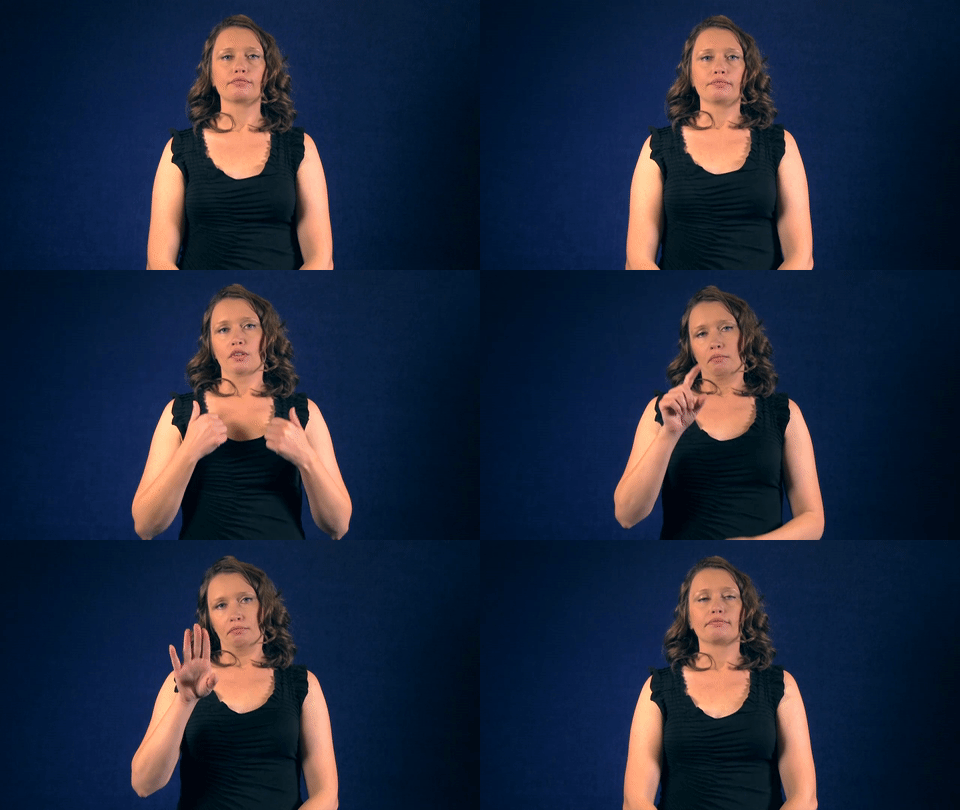
Definition: A large container for bathing.
Sign for BATH TUB in ASL

Practice Activities:
To practice the sign for BATH TUB in ASL, start by isolating each part of the compound sign. Practice the sign for BATH by miming scrubbing your chest with both fists (which represent washing) and then follow with the sign for TUB, which uses your hands to visually outline the shape of a tub. Repeat this sequence slowly and clearly in a mirror to build muscle memory and improve signing smoothness.
Next, incorporate the sign into vocabulary drills. Create flashcards or use an ASL vocabulary app to test recognition and production of the sign for BATH TUB in ASL. Practice signing common bathroom-related vocabulary together with this term to increase contextual fluency. Include items like soap, towel, water, and shower to reinforce category-based learning.
Use short sentences to practice BATH TUB in context. Examples include: “I like the BATH TUB,” “The child plays in the BATH TUB,” and “My house has a big BATH TUB.” Sign these while emphasizing clear facial expression, non-manual markers, and consistent handshape transitions. Film yourself and watch your video to self-assess your form and fluidity.
For storytelling practice, create a short narrative about a relaxing bath-time routine or a funny bath-time mishap. Try including events like filling the BATH TUB, adding bubbles, or a pet jumping in accidentally. Use supporting signs and classifiers to enrich your story and portray action vividly.
In partner activities, alternate signing short descriptions for each other to guess. One person can describe a luxurious BATH TUB while the partner interprets and draws or identifies the scenario. Encourage feedback on each other’s signing clarity. Games like “ASL Charades” where one person signs an action like sitting in a BATH TUB and others guess, can make learning interactive and fun.
Cultural Context:
In American Sign Language, signs often carry deep cultural significance beyond their literal meanings. The sign for bath tub in ASL reflects the importance of daily routines and self-care within the Deaf community. Like many signs, it combines practical visual representation with intuitive motion to convey its meaning clearly and efficiently.
The sign for bath tub in ASL typically uses a combination of signs that represent bathing and the physical structure of a tub. This pairing of concepts captures both the action and the object, allowing for natural and expressive communication. Such signs are essential in daily conversations, especially when discussing hygiene, home environments, or routines involving children or elder care.
Understanding the sign for bath tub in ASL involves more than just copying movements—it’s about recognizing how Deaf culture integrates everyday life into its language. Many signs in ASL are deeply rooted in the experiences of the Deaf community, where visual learning and conceptual context are central to communication. That makes learning the sign for bath tub in ASL a unique cultural experience.
Within Deaf households, using ASL to describe the layout of a home or discuss renovations includes signs like bath tub. Home-related signs are frequently taught to children from a young age as part of language development and independence. Signing about the bath tub is part of common visual routines used to explain schedules, teach self-care, or encourage safety in the bathroom.
In ASL storytelling, the setting of a bath tub can be used humorously or dramatically, playing on shared experiences of relaxing baths or struggles with slippery soap. These relatable situations underscore how the sign for bath tub in ASL serves not just as a noun, but as a bridge to emotions, personal narratives, and descriptive storytelling. ASL allows users to animate these experiences vividly through facial expressions and body language.
The sign for bath tub in ASL also reflects how language evolves with technology and social norms. In some contexts, newer signs may develop to distinguish between traditional tub styles, modern jacuzzi baths, or cultural bathing methods. ASL grows alongside the lifestyle and language of the Deaf community, offering signs that suit contemporary life while maintaining past meanings.
Teaching the sign for bath tub in ASL helps non-signers understand how descriptive and flexible ASL can be. For interpreters and ASL learners, masterfully using household signs like bath tub deepens fluency and builds trust with Deaf clients or friends. These signs form the vocabulary of everyday life, making them essential for clear and respectful communication.
Using signs like bath tub in real-time conversation allows for rich exchanges
Extended Definition:
The sign for bath tub in ASL combines two concepts: the sign for BATH and a gesture that shows the shape or function of a TUB. In American Sign Language, many compound signs are expressed by pairing individual signs or using classifiers to describe the object’s appearance or use. For the bath tub, the sign often starts with the standard sign for BATH, which involves rubbing closed fists up and down the chest area, representing washing the body.
To complete the full sign for bath tub in ASL, you may follow the BATH sign with a descriptive motion that shows the shape of a rectangular tub. This can be done by tracing the shape in the air with both hands or showing the idea of sitting or reclining in the tub. Classifiers are especially helpful here, as they allow the signer to convey not just the object but how it’s used or interacted with.
The use of classifiers is common when signing compound nouns like bath tub. After signing BATH, a signer might use a classifier handshape, such as a C or curved hand, to indicate the depth and sides of the tub. The hands may then show the tub’s size and even the concept of someone sitting inside it. These movements help give context to the object and ensure clarity.
Facial expressions and body posture can also play a part in making the sign for bath tub in ASL more accurate. Leaning the shoulders back slightly while tracing the shape of the tub can add realism and emphasize the action of reclining in a bath. This makes the concept come alive and helps listeners or viewers better understand the meaning.
When fingerspelling is necessary — such as when teaching the word or introducing it in an educational setting — you can fingerspell B-A-T-H T-U-B. However, this method is generally reserved for formal instruction or clarification. Most casual conversations in ASL prefer using the signs and classifiers that visually describe the object rather than spelling it out.
Cultural context is also key in understanding signed concepts like bath tub. Because ASL is a visually rich language, users often use space, classifiers, and realistic gestures to make their communication more effective. This brings the sign for bath tub in ASL closer to a real-life visualization of a person getting into a tub, washing, or relaxing.
The sign may vary slightly depending on region or personal signing style, but the core components remain the same. Most commonly, users start with the BATH sign, then use hand shapes and gestures to complete the concept of
Synonyms: bathtub, tub, bath basin, soaking tub, bathing vessel
Educational resources: Find related learning materials in our course bank!
Want more? Check out some of our popular learning activities on the homepage!
Need to look up a sign? Use our highly rated dictionary: https://aslinteractive.com/best-asl-dictionary/
Follow us on tiktok: https://www.tiktok.com/@aslinteractive. More social media links at the bottom of this page!
Long-tail Keywords: what is the sign for bath tub in asl, how do you sign bath tub in asl, asl sign for bath tub
Categories:
tags: Objects, Bathroom, Everyday activities, Housing, Chores
Parameters
*Handshape*:
The handshape for the sign for BATH TUB in ASL involves two main parts. First, for “bath,” use both hands in the A handshape (fists with thumbs resting on the side) and move them up and down across the chest area as if scrubbing. This represents washing the body.
Next, for “tub,” form a visual outline using both open B handshapes. Start with hands apart, palms facing each other, then bring them down and curve slightly outward to indicate the shape of a bathtub. Together, these signs complete the full sign for BATH TUB in ASL .
*Palm Orientation*:
For the sign for BATH TUB in ASL, the palm orientation begins with both hands in an “A” handshape. The palms face inward toward the body as they mime washing the chest in a scrubbing motion, representing the BATH part. Afterward, to indicate TUB, the hands shift into flat “B” or bent hands, palms facing each other and slightly down, outlining the sides of an imaginary tub. This creates a full and clear visual concept of the sign for BATH TUB in ASL .
*Location*:
The sign for BATH TUB in ASL is produced in two parts, beginning at the upper torso. The sign for “bath” starts with both A-handshapes rubbing up and down the chest area to mimic washing the body. This location represents where bathing would typically occur, anchoring the concept physically.
To complete the sign for BATH TUB in ASL, the signer often follows with a movement using both flat hands to outline the rectangular shape of a tub, usually at torso level or slightly outward. This spatial referencing emphasizes the physical structure and use of the tub in conjunction with bathing.
*Movement*:
The sign for BATH TUB in ASL combines two separate signs: one for “bath” and another for “tub.” Start by using both hands in the “A” handshape and rub them up and down the chest area to indicate “bath.” Then transition to the sign for “tub” by outlining a rectangular tub shape in front of you using index fingers or flat hands moving outward and then down.
This compound sign smoothly connects both concepts to fully represent the sign for BATH TUB in ASL. Facial expressions remain neutral unless contextual emotion is needed. Keep the motion steady and deliberate for clarity .
*Non-Manual Signals*:
When producing the sign for BATH TUB in ASL, your facial expression should remain neutral or slightly inquisitive, depending on context. Slight squinting of the eyes can add clarity, especially if distinguishing it from similar signs.
Keep your eyebrows in a relaxed position, avoiding overly expressive emotion unless asking a question about a bath tub. Mouth movement can mirror the syllables softly, like mimicking the word “bath,” to enhance clarity when forming the sign for BATH TUB in ASL .
*Prosody, Dominant/Non-Dominant Hand*:
The sign for BATH TUB in ASL uses both hands. First, sign BATH by brushing both A-handshapes over the chest in a scrubbing motion. Then show the concept of TUB by outlining a rectangular tub shape with both hands, moving outward from the body in parallel horizontal lines.
In the sign for BATH TUB in ASL, both the dominant and non-dominant hands are actively involved. The dominant hand may initiate the scrubbing motion more prominently, while both hands share equal motion when creating the shape of the tub.
Tips for Beginners:
The sign for BATH TUB in ASL is a compound sign, combining the sign for BATH followed by the sign for TUB. The first part, BATH, is made by rubbing both fists (in the “A” handshape) up and down your chest, mimicking washing the body. The second part, TUB, is often expressed by outlining the rectangular shape of a bathtub with both hands in a C or flat handshape, moving outward to show the length or sides.
When learning the sign for BATH TUB in ASL, it helps to break down the sign into its two components. Practice each segment separately to make sure your movements are clear and distinct. Many beginners try to rush the sign, but clarity and accuracy are more important than speed. Take your time to show the motion for BATH and the shape for TUB clearly.
A common mistake is to use the wrong handshape for BATH. Be sure your hands are in an “A” shape and that the movement resembles scrubbing. For TUB, if you are outlining the shape, use deliberate and symmetrical arm movements to depict the sides of the bathtub. Imagining the tub’s actual size can assist in your spatial referencing.
Mirror practice can be extremely useful. Watch yourself signing in the mirror to make sure your motions are visually legible. Consider watching native signers use the sign for BATH TUB in ASL via video to see variations, as some signers may simply fingerspell T-U-B after signing BATH.
Remember to keep your facial expression neutral or contextually appropriate when signing. In real-life conversations, context will clarify that you’re referring to a bathtub rather than taking a bath. The more you practice the sign for BATH TUB in ASL in context, the easier it will be to incorporate into fluid signing.
sign for BATH TUB in ASL, ASL sign for BATH TUB, how to sign BATH TUB in American Sign Language, BATH TUB sign ASL, sign language for BATH TUB
Connections to Other topics:
The sign for BATH TUB in ASL is often created using a compound approach, combining the sign for BATH with a representation of a TUB, typically mimed or shaped with the hands. This use of compounding is common in ASL when one concept is best expressed through the combination of simpler, related signs. In this case, it shows how ASL builds meaning visually by layering individual signs.
It connects closely to other hygiene-related vocabulary like SHOWER, SOAP, WATER, and CLEAN. These signs often appear in contexts like daily routines, personal care, or discussing bathroom environments. Learners who know these related signs will more easily understand and use the sign for BATH TUB in ASL within broader conversations.
The sign for BATH on its own is frequently used in compound forms with other signs to create more specific meanings. For example, signs like BATHE-CHILD or BATHROOM OR BATH-SOAP can be constructed depending on context. This shows how ASL is rich in visual expression and tends towards specificity through modification and compounding.
The concept of rooms or furniture often uses geometric classifiers or iconic miming. The “TUB” part of the sign for BATH TUB in ASL may involve classifiers (such as a C-handshape showing a tub shape) or descriptive gestures. Understanding classifiers is critical in ASL, especially for describing household objects and layout.
Because signs like SHOWER and TOILET also exist within similar lexical fields, learning the sign for BATH TUB in ASL can help reinforce a learner’s overall understanding of how space and actions are integrated in ASL descriptions. This visual-spatial relationship is a key feature of the language and opens the door to more fluent narrative skills.
Summary:
The sign for BATH TUB in ASL is typically a compound of two individual signs: BATH and TUB. This makes it a compound sign, built logically from pieces of meaning that combine into a clear visual representation. Each component contributes to the overall understanding of the concept.
To begin with, BATH is signed by miming a scrubbing motion on your chest using both fists, as if washing your upper body. This non-iconic yet intuitive motion represents bathing or washing one’s body. It’s a common sign in daily usage, particularly when discussing personal hygiene routines.
To express TUB, users often mime the shape of a rectangular container, drawing the sides of the tub in the air with their open hands. The aspect of the tub may also be expressed using classifiers or spatial referencing techniques. The visual nature of this portion gives depth to the compound structure of the full sign.
When combined, the sign for BATH TUB in ASL generally starts with the scrubbing motion of BATH, followed by outlining the tub shape. This sequence preserves the original order of the English compound word. It integrates the concept of the action and the object.
The sign for BATH TUB in ASL is understood without needing to fingerspell the English word. In most cases, native signers will skip fingerspelling in favor of spatially rich depictions. Fingerspelling might only be used if clarification is necessary, especially with non-signers or in educational contexts.
This sign fits into the category of everyday signs that describe household items and routines. Its frequency is moderate, often appearing in conversations about family life, cleaning, and care tasks. It is especially useful in contexts involving young children or elders, where bathtime is a common routine.
Culturally, the use of the sign may reflect aspects of accessibility and independence. For many members of the Deaf community, discussions around self-care routines and housing include the need to access or modify bathrooms with bathtubs. The sign for BATH TUB in ASL reflects not just an object, but a living space consideration.
In terms of grammatical use, the sign for BATH TUB in ASL acts as a noun. It’s often used in descriptive signing, preceded or followed by size and shape classifiers to clarify dimensions or features. For example, a signer may show a small or large tub using facial expressions and hand size gestures.
The sign integrates seamlessly into topic-comment sentence structures common in ASL. A user may establish the location or condition of a bathtub and then comment on its cleanliness, accessibility, or usability. This fits the broader syntax patterns of ASL.
The sign for BATH TUB in ASL can also be modified with non-manual markers. Raised eyebrows may accompany a yes-no question like “Is there a bathtub?” while an inquisitive expression supports “What kind of bathtub?” use cases. Grammar is conveyed not just with hands, but facial expression and posture.
Linguistically, the compounding of BATH and TUB mirrors a core feature of ASL: the creation of new meanings through sign combination. ASL often builds new terms by combining concrete signs, and these merged signs become standard over time. The clarity and efficiency of compounding make it a pillar of ASL morphology.
This process aligns with theories in applied linguistics, where signers engage in productive signing strategies. The use of conceptual blending, iconicity, and spatial grammar all appear in the sign for BATH TUB in ASL. Such signs show how visual language leverages human perception and cognition.
In discussions of semantics and pragmatics, the sign for BATH TUB in ASL showcases how meaning is context-dependent. A signer may adjust the sign to show a luxurious whirlpool-type tub or a standard, practical model. Spatial and gestural choices allow for high degrees of personalization.
From a pedagogical standpoint, the sign for BATH TUB in ASL can be helpful when teaching environmental vocabulary. This sign introduces learners to compounding, as well as shape classifiers and home-related terms. It anchors learning in real-life concepts.
Deaf educators often use actual room tours or virtual setups to demonstrate signs like this using lived experience. Sharing routines and chores in ASL naturally includes the sign for BATH TUB, bringing the vocabulary into meaningful, situational use. Such functional learning anchors language acquisition.
One interesting intersection with Deaf culture is how signs like BATH TUB in ASL reflect autonomy and safety. The choice of bathtub versus shower can influence communication around disability access or safety risks. The sign may be part of larger discussions about accessible housing.
In some ASL dialects or regions, users may sign bathe using a different regional variant. However, the overall pattern of creating the sign for BATH TUB in ASL remains mostly consistent. Slight impromptu modifications in classifier use may hint at local influences.
The sign also connects to broader vocabulary related to bathrooms, such as TOILET,
Want more? Check out some of our popular learning activities!
ASL Interactive Resources
ASLInteractive YouTube Channel
Follow us on tiktok: @aslinteractive.com
Follow us on Instagram: aslinteractive
Facebook page: aslinteractive
Facebook group: aslinteractive
LInkedIn: ASL Interactive LLC
Twitter: @ASL_interactive
*Some information on this page is AI-generated. AI can make mistakes. Please check the information.


Responses