
Definition: A room with a toilet and sink v2.
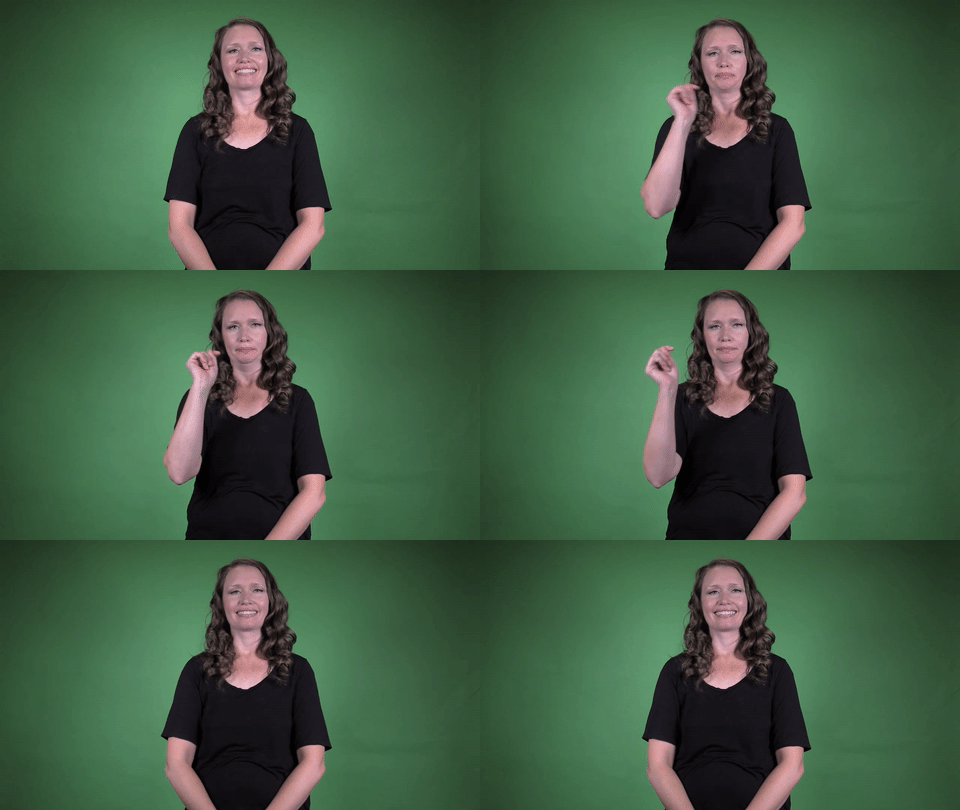
Sign for BATHROOM 2 in ASL

Practice Activities:
To start practicing the sign for BATHROOM 2 in ASL, try using it in front of a mirror. This will help you see the handshape and movement clearly. Practice the sign by itself multiple times to build muscle memory and reinforce accuracy.
Next, create flashcards with common locations, including the sign for BATHROOM 2 in ASL. Flip through the cards and sign each location when you see the word. For example, pair it with other nouns like school, hospital, or house to practice asking where the bathroom is in those contexts.
Come up with short example sentences such as “Where is the bathroom?” “I need to find a bathroom,” or “The bathroom is down the hall.” Practice signing these full sentences to become more comfortable using the sign in real-life situations.
Role-play with a partner and take turns asking for the bathroom in various places. Your partner can respond using directional signs or pointing to imaginary locations. This adds movement and context to your signing practice.
Create a short dialogue or story that includes going to several places and needing to find the bathroom. For example, a story about going to a mall, visiting a friend’s house, or walking through a park, and needing to stop for a bathroom break. Repeating the sign for BATHROOM 2 in ASL naturally throughout the story will strengthen your fluency.
Add some fun by playing a scavenger hunt game. Place signs or labels around a room with different location words. Whenever you land on the bathroom label, sign the word using BATHROOM 2 and give a sentence about it.
Lastly, record yourself signing different bathroom-related phrases and review the videos to self-correct or track your improvement over time. Practicing this way will ensure a deeper understanding of the correct sign use and boost your confidence.
Cultural Context:
The sign for bathroom 2 in ASL is a common and essential vocabulary word used in everyday conversation across the Deaf community. It plays a vital role in helping individuals navigate shared public spaces, homes, schools, and workplaces, ensuring effective communication. This version of the sign may reflect regional or personal preference, as sign language naturally includes variation based on geography and culture.
In American Sign Language, the existence of multiple signs for a single concept like bathroom represents the diverse ways ASL is used in real-life settings. Exposure to variations like the sign for bathroom 2 in ASL can improve fluency and understanding, especially for those learning the language in different regions. Recognizing sign options also reflects respect for cultural diversity within the Deaf and hard-of-hearing communities.
Common social situations call for quick and polite ways to express personal needs, and the sign for bathroom 2 in ASL is a respectful and discrete way to do that. This variation may be favored in certain settings or by specific individuals, and learning this version shows sensitivity and awareness when interacting in ASL. Understanding when and how to use each version can help deepen cultural competence and build more meaningful connections.
The sign for bathroom 2 in ASL also reinforces how American Sign Language is both a functional and expressive language. It conveys not just meaning but can also express tone, urgency, or mood depending on the person’s facial expressions and the context. Using the correct sign version in the right social setting reflects true language learning beyond just vocabulary memorization.
Parents, teachers, interpreters, and students can benefit from knowing the sign for bathroom 2 in ASL because it expands their communicative options. Fluency in multiple variations of a commonly used sign enables smoother interactions in diverse ASL spaces. Learning this sign supports inclusive education, access, and better public interaction for everyone involved in the Deaf experience.
ASL learners should become familiar with both popular and lesser-known signs like the sign for bathroom 2 in ASL to become competent communicators. Recognizing variation empowers learners to adapt their signing based on who they’re communicating with and where. Whether used in a classroom, at an event, or in everyday social interaction, this sign adds to a more complete ASL experience.
The sign for bathroom 2 in ASL is taught in many ASL classes and featured in language tutorials that value cultural context. It often appears in environments where etiquette and nonverbal communication are key, such as restaurants, hospitals, and schools. Understanding this sign improves accessibility
Extended Definition:
The sign for bathroom 2 in ASL is a common and essential part of basic American Sign Language vocabulary. It is used in everyday situations where someone needs to indicate the location of a restroom or ask to use one. This sign is crucial in schools, public places, healthcare settings, and at home when communicating with someone who uses ASL.
To produce the sign for bathroom 2 in ASL, the handshape usually resembles the letter “T” from the ASL alphabet. The signer typically shakes the “T” hand side to side. This motion conveys the idea of restroom or toilet, and it’s a gesture understood widely by members of the Deaf community.
This version of the sign may be a regional or alternative variant of the more commonly used bathroom sign. In many cases, the sign for bathroom 2 in ASL could reflect a local dialect or slight modification used in specific communities. Knowing multiple variations can help signers communicate more effectively with different users of ASL.
Children learning sign language are often introduced to basic needs signs early, and the sign for bathroom 2 in ASL is usually among the first functional signs they learn. It empowers Deaf children to express important personal needs clearly and quickly. Teaching this sign at an early stage supports both communication and independence.
For caregivers and educators, understanding and consistently using the sign for bathroom 2 in ASL helps reinforce nonverbal communication. Visual aids and consistent repetition help learners retain this sign. It’s also useful in inclusive classrooms and public settings where ASL is used alongside spoken language.
In fast-paced or noisy environments where verbal communication may be difficult, the sign for bathroom 2 in ASL provides a discreet and effective way to communicate. It also promotes accessibility in places such as restaurants, hospitals, and public transport. Many service employees are now trained to understand common signs like this to serve Deaf patrons better.
Learning this sign is not limited to native signers. Hearing individuals who interact with Deaf people regularly also benefit from knowing the sign for bathroom 2 in ASL. It fosters mutual understanding and respect and makes basic assistance easier to provide during social and professional interactions.
Various video demonstrations are available online to help learners practice the hand motion and facial expressions used in the sign for bathroom 2 in ASL. These resources are helpful for beginners and those trying to increase their sign fluency. Practice ensures accurate and respectful communication in appropriate contexts.
There can be confusion when multiple versions of a sign exist, which is why understanding different interpretations like the
Synonyms: restroom, washroom, lavatory, toilet, powder room
Educational resources: Find related learning materials in our course bank!
Want more? Check out some of our popular learning activities on the homepage!
Need to look up a sign? Use our highly rated dictionary: https://aslinteractive.com/best-asl-dictionary/
Follow us on tiktok: https://www.tiktok.com/@aslinteractive. More social media links at the bottom of this page!
Long-tail Keywords: What is the sign for bathroom in ASL?, How do you sign bathroom in ASL?, How to sign bathroom in American Sign Language?
Categories:
tags: Facilities and other locations/needs, Housing, Everyday activities, Chores, Describing Residence
Parameters
*Handshape*:
The handshape used in the sign for BATHROOM 2 in ASL is a “T” handshape , where the thumb is tucked between the index and middle fingers. This is the standard ASL letter “T” handshape and is essential for this specific sign.
In the sign for BATHROOM 2 in ASL, the “T” handshape is shaken side to side at the wrist. The movement and handshape clearly distinguish it from other signs, reinforcing its meaning related to toilet or bathroom.
*Palm Orientation*:
For the sign for BATHROOM 2 in ASL, the dominant hand forms the letter “T” handshape, with the thumb tucked between the index and middle fingers. The palm orientation faces outward, away from the body. The hand gently twists back and forth at the wrist, creating a small shaking motion.
This palm orientation and movement are key elements in the sign for BATHROOM 2 in ASL , clearly distinguishing it from other similar signs. Make sure the palm stays outward to reflect the correct expression.
*Location*:
The sign for BATHROOM 2 in ASL is made at the side of the dominant side of the body, typically near the shoulder or upper chest. The palm faces forward in a small twisting motion, staying close to the torso.
This sign keeps movement and location centered on the upper side area to maintain clarity. In ASL conversations, the sign for BATHROOM 2 in ASL remains in this standard position to avoid confusion with similar signs.
*Movement*:
The sign for BATHROOM 2 in ASL involves forming the hand into the American Sign Language letter “T” (thumb between index and middle fingers) and shaking it side to side near the dominant side of the body, typically at chest level. The wrist makes a small, quick twisting or shaking movement .
This sign for BATHROOM 2 in ASL emphasizes the standardized location and movement to differentiate it from similar signs. Keep the motion tight and controlled to ensure clarity and prevent confusion with other T-handshape signs.
*Non-Manual Signals*:
When using the sign for BATHROOM 2 in ASL, a neutral or slightly inquisitive facial expression is most common, especially when asking where the bathroom is. Eyebrows may be slightly raised to indicate a question, and eye contact should be consistent with the context of the conversation.
In informal situations, a small head tilt or nod can accompany the sign for BATHROOM 2 in ASL to emphasize urgency or direction. Keep the mouth neutral or use a small “b” shaped mouthing to match the letter handshape.
*Prosody, Dominant/Non-Dominant Hand*:
The sign for BATHROOM 2 in ASL uses the dominant hand in the shape of the letter “T,” shaken side to side near the dominant side of the torso. The non-dominant hand is not used in this sign. This gesture represents the initial of the word “toilet,” which is commonly understood as bathroom.
In the sign for BATHROOM 2 in ASL, only the dominant hand moves, showing the concept in a quick, efficient motion . It’s typically used for informal or quick references to a restroom.
Tips for Beginners:
When learning the sign for BATHROOM 2 in ASL, one of the most important things to remember is to avoid confusing movements. A common mistake is over-exaggerating the wrist shake, which can make the sign unclear. Keep the wrist movement tight and controlled, typically making a small side-to-side twist with the T-handshape, which represents the toilet.
Practice the sign in front of a mirror to ensure your hand is forming the correct handshape and angle. The palm should face away from your body, and your thumb should be tucked under your fingers to create the letter “T,” then shake it slightly from side to side. Adding natural facial expressions also enhances clarity and intent ♀️ .
The sign for BATHROOM 2 in ASL can often be used quickly in public or loud environments, so keeping it crisp and accurate is key. Do not switch to an open or clawed hand; this leads to misinterpretation. Develop muscle memory by using the sign regularly throughout your day, such as when asking to use or directing someone to the restroom.
You may also notice some people simply fingerspell B-A-T-H-R-O-O-M or use a similar variation of this sign. While that’s acceptable in certain contexts, mastering this version ensures you’re ready for quick, practical conversations. Don’t rush through learning it – start slow, and build speed once you feel confident.
If you’re introducing the sign to young children or beginners, exaggerate the motion slightly at first to help them understand, and then gradually refine it. Consistent practice and watching fluent signers will help you achieve smoother execution. The sign for BATHROOM 2 in ASL is short but widely used, so it’s an essential building block for everyday communication in the Deaf community.
Connections to Other topics:
The sign for BATHROOM 2 in ASL builds upon the foundational understanding of basic location-related vocabulary in American Sign Language. It connects well with other everyday location or room-specific signs such as KITCHEN, BEDROOM, and HOSPITAL. Learners familiar with directional signs like GO-TO or WHERE can easily build more complete phrases with the sign for BATHROOM 2 in ASL, such as “GO-TO BATHROOM” or “WHERE BATHROOM.”
This variation of the bathroom sign also helps learners explore classifier use and spatial referencing. For example, you might place the sign directionally to indicate the bathroom’s position within a home or public space. This supports broader comprehension of spatial grammar, a key feature of ASL at intermediate learning stages, especially within describing a house or giving directions.
An important connection can be made with the use of initialized signs. The sign for BATHROOM 2 in ASL uses the handshape of the letter “T,” similar to the more common sign for TOILET. Recognizing the role of initialization helps learners understand patterns among other room-related signs like B for BASEMENT or R for RESTAURANT. This enhances vocabulary recall and lends itself to decoding unfamiliar signs.
The sign also ties into polite and situational expressions. In conversations that require social awareness, such as at school or work, knowing this variation supports using questions like “EXCUSE-me, BATHROOM?” or inserting it into emergency situations (e.g. HURRY BATHROOM). It bridges etiquette with functional language.
Finally, this variant helps reinforce the idea that ASL is not universally standardized in one form. Regional dialects or personal preferences might result in more than one version of a common sign, and seeing BATHROOM 2 used in context expands a learner’s exposure. This flexibility helps prepare users for real-life ASL conversation where nuances and diversity of sign usage are inevitable.
Summary:
The sign for BATHROOM 2 in ASL is a commonly used variation emphasizing location-based or context-specific usage, especially in public spaces. This variation is different from the basic version of the sign and demonstrates how regional or situational needs influence everyday ASL communication.
To perform the sign for BATHROOM 2 in ASL, use the dominant hand forming the letter “R” from the ASL fingerspelled alphabet. Twist the wrist side to side quickly near the upper chest or shoulder area. This motion resembles the iconic and widespread “restroom” sign often seen on public signage.
Unlike the traditional BATHROOM sign which may incorporate a “T” handshape, this version’s use of the “R” handshape corresponds with “restroom” more so than “toilet.” Its adoption reminds users how diverse and adaptable ASL truly is. Despite appearing subtle, the specific handshape selection alters the context and meaning.
This variation is especially prevalent in settings like airports, malls, or hospitals, where the English signage favors “restroom.” Users adapt to these English-centric environments by modifying the base sign to align better with what is visually displayed or expected. Such interplay between spoken/written English and ASL reflects bilingual navigational behaviors.
The sign for BATHROOM 2 in ASL is not just about function — it represents how environment influences linguistic evolution in sign language. It is a symbol of accessibility, showing how deaf signers blend utility with expressivity in their interactions. It also reflects the adaptive nature of language as a living process.
Culturally, bathrooms carry importance in public accessibility and advocacy movements within the Deaf community. Campaigns around deaf-friendly signage, placement, and visibility often consider signs like restroom navigation as key in ensuring equitable access. Therefore, the sign for BATHROOM 2 in ASL also serves as a visual anchor to these efforts.
Grammatically, the sign for BATHROOM 2 in ASL typically operates as a noun within a sentence but can act in locative expressions. For example, the spatial context or directional cues may indicate where the bathroom is relative to the signer or listener. ASL syntax permits rich spatial descriptions that go far beyond the gesture alone.
Linguistically, this sign showcases how nonmanual signals and spatial-face orientation can frame or emphasize the sign. Raised eyebrows or body lean often accompany the sign when used as a question, asking where the bathroom is. This adds another layer of meaning and underscores how grammatical functions in ASL depend on facial expression and body motion.
In applied linguistics, the sign for BATHROOM 2 in ASL offers scholars insight into how gesture and environment dynamically align. The slight variance in performance informs how signers negotiate space and semantics within bounded physical environments. It becomes a lens for examining embodied cognition in signed languages.
This sign also often coexists with directional movement, especially in classrooms or formal settings. Someone may perform the sign with an added point to direct the receiver toward the bathroom. This underscores ASL’s capacity for rich spatial referencing and efficient interaction.
The existence and usage of the sign for BATHROOM 2 in ASL contrast with its fingerspelled forms. Occasionally, new signers or English-dominant environments will fall back to fingerspelling “B-A-T-H-R-O-O-M” or “R-E-S-T-R-O-O-M.” However, fluent ASL users favor the conventional sign because of efficiency and cultural fluency.
New ASL learners often ask why the letter “R” is used instead of “B” or “T.” The reason lies in sociolinguistic development. The “R” corresponds more directly to “restroom” and has, over time, been adopted widely within specific communities or geographic regions as the standard sign.
There are signs closely related to the sign for BATHROOM 2 in ASL, such as TOILET, WASH, and SHOWER. These can be used interchangeably depending on the context. This highlights how lexicon choices depend on usage, social situation, and purpose of the conversation.
Emergent users of ASL, particularly children, often learn this sign early due to its practical frequency. Many preschools and early-childhood settings prioritize restroom vocabulary early because of its immediate functional value. As such, this sign becomes a critical first step into the broader world of ASL expression.
The sign for BATHROOM 2 in ASL also exemplifies how language standardization is not fixed across all regions. Some areas in the U.S. may consistently use one form over another, depending on local norms, deaf community usage, or educational programming. ASL dictionaries may include multiple variants without fully indicating regional distributions.
In Deaf culture, knowing multiple variants of a sign like this allows for more intimate, fluent communication across communities. It shows respect for different dialects within ASL and improves mobility across signing spaces. It also underscores the collaborative nature of ASL knowledge-sharing
Want more? Check out some of our popular learning activities!
ASL Interactive Resources
ASLInteractive YouTube Channel
Follow us on tiktok: @aslinteractive.com
Follow us on Instagram: aslinteractive
Facebook page: aslinteractive
Facebook group: aslinteractive
LInkedIn: ASL Interactive LLC
Twitter: @ASL_interactive
*Some information on this page is AI-generated. AI can make mistakes. Please check the information.
Responses