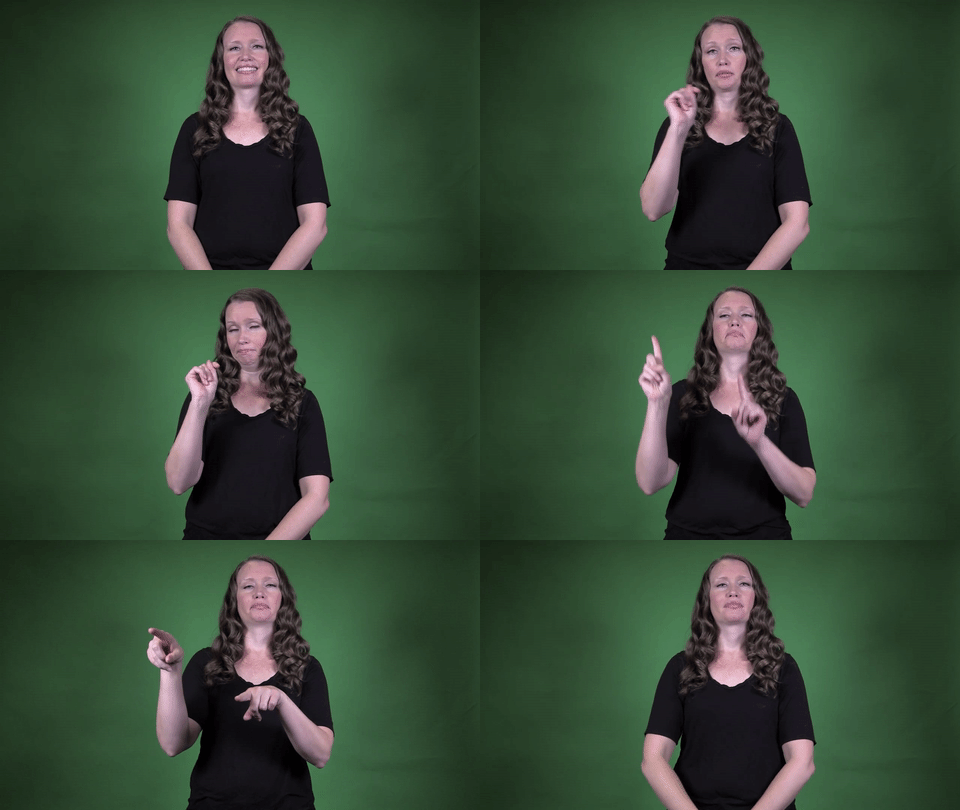
Sign for BATHROOM, GO TO in ASL | 🚻 ASL Dictionary

Definition: To go to A room with a toilet and sink.

Sign for BATHROOM, GO TO in ASL

YouTube player

Practice Activities:

To effectively practice the sign for BATHROOM, GO TO in ASL, begin with isolating each part of the phrase. Practice the sign for “bathroom” by forming the ASL letter “T” handshape and shaking it slightly side to side near your dominant shoulder. Next, practice “go to” by pointing with both index fingers and moving them in an arching path outward to indicate movement. Repeat the full phrase slowly and fluidly in front of a mirror to work on clarity and sign transitions.

Use flashcards or sign drill apps to reinforce the vocabulary. Sign the phrase in front of a mirror or record yourself using the sign for BATHROOM, GO TO in ASL to evaluate your handshape, motion, and facial expression. Emphasize correct directionality and spatial usage by practicing with different endpoints—pretend you are directing someone to various parts of a room or building.

Create simple sentences such as “I go to the bathroom now” or “Child needs to go to the bathroom,” and sign each one fluently. For added practice, remove the spoken phrases and rely solely on ASL structure to express the same concepts. Practice fingerspelling your name before pairing it with the phrase to expand basic conversation skills.

Storytelling is a great way to practice the sign for BATHROOM, GO TO in ASL. Create short narratives like a day at school or a trip to the store and incorporate the sign naturally into scenes, such as when a character needs to excuse themselves. Act out each scene while signing in full ASL grammar.

Work with a partner to simulate daily interactions. Take turns asking and responding to “Where are you going?” with the sign for BATHROOM, GO TO in ASL. Incorporate facial expressions and directional signing to enhance communication and get comfortable using the phrase with others.

Cultural Context:

In American Sign Language (ASL), cultural context plays an important role in understanding how certain phrases and signs are used. The sign for BATHROOM, GO TO in ASL combines two essential ideas that often come up in everyday conversation. Whether you’re learning ASL for school, work, or personal interactions, understanding how to properly use this phrase helps connect better with the Deaf community.

The sign for BATHROOM, GO TO in ASL is not just a functional phrase—it reflects a shared cultural habit of being clear and respectful in communication. In Deaf culture, people value directness, and letting someone know that you need to use the bathroom is a simple but necessary part of respectful interaction. You might see this sign in classroom settings, social gatherings, or during meetings when someone needs to excuse themselves.

Because ASL is a visual language, facial expressions and body movements matter just as much as the hand signs. When using the sign for BATHROOM, GO TO in ASL, you might also notice slight shifts in body position to indicate movement or urgency. These subtle cues give extra meaning to the phrase and help maintain smooth communication without interrupting others.

In public spaces and at Deaf events, the sign for BATHROOM, GO TO in ASL is commonly used to ask where the restroom is or to indicate you are heading there. It’s polite and expected to let others know where you’re going rather than just walking away. This shared understanding shows how community norms in Deaf culture differ slightly from hearing culture.

Teaching children or beginners how to sign BATHROOM, GO TO in ASL can be a good way to introduce them to the practical side of fluent signing. It’s often one of the first useful phrases learned by new signers. Mastering the sign helps build confidence and gives learners an easy way to participate in everyday conversations.

In school classrooms with Deaf students or interpreters, the sign for BATHROOM, GO TO in ASL is commonly used to maintain order without interrupting teaching. The visual nature of the sign lets students quietly communicate their need without calling attention to themselves. This is part of the respectful communication style taught early in ASL education.

There’s also a cultural element of self-advocacy in knowing how to sign BATHROOM, GO TO in ASL. In both Deaf and multifaceted hearing environments, being able to communicate personal needs independently is empowering. This is especially true in inclusive classrooms, airports, workplaces, or public settings where clear non

Extended Definition:

The sign for bathroom, go to in ASL is a practical phrase often used in everyday conversations. This phrase combines the concept of location with the need to use the restroom, making it an essential part of functional American Sign Language. Whether you’re in school, at work, or running errands, being able to ask where the bathroom is or say you’re going there is very useful.

To sign bathroom in ASL, the dominant hand forms the letter “T” in ASL fingerspelling by placing the thumb between the index and middle fingers. Then, you shake the “T” hand slightly side to side near shoulder height. This sign is commonly understood and easy to learn .

The phrase go to in ASL is formed by pointing both index fingers forward and moving them outward in the direction you’re indicating. It suggests movement from one location to another, and when combined with the bathroom sign, it forms the complete phrase: sign for bathroom, go to in ASL ‍♀️ . This phrase is common in educational settings, especially for students learning ASL for the first time.

Facial expressions and body language also help clarify intent in ASL. When saying sign for bathroom, go to in ASL, include a neutral to mildly inquisitive facial expression if you’re asking, or a determined one if you’re stating that you’re leaving. These non-manual signals play a vital role in making your message clear.

In casual conversation, a signer might just say bathroom alone when asking permission or informing someone of their intention. However, adding the go to element gives the phrase a directional and complete meaning. The phrase sign for bathroom, go to in ASL shows a full understanding of sentence structure and is more respectful in formal or structured environments like classrooms.

Many parents teaching their young children basic ASL also prioritize phrases like this one. Teaching kids how to use the sign for bathroom, go to in ASL empowers them to communicate their needs clearly and early . It helps foster independence and reduces frustration when verbal communication is still developing.

For individuals new to signing, getting the movements right for go to may take a little practice. It’s important that the fingers are straight and move neatly so the message is not confused with other directional signs. When practiced together as one smooth motion, the sign for bathroom, go to in ASL becomes second nature.

Videos and visual aids are helpful learning tools. Watching someone demonstrate the motion while repeating back the phrase helps reinforce memory and confidence.

Synonyms: restroom, use the bathroom, go to the toilet, visit the loo, freshen up

Educational resources: Find related learning materials in our course bank!

Want more? Check out some of our popular learning activities on the homepage!

Need to look up a sign? Use our highly rated dictionary: https://aslinteractive.com/best-asl-dictionary/

Follow us on tiktok: https://www.tiktok.com/@aslinteractive. More social media links at the bottom of this page!

Long-tail Keywords: What is the ASL sign for bathroom go to, how do you sign bathroom go to in ASL, how to say bathroom go to in American Sign Language

Categories:

tags: bathroom in sign language, how to sign bathroom in ASL, ASL sign for bathroom, learn bathroom in American Sign Language, bathroom sign language tutorial

Parameters

*Handshape*:

The handshape used in the sign for BATHROOM, GO TO in ASL involves the dominant hand forming the letter “T” from the ASL alphabet. This is done by placing the thumb between the index and middle fingers, with all fingers curled into a loose fist . The hand is typically shaken side to side at wrist level to indicate “bathroom.”

To express “go to,” both index fingers point outward and arc from the current location toward an imagined destination. This combined usage helps convey the full meaning of the sign for BATHROOM, GO TO in ASL in a natural, fluid way .

*Palm Orientation*:

For the sign for BATHROOM, GO TO in ASL, the palm orientation starts with the dominant hand making the letter “T” in the American manual alphabet. The palm faces outward, away from the signer, with the thumb tucked between the index and middle fingers.

As you transition to sign GO TO, the dominant hand points with the index finger and moves in a forward direction, with the palm facing downward or slightly to the side. This movement indicates direction and destination, effectively completing the meaning of the sign for BATHROOM, GO TO in ASL .

*Location*:

The sign for BATHROOM, GO TO in ASL is made near the side of the body, usually around shoulder to chest level. The dominant hand forms the letter “T” handshape for “BATHROOM” and is shaken slightly from side to side at the side of the torso.

For “GO TO,” the hand moves forward from near the body, typically around head or shoulder height, using a pointing gesture to indicate direction. The signs stay within neutral space close to the body, making them clear and easy to see. ➡️

*Movement*:

To produce the sign for BATHROOM, GO TO in ASL, begin by forming a “T” handshape (thumb between index and middle fingers) for “bathroom.” Shake the “T” hand slightly side to side near your dominant shoulder. Then move into the sign for “go to” by pointing both index fingers outward from yourself and arcing them forward in a smooth motion, as if directing someone to a destination ➡️.

The sign for BATHROOM, GO TO in ASL combines these two motions fluidly. Keep facial expressions neutral or slightly inquisitive, depending on context. The transition from the bathroom sign to the going gesture should be natural, indicating physical movement toward a location.

*Non-Manual Signals*:

Non-manual signals for the sign for BATHROOM, GO TO in ASL involve raised eyebrows and slight head tilting when asking a question . The facial expression should show inquisitiveness, especially if you’re asking someone where the bathroom is or if you are going there.

When signing this phrase in a statement, maintain neutral brows and direct eye contact, indicating a clear statement of intent. The sign for BATHROOM, GO TO in ASL uses appropriate directional movement with supportive body language to convey purpose.

*Prosody, Dominant/Non-Dominant Hand*:

The sign for BATHROOM, GO TO in ASL uses the dominant hand in the “T” handshape, a common way to represent “toilet,” with a small side-to-side twisting motion near the side of the body. To express “go to,” point using the dominant index finger and direct it forward, as if indicating a destination. The non-dominant hand typically remains relaxed or supports the directional movement.

When combining the signs, the dominant hand manages both components: first signing BATHROOM with the “T” shape, then transitioning into the directional phrase GO TO. The sign for BATHROOM, GO TO in ASL is performed smoothly in sequence, allowing for clear understanding and visual flow. ➡️

Tips for Beginners:

When learning the sign for BATHROOM, GO TO in ASL, it’s important to break it into two parts. “Bathroom” is typically signed using the handshape for the letter “T” from the ASL alphabet, which you shake side to side near the dominant side of your torso. Make sure your palm faces forward and don’t overextend or twist your wrist—just a subtle movement is enough.

The phrase “go to” is signed by pointing with one or both hands in the direction of the location as if you’re physically indicating where to go. For beginners, combining these two signs can feel awkward at first, so it’s helpful to practice them together in natural contexts. Think of making a sentence flow, like miming real movement, rather than thinking of each sign individually.

One of the most common issues learners face with the sign for BATHROOM, GO TO in ASL is clarity. For example, a timid shake of the “T” handshape or not directing your point naturally can confuse your meaning. Practice in front of a mirror or record yourself on video to ensure your handshape, location, and movement are clean and consistent.

It’s also important to use appropriate facial expressions with location-based signs like ‘go to.’ Adding a question on your face, such as raised eyebrows when asking where the bathroom is, helps match the tone of your message. Also, remember that ASL uses space to show direction, so be mindful of body orientation.

To master the sign for BATHROOM, GO TO in ASL, use it in everyday conversation scenarios. Ask yourself or a friend simple questions using this phrase, or create short skits. The more you integrate the structure naturally, the faster it will become second nature. ✅

sign for BATHROOM, GO TO in ASL, bathroom in ASL, go to in ASL, asking for directions in ASL, sign for toilet in ASL, ASL sign for going somewhere, go in ASL, ASL travel phrases, sign for where is the restroom, american sign language bathroom direction

Connections to Other topics:

The sign for BATHROOM, GO TO in ASL connects to broader concepts of spatial referencing, directional verbs, and daily routine expressions in American Sign Language. The phrase generally combines the sign for “bathroom,” typically formed using the letter ‘T’ in a shaking motion, and the directional verb “go-to,” which shows movement from one location to another. This creates an action phrase used often in everyday situations, especially in public or social contexts.

Understanding the sign for BATHROOM, GO TO in ASL ties into the concept of topic-comment sentence structure. In ASL, it’s common to sign “bathroom” first as the topic, followed by the command or action “go to.” This mirrors how many ASL speakers structure phrases to emphasize clarity and meaning through order and facial expressions that indicate intent or urgency.

This sign also connects to many other location-based expressions, such as “go to school,” “go to work,” and “go to store.” In all of these phrases, the verb “go” adjusts based on the referential location in space, allowing for natural use of classifiers and spatial mapping in ASL. This teaches learners how to construct more complex and fluid statements.

Moreover, the sign for BATHROOM, GO TO in ASL can lead into time-based or situational expansions, such as “after class, go to bathroom” or the question “can I go to the bathroom?” These compound uses introduce grammatical roles like time indicators or modal signs, helping learners deepen their understanding of sentence structure in real-life ASL usage.

Facial expressions are vital when using the sign for BATHROOM, GO TO in ASL. They indicate urgency, permission-seeking, or declarative statements. This supports learners in developing key non-manual markers essential for fluent and understandable ASL communication.

Summary:

The sign for BATHROOM, GO TO in ASL combines two commonly used signs that are important in daily conversation. Recognizing each sign individually helps in understanding how they merge when used together. In ASL, signs often follow a time-topic-comment structure, so intuition and context matter.

For BATHROOM, the most common sign uses the “T” handshape, which comes from the ASL alphabet. This is because “toilet” is often used interchangeably with “bathroom” in ASL, and the letter T reflects that. The dominant hand forms the “T” handshape and shakes slightly side to side near the body.

This sign is quick and subtle, frequently used in educational, medical, and workplace settings. It’s also used in casual contexts, such as among friends or in public spaces. It’s a polite, universal way in ASL to ask where the bathroom is or to excuse oneself.

Culturally, signs like BATHROOM are highly contextual and can signal both urgency and politeness. The shaking of the “T” handshape acts almost like raising your hand to ask permission to leave. Children often use this sign to communicate with teachers discreetly during class.

The GO TO portion of the sign breaks down into two elements: “GO” and the directional marker indicating the destination. “GO” usually involves both index fingers pointing forward simultaneously in a smooth, conscious motion. The direction the fingers point can indicate the physical location.

In directional verbs like GO TO, movement carries meaning. Signing GO TO with fingers aiming toward your left or right suggests a specific place known to both signer and receiver. This directional grammar makes ASL rich and efficient.

When combined, the sign for BATHROOM, GO TO in ASL often follows the location-response structure. One may sign “BATHROOM” followed by “GO TO” with fingers aiming in the direction of the bathroom. It’s a visual spatial representation of navigating a physical space.

The linguistic structure benefits from ASL’s use of classifiers and space. For the sign for BATHROOM, GO TO in ASL, the sign depends not only on movement but also on handshape clarity and appropriate facial expressions. A slight raised brow or questioning look may accompany the motion to form a polite query.

In applied linguistics, the integration of signs like these reflects the embodiment of meaning. Rather than using auxiliary words or altering pitch like in spoken English, ASL changes movement paths and uses spatial logic. This is what allows GO TO to carry directional weight that spoken language cannot easily express.

Within the Deaf community, the sign for BATHROOM, GO TO in ASL is functional and foundational. It appears early when Deaf children learn ASL and is reinforced through repetition and modeling. Its use extends into adulthood, showing how ASL builds fluency through foundational vocabulary.

The sign also reflects cultural values in the Deaf world: communication efficiency, spatial awareness, and mutual understanding. Pointing or signing toward a place integrates natural body language into language structure. It mirrors how humans naturally think about space and direction.

Technically, the BATHROOM sign’s origin from the fingerspelled “T” makes it an example of a lexicalized sign, where part of fingerspelling becomes standardized into shorthand. This transformation shows language fluidity. In contrast, GO TO is not lexicalized but follows systematic syntax rules.

The blending of these two types of signs—lexicalized and non-lexicalized—shows the intricate design of ASL grammar. When you sign BATHROOM, GO TO in ASL, you’re participating in a visual-kinetic method of constructing meaning. This is different from spoken English, which relies on word order and syntax.

From a grammatical perspective, BATHROOM serves as the topical noun, while GO TO acts as the verb. The sign GO TO can also vary based on tense and subject. Non-manual signals, like head tilt, speed, or mouth morphemes, can indicate urgency or additional meaning.

The sign for BATHROOM, GO TO in ASL is useful in both formal and informal contexts. It’s not marked as overly formal or casual, making it versatile in various environments. Context and expression adapt its tone, supporting ASL’s flexible, dynamic communication model.

Related signs include TOILET, RESTROOM, and POTTY, each with overlapping usage but subtle differences in tone and audience. For instance, POTTY is often used with toddlers, while RESTROOM may serve as a more polite alternative in professional settings. These signs highlight layered language use.

The sign for BATHROOM, GO TO in ASL also reflects the spatial metadata embedded in signed languages. This spatial grammar allows ASL users to map meaning onto real-world orientations with physical clarity. It reinforces how ASL embodies three-dimensional thinking in its grammar.

In educational settings, the sign for BATHROOM, GO TO in ASL is typically taught among the first 50 signs due

Want more? Check out some of our popular learning activities!

ASL Interactive Resources

ASLInteractive YouTube Channel

Follow us on tiktok: @aslinteractive.com

Follow us on Instagram: aslinteractive

Facebook page: aslinteractive

Facebook group: aslinteractive

LInkedIn: ASL Interactive LLC

Twitter: @ASL_interactive

*Some information on this page is AI-generated. AI can make mistakes. Please check the information.

Sign for BATHROOM, GO TO in ASL

Responses