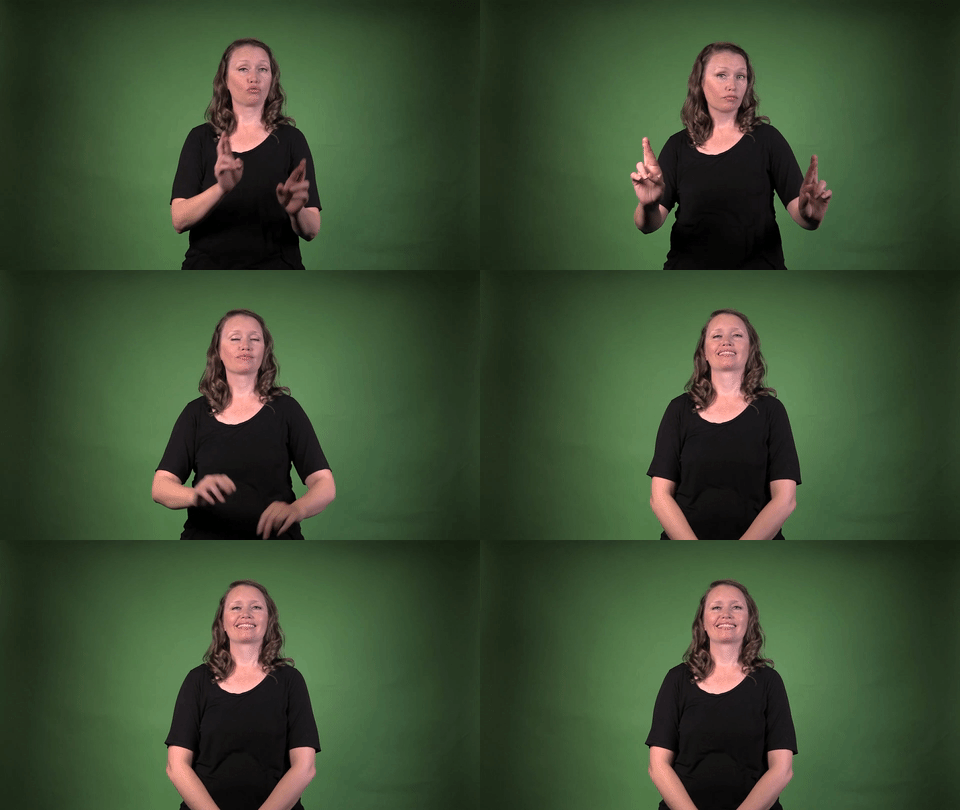
Definition: To be prepared.
Sign for BE-READY in ASL

Practice Activities:
Start by practicing the sign for BE-READY in ASL in isolation. Use a mirror or record yourself signing it to make sure your handshape and movement are accurate. Repeat this several times to build muscle memory and fluidity. Try signing at different speeds, gradually increasing until the motion feels natural and confident.
Next, incorporate the sign for BE-READY in ASL into short phrases. For example, practice sentences like I BE-READY GO or YOU BE-READY SCHOOL? This helps you transition between signs smoothly and understand grammatical structure in ASL. Use facial expressions to match the meaning, such as raised eyebrows for yes/no questions.
Create a list of situations where people need to be ready, such as going to work, taking a test, or catching a bus. Sign each scenario in ASL, using the sign for BE-READY in context. For example, YOU BE-READY TEST TOMORROW? or I BE-READY RAIN WALK HOME. This allows you to build vocabulary around daily activities and reinforce the sign in meaningful ways.
Work with a partner to practice dialogues that include the sign for BE-READY in ASL. One person can ask questions like ARE-YOU BE-READY MEET?, and the other can respond appropriately. Take turns switching roles and adding variety to your conversations. This will support conversational fluency and make learning more interactive.
Use the sign in storytelling. Tell a short narrative about a time you had to be prepared for something important. For example, you could sign about being ready for a job interview or a school performance. Add details using time signs, adjectives, and facial expressions to make your story engaging.
To reinforce learning, create flashcards with pictures or situations and sign the appropriate response using the sign for BE-READY in ASL. Reviewing with flashcards regularly will improve your recall and confidence using the sign in everyday conversation.
Cultural Context:
In American Sign Language, the sign for BE-READY in ASL reflects more than just a literal translation. It carries a cultural emphasis on preparedness and mindfulness, values highly regarded in Deaf culture. This concept extends beyond emergencies or physical readinessâit also speaks to being mentally and emotionally prepared for communication.
The sign for BE-READY in ASL is often used in conversations to express that someone should be alert, aware, and paying attention. In a cultural context, this connects to the importance of eye contact and visual engagement in the Deaf community. Since ASL relies on visual cues, being ready to watch and respond is key for smooth interaction.
In Deaf culture, showing that you are ready means more than physically being present. It also implies respect for the conversation and the person signing. If someone uses the sign for BE-READY in ASL, they may be signaling that it’s time to focus, pay attention, or prepare for what’s coming next.
Another cultural layer to this sign reflects the high value placed on self-advocacy and independence in the Deaf community. The sign for BE-READY in ASL is not just about readiness for othersâitâs a form of self-empowerment. It communicates that the person is equipped to participate, respond, or make decisions on their own.
When this sign is used in educational settings, it takes on special meaning. Teachers may use the sign for BE-READY in ASL to prompt students to gather their materials or focus on the task. It plays a social role in guiding behavior and setting expectations without needing to vocalize them, which can be especially effective in classrooms where ASL is the main language of instruction.
In everyday life, the sign for BE-READY in ASL might be used before a journey, a medical visit, or a conversation that requires focus. Itâs often paired with facial expressions that indicate seriousness or urgency. Even though ASL uses the hands, meaning is shaped by facial cues, posture, and timing, which all play into how this sign is communicated in a cultural context.
Family dynamics within the Deaf community also show how the sign for BE-READY in ASL is used naturally. Parents might use it with children to teach them to prepare before leaving the house or before starting chores. Itâs a practical and respectful way to encourage responsibility and attention to detail.
Deaf culture puts significant focus on shared responsibility and visual awareness. The sign for BE-READY in ASL serves as a bridge to these deeper values.
Extended Definition:
The sign for BE-READY in ASL is a commonly used phrase within American Sign Language that expresses the concept of being prepared or in a state of readiness. It is especially valuable in conversations involving schedules, plans, or emergency situations. The sign captures the feeling of alertness and willingness to act when needed.
To sign BE-READY in ASL, the hands generally move from a neutral space to a more alert position. This movement visually reflects the transformation from an unprepared state to being alert or geared up. Depending on the sentence and context, facial expressions and body posture can significantly shape the meaning of the sign.
In the Deaf community, the sign for BE-READY in ASL is often used in educational settings, during sports or physical activities, or in daily routines. Teachers might use the sign with students before transitioning to a new subject or activity. Parents could use it at home to remind their children to be ready for school or bedtime.
This sign also appears in public service content and safety training. Whether it’s a fire drill or a community awareness workshop, instructors will use the sign for BE-READY in ASL to encourage quick thinking and preparedness. This sign is also useful for giving instructions during travel, field trips, or sudden weather events ïž.
The sign’s meaning can be adjusted with context and tone. If you’re trying to emphasize urgency, your expression might become more intense while signing. For a casual reminder, the sign can be softened with a friendly tone and smile . This flexibility makes the sign for BE-READY in ASL helpful across many types of conversations.
When taught to young learners, the sign for BE-READY in ASL becomes a behavioral cue to help them transition easily. It promotes awareness, timely action, and mindfulness about upcoming changes. In structured environments such as summer camps or daycare, it can help build habits that lead to better organization and cooperation.
This sign also holds a place in motivational or inspirational communication. Leaders and coaches often use BE-READY as a mindset prompt, instilling confidence and encouraging mental and emotional readiness. Whether in one-on-one talks or group interactions, this ASL sign supports strong communication.
Digital content like videos and interactive lessons often include the sign for BE-READY in ASL to teach planning and self-discipline. It’s a great way to build anticipation before introducing new ideas, activities, or instructions. Because of this, it is one of those versatile signs that find use in both casual and formal interactions.
Understanding how and
Synonyms: prepared, set, equipped, primed, geared up
Educational resources: Find related learning materials in our course bank!
Want more? Check out some of our popular learning activities on the homepage!
Need to look up a sign? Use our highly rated dictionary: https://aslinteractive.com/best-asl-dictionary/
Follow us on tiktok: https://www.tiktok.com/@aslinteractive. More social media links at the bottom of this page!
Long-tail Keywords: what is the sign for be ready in ASL, how to sign be ready in American Sign Language, ASL sign for be ready
Categories:
tags: Commands, Language Learning, Activities, Verbs, Everyday Activities
Parameters
*Handshape*:
The handshape used in the sign for BE-READY in ASL involves both hands forming the “R” handshape, which means the index and middle fingers are crossed while the other fingers are curled into the palm. The thumbs wrap across the curled fingers for support.
In the sign for BE-READY in ASL, your “R” hands begin next to each other and then move outward in a parallel motion. This handshape visually reinforces the concept of preparation or readiness in American Sign Language.
*Palm Orientation*:
In the sign for BE-READY in ASL, both hands are generally used with palms facing slightly upward and slightly outward, as if holding or presenting something in front of the body. The hands are typically positioned parallel and level with each other, around chest height.
Depending on the variation, palm orientation may remain consistent throughout, or shift slightly as the hands move out or separate. The palm orientation is crucial for clarity in the sign for BE-READY in ASL.
*Location*:
The sign for BE-READY in ASL is produced in the neutral space just in front of the chest. Both hands start with palms facing slightly inward and fingers curved, positioned near the mid-torso. Movements occur outward and slightly forward from this central chest area. This central location helps emphasize preparedness and alertness when using the sign for BE-READY in ASL .
*Movement*:
The sign for BE-READY in ASL involves both hands in the “B” handshape, held parallel to each other at chest level, with palms facing slightly down. The hands move forward slightly in a simultaneous motion, then separate outward smoothly to either side, suggesting preparedness and anticipation.
The movement in the sign for BE-READY in ASL is direct yet fluid, conveying alertness. It often accompanies a serious or focused facial expression to emphasize readiness.
*Non-Manual Signals*:
When performing the sign for BE-READY in ASL, the eyebrows are typically slightly raised, signaling alertness and preparation. The eyes may widen slightly to show focus and awareness of an upcoming action or situation.
The mouth is often neutral or slightly pursed, emphasizing seriousness or anticipation. These non-manual signals complement the physical motion and help express the urgency or immediacy associated with the sign for BE-READY in ASL .
*Prosody, Dominant/Non-Dominant Hand*:
The sign for BE-READY in ASL uses both hands in a symmetrical movement. The dominant and non-dominant hands start in flat “B” handshapes, palms facing down and roughly shoulder-width apart. Both hands move forward slightly and then separate outward at the same level in a smooth motion, indicating preparedness or readiness.
In the sign for BE-READY in ASL, both hands are equal in activity, and there’s typically no dominant hand unless modified. The facial expression should show attentiveness or alertness to match the concept of being ready.
Tips for Beginners:
When learning the sign for BE-READY in ASL, it’s essential to focus on fluidity and symmetrical movement. This sign uses both hands, starting in a neutral space in front of your torso, palms facing down, and then sweeping outward slightly to show preparedness. Make sure your movements are smooth and synchronized â jerky or uneven motions can confuse the meaning.
A key tip for mastering the sign for BE-READY in ASL is posture and positioning. Your elbows should remain relaxed, and the hands should stay at an even level. Beginners sometimes raise one hand higher than the other, which can distort the shape and intention of the sign. Practicing in front of a mirror can help correct this common error and improve muscle memory.
Facial expression plays an important role when signing BE-READY. A look of focus or alertness reinforces the concept and adds meaning beyond just the hand motion. Without an expressive face, the sign may appear flat or less urgent in tone. Donât be afraid to engage your faceâitâs a big part of effective communication in ASL.
Another helpful tip is watching native signers perform the sign for BE-READY in ASL in different contexts. Observe how the sign may slightly differ based on speed or emphasis. This experience can boost your comfort with natural variations while keeping your own version accurate.
Repetition is your friend, but so is feedback. Record yourself and ask a fluent signer or instructor to evaluate your execution of the sign for BE-READY in ASL. Even subtle adjustments in movement can result in much clearer communication. Practice regularly, be patient with yourself, and stay consistentâthatâs how mastery happens in ASL.
sign for BE-READY in ASL, be-ready sign asl, american sign language for be-ready, how to sign be-ready in asl, learn be-ready in asl, asl sign BE-READY, practicing BE-READY in sign language, accurate ASL for be-ready
Connections to Other topics:
The sign for BE-READY in ASL connects closely with time management and preparedness concepts. It’s related to signs like PLAN, PREPARE, and WAIT, which are commonly used in similar contexts. In storytelling or everyday conversation, you might see the sign for BE-READY used to emphasize anticipation or mental preparedness before an important event.
This sign can also be found in compound phrases like BE-READY/LEAVE or BE-READY/FINISH, where the focus shifts to being prepared for departure or completing a task. In an academic setting, the sign often links with STUDY or TEST to express being ready for a class or exam. It reinforces a proactive mindset, commonly seen in discussions around responsibility or time-sensitive actions.
BE-READY can be conceptually connected to EMERGENCY or ALERT, especially when dialog involves sudden changes or urgency. It also links to emotional readiness through variations of signs like STRONG, PATIENT, or CALM, especially when individuals are preparing mentally for something challenging or emotional.
In bilingual learning contexts, the sign for BE-READY in ASL is helpful when teaching transitions between activities. It often appears alongside instruction-based signs like NOW, NEXT, or SOON. Used in commands or advice, such as BE-READY/GO or BE-READY/TRY, it supports assertive or motivating communication patterns in ASL.
The transition between BE-READY and signs involving movement or actionâsuch as GO, MEET, or PARTICIPATEâshows the holistic nature of how readiness builds context. The sign for BE-READY in ASL is not just about physical preparedness but often carries an emotional and cognitive layer, making it versatile across educational, daily, and narrative conversations. Understanding its use deepens a learner’s grasp of sequencing, context, and conversational flow in ASL.
Summary:
The sign for BE-READY in ASL conveys a sense of preparation and anticipation. It merges physical posture with a mental state, emphasizing an alert awareness towards upcoming actions or events. This sign captures both readiness and willingness, which are core to its cultural interpretation.
To form the sign for BE-READY in ASL, use both hands in the “R” handshape. Position them near each other in front of the body, palms facing down. Then move both hands outward simultaneously in a short, quick motion, similar to curtains parting or readiness being unveiled.
Facial expression is crucial when signing BE-READY. Brows may be raised for anticipation, or a serious expression may reflect determination. Using the right non-manual markers helps contextualize the urgency or emotion behind the readiness being expressed.
The sign for BE-READY in ASL is used in numerous contexts, such as emergencies, life transitions, or instructions. In both casual and formal scenariosâwhether encouraging someone to prepare emotionally or instructing readiness for a taskâit serves as a vital communication tool.
In ASL grammar, BE-READY fits a range of sentence structures. It can occur at the beginning, middle, or end of a sentence, depending on emphasis. Its flexibility mirrors how English adjusts tone and phrasing for the word “ready.”
This concept intertwines closely with signs like PREPARE, PLAN, or ALERT. While BE-READY signals the current state of preparedness, PREPARE and PLAN are more process-oriented, referring to actions leading up to readiness. ALERT adds urgency and often incorporates larger, faster movement and facial intensity.
Culturally, the sign for BE-READY in ASL has deep roots in community-oriented living. In Deaf culture, collective preparednessâespecially during gatherings or public safety situationsâshows respect and responsibility. Signing BE-READY encourages community attentiveness and shared support.
In educational settings, this sign is commonly seen before transitioning between activities. Teachers working with Deaf students often sign BE-READY in ASL to indicate upcoming instructions, reinforcing the value of staying alert and attentive.
Military and emergency response contexts within the Deaf community also heavily use this sign. From fire drills in residential schools to community training sessions, BE-READY plays a foundational role in preparedness communication and safety drills.
Children learning ASL are introduced to the sign for BE-READY early on because it emphasizes structure and response. Caregivers use it to cue upcoming events, teaching children sequencing and expectation in routines, such as before meals or bedtime.
Linguistically, the sign for BE-READY in ASL demonstrates the iconicity feature within the language. The hand motion resembles the visual of something opening or clearing, metaphorically suggesting availability or readiness. This iconic relation between sign form and meaning enhances semantic clarity.
The use of “R” handshapes connects to the initialized sign form, showing the influence of English on ASL. While pure ASL tends to avoid initialization, some signs like BE-READY integrate it without losing naturalness, especially since its intuitive motion supports comprehension.
This sign also takes on a socio-emotional layer. BE-READY can signal emotional preparedness, such as before receiving difficult news or facing a challenge. Its meaning, then, transforms depending on tone, eye contact, and body stance accompanying the sign.
In performance contexts, such as theater or storytelling, BE-READY is often used to build tension or communicate a characterâs mindset. The timing and pacing of the sign can reflect excitement, fear, or determination, making it dynamic and expressive on the visual stage.
Technologically, BE-READY in ASL is a common command given in translation software and virtual assistants tuned for Deaf users. Its clear handshape and recognizable structure make it a speech-recognition-friendly sign that systems can detect with fewer errors.
In Deaf sports, referees and coaches use the sign for BE-READY frequently. Prior to the start of a race or team play, this sign ensures visual clarity and equal-access pacing. It has become standard in visually conducted team management.
Analyzing the syntax further, BE-READY can function as a predicate adjective. For example, in ASL, one might sign YOU BE-READY NOW, which reflects subject-predicate agreement and uses topicalization for emphasis. The dynamic tension in the sign supports tone-setting across diverse communication scenarios.
The sign also relates metaphorically to internal feelings. People use BE-READY when discussing emotional maturity or the decision to commit, such as before marriage or parenthood. In these instances, the sign suggests mental and emotional openness, rather than physical attendance.
Because ASL relies heavily on context, the sign for BE-READY in ASL can shift its tone with slight changes in hand movement speed or facial intensity. This makes the sign rich in prosodic variety, suitable for a wide spectrum of emotional states or urgency levels.
Interestingly, regional differences in signing BE-READY can occur. While the R-handshape variation is standard, some signers might use a
Want more? Check out some of our popular learning activities!
ASL Interactive Resources
ASLInteractive YouTube Channel
Follow us on tiktok: @aslinteractive.com
Follow us on Instagram: aslinteractive
Facebook page: aslinteractive
Facebook group: aslinteractive
LInkedIn: ASL Interactive LLC
Twitter: @ASL_interactive
*Some information on this page is AI-generated. AI can make mistakes. Please check the information.


Responses