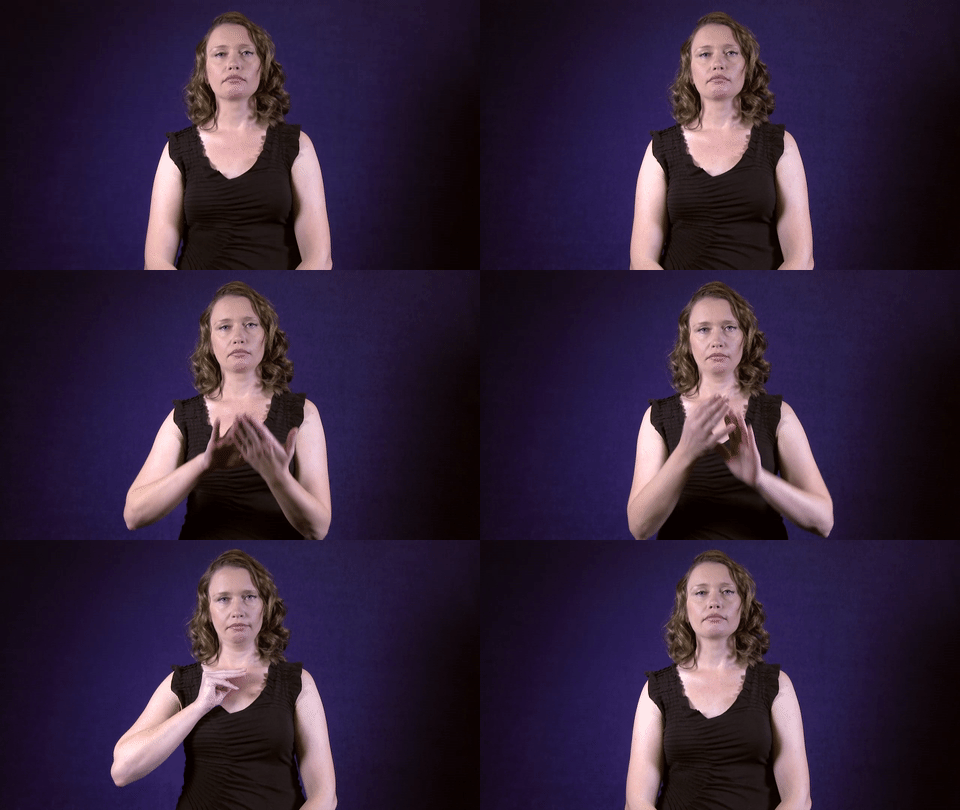
Definition: To become a part of a group or organization.
Sign for BECOME A MEMBER in ASL

Practice Activities:
To practice the sign for BECOME A MEMBER in ASL, start by reviewing the handshape and movement in a mirror. Focus on the transition from open hands to clasped hands, making sure the motion is fluid and intentional. Practice this sign five to ten times in isolation to build muscle memory and comfort with the movement.
Next, practice the sign within simple sentences. For example, you can sign: I BECOME A MEMBER LIBRARY or SHE BECOME A MEMBER TEAM. Sign each sentence slowly at first, then try signing it at conversational speed. Vary the subject and context to get used to using this sign in different situations.
Partner up and take turns asking and answering questions using the sign for BECOME A MEMBER in ASL. Example prompts include: When did you BECOME A MEMBER of your school club? or Why did you BECOME A MEMBER of the gym? Practicing in dialogue helps build fluency and comfort with conversational flow.
Try storytelling exercises where you explain a sequence of events leading to someone becoming part of a group or organization. Begin with a sentence like: LAST YEAR, I INTEREST CLUB, I BECOME A MEMBER. This allows you to link multiple signs together, improving your transition skills between phrases.
Watch videos or short ASL skits and identify moments where someone uses the sign for BECOME A MEMBER in ASL. Imitate what you see, paying attention to non-manual markers and facial expressions that support the concept of joining or becoming part of something.
Use flashcards with different organizations like CHURCH, SCHOOL CLUB, or SPORTS TEAM, and practice constructing sentences using the sign for BECOME A MEMBER in each context. This expands your vocabulary and helps you associate the sign with a variety of real-world situations.
Cultural Context:
In American Sign Language (ASL), the sign for become a member carries more than a literal translation. It reflects how Deaf culture views group identity, community involvement, and belonging. Membership, whether in a Deaf club, advocacy group, or social circle, means actively participating and contributing, not just signing up.
The sign for become a member in ASL often emphasizes inclusion and shared purpose. In Deaf culture, being a member of something isn’t just paperwork ; it often involves deep connection and shared values. It can represent being part of educational, linguistic, or cultural communities that support ASL users.
Using the sign for become a member in ASL in conversation shows an understanding of how the Deaf community values collective identity. It’s not just about joining an organization—it’s about aligning with the goals and vision of a group that supports access, equity, and Deaf leadership. This sign is commonly used when talking about becoming a part of a Deaf church, student group, or national organization.
When you use the sign for become a member in ASL, you might be expressing dedication to long-term involvement. In many Deaf spaces, becoming a member means attending events, sharing knowledge, and advocating for Deaf rights. The concept reinforces the cultural importance of showing up and being reliably present.
Social bonds carry weight in the Deaf world. So the sign for become a member in ASL doesn’t just point to formal institutions. It also highlights the ways Deaf people build networks of support, such as peer mentorships, families with Deaf children, or ASL learning groups. Membership implies loyalty and unity .
In historical contexts, the idea of becoming a member resonated during times when Deaf clubs were a central part of Deaf social life. These clubs offered not only recreation but also resources, education, and pride in ASL. Today, using the sign for become a member in ASL continues that legacy of connection and empowerment.
In educational settings, students are often encouraged to become members of ASL learning communities and clubs. This sign is frequently used during group introductions, Deaf culture presentations, and membership calls to action. It helps reinforce a shared commitment to inclusion and visibility for ASL signers.
Even in digital spaces, the sign for become a member in ASL supports Deaf inclusivity . Online forums, social groups, and advocacy networks use this sign to express engagement with broader ASL users. Membership in these settings continues to symbolize participation and belonging, even across distances.
The sign for become a member in
Extended Definition:
The sign for become a member in ASL represents the action of someone joining a group, organization, or club. It’s often used in both casual and formal contexts, such as when encouraging someone to join a gym, sign up for a class, or become part of a community.
To convey become a member in ASL, the sign typically combines elements that show the transition from being an outsider to becoming part of a group. It often starts with a sign indicating change or transformation, followed by a movement that indicates joining or entering a group. Facial expressions and context help clarify the exact meaning.
When using the sign for become a member in ASL, it’s important to be aware of your audience. In some contexts, you might be encouraging someone to join a nonprofit organization , a religious community, an online group, or a workplace team. The sign works across a wide variety of situations and helps promote inclusion, participation, and involvement.
If you’re inviting someone to participate in a cause or join your club, the sign for become a member in ASL sends a welcoming message. It emphasizes action and transition—moving from one status to another. This makes it an essential part of vocabulary when building community through signed language.
In Deaf culture, membership in a group carries emotional meaning and social identity. When someone signs become a member in ASL, they’re not just talking about signing a form—they’re referring to shared values, experiences, and belonging . It’s more than a transaction; it’s a connection.
Understanding how to use the sign for become a member in ASL can also support accessibility goals. Interpreters often rely on it during meetings, events, and promotional videos. It’s a useful phrase in educational, professional, and social settings alike.
If you’re learning ASL, adding the sign for become a member to your vocabulary helps expand your ability to talk about inclusion and group dynamics. Whether you’re discussing joining a book club or signing up for a volunteer event, this sign expresses motivation and a desire to belong.
Teachers, interpreters, and community leaders use the sign for become a member in ASL when encouraging participation from new individuals. It’s especially helpful in onboarding processes or when introducing someone to a new environment. A clear and accurate sign can help reduce confusion and create a stronger sense of unity.
The concept behind become a member in ASL goes beyond the literal. It’s about forming bonds and stepping into a new role or identity. Signing it with clarity can help bridge
Synonyms: join now, sign up, register, enlist, subscribe
Educational resources: Find related learning materials in our course bank!
Want more? Check out some of our popular learning activities on the homepage!
Need to look up a sign? Use our highly rated dictionary: https://aslinteractive.com/best-asl-dictionary/
Follow us on tiktok: https://www.tiktok.com/@aslinteractive. More social media links at the bottom of this page!
Long-tail Keywords: what is the ASL sign for become a member, how do you sign become a member in American Sign Language, ASL sign for become a member
Categories:
tags: Membership, Actions, Commands, Language Learning, Everyday Activities
Parameters
*Handshape*:
The handshape for the Sign for BECOME A MEMBER in ASL begins with both hands in flat open-B handshapes, palms facing each other. Then the dominant hand changes into a modified C handshape while the non-dominant hand forms an S handshape, representing a shift from a general group to individual inclusion.
This transition symbolizes the idea of joining or being accepted. The Sign for BECOME A MEMBER in ASL relies on clear handshape changes to convey the concept of entering a group or organization .
*Palm Orientation*:
For the sign for BECOME A MEMBER in ASL, begin with both hands in an open “5” shape. The dominant hand starts with the palm facing inward toward the non-dominant hand, which also faces inward. As the sign is executed, the dominant hand slides down over the back of the non-dominant hand, changing into a flat “O” shape. Throughout the motion, the palm orientation shifts slightly forward while maintaining a centered position. This adjustment supports the natural flow of meaning in the sign for BECOME A MEMBER in ASL .
*Location*:
The sign for BECOME A MEMBER in ASL is generally produced in the area between the upper chest and the mid-torso. The motion typically starts near the center of the chest, a common location for signs involving identity or roles. Hands remain within the neutral space in front of the body, ensuring clear visibility.
When using the sign for BECOME A MEMBER in ASL, the transition movement maintains a natural flow in this central body region. The consistency of this location emphasizes the concept of joining or becoming part of a group within a clear, central signing space.
*Movement*:
Start with both hands open and slightly curved, palms facing each other near the chest. Move the dominant hand in a quick motion to slide into the non-dominant hand, which remains stationary and forms a loose “C” shape. This mimics the concept of entering or joining something. The sign for BECOME A MEMBER in ASL visually represents the act of inclusion or integration into a group or organization.
*Non-Manual Signals*:
When demonstrating the sign for BECOME A MEMBER in ASL, maintain a neutral to mildly inquisitive facial expression to match the concept of joining or becoming part of a group. Slight eyebrow raises can emphasize the transition or change implied by the sign. ➡️ Keep your head steady and direct your eye gaze slightly forward to signify inclusion or connection. Use clear eye contact when appropriate, enhancing clarity and engagement while showing the intent behind the sign for BECOME A MEMBER in ASL.
*Prosody, Dominant/Non-Dominant Hand*:
Use both hands starting in open B-handshapes with palms facing each other. Place the fingertips of one hand into the palm of the other and then pull them together, clasping the dominant hand over the non-dominant like joining or including someone. The movement is smooth and deliberate, representing an individual becoming part of a group.
The sign for become a member in ASL visually conveys inclusion and transition into a collective. The dominant hand does most of the motion, symbolizing entry into an established unit. This sign captures the concept of connecting or enrolling clearly and fluidly.
Tips for Beginners:
When learning the sign for BECOME A MEMBER in ASL, one of the most important things to focus on is the hand transition and clarity of movement. The sign typically involves a movement that combines elements of “become” and “member” by first showing a change or transformation and then referencing inclusion in a group. This makes it a compound sign, and learners should practice smooth transitions so the overall motion appears fluid rather than choppy.
To master the sign for BECOME A MEMBER in ASL, practice in front of a mirror. This helps ensure your handshapes are clear and movements are precise. Use your dominant hand to mimic correct placement on your non-dominant side. It can be easy to misplace or misalign your hands, which might change the meaning or create confusion. Always maintain clean, intentional movements.
Consistency and repetition are key for new signers. Watch fluent signers perform the sign for BECOME A MEMBER in ASL in videos or in person to get a feel for the natural flow. Mimic their pacing—too fast and it becomes sloppy, too slow and it looks stiff. Remember, facial expressions matter. Use a slightly focused or attentive facial expression to match the context of joining or becoming part of something.
Be cautious of combining too many signs together without understanding their structure. Some beginners may mistakenly add unnecessary signs, overcomplicating the phrase. Focus on simplicity and understanding that ASL often condenses concepts into single, compound expressions.
When building vocabulary like the sign for BECOME A MEMBER in ASL, create real-life scenarios for yourself. Imagine joining a club or group and signing the concept in context. This reinforces retention and helps you use the sign more naturally during conversations. Practice regularly and seek feedback from fluent signers or instructors to fine-tune your technique.
Connections to Other topics:
The sign for BECOME A MEMBER in ASL connects closely with broader vocabulary related to inclusion, identification, and affiliation. It often shares similarities with signs like JOIN, PARTICIPATE, and INCLUDE, all of which revolve around the concept of being part of a group or organization. Understanding these related signs helps learners distinguish subtle differences in meaning and usage, especially when describing relationships within social, professional, or institutional contexts.
This sign also intersects with signs used to discuss roles and responsibilities within a group, such as VOLUNTEER, LEADER, and REPRESENT. These signs expand on what happens after one becomes a member, offering learners a pathway to express hierarchical or functional relationships beyond basic group membership. Mastering group and affiliation-based signs builds a strong social and organizational vocabulary in ASL.
Contextual variations of the sign for BECOME A MEMBER in ASL may depend on whether one is joining a general group or a more specific organization like a club, team, or association. For example, in storytelling or conversation, compound expressions like BECOME A TEAM-MEMBER or BECOME A CHURCH-MEMBER may be constructed, where TEAM or CHURCH is signed first, followed by the general MEMBER concept.
The sign also aligns with discussions around identity, seen in signs like BELONG, PART-OF, and COMMUNITY. These connections reveal how ASL often focuses on spatial and relational concepts, encouraging learners to think in terms of group dynamics and inclusion. Using the sign for BECOME A MEMBER in ASL teaches more than vocabulary—it builds understanding of how communities form and function in cultural and linguistic contexts.
Additionally, this concept links well with educational and workplace signs such as REGISTER, SIGN-UP, or ENROLL, showing process and commitment through sign structure. Whether at school, in a club, or an advocacy group, learning the sign for BECOME A MEMBER in ASL supports communicative clarity when discussing personal involvement and social commitment.
Summary:
The sign for BECOME A MEMBER in ASL communicates the concept of joining a group or formally being accepted into an organization. It carries both functional and social meaning, reflecting inclusion, commitment, and belonging. ASL specifies this concept using signs that can represent transformation and entrance into a collective.
To express the sign for BECOME A MEMBER in ASL, the sign typically combines the idea of change or transformation with the representation of a group. This is often done by starting with open palms facing each other or signs indicating “BECOME” followed by a sign connoting an individual joining a body. Sometimes fingerspelling the word MEMBER is used depending on context.
The sign for BECOME is usually formed by overlapping the palms of both hands, flipping them over to switch positions, signifying transformation or change. This motion suggests a shift from one identity or role to another—perfect for ideas like membership. This transition is key in conveying the deeper meaning behind the act of joining something.
To indicate MEMBER, one variation is to use a sign for GROUP or TEAM, followed by inserting the index finger into the circle of the opposite C-hand. This insertion symbolizes becoming part of an already-established body. The movement metaphorically mirrors the individual slotting into a larger structure.
Grammatically, ASL conveys “becoming a member” as an event-based or status-changing action. Sequence and facial expression are important in context. The transformation is supported by directional verbs and noun incorporation in some instances, especially when referencing an organization or type of group.
The facial expressions that accompany the sign for BECOME A MEMBER in ASL often include slight nods or raised eyebrows, depending on tone and meaning. In serious or formal contexts, there might be a solemn expression to reflect gravity. In social contexts—like joining a club—excitement or pride may be shown with an open, animated face.
Fingerspelling the word MEMBER is sometimes used, especially in academic, political, or official settings. Fingerspelling adds specificity when it’s important to distinguish from related concepts such as join, participate, or citizenship. This emphasizes the precision in sign choices for formal communication.
In ASL discourse, the exact variation depends on the audience, the nature of the group, and formality. For community groups, casual visual metaphors may suffice. For structured organizations like legal or religious memberships, more formalized or fingerspelled signs are appropriate.
The cultural significance of the sign for BECOME A MEMBER in ASL derives from the concept of inclusion within the Deaf community. Membership in clubs, advocacy circles, or even familial units holds strong value. Signing this concept implies dedication and interdependence—a vital theme within Deaf culture.
Many Deaf organizations have long histories and traditions. Joining these groups is often a rite of passage. So the sign for BECOME A MEMBER in ASL resonates with legacy, history, and pride.
In educational settings, knowing how to sign becoming a member is important for school clubs or student organizations. Students use this regularly during introductions or calls for participation. It’s a basic yet useful vocabulary item in early ASL acquisition.
The sign for BECOME A MEMBER in ASL holds practical relevance in interpreting and translation. When translating lectures or speeches concerning rights, benefits, or responsibilities tied to membership, accuracy in this sign matters greatly. It can blend with signs representing organizations, commitment, or even eligibility.
Sociolinguistically, signing BECOME A MEMBER in ASL reflects the communal nature of Deaf society. Membership often goes beyond inclusion—it encompasses identity and loyalty. It also links with language transmission between generations in Deaf families.
In applied linguistics, the concept of becoming a member is essential when discussing identity formation in second language communities. For ASL learners, using the sign for BECOME A MEMBER can metaphorically signal their assimilation into the signing world. It’s a powerful symbol on a linguistic as well as personal level.
The transition implied by BECOME as a component of the sign ties into broader linguistic elements like gradience and aspect in ASL. The movement and contact in the sign can shift based on whether the action is completed or ongoing. This reflects ASL’s elaborate use of visual morphology.
Linguistic studies often examine signs like BECOME A MEMBER for their iconic vs. abstract elements. The combination of transformation and inclusion has a near-iconic representation. Learners benefit from the clarity of this visual metaphor in comprehending abstract syntactic constructions.
The sign for BECOME A MEMBER in ASL also appears in conversations dealing with age, maturity, and accountability. Becoming part of adult community groups or being initiated into responsibilities often utilizes this sign. It helps frame the concept of readiness and acceptance.
The sign can be paired with others—such as ORGANIZATION, TEAM, or CLASS—to add specificity. For example, “BECOME A MEMBER of Alumni Association” may include the appropriate sign for alumni. This enhances clarity and depth
Want more? Check out some of our popular learning activities!
ASL Interactive Resources
ASLInteractive YouTube Channel
Follow us on tiktok: @aslinteractive.com
Follow us on Instagram: aslinteractive
Facebook page: aslinteractive
Facebook group: aslinteractive
LInkedIn: ASL Interactive LLC
Twitter: @ASL_interactive
*Some information on this page is AI-generated. AI can make mistakes. Please check the information.


Responses