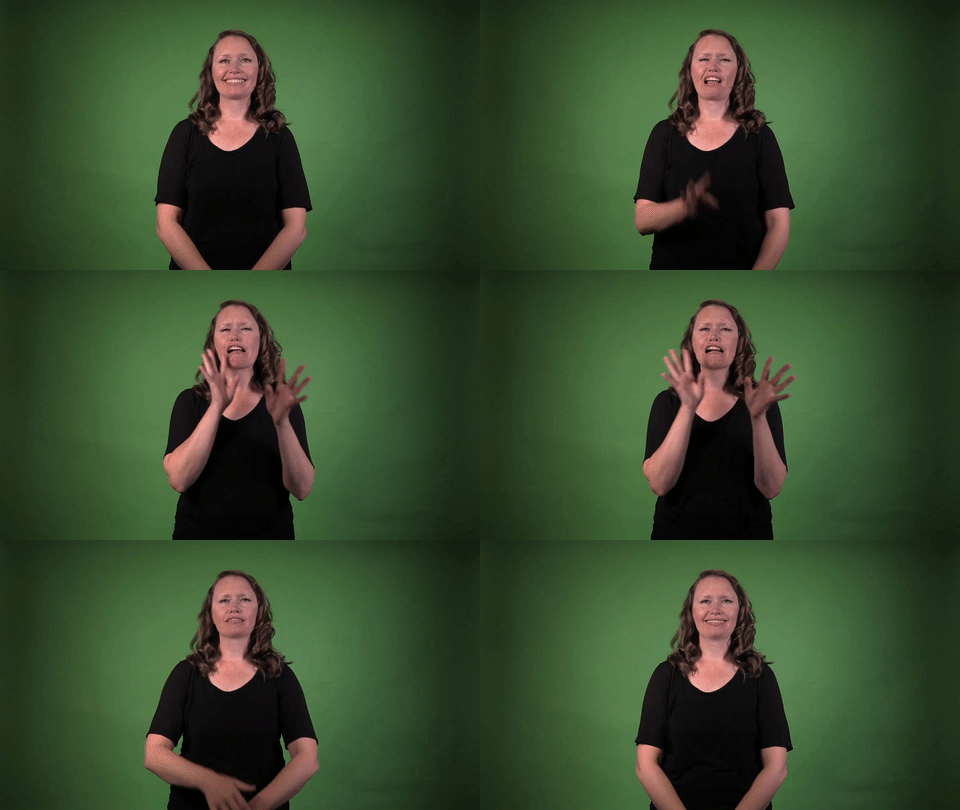
Definition: A person who talks a lot.
Sign for BIG TALKER in ASL

Practice Activities:
Begin practicing the sign for BIG TALKER in ASL by isolating the movement. Stand in front of a mirror and focus on clear, consistent hand shapes and exaggerated mouth movements if your version includes facial grammar. Repeat the sign slowly multiple times to build muscle memory and ensure proper motion.
Next, pair the sign for BIG TALKER in ASL with related vocabulary such as GOSSIP, CHAT, or TALK-TOO-MUCH. Use simple sentences like “MY COUSIN BIG TALKER” or “HE ALWAYS BIG TALKER SCHOOL.” Say each sentence aloud as you sign to reinforce the connection between the sign and its meaning. Practice varying sentence structure to get used to using the sign in different contexts.
Storytelling prompts can help build fluency. Create a story about someone who talks too much and use the sign several times throughout the narrative. For example, describe a funny classroom situation where a student keeps interrupting the teacher, using the sign to highlight their behavior.
Work with a signing partner if possible. Take turns describing people using personality signs, including the sign for BIG TALKER in ASL. Ask your partner to guess who you’re talking about based on your description. You can also play charades, acting out scenarios where one person is a big talker and the other must guess using ASL vocabulary.
Try recording yourself signing a monologue or a dialogue using the sign for BIG TALKER in ASL naturally within your ASL sentences. Watch your video afterward to evaluate clarity, pacing, and expression. Pay attention to how facial expressions support the meaning of the sign.
Finish your practice with a review quiz. Watch a video containing the sign and identify when and how it’s used. Consider how the sign is modified for sarcasm, emphasis, or storytelling style.
Cultural Context:
In Deaf culture, personality traits are often expressed vividly through facial expressions and body language in American Sign Language. When someone is called a big talker, it does not always carry the same negative connotation as it might in spoken English. The sign for BIG TALKER in ASL captures a lot of nuance, showing not just that someone talks a lot, but how they do it—whether it’s entertaining, boastful, or excessive.
The sign for BIG TALKER in ASL is often used in conversations where someone dominates a discussion or tends to exaggerate stories. This could apply to someone who speaks with flair and drama, always needing to be at the center of attention. In Deaf culture, being expressive and engaging is encouraged, but being a big talker can sometimes suggest a lack of listening or humility.
ASL is deeply connected to cultural values and social norms. The context in which the sign for BIG TALKER in ASL is used can shift its tone. Whether the signer is criticizing, teasing, or simply describing a talkative person depends heavily on the situation and accompanying facial expressions. For Deaf people, communication is often more layered than just hand movements—it’s a full-body activity backed by community understanding.
This sign is relatable and often used among friends, especially when telling stories or reflecting on events. Because storytelling plays such a key role in Deaf gatherings, someone labeled with the sign for BIG TALKER in ASL might actually be a popular figure. It’s not uncommon for the term to be used playfully, especially when a story spins out of control or becomes more theatrical than factual .
It’s also important to note that the sign for BIG TALKER in ASL might vary slightly depending on region or community. Like all living languages, ASL evolves, and different groups may use distinct gestures or expressions to convey the same idea. However, the intent behind the sign remains focused on someone who speaks a lot, often without pause or consideration for others’ input.
Kids in Deaf schools might learn the sign for BIG TALKER in ASL early on, especially during social lessons where they discuss communication styles. It helps build awareness about group dynamics and the importance of taking turns during conversations. Within Deaf households, the term may come up when describing a family member who can’t stop adding their opinion to every topic ️.
Understanding cultural context is essential when learning ASL. The sign for BIG TALKER in ASL is more than just vocabulary; it reflects how the
Extended Definition:
The sign for BIG TALKER in ASL refers to someone who talks excessively or boasts a lot, often without much follow-through. This sign is commonly used in informal conversations to describe someone who tends to exaggerate their experiences or constantly dominates the discussion. It carries a playful or mildly critical tone, depending on the context in which it’s used.
To sign BIG TALKER in ASL, you typically start with the sign for BIG, using open hands and moving them apart in front of your body to indicate something large. Then you use the sign for TALKER, often portrayed by wagging the fingers near the mouth or using a handshape that mimics chatter or speech. The motion and facial expression can greatly enhance the meaning, showing either lighthearted teasing or more serious criticism.
Facial expressions are very important when using the sign for BIG TALKER in ASL. A raised eyebrow, smirk, or rolling eyes can communicate whether you’re joking or being sarcastic. ASL relies heavily on facial grammar, so how you deliver the sign will determine if it comes across as friendly teasing, affectionately annoyed, or genuinely frustrated.
In social settings, the sign for BIG TALKER in ASL is often used humorously to call out a friend who loves to hear themselves speak. It’s a way for Deaf community members to comment on social behavior while maintaining cultural humor. Since ASL is a visual language, signs like these quickly and effectively communicate character traits.
Using the sign for BIG TALKER in ASL can also reflect cultural nuances. In Deaf culture, directness is valued, and this sign can be a light-hearted way to be honest about someone’s personality. It’s not necessarily rude; instead, it helps build community through shared, expressive interactions.
The sign for BIG TALKER in ASL can vary slightly between regions or individuals. While some may emphasize the size or exaggeration aspect, others may focus more on the speed or volume of talking. This flexibility makes the sign rich in meaning, allowing it to be adapted to fit different social contexts.
Parents and teachers within the Deaf community may use this sign to point out when a child is interrupting or talking too much in class. It offers a gentle yet clear way to guide behavior through visual explanation. Similarly, peers may use it among themselves to joke about someone’s storytelling habits.
Learning the sign for BIG TALKER in ASL gives learners insight into the personality-oriented vocabulary used in everyday Deaf communication. It enriches
Synonyms: blowhard, braggart, boaster, swaggerer, loudmouth
Educational resources: Find related learning materials in our course bank!
Want more? Check out some of our popular learning activities on the homepage!
Need to look up a sign? Use our highly rated dictionary: https://aslinteractive.com/best-asl-dictionary/
Follow us on tiktok: https://www.tiktok.com/@aslinteractive. More social media links at the bottom of this page!
Long-tail Keywords: what is the sign for big talker in ASL, how do you sign big talker in ASL, ASL sign for big talker
Categories:
tags: language learning, communication, people, adjectives, describing traits
Parameters
*Handshape*:
The handshape for the sign for BIG TALKER in ASL uses the dominant hand formed into a bent “L” shape, where the thumb and index finger point outward while the other fingers curl in slightly. This handshape taps repeatedly near the side of the mouth or jaw to simulate excessive talking or chatter ️.
The repeated motion with the bent “L” reflects the idea of constant speaking, enhancing the expressive nature of the sign for BIG TALKER in ASL. The exaggerated movement helps convey someone who talks a lot or dominates conversations.
*Palm Orientation*:
The palm orientation for the sign for BIG TALKER in ASL typically faces sideways or outward, depending on the variation. When using the dominant hand to mimic exaggerated talking, the fingers flutter rapidly near the mouth with the palm facing slightly outward.
This position reflects constant speaking or chatter, which emphasizes the idea behind the sign for BIG TALKER in ASL. The non-dominant hand may remain at rest or serve as a base for comparison, always maintaining a neutral orientation.
*Location*:
The sign for BIG TALKER in ASL is typically located in the front of the body, near the mouth or center of the chest. The dominant hand moves to indicate exaggerated talking, often with a wigwag or flapping motion to mimic excessive speaking.
In the sign for BIG TALKER in ASL, the facial expression plays a role too, often showing exaggeration or emphasis. The location remains within the neutral space in front of the torso for clear visibility.
*Movement*:
To show the sign for BIG TALKER in ASL, start with your dominant hand in a number 1 handshape at your mouth, as if indicating constant talking. Then repeatedly move the hand slightly out from the mouth and back in short, quick motions, mimicking nonstop chatter.
Facial expression is key—incorporate an exaggerated or dramatic look to show excessiveness. The sign for BIG TALKER in ASL combines motion and expression to communicate someone who talks a lot or excessively.
*Non-Manual Signals*:
The facial expression for the sign for BIG TALKER in ASL typically includes raised eyebrows and an exaggerated mouth shape, suggesting someone who talks a lot or brags. A slightly tilted head paired with a knowing or sarcastic smirk can enhance the meaning of the sign.
Eye gaze is usually direct and intense, emphasizing the dramatic or humorous tone. These non-manual signals help convey that the sign for BIG TALKER in ASL refers to someone who speaks excessively or boasts. ️
*Prosody, Dominant/Non-Dominant Hand*:
In the sign for BIG TALKER in ASL, the dominant hand takes the lead using a modified “L” or bent index gesture near the mouth, representing continuous or excessive talking. The movement is repetitive, showing non-stop chatter, and the facial expression is exaggerated to match the idea of someone who talks a lot.
The non-dominant hand is either inactive or serves as a base if emphasizing intensity. Overall, the prosody involves energetic, rhythmic motion to convey the talkative personality clearly. This helps solidify the meaning behind the sign for BIG TALKER in ASL ️.
Tips for Beginners:
When learning the sign for BIG TALKER in ASL, it’s important to understand that the sign conveys more than just someone who enjoys conversation—it typically suggests someone who talks excessively or brags. To sign it clearly, you’ll often use expressive facial features, along with a repeated motion of the hand near the mouth, mimicking exaggerated talking. Make sure your gestures are fluid but controlled to avoid miscommunication.
One of the biggest tips for beginners is to pair your facial expression with the movement. The sign for BIG TALKER in ASL is not about just moving your hands—your face adds crucial layers to the meaning. A smirk or exasperated look can really bring the sign to life and help convey the intent more naturally.
Practice in front of a mirror or record yourself so you can see how your expressions match your hand movements. This will help increase your confidence and improve your clarity when you sign in real-life conversations. Don’t rush—build fluency by starting slow and then gradually increasing your speed while staying accurate.
Be aware of the handshape and repetition. A common mistake is to drop the movement too soon or overdo it, which can lead to confusion. For the sign for BIG TALKER in ASL, two or three exaggerated movements, depending on the context, are usually enough. Overemphasizing can make your signing look unnatural.
Also, take time to observe how native signers use this expression in context. Whether in videos or real-life settings, seeing the sign used authentically helps reinforce proper usage. Since this sign is often used humorously or critically, lean into learning the tone behind it as well. This will help your use of the sign for BIG TALKER in ASL feel more genuine and effective whenever you use it.
Connections to Other topics:
The sign for BIG TALKER in ASL connects closely with concepts such as exaggeration, gossip, and attention-seeking behaviors. It shares visual and thematic similarities with signs like SHOW-OFF and BOAST, where body language and facial expressions are essential to delivering the intended message. The exaggeration in movement helps to mimic the characteristics of someone who speaks frequently or boastfully.
This sign also has ties to conversational ASL, especially in storytelling or when describing personality traits. It can be used to describe someone as a chatterbox or someone who cannot keep quiet, often overlapping with idiomatic signs such as TALK-TO-MUCH or GOSSIP. These signs often share rapid, repetitive hand movements and are best understood in the appropriate expressive context.
In compound signs or narrative forms, the sign for BIG TALKER in ASL can be paired with signs like KNOW-IT-ALL or LIE, depending on the intent. For instance, when describing someone who dominates conversations with misinformation, combining BIG TALKER with LIE adds layered meaning. These combinations help clarify tone, making it powerful in character descriptions or social commentary.
The sign’s character-based nature emphasizes the role of facial grammar, which is a vital component of ASL. Just like signs for RUDE or DRAMA, what differentiates one from another often lies in the non-manual signals, such as eyebrow positions or mouth morphemes. This highlights the importance of mastering expressive features alongside vocabulary.
The sign for BIG TALKER in ASL emphasizes abstract human behaviors and reinforces how ASL can convey humor, satire, or critique through visual storytelling. It opens up discussions on cultural attitudes toward talkativeness and can be linked to signs in Deaf culture that describe social roles and group dynamics. This makes it a valuable sign when learning both language and cultural nuances.
Summary:
The sign for BIG TALKER in ASL is a visually expressive and culturally nuanced concept. It captures both the literal idea of someone who talks a lot and the figurative sense of boasting or exaggeration. This sign often has layers of meaning depending on the context and the speaker’s tone.
To produce the sign for BIG TALKER in ASL, you typically start with a dominant hand in a modified ‘G’ handshape. The thumb and index finger move away from the mouth repeatedly, mimicking the action of ongoing speech. The motion emphasizes excessiveness and can be adjusted in speed or exaggeration.
This repeated motion suggests non-stop talking and often carries an evaluative tone. The speed, facial expression, and size of the sign contribute heavily to how it is interpreted. A neutral expression might simply imply someone is chatty, whereas a dramatic one could signal boasting or gossip.
Facial expressions play a crucial role with the sign for BIG TALKER in ASL. A raised eyebrow or smirk may indicate exaggeration or disbelief. A serious or flat expression can suggest annoyance or criticism. ASL relies heavily on such non-manual markers to provide nuance.
The cultural significance of this sign is deeply tied to the Deaf community’s values around communication. Since ASL is a visual language, being respectful in how and when one communicates is very important. The sign for BIG TALKER in ASL can sometimes serve as a mild social rebuke or an ironic comment.
Grammatically, the sign functions as a noun or description. It can be used within a sentence to mock or point out someone’s verbal habits. For example, pointing toward an individual and then signing BIG TALKER suggests they tend to speak (or sign) more than is necessary or appreciated.
This fits into ASL’s preference for visual descriptions and character labeling. The sign doesn’t require additional signs to make its meaning clear. It falls into the category of descriptive classifiers that identify traits or behaviors.
Linguistically, the sign combines classifier-like movements with iconic representation. The source of the sign reflects a visual metaphor for continuous talking. The bounded and repetitive motion of the hand gives the viewer the impression of endless speech.
The sign for BIG TALKER in ASL also intersects with applied linguistics. It shows how natural sign languages encode social evaluation, similar to how spoken languages use tone or inflection. In ASL, signs are layered with cultural meaning and visual storytelling.
Many signs in ASL develop from visual-motoric metaphors, like describing actions that accompany speech. Here, the way hand moves from mouth mimics a speaking gesture. This sign is a good example of how metaphorical language gets encoded into everyday sign use.
There are related signs and expressions like GOSSIP, CHAT, and TALK A LOT. While similar in meaning, they are not identical. Each sign has its own movement pattern and facial cues that set them apart and add precision to ASL descriptions.
For instance, GOSSIP uses a quick pinching motion between fingers, suggesting a whisper or subtle talk. CHAT is typically more neutral and friendly. TALK A LOT involves fast, repetitive signing and emphasizes volume or duration over intent.
The sign for BIG TALKER in ASL overlaps with the cultural value of concise, appropriate signing. In Deaf culture, clarity and purposefulness in communication are often highly respected. Thus, calling someone a big talker can be gently disparaging, depending on your tone.
The phrase could be used comically, especially when accompanied by playful facial expressions. In this sense, it’s not always negative. It can even reflect affection or familiarity, like teasing a friend who always has something to say.
The visual structure of the sign mirrors tone and delivery present in spoken sarcasm or exaggeration. This serves as an important reminder that tone in ASL comes from physical expression rather than sound. It’s an embodied language, where meaning flows from the whole body.
Sociolinguistically, this sign represents how ASL encodes social judgment within simple vocabulary. Its use shows how community norms influence language. An ASL user might use this sign to maintain or reinforce group values around humility and listening.
In bilingual Deaf contexts, where ASL and English coexist, signs like BIG TALKER capture nuanced meanings not easily conveyed with just words. They rely heavily on shared values and understandings within the Deaf community.
The simultaneous use of classifier parameters, facial expressions, and movement trajectory makes the sign for BIG TALKER in ASL a layered and subtle form of critique. It’s not just a label, but a whole performance of meaning.
Using this sign accurately demands cultural competence and shared situational understanding. A non-native signer might need extra exposure to understand when the sign is playful versus critical. Misuse of this sign could lead to confusion or offense.
From a teaching perspective, it’s a powerful example of how ASL blends literal gestures with abstract meanings. It makes a strong case for emphasizing storytelling and expression when learning the language.
Want more? Check out some of our popular learning activities!
ASL Interactive Resources
ASLInteractive YouTube Channel
Follow us on tiktok: @aslinteractive.com
Follow us on Instagram: aslinteractive
Facebook page: aslinteractive
Facebook group: aslinteractive
LInkedIn: ASL Interactive LLC
Twitter: @ASL_interactive
*Some information on this page is AI-generated. AI can make mistakes. Please check the information.


Responses