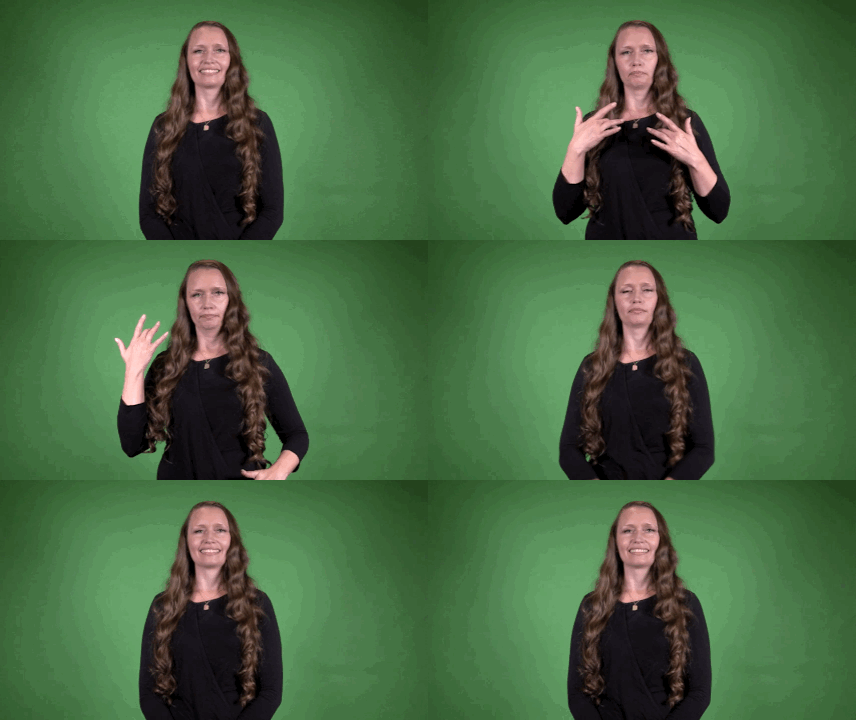
Definition: A serious mental illness that causes extreme mood swings, from mania or hypomania to depression
Sign for BIPOLAR in ASL

Practice Activities:
Begin by practicing the sign for BIPOLAR in ASL in front of a mirror. Focus on refining the movement between emotional extremes, which is central to conveying the meaning accurately. Do the sign slowly, then gradually increase your speed while maintaining clarity.
After practicing it in isolation, use it in simple sentences such as “My cousin is bipolar,” or “Bipolar disorder is a mental health condition.” Say the sentence out loud while signing to reinforce the connection between the concept and the sign. Repeat these until it feels natural.
Use a video-based signing journal to record yourself using the sign for BIPOLAR in ASL in short statements. Review the recordings to check for consistency, facial expressions, and accuracy. Try signing different descriptive phrases like “bipolar emotions shift quickly” or “she manages bipolar symptoms with medication.”
Partner exercises can deepen understanding. Pair up and take turns giving short narratives where mental health is mentioned. For example, you can describe someone’s daily routine who lives with a bipolar condition or have a discussion about how society views mental health. Include related signs like MEDICATION, FEELINGS, or THERAPY for added context.
Write a short story about a character who experiences mood changes and sign it to a classmate or record it. Incorporate the sign for BIPOLAR in ASL along with expressions that show high and low emotional states. This will help associate the sign with more realistic conversations and storytelling.
Flashcard games can be helpful too. Mix cards with mental health-related signs and take turns picking one, signing it, and using it in context. Include the sign for BIPOLAR in ASL multiple times to ensure repetition and retention.
Finally, reflect on what bipolar means and how to respectfully sign about it when discussing sensitive topics. This will help learners build both linguistic and cultural competency in ASL communication.
Cultural Context:
Understanding the sign for bipolar in ASL involves more than just learning hand movements. It also requires an understanding of how mental health is discussed in the Deaf community. The way people communicate about bipolar disorder in American Sign Language reflects cultural attitudes, accessibility, and the importance of visual language.
In the Deaf community, mental health is a topic that carries its own unique challenges. Many Deaf individuals face barriers when accessing mental health care due to communication gaps. Learning the sign for bipolar in ASL helps close that gap by offering a way to discuss the condition clearly and respectfully.
When using the sign for bipolar in ASL, it’s important to consider the context. Bipolar disorder involves intense emotional shifts, and that meaning can be conveyed through facial expressions and body language in ASL. Cultural fluency is essential to make sure that the sign matches the tone and intent of the conversation.
Deaf culture places strong emphasis on clarity and directness. This means that discussing mental health issues like bipolar disorder may be more straightforward in ASL when compared to spoken language cultures. Using the correct sign for bipolar in ASL ensures that the topic is approached with sensitivity and understanding.
The sign for bipolar in ASL may vary slightly by region or personal preference, much like spoken dialects. However, most signs for mental health terms are rooted in accurate descriptions of behavior or feelings. This makes learning the sign for bipolar in ASL especially valuable when engaging with the Deaf community or interpreting in medical settings.
Mental health awareness in the Deaf community is growing, and having access to accurate ASL vocabulary plays a big role in that progress. Using the sign for bipolar in ASL can open up conversations that might otherwise be difficult. Understanding this sign also supports better inclusion and representation in medical and therapeutic environments.
Children and adults who grow up using ASL benefit from a full explanation of mental health terms like bipolar disorder. Teachers, interpreters, and family members play a key role in using the correct signs to educate and support those with mental health needs. The sign for bipolar in ASL becomes a bridge to better communication and more inclusive care.
It’s not just about knowing the sign—it’s also about knowing when and how to use it. Cultural nuances influence how and when the sign for bipolar in ASL is used. Respecting individual identity and avoiding stigmatizing language is crucial in conversations about mental health.
The Deaf community advocates for accessible and respectful mental health conversations. Learning the sign for bipolar in ASL means participating in that advocacy in a
Extended Definition:
The sign for bipolar in ASL is a visual representation of the emotional highs and lows associated with the condition. This American Sign Language sign often involves facial expressions and movement to convey the contrast in moods experienced by someone with bipolar disorder. Understanding the sign for bipolar in ASL helps promote awareness and inclusion, especially when communicating mental health topics within the Deaf community.
In ASL, mental health terminology is expressed with care and sensitivity. The sign for bipolar in ASL typically includes two distinct motions that reflect the shifts in emotional states. One motion may indicate an elevated mood, while the other shows a sudden drop, resembling the pattern of mania and depression.
When signing about bipolar disorder, it’s important to consider contextual and cultural understanding. Many Deaf individuals prefer signs that reflect the experience rather than the medical terminology. That’s why the sign for bipolar in ASL isn’t always a direct translation but more of a conceptual representation.
The facial expression used with the sign is crucial for conveying meaning. ASL is a visual and expressive language, and signs like the one for bipolar rely heavily on non-manual markers. By using expressive eyebrows, shifts in body posture, and clear transitions between hand movements, the sign becomes more accurate and nuanced.
The sign for bipolar in ASL is not universally fixed, as regional and personal variations exist. Some signers may use one version based on discussions with mental health professionals or what they have seen in the community. This variation reflects ASL’s diversity and its ability to adapt language around mental health.
In some cases, a signer might combine the signs for mood or emotion with directional movement to dramatize the contrast in states. These modifications help clarify the message when discussing complex psychological conditions. The flexibility of the sign for bipolar in ASL makes it a powerful tool for communication and advocacy.
Learning the correct way to sign bipolar in ASL empowers both Deaf and hearing individuals to discuss mental health more effectively. This inclusive approach reduces stigma and encourages open dialogue across communities. Teachers, interpreters, and caregivers benefit from knowing accurate signs related to emotional and cognitive health.
ASL students should also practice using the surrounding grammar and expressions to deliver the sign fluidly. The meaning of the sign for bipolar in ASL is more than just handshape—it includes timing, intensity, and emotion. These elements turn a basic sign into meaningful and respectful communication.
When creating educational videos or resources, it’s helpful to slow down the sign and explain how and why it’s used. This increases awareness and understanding while preserving
Synonyms: manic-depressive, alternating mood disorder, mood swings disorder, polar mood disorder, manic depression
Educational resources: Find related learning materials in our course bank!
Want more? Check out some of our popular learning activities on the homepage!
Need to look up a sign? Use our highly rated dictionary: https://aslinteractive.com/best-asl-dictionary/
Follow us on tiktok: https://www.tiktok.com/@aslinteractive. More social media links at the bottom of this page!
Long-tail Keywords: what is the sign for bipolar in ASL, how do you sign bipolar in ASL, ASL sign for bipolar disorder
Categories:
tags: emotions, mental health, describing feelings, personal experiences, wellness
Parameters
*Handshape*:
The handshape used for the sign for BIPOLAR in ASL typically begins with both hands in a flat “B” handshape. The fingertips point slightly forward or to the side, depending on regional variation. One hand touches the side of the head, representing the mind, while the other hand may move outward or alternate placement to indicate the concept of opposing states.
This movement visually symbolizes the dual nature often associated with the sign for BIPOLAR in ASL. The contrasting motions and structured handshapes work together to communicate the fluctuations between emotional or mental states. Consistent use of flat “B” hands helps reinforce the meaning clearly and effectively.
*Palm Orientation*:
For the sign for BIPOLAR in ASL, the palm orientation typically begins with both hands held upright, fingers spread, and palms facing each other or slightly inward toward the signer. As the motion progresses to show contrasting emotions or states, the palm orientation may shift—one hand may flip outward with the palm away from the signer, while the other remains inward.
This contrast in palm orientation helps illustrate the dual nature represented in the sign for BIPOLAR in ASL. Changes in palm direction mirror the emotional swing conveyed by the concept. ✋➡️
*Location*:
The location for the sign for BIPOLAR in ASL is primarily in front of the body at chest level. Both hands begin near the center line of the torso, where the action moves outward to either side to reflect the shifting nature of the condition. This placement helps visually convey the concept of contrasting emotional states. The sign for BIPOLAR in ASL uses the body space effectively to illustrate emotional variation.
*Movement*:
The dominant hand starts in the “1” handshape near the side of the head and makes a quick flick outward, then arcs down and around to point at the heart. Some variations may use alternating “1” handshapes at the head and chest to show a shift in focus or mood.
The sign for bipolar in ASL represents the contrast between extreme mental states. The motion reflects internal movement between emotional or mental poles, capturing the essence of the term.
*Non-Manual Signals*:
Facial expressions for the sign for BIPOLAR in ASL shift to match the two extreme moods associated with the condition. One side of the face may show a happy or excited emotion, while the other reflects sadness or distress. Eyebrows may alternate between raised and furrowed, and the eyes can adjust to highlight the contrast.
This emotional fluctuation in non-manual signals is key to effectively conveying the sign for BIPOLAR in ASL, emphasizing the dramatic shift in states.
*Prosody, Dominant/Non-Dominant Hand*:
The sign for BIPOLAR in ASL typically uses both hands to show contrast or shift, often representing opposing moods or states. The dominant hand may begin on one side of the head, palm facing in, and then shift to the other side, signifying changes in mental state. The non-dominant hand may mirror the motion or remain static depending on regional preference.
Facial expression plays a key role, showing an emotional swing or division. The sign for BIPOLAR in ASL may also include a brief pause between the two movements, emphasizing the switch or difference between the poles. This physical representation aligns with the concept of bipolar changes .
Tips for Beginners:
When learning the sign for BIPOLAR in ASL, it’s important to understand both the meaning behind the term and the way the concept is represented visually. Typically, this sign is produced using a combination of facial expressions and hand movements that reflect the shifting emotional states associated with bipolar disorder. In some instances, the term may be fingerspelled, especially in formal or medical settings, so it’s valuable to be comfortable with both methods.
For beginners, one helpful tip is to practice the emotional expression behind the sign for bipolar in ASL. Since this sign conveys a mental health condition involving mood swings, your facial expression plays a major role in making your message clear. A neutral expression doesn’t reflect the concept accurately; instead, varying your facial tone to show highs and lows can enhance communication .
Another tip is to be consistent in your handshapes and movement path. In the variant where the sign involves moving hands to show opposite sides or states, make sure the motion is clean and deliberate. This ensures that the visual meaning doesn’t get lost. Practicing in the mirror can help you track your expression and the clarity of your gestures.
It’s common for new learners to rely too heavily on mouth movements or spoken words while signing. This can be distracting and shift the focus away from proper hand articulation. Focus instead on signing smoothly and integrating the emotional shift into your signing space.
If the fingerspelled version of the sign for bipolar in ASL is used, try repeating it regularly during practice to build muscle memory. Fingerspelling accuracy can be tricky at first, especially for longer or less familiar terms. Keep your hand steady and letters well-spaced for clarity .
Lastly, be respectful and sensitive when using the sign for bipolar in ASL, especially when discussing someone’s condition. Always consider the context and audience when using mental health-related signs.
Connections to Other topics:
The sign for BIPOLAR in ASL often connects with mental health vocabulary in general, making it useful to study alongside signs for DEPRESSION, MOOD, MIND, and EMOTIONS. These signs often use facial expressions to indicate intensity or variability—a key component in portraying nuanced mental health conditions. For example, moving between expressions of sadness and excitement supports the conceptual dynamic of bipolar disorder.
Other related signs include SCHIZOPHRENIA and ANXIETY, both of which, like the sign for BIPOLAR in ASL, require layered meaning through both manual sign and affect. This encourages a more visually expressive signing style frequently used when describing psychological or emotional conditions. Facial grammar and body movement become critical tools in differentiating between types of mental health challenges.
Compound signs can arise in real-world conversation where mental health topics are common, such as combining the sign for MOOD with CHANGE to express “mood swings.” This can help reinforce and contextualize the sign for BIPOLAR in ASL when explaining symptoms or experiences. Similarly, integrating signs like MEDICINE or THERAPY can emphasize treatment discussions.
Linguistically, exploring the sign for BIPOLAR in ASL can highlight how ASL expresses abstract concepts. Terms that don’t have concrete physical referents typically require creative visualization and metaphor, which strengthens understanding of how ASL handles non-tangible ideas. This can be applied across topics such as identity, trauma, or self-awareness.
Awareness of cultural considerations also arises when discussing the sign for BIPOLAR in ASL. Sensitivity to person-first language and tone is vital, as discussions about mental health necessitate respect and empathy. The sign, when used properly in context, demonstrates ASL’s ability to handle complex personal narratives gracefully and meaningfully.
Finally, examining how the sign is used in narratives or shared experiences—such as in Deaf counseling sessions, vlogs, or storytelling—can illustrate real-world function, making the sign for BIPOLAR in ASL not just a term, but part of a broader dialogue within the Deaf community.
Summary:
The sign for BIPOLAR in ASL reflects both conceptual layering and cultural nuance. It is often a compound or descriptive sign meant to express duality or contrasting emotional states, which are central to the understanding of the term.
Some signers choose to express bipolar through directional shifts in emotion. For example, they may show a neutral face transitioning rapidly between a sign for HAPPY and SAD, indicating the fluctuation typical of bipolar disorder.
Others might sign the medical condition by fingerspelling B-I-P-O-L-A-R, especially in medical, clinical, or formal settings. Fingerspelling is also used when clarity or specificity is essential, ensuring there’s no ambiguity in meaning.
When portraying this concept, it’s important to consider the cultural sensitivity around mental health. The sign for BIPOLAR in ASL should avoid reinforcing stigma and should instead foster understanding and support.
Signers can also combine related signs such as MIND, MOOD, and CHANGE when elaborating on the condition, especially in educational or advocacy situations. These signs help provide context, especially when addressing an audience unfamiliar with mental health terminology.
In everyday conversation, simplifications often occur. Some use gestures showing mood contrast—using facial expression and posture to simulate energy shifts—accompanied by directional signs like CRAZY transitioning into CALM or ENERGETIC.
The sign for BIPOLAR in ASL also draws from visual metaphors. The concept of “poles” or “extremes” can be shown using spatial contrast—placing the hands far apart and shifting between them rapidly—that reflect opposing mental states.
Another common signing method involves first referencing the brain or MIND area, then showing abrupt shifts using facial expressions and contrasting handshapes or directional movement. This draws a line between thought and affective changes.
Because ASL is not a direct translation of English, signing BIPOLAR cannot rely solely on direct linguistic equivalents. It must carry cultural and emotional accuracy, especially where mental health is discussed with respect.
Context matters significantly in how the sign for BIPOLAR in ASL is delivered. In a therapeutic setting, the sign may be more subdued and clinically accurate, whereas in storytelling or personal narratives, it may contain dynamic visual storytelling techniques.
The grammar of ASL allows flexibility. Some signers prefer to describe the condition through classifier constructions that visualize person’s change in behavior over time, showing movement from one psychological state to another.
Facial expression is critical in this sign. Signers utilize facial grammar to match the emotional undertone they’re conveying, cycling through joy, despair, confusion, or intensity, emphasizing the lived experience behind the diagnosis.
Sign choice may also change depending on audience. Deaf individuals familiar with mental health discourse may understand the signed compound, while newcomers may require the fingerspelled version of BIPOLAR to clarify.
Many Deaf professionals in psychology or social services advocate for consistent signs for mental health conditions. However, there remains debate about whether conditions like bipolar should always be fingerspelled or replaced with meaningful semantic signs.
In ASL linguistics, this topic highlights how new terminologies are integrated into the lexicon. The sign for BIPOLAR in ASL exemplifies how Deaf communities respond to specialized medical and psychological concepts, creating unique visual equivalents.
Regional variations may affect how the sign for BIPOLAR in ASL is performed. In some areas, slang or informal signs have developed, which may not be recognized universally within the Deaf community.
Interpreter training often includes instruction on how to deliver mental health terminology respectfully and clearly. The sign for BIPOLAR in ASL is a common example, where accuracy and sensitivity must work together.
Signs like BIPOLAR intersect deeply with patient identity. Choosing the correct sign shows awareness of how language and representation influence how individuals with the condition are viewed socially and professionally.
Metaphorical framing is frequent in ASL. Signers often rely on metaphor to encapsulate abstract or symbolic dimensions of bipolarity, which don’t lend themselves to straightforward translation.
The influence of English persists. Many ASL users borrow from English or fingerspell BIPOLAR when lacking an agreed-upon sign. This is common in academic settings or institutions using Signed Exact English (SEE) models.
Because ASL is a living language, its signs evolve. As mental health discourse grows within the Deaf community, the sign for BIPOLAR in ASL may develop standardized forms that more authentically represent the condition’s complexities.
From a socio-linguistic perspective, discussing the sign for BIPOLAR in ASL raises questions about access to healthcare language. The clarity and availability of such signs impact how Deaf people receive or express medical diagnoses.
Applied linguistics studies suggest that modality—the visual-gestural nature of ASL—offers expressive potential for psychological states. BIPOLAR as a concept is ideally suited for depiction through gesture and facial shifts.
Storytelling within the Deaf community often uses visual strategies to depict psychological experiences, allowing people to show manic episodes through increased signing speed or intense eye gaze,
Want more? Check out some of our popular learning activities!
ASL Interactive Resources
ASLInteractive YouTube Channel
Follow us on tiktok: @aslinteractive.com
Follow us on Instagram: aslinteractive
Facebook page: aslinteractive
Facebook group: aslinteractive
LInkedIn: ASL Interactive LLC
Twitter: @ASL_interactive
*Some information on this page is AI-generated. AI can make mistakes. Please check the information.


Responses