Definition: A celebration of the anniversary of one’s birth v2.
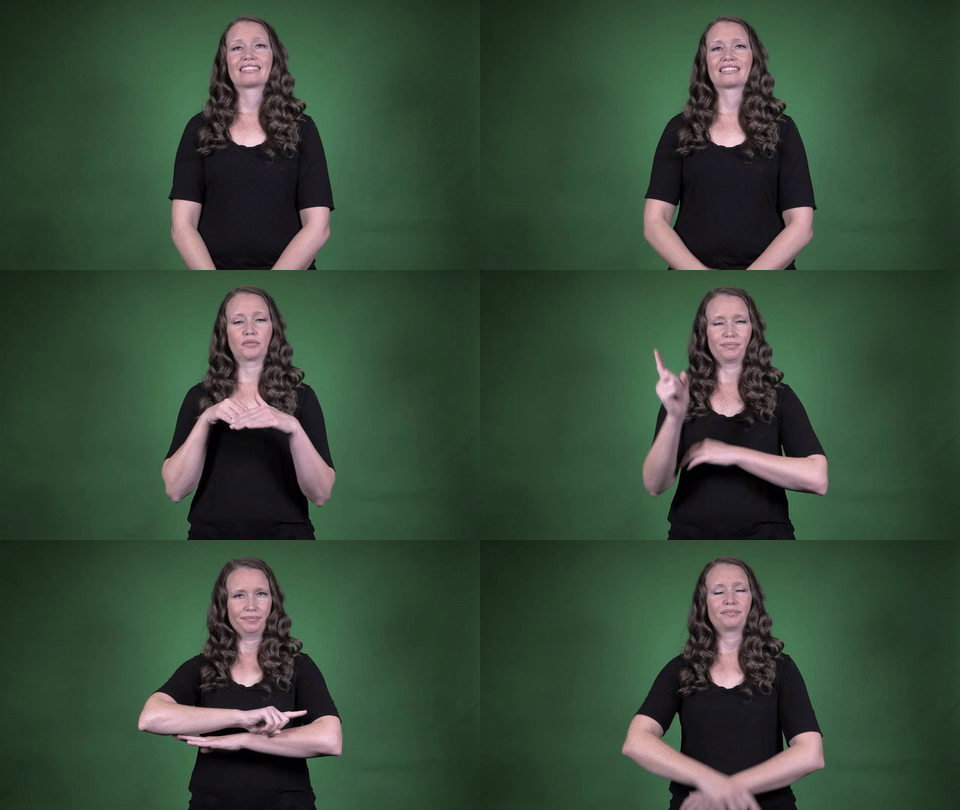
Sign for BIRTHDAY 2 in ASL

Practice Activities:
Start by practicing the sign for BIRTHDAY 2 in ASL on its own in front of a mirror. Pay attention to your handshape, movement across the body, and facial expressions. Repeat the sign multiple times slowly, then gradually increase your speed while maintaining accuracy.
Next, practice fingerspelling the months of the year and pairing them with the sign for BIRTHDAY 2 in ASL. For example, sign “February” and then “birthday,” saying: “My birthday is in February.” Try creating sentences about your family members’ birthdays and signing them one by one.
Create a mini dialog with a partner or in a video recording where you ask and answer questions like, “When is your birthday?” or “How do you celebrate your birthday?” Use the sign in each sentence to reinforce vocabulary connection. This will help in associating the sign with conversational context.
Use a storytelling prompt such as describing your favorite birthday memory. Include complete details such as age, place, gifts, or people involved. Incorporate the sign for BIRTHDAY 2 in ASL every time you talk about the occasion and watch how naturally it fits into the flow.
Write and sign five different birthday-related sentences using time expressions like “last year,” “next month,” or “every year.” For example: “Last year, my birthday was on a Saturday.” Sign each sentence clearly and review for smooth transitions.
As a game, present flashcards with words like cake, gift, age, celebrate, and see if you can create a sentence using each word along with the sign for BIRTHDAY 2 in ASL. This activity helps activate spontaneous language creativity and reinforces correct sign usage.
End each practice session by watching ASL videos or vlogs featuring birthday conversations and mimic how the sign for BIRTHDAY 2 in ASL appears naturally. Repeat the signs and phrases you observe to build fluency and confidence.
Cultural Context:
The sign for BIRTHDAY 2 in ASL is an alternative version used by some members of the Deaf community to express the concept of a birthday. While the most common sign for birthday involves touching the middle finger to the chin and then the chest, this variation uses a different motion or handshape depending on the region or personal signing preference. Understanding various ways to sign birthday is essential for clear communication and cultural fluency.
In the context of the Deaf community, birthdays are meaningful celebrations much like in hearing culture, but access to these celebrations through American Sign Language is what makes the experience inclusive and fully accessible. The sign for BIRTHDAY 2 in ASL represents one of the ways Deaf individuals express celebration and personal milestones. This version might be taught in certain schools, families, or regions, reflecting the natural variation and evolution of language.
ASL is a living language, and just like spoken languages have regional accents or dialects, signed languages have variations too. The sign for BIRTHDAY 2 in ASL reflects this diversity. It’s not uncommon for younger signers or native Deaf users to use different versions than what might be found in textbooks or formal instruction.
Cultural exposure plays a large role in learning which signs are used commonly or in specific situations. The sign for BIRTHDAY 2 in ASL may be more familiar to those who grew up in signing households or were educated in Deaf schools. When learning ASL, it’s useful to observe the variations so you can adapt your communication style to different settings.
Celebrating birthdays in Deaf culture often involves community gatherings, storytelling, visual games, and, of course, lots of signing. Knowing multiple versions, like the sign for BIRTHDAY 2 in ASL, enhances the richness of the interaction. It also demonstrates cultural respect and a deeper understanding of the language.
Many ASL users appreciate when others recognize and use regional or community-specific signs. Using the sign for BIRTHDAY 2 in ASL correctly might elicit recognition or approval from native signers who are familiar with that form. It shows attention to detail and a willingness to learn more than just the basics.
The sign for BIRTHDAY 2 in ASL is also a good example of how signing evolves and adapts. Deaf communities are not monolithic, and each community tailors language to its own use. This is part of what makes learning ASL both a challenge and a joy.
When sharing birthday wishes using American Sign Language, using the variation
Extended Definition:
The sign for birthday 2 in ASL is a common variation of the sign used to express the concept of someone’s birth anniversary. American Sign Language often features regional or personal variations in how certain signs are expressed, and birthday 2 is one such alternative. This version of the sign may be used in specific communities or passed down through family or educational settings where a particular signing style is preferred.
To sign birthday 2 in ASL, one version involves the middle finger of the dominant hand touching the chin and then the chest, tapping both points lightly. This differs slightly from another popular version where the open hand may brush the chin and then move to the chest or lower body area. Both signs convey the same meaning, so recognizing multiple ways to sign birthday can enhance your understanding and communication within the Deaf community.
When learning the sign for birthday 2 in ASL, it helps to watch videos or live demonstrations. The fluid motion of the sign can be difficult to capture in written descriptions alone. Observing native ASL users or experienced signers can give insights into the subtle movements and facial expressions that accompany this variation.
The facial expressions used with the sign for birthday 2 in ASL play a significant role in conveying the tone and emotion behind the message. A joyful or celebratory expression, combined with the sign, helps reinforce that the topic is about a happy occasion. Non-manual signals such as smiling or raising your eyebrows can further enhance clarity.
This version of the birthday sign is often used in casual settings, such as with friends or family members. It can be part of larger expressions like happy birthday songs in ASL or in storytelling that involves birthdays. Incorporating the sign for birthday 2 in ASL into full phrases improves fluency and helps the signer become more comfortable with conversation structure in ASL.
Context matters when choosing which version of a sign to use. If you’re signing in a formal setting, such as interpreting or classroom instruction, it might be useful to confirm which version is preferred by the audience. But for day-to-day interaction, using the sign for birthday 2 in ASL is perfectly acceptable and widely understood by most Deaf signers.
The importance of understanding multiple sign variations, like birthday 2, highlights the diversity within the ASL community. Just as with spoken languages, ASL evolves, allowing for different expressions of the same concept. When you’re aware of these variations, your ASL skills become richer and more adaptable to different situations.
Practice and repetition are key when
Synonyms: birthday, anniversary, natal day, birth date, day of birth
Educational resources: Find related learning materials in our course bank!
Want more? Check out some of our popular learning activities on the homepage!
Need to look up a sign? Use our highly rated dictionary: https://aslinteractive.com/best-asl-dictionary/
Follow us on tiktok: https://www.tiktok.com/@aslinteractive. More social media links at the bottom of this page!
Long-tail Keywords: what is the sign for birthday in ASL, how do you sign birthday in ASL, ASL sign for birthday
Categories:
tags: Birthday, Occasions, Celebration, Party, Life milestones
Parameters
*Handshape*:
The handshape used in the sign for BIRTHDAY 2 in ASL begins with the middle finger of the dominant open hand. The hand is open and relaxed, not stiff, and commonly referred to as a “five” handshape. The fingers are spread slightly apart.
This handshape moves between two locations on the body in the sign for BIRTHDAY 2 in ASL. The tip of the middle finger touches the chin area first, then moves to touch the chest. This soft and open hand configuration supports fluid movement. ️
*Palm Orientation*:
The palm orientation in the Sign for BIRTHDAY 2 in ASL starts with the dominant hand open and facing upward as it moves from the chin area to the chest. This motion mimics a soft downward glide, showing the transition from the face to the heart area.
Throughout the Sign for BIRTHDAY 2 in ASL, the palm remains mostly upright or slightly angled toward the body, depending on signer preference. This subtle orientation helps indicate the personal connection and celebration implied by the sign.
*Location*:
The location for the sign for BIRTHDAY 2 in ASL begins at the chin and then transitions to the chest. The dominant hand touches the chin with the middle finger and then moves down to touch the chest in a similar fashion.
This version of the sign for BIRTHDAY 2 in ASL places emphasis on the body’s central axis, going from the face to the chest area. This pathway helps differentiate it from other versions of the birthday sign.
*Movement*:
The sign for BIRTHDAY 2 in ASL starts with the middle finger of your dominant open hand touching your chin. Then move the hand in an arc to touch the center of your chest. This movement combines the sign for “favorite” with a downward and inward motion.
Incorporating both facial expressions and smooth hand transitions helps convey the sign for BIRTHDAY 2 in ASL more naturally. Make sure the motion flows from chin to chest in one clean movement .
*Non-Manual Signals*:
When performing the sign for BIRTHDAY 2 in ASL, the facial expression is relaxed and slightly pleasant, reflecting the celebratory nature of the concept. A soft smile is common, but not exaggerated. Eyebrows remain in a neutral position, and there’s no head tilting unless used contextually in a specific sentence.
The sign for BIRTHDAY 2 in ASL often includes a slight pause or nod to emphasize importance, especially when used in storytelling or introductions. Eye gaze should be focused forward or directed toward the person discussed.
*Prosody, Dominant/Non-Dominant Hand*:
The sign for BIRTHDAY 2 in ASL uses the dominant hand in a middle finger touch motion. Begin by touching the middle finger of the dominant open hand to the chin, then move to touch the same finger to the chest. The non-dominant hand is not used actively in this version.
This variation of the sign for BIRTHDAY 2 in ASL is a streamlined option commonly used in conversational signing. The dominant hand carries the full movement and expression .
Tips for Beginners:
The sign for BIRTHDAY 2 in ASL is a useful variation you might encounter depending on the region or the signer. In this version, the dominant hand begins in the middle of the chest with the middle finger touching the sternum, and then moves to touch the middle finger to the chin. This uses a slight arc motion, and it’s important to keep the handshape consistent throughout the movement. Practice the transition between these two points to make the sign fluid and natural.
When learning the sign for BIRTHDAY 2 in ASL, it’s helpful to use a mirror or video recording to observe the accuracy of your hand placement and facial expressions. Middle finger contact on the chest and chin is specific and should not be confused with the index finger, which is used in some other signs. Making sure the motion is smooth instead of choppy will help make your sign more legible to fluent users.
One common mistake beginners often make is using the incorrect handshape or tapping instead of smoothly moving between the chest and chin. If the motion becomes bouncy or hesitates, it can interfere with the clarity of the sign. Taking time to watch native signers perform the sign for BIRTHDAY 2 in ASL and mimicking their speed and flow will train your motor memory for more accurate use.
When interacting with native signers, don’t be afraid to ask for feedback. This can be invaluable in pinpointing subtle issues you might not recognize on your own. The sign for BIRTHDAY 2 in ASL may not be as commonly used as other birthday sign variants, but it’s still widely understood. Practicing it in context, such as discussing family or friends’ birthdays, can solidify retention and improve conversational fluency.
Connections to Other topics:
The sign for BIRTHDAY 2 in ASL connects with the broader category of personal milestones and calendar-related signs such as ANNIVERSARY, CELEBRATE, and HOLIDAY. These signs often appear together in stories, narratives, or conversations involving time, age, or special events. Signs involving dates and celebrations tend to blend numeracy with facial expressions to offer additional context.
A common connection is found between the sign for BIRTHDAY 2 in ASL and signs related to age, such as OLD, AGE, or YEAR. These signs are often combined in storytelling to express someone’s age during a specific birthday or to describe how a child is growing over time. For example, a signer might combine YEAR and BIRTHDAY to explain how many birthdays someone has celebrated.
This version of the birthday sign can also blend into compound expressions with signs like PARTY (to indicate a birthday party), PRESENT (for receiving gifts), or FAMILY (when describing who attended the celebration). These pairings enrich the narrative and provide a fuller emotional context. The sign for CAKE or ICE CREAM may also accompany the sign for BIRTHDAY 2 in ASL when describing typical birthday festivities.
Temporal signs such as TODAY, YESTERDAY, or NEXT-WEEK are often used with the sign for BIRTHDAY 2 in ASL to specify the timing of the birthday. These time indicators help establish the sequence and can be useful in discussing upcoming plans or past memories.
Additionally, the sign for BIRTHDAY 2 in ASL can be featured in everyday dialogues, particularly in school settings or with children, where birthdays are often noted. Teachers or caregivers may use this version to signal birthdays during classroom announcements or special events, often combined with signs like NAME and STUDENT. These contextual uses make the sign versatile and deeply connected to daily interactions.
Summary:
The sign for BIRTHDAY 2 in ASL offers a rich variation that highlights the dynamic nature of American Sign Language. Unlike the more commonly seen birthday sign, this version reflects specific regional or individual stylistic preferences. It’s an excellent representation of how ASL evolves both personally and communally.
In the variation known as the sign for BIRTHDAY 2 in ASL, the dominant hand touches the chin with the middle finger and then moves to the chest. The movement is smooth and relaxed, showing a connection between one’s identity (chin) and the heart (chest), possibly signifying the personal and emotional importance of a birthday. The orientation is palm in, and the handshape is the open “5” with the middle finger extended slightly farther.
This version emphasizes a more sentimental or introspective interpretation of the concept. Birthdays are not just a celebration of years passed but a recognition of the self. The motion from the chin to the chest may metaphorically highlight the self-reflective nature of aging and personal growth.
The sign for BIRTHDAY 2 in ASL exists alongside its more frequently used counterpart, which often substitutes the forehead or the stomach as contact points. This shows an intriguing variance in how signers visualize and express time-linked milestones. Such differences usually depend on local norms or even familial influence.
Linguistically, this variation is rich with morphological insight. The combination of the touching motion and the movement adds layers of meaning that derive from spatial and bodily metaphor. In ASL, the body is a canvas for abstract concepts, and here, the concept of “birth” traverses one’s identity and heartspace.
From a grammatical perspective, the sign for BIRTHDAY 2 in ASL works similarly to standard noun signs. When telling a story or providing information, it can anchor a timeline around someone’s age or a specific date. For example, “Her birthday is next month” would feature this sign seamlessly within a sequence of time signs and subject markers.
Culturally, birthdays are significant markers in Deaf communities, much like in hearing ones. They are used to signify maturity, rights of passage, or legal turning points such as employment eligibility and voting. The sign for BIRTHDAY 2 in ASL therefore becomes more than a lexical item—it’s a cultural token of identity and affirmation.
The tactile nature of this sign also plays a role for DeafBlind individuals. Transliterating from ASL to Pro-Tactile or other visual-tactile languages may involve preserving the pathway of motion from chin to chest. Such adaptations retain the original’s emotional geography while making it accessible.
The sign for BIRTHDAY 2 in ASL has connections to other signs in terms of movement and contact points. For example, signs such as FAVORITE or FEELED OF are often marked by middle finger contact to the chest. These body locations signify emotional or cognitive connection in ASL, which enriches the semantic interpretation of this version of birthday.
Understanding the sign for BIRTHDAY 2 in ASL also invites reflection on classifiers and indexing. While the sign itself isn’t a classifier, it may be used in a storytelling context where age or celebration becomes indexed or visualized through additional hand movements. These completions give the sign narrative depth.
The emotional resonance of birthdays in Deaf culture is poignant. For many, birthdays symbolize survival, resistance, and affirmation of their Deaf identity in a predominantly hearing world. Signing one’s birthday, especially using a gesture that ties the self to the heart, becomes a symbolic declaration of presence.
This variation is a perfect example of how ASL accommodates stylistic freedom while preserving semantic integrity. There is no loss of clarity or comprehension when choosing between birthday sign variations. Each tells a nuanced story dependent on speaker, context, and preferred regional syntax.
Applied linguistics shows us that signs like this one are embedded with deeper insights about cognition. The choice of points — chin and chest — tell us about self-conception and emotional physics in ASL metaphors. In English, we speak from the head or heart, while ASL makes this manifest physically.
The sign for BIRTHDAY 2 in ASL is also often learned in storytelling contexts during early Deaf education. These educational experiences help children connect abstract calendar concepts to lived experience. Birthday parties, age milestones, and narrative exercises all center around this potent symbol of self.
This sign provides opportunities for language teachers to explore cross-linguistic meaning. For instance, making comparisons with how other signed languages represent birthdays can highlight typological trends. The fact that many use a head-to-chest motion suggests an embodied cognition model that might be universal in signed languages.
The rhythmic sequence and symmetrical motion of the sign lend it musical potential. In Deaf poetry or signed song, birthday signs are often stylized with enhanced flow, handshape bling, or spatial exaggeration. The second version is especially poetic, given its semi-circle trajectory.
Community events that center around birthdays often feature this sign
Want more? Check out some of our popular learning activities!
ASL Interactive Resources
ASLInteractive YouTube Channel
Follow us on tiktok: @aslinteractive.com
Follow us on Instagram: aslinteractive
Facebook page: aslinteractive
Facebook group: aslinteractive
LInkedIn: ASL Interactive LLC
Twitter: @ASL_interactive
*Some information on this page is AI-generated. AI can make mistakes. Please check the information.
Responses