Definition: A surface for writing or drawing with chalk v2.
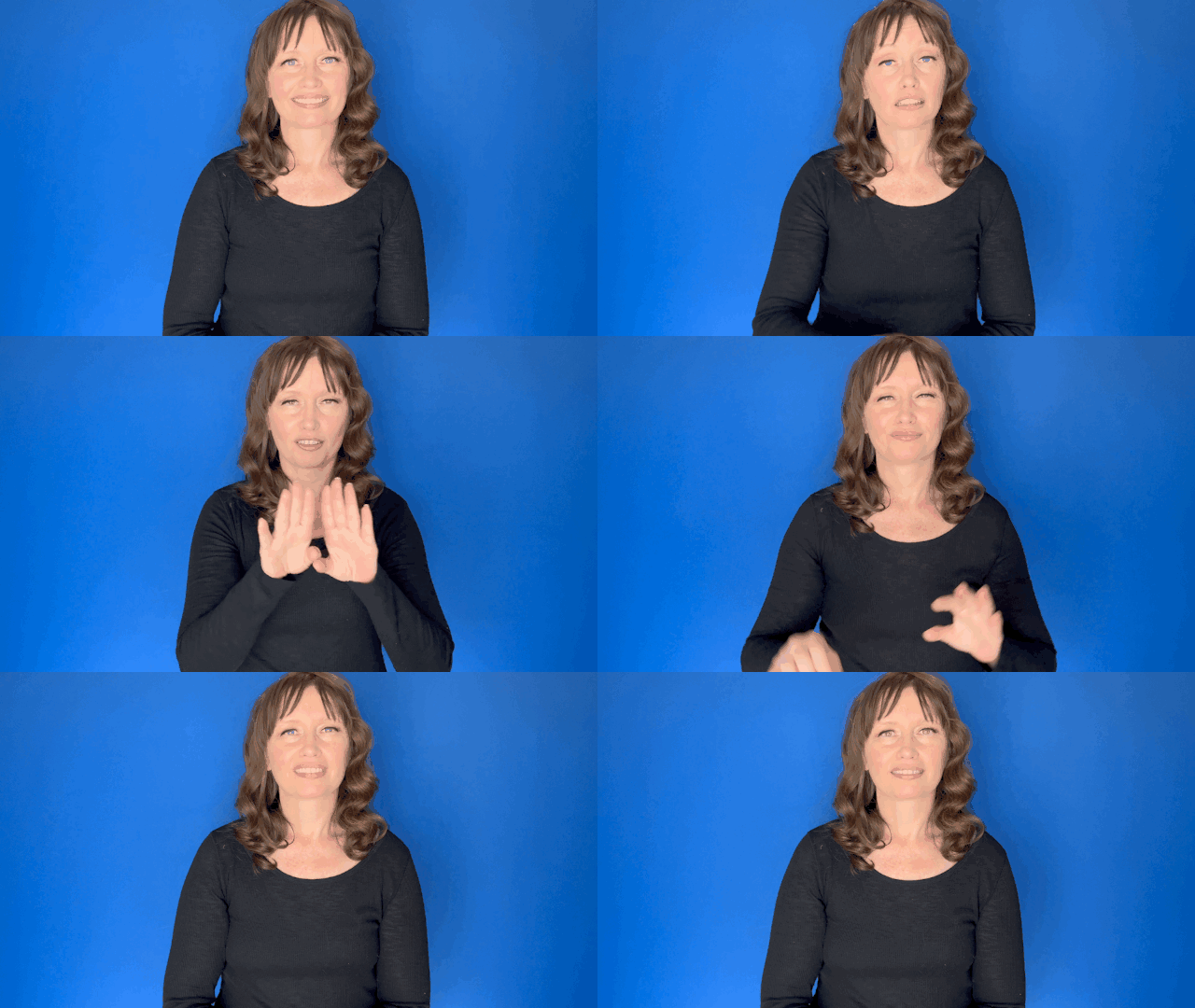
Sign for BLACKBOARD 2 in ASL

Practice Activities:
Begin practicing the sign for BLACKBOARD 2 in ASL by first isolating the movement. Use a mirror or record yourself signing to ensure handshape and facial expressions match standard usage. Repeat the sign slowly, then increase speed as you build muscle memory. Do ten repetitions focusing on accuracy, then sign it in three different directions to practice spatial awareness.
Follow up with simple phrase drills such as “clean blackboard,” “write on blackboard,” or “erase blackboard.” These practice sentences help build fluency and connect the sign for BLACKBOARD 2 in ASL with related concepts commonly used in educational settings. Consider attaching activities where one person signs the phrase and the other responds with an appropriate follow-up sentence to promote quick comprehension.
Add storytelling elements to increase retention. For example, describe your first day of school and include moments when the teacher used a blackboard. Include as many related vocabulary signs as you can, like TEACH, STUDENT, CLASS, and WRITE. Practicing storytelling makes the vocabulary come alive and supports memory through context.
Engage in partner activities where one student pretends to be a teacher and the other a student. The “teacher” can sign instructions like “Look at the blackboard,” while the “student” responds with action or clarification questions. This reinforces real-world use of the sign for BLACKBOARD 2 in ASL.
Another helpful exercise is matching. Create flashcards with different classroom objects and activities. Mix the flashcards and pick two at a time, linking them into a signed sentence. For instance, draw CAR and BLACKBOARD and sign “Draw a car on the blackboard.” This practice strengthens vocabulary pairing and encourages spontaneous signing.
End with a game such as charades or Pictionary where one person signs a sentence using BLACKBOARD 2 and others guess or draw what was signed. These games make learning fun while anchoring the sign in mental images.
Cultural Context:
The sign for BLACKBOARD 2 in ASL reflects a significant cultural symbol in Deaf education and community spaces. The blackboard has long been a staple in Deaf schools and classrooms, where visual learning is central to instruction. Using the sign for BLACKBOARD 2 in ASL captures not just an object, but a shared experience of learning and communication in Deaf culture .
Traditional blackboards were crucial in classrooms where spoken language isn’t the primary mode of interaction. Teachers often used blackboards to demonstrate signs, write instructions, and clarify concepts visually. The use of the sign for BLACKBOARD 2 in ASL recalls these shared educational practices.
In many Deaf schools, blackboards were one of the few tools universally accessible to all students, regardless of their signing proficiency or speech ability. The sign for BLACKBOARD 2 in ASL can evoke memories of group learning, visual storytelling, and the collaborative nature of Deaf education. It’s a symbol that continues to resonate even in today’s digital classrooms.
The sign for BLACKBOARD 2 in ASL may vary slightly depending on regional usage and the influence of educators who helped shape early sign language in academic spaces. This illustrates how language and culture are intertwined in the Deaf community. Even signs for objects like blackboards carry layered meanings.
Though whiteboards and smart boards have become more common, the traditional blackboard still holds cultural significance. The sign for BLACKBOARD 2 in ASL serves as a reminder of the history and evolution of Deaf pedagogy over generations. It’s also a nod to early exposure to ASL in formal learning environments .
Deaf students often have strong visual and spatial strengths, so blackboards were ideal for both teaching and encouraging class participation. Using the sign for BLACKBOARD 2 in ASL is more than indicating an object; it honors the visual-centric approach to knowledge that defines Deaf education.
Blackboards were also common in community halls and Deaf clubs, where people gathered to plan events, workshops, or just socialize. In these spaces, the sign for BLACKBOARD 2 in ASL might have been used to discuss logistics or presentations, supporting community bonding and information sharing.
Using the sign for BLACKBOARD 2 in ASL can bring older generations of Deaf individuals a sense of nostalgia. It connects them to a specific time when blackboards were at the heart of Deaf learning environments. It’s a piece of cultural memory preserved through sign language.
Understanding the cultural undertones behind the sign for BLACKBOARD 2 in ASL enriches our
Extended Definition:
The sign for BLACKBOARD 2 in ASL represents a visual concept that is commonly associated with traditional classroom education. This version of the sign emphasizes the object’s historical and physical features, typically seen in older learning environments where chalk and erasers are used on a dark surface.
To sign BLACKBOARD 2 in ASL, the signer usually mimics the shape or usage of a blackboard, depending on regional use or personal teaching style. This sign may differ slightly from other versions, especially if the context changes from a classroom to a metaphorical use. Understanding the distinction between similar signs can help reduce confusion.
In many school settings, the sign for BLACKBOARD 2 in ASL may be taught when explaining classroom-related vocabulary. Teachers might introduce this sign in early education to help students identify learning tools around them. It reinforces both language learning and concept recognition for young ASL users.
The sign may also be used in storytelling, educational videos, or interactive ASL games related to school themes. When students or teachers use the sign for BLACKBOARD 2 in ASL, it creates a clear association with education and learning environments. This visual concept strengthens communication and inclusivity in the classroom.
Because technology continues to evolve, blackboards are being replaced with whiteboards or smart boards. Still, the sign for BLACKBOARD 2 in ASL remains a relevant part of vocabulary, especially when discussing historical or traditional teaching methods. It serves as a reminder of the way learning used to be structured.
In Deaf education, visual representation is key to understanding and retention. The distinct motion used in the sign for BLACKBOARD 2 in ASL helps learners remember both the sign and the concept it represents. This makes it easier for students to engage in conversation about school experiences.
ASL learners might come across multiple signs for similar concepts, so it’s important to know the version being referenced. The sign for BLACKBOARD 2 in ASL may appear in academic ASL glossaries, dictionaries, or signing exercises focused on school topics. It is frequently included in educational settings and curriculum guides.
Parents and caregivers who use ASL can incorporate this sign into at-home learning routines. For example, when setting up a small classroom space at home, using the sign for BLACKBOARD 2 in ASL supports the learning atmosphere. It offers a way to connect everyday objects with language.
When teaching vocabulary, the sign for BLACKBOARD 2 in ASL often accompanies real-world context or visuals to cement understanding. Flashcards, picture
Synonyms: chalkboard, writing board, school board, slate board, lecture board
Educational resources: Find related learning materials in our course bank!
Want more? Check out some of our popular learning activities on the homepage!
Need to look up a sign? Use our highly rated dictionary: https://aslinteractive.com/best-asl-dictionary/
Follow us on tiktok: https://www.tiktok.com/@aslinteractive. More social media links at the bottom of this page!
Long-tail Keywords: what is the sign for blackboard in ASL, how do you sign blackboard in American Sign Language, blackboard ASL sign
Categories:
tags: blackboard sign in ASL, how to sign blackboard in ASL, ASL dictionary blackboard, learn blackboard in ASL, blackboard gesture in sign language
Parameters
*Handshape*:
The handshape used in the sign for BLACKBOARD 2 in ASL typically involves both hands in a flat “B” handshape, with fingers extended and together, and thumbs tucked in toward the palms. This handshape is standard for representing broad, flat surfaces in ASL ❏.
In the sign for BLACKBOARD 2 in ASL, these “B” hands move as if outlining a rectangular shape on an imaginary board. This motion, combined with the handshape, effectively conveys the concept of a traditional classroom blackboard.
*Palm Orientation*:
The palm orientation for the sign for BLACKBOARD 2 in ASL typically involves both hands in a flat “B” handshape. The palms face the body while they move side to side in front of the torso, mimicking the motion of writing or referencing a board.
In some versions of the sign for BLACKBOARD 2 in ASL, the dominant hand may gesture a sweeping motion across the non-dominant palm, with the palm facing slightly up or inward. This helps convey the idea of the writing surface commonly associated with a blackboard. ️
*Location*:
The location for the sign for BLACKBOARD 2 in ASL begins near the center of the chest and extends slightly outward in front of the torso. The dominant hand starts at this central point, drawing an imaginary rectangular or horizontal space, similar to where a blackboard would hang.
This sign stays within the neutral signing space to ensure clarity. The sign for BLACKBOARD 2 in ASL remains visible without requiring contact with the body or any high movement above the shoulders.
*Movement*:
The sign for BLACKBOARD 2 in ASL uses both hands to mimic the action of writing on a board. Start with the dominant hand in a flat-B handshape, palm facing outward, and move it in a short horizontal motion across an imaginary surface in front of you, like wiping or writing on a board.
The non-dominant hand may stay at the side or provide a supportive space, depending on regional variation. The sign for BLACKBOARD 2 in ASL visually references the traditional use of chalkboards in classrooms ️ . The motion is simple and direct, emphasizing the object’s flat and writable surface.
*Non-Manual Signals*:
When demonstrating the sign for BLACKBOARD 2 in ASL, keep a focused, neutral facial expression with slightly raised eyebrows to indicate attentiveness. Your eyes should track the motion of your hands, simulating the action of writing or referencing a blackboard.
Mouth movements are generally minimal for the sign for BLACKBOARD 2 in ASL, unless contextually needed to match teacher or classroom settings. Slight head tilts can support indicating the surface orientation of a blackboard .
*Prosody, Dominant/Non-Dominant Hand*:
The sign for BLACKBOARD 2 in ASL uses the dominant hand in a motion that mimics drawing or writing on a vertical surface. Typically, the dominant hand is shaped flat like a B-hand and moves in a horizontal back-and-forth motion across the palm or air, symbolizing the blackboard surface.
The non-dominant hand may serve as a stationary base, mimicking the bottom edge of a board. This version of the sign for BLACKBOARD 2 in ASL visually emphasizes the concept of a classroom board used for writing ️.
Tips for Beginners:
When learning the sign for BLACKBOARD 2 in ASL, start by focusing on keeping your handshape and arm movement smooth and deliberate. This version of the sign typically mimics the act of holding and writing on a blackboard, so your hand positioning and motion need to be clearly visible and consistent. Practicing in front of a mirror can help you improve spatial accuracy and fluidity.
A common mistake beginners make with the sign for BLACKBOARD 2 in ASL is over-exaggerating the motion or moving the hands too quickly. This can make the sign appear awkward or unclear. Keep the motion steady and avoid adding extra movements that may confuse the message. It’s best to watch native ASL users and mirror their speed and precision.
Another tip is to maintain facial expressions appropriate to context when using this sign. ASL relies heavily on non-manual markers, and an engaged or contextual facial expression helps reinforce the meaning of the sign. For instance, if you’re referencing a classroom setting, consider showing focus or engagement through your expression.
It’s also helpful to practice the sign for BLACKBOARD 2 in ASL during realistic scenarios. For example, sign while pretending to describe the layout of a classroom, reinforcing the concept through use. Repetition within natural context supports memory and boosts confidence.
Be mindful of your angles. Since the sign mimics drawing or writing, keep your movements facing slightly outward from your body so that others can clearly see what you’re doing. Signing too close to your chest may obscure the motion, especially to viewers positioned slightly off-center.
Lastly, don’t be afraid to ask for feedback from fluent signers. They can offer valuable insights on your technique and clarity for the sign for BLACKBOARD 2 in ASL, helping you refine your skills much faster .
Connections to Other topics:
The sign for BLACKBOARD 2 in ASL is connected to a broader set of educational and classroom-related signs. It complements other signs like SCHOOL, TEACHER, and STUDENT, creating an intuitive framework for discussing academic environments. This context helps learners understand ASL’s visual and spatial storytelling methods, which often group related ideas together.
BLACKBOARD 2 can also relate to compound signs where general concepts are modified to become more specific. For example, the sign for WRITE combined with BOARD could give the impression of writing on a surface, reinforcing the meaning of blackboard. These combinations model how ASL expresses compound nouns through layering signs in meaningful ways.
This sign also links closely to signs such as CHALK, ERASER, and LESSON. These associations support learning vocabulary in clusters, simplifying memory and comprehension. Understanding the sign for BLACKBOARD 2 in ASL opens doors for describing school routines and teaching activities in more detailed ways.
A deeper connection can be made with the cultural shift from traditional blackboards to whiteboards and smartboards. While the term “blackboard” might seem outdated, ASL still preserves its own visual history by offering signs like BLACKBOARD 2, which may differ from WHITEBOARD both in appearance and cultural connotation. This allows learners to discuss technology shifts within classrooms using nuanced sign choices.
Finally, signs like BOARD, used in BLACKBOARD 2, serve as roots for constructing other educational or instructional terms. Knowing how to recognize and adapt the core sign helps learners generate new signs like BULLETIN BOARD or CHALKBOARD with minimal effort. As learners grow fluent with signs like BLACKBOARD 2, they gain greater flexibility in describing learning, environments, and teaching tools in ASL ✍️.
Summary:
The sign for BLACKBOARD 2 in ASL shows an alternative way of representing the common classroom object. This version is distinct from other variations in its execution and visual metaphor. It blends iconic imagery with culturally associated elements.
In BLACKBOARD 2, the signer starts by using a dominant flat hand to mimic writing on a surface. The motion often resembles the act of chalk drawing, evoking the act of using a blackboard. The hand is held out at an angle as if facing an imaginary upright board.
The nondominant hand can be flat and held vertically to represent the board’s structure. The dominant hand “writes” across the surface, suggesting the experiential view of a board placed on a classroom wall. This method captures both the physical and functional significance of a blackboard.
This depiction is highly visual, relying on clear gestures that suggest the tactile and manual use of chalkboards. The use of spatial referencing enhances the realism of the sign for BLACKBOARD 2 in ASL. The size of the board can be suggested with larger gestures or expanded signing space.
In linguistic terms, this sign is considered iconic, meaning it visually resembles the object it represents. Iconicity is a major theme in American Sign Language, and signs like BLACKBOARD 2 in ASL show how an abstract classroom concept is made concrete. The mime-like motion of chalking on a surface speaks to the affordances of visual-manual language.
Grammatically, the sign functions as a noun. It is typically used as a subject or object in ASL sentences describing location, usage, cleaning, or instruction. You might see it preceded or followed by verbs like TEACH, WRITE, or ERASE depending on sentence structure and intent.
The cultural implication of the sign for BLACKBOARD 2 in ASL taps into shared experiences across American educational settings. The image of a blackboard is deeply familiar, evoking scenes of teachers writing notes and students copying down material. This correlates to ASL’s tendency to encode shared community knowledge into signs.
The variation in signs for blackboard may reflect regional tendencies or generational usage shifts. Younger signers or those in digitally-savvy environments may rarely see physical blackboards, favoring whiteboards or digital screens instead. Nevertheless, BLACKBOARD 2 in ASL remains important due to its cultural longevity.
Historically, the presence of blackboards in Deaf schools has been profound. They were integral tools for teaching reading, writing, and sign integration in structured classrooms. The sign preserves the tangible act of writing and visual learning in Deaf pedagogy.
From a sociolinguistic perspective, BLACKBOARD 2 in ASL illustrates how Deaf individuals encode educational objects into their language. This sign may prompt conversation about the evolving classroom technologies within Deaf education. As newer signers become more accustomed to digital tools, the form or frequency of the sign may eventually decline.
It’s worth noting that BLACKBOARD 2 in ASL may overlap slightly in form or movement with the sign for CHALKBOARD. Both use spatial representation but may differ subtly depending on the signer. The context of use often disambiguates the two in natural conversation.
In terms of grammar and classifier usage, some signers may incorporate CL:FLAT-SURFACE constructions to refer to blackboards descriptively. These allow more dynamic interaction with space, describing dimensions, damage, handwriting areas, or cleaning actions. BLACKBOARD 2 in ASL may serve as the foundation for further classifier expansions.
Some related signs include TEACHER, STUDENT, CLASSROOM, and WRITE. Each of these connects logically to the concept of a blackboard and can be used to build semantically rich ASL narratives. The sign for CLASS is commonly used nearby in classroom settings, linking environmental components smoothly.
For Deaf students, the blackboard has symbolic value. It is not simply instructional material but a representation of the visual access to education. Using signs like BLACKBOARD 2 in ASL links this cultural memory into everyday dialogue and historical record.
In applied linguistics, the sign supports studies of educational discourse among signers. The ways in which classroom elements are described, and how they influence concept acquisition in signers, reflect holistic language development. Research shows that visually iconic signs like this support cognitive retention and conceptual clarity.
This sign also provides a gateway for understanding how environments are diagrammed in sign languages. Rather than arbitrarily assigning words, ASL frames them spatially. BLACKBOARD 2 in ASL is a clean example of this frame-participant approach.
The ergonomic nature of the sign encourages natural use. Signers can efficiently produce the sign without exertion, and its repetitive nature fits school-related storytelling. This ergonomics also aids young learners acquiring complex signs through mimicry-based learning.
Technological changes may push the evolution of this sign. As traditional blackboards are replaced, ASL may adapt to accommodate digital boards or smart screens. However, signs such as BLACKBOARD 2 in ASL serve as linguistic time capsules,
Want more? Check out some of our popular learning activities!
ASL Interactive Resources
ASLInteractive YouTube Channel
Follow us on tiktok: @aslinteractive.com
Follow us on Instagram: aslinteractive
Facebook page: aslinteractive
Facebook group: aslinteractive
LInkedIn: ASL Interactive LLC
Twitter: @ASL_interactive
*Some information on this page is AI-generated. AI can make mistakes. Please check the information.
Responses