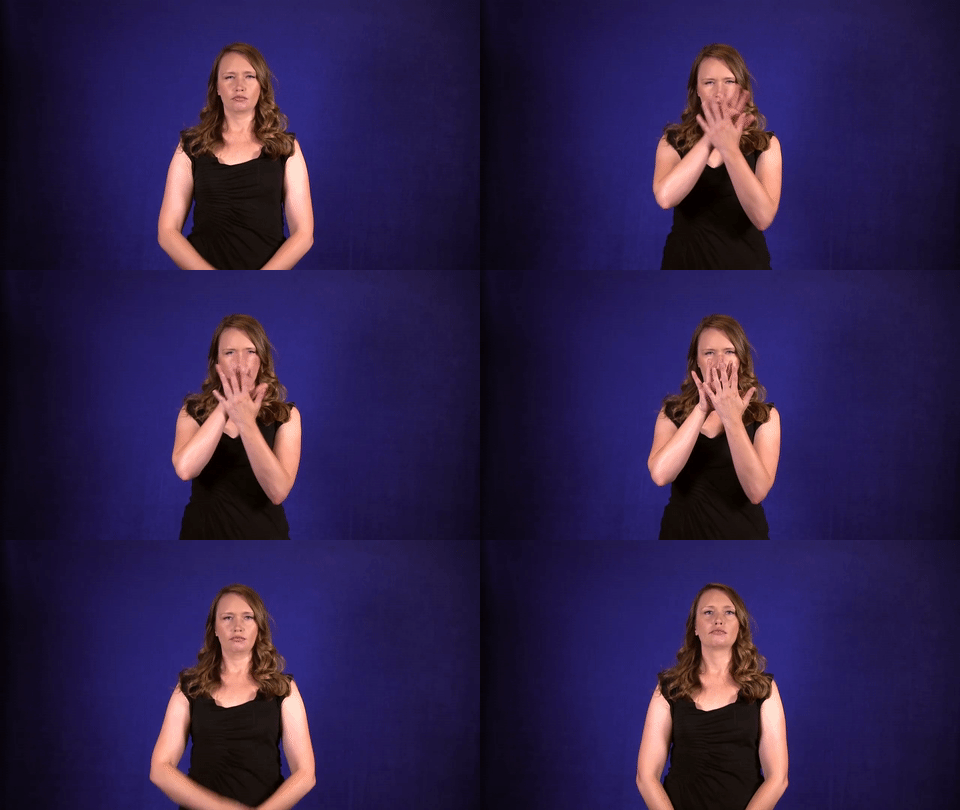
Sign for BLURRY in ASL | 👓 ASL Dictionary

Definition: Not clearly visible.

Sign for BLURRY in ASL

YouTube player

Practice Activities:

To practice the sign for BLURRY in ASL, start by focusing on the sign in isolation. Stand in front of a mirror and repeat the sign slowly, concentrating on handshape, movement, and facial expression. Try signing it with different facial expressions to reflect how “blurry” can feel depending on the context—such as squinting to mimic unclear vision or confusion.

Incorporate the sign into short, repeated phrases like “the picture is blurry,” “my glasses are blurry,” or “that memory is blurry.” Sign each sentence slowly at first, then build speed while maintaining clarity. Use flashcards with different scenarios where something might be blurry, and sign the sentence that matches the situation.

Work with a partner and take turns describing everyday blurry experiences using ASL. For example, one partner can mime wiping foggy glasses, and the other has to respond using the sign for BLURRY in ASL with an appropriate sentence. This helps with reading context and responding naturally.

Create a storytelling prompt like “You are waking up and everything looks blurry.” Sign a short story describing what you see, what you do, and how you respond using visual language and descriptive classifiers. Incorporate the sign multiple times and vary your facial expressions to make the story engaging.

Another fun activity is watching silent video clips where something is unclear or fuzzy. Pause the video and sign what’s happening, including the sign for BLURRY in ASL wherever it fits. This practice helps with visual comprehension and applying the sign in real-life scenarios.

Finally, go on a walk and identify things that could be described as blurry—fog on a car window, distant lights at night, or motion blur. Sign what you see and describe it using complete phrases to build confidence using BLURRY naturally.

Cultural Context:

In American Sign Language, the concept of visual clarity is deeply connected to how Deaf individuals describe their daily experiences. The sign for blurry in ASL helps convey not just a physical description, but a sensory impression that reflects reality through visual perception. This sign has cultural significance because vision plays a major role in communication within the Deaf community.

The sign for blurry in ASL is used in many contexts, helping to describe situations involving unclear or unfocused vision. Whether someone is describing bad eyesight, foggy weather, or a confusing situation, this sign bridges the gap between physical seeing and emotional understanding. Using the sign allows people to express much more than just poor clarity—it shows how something feels when it can’t be fully made out.

In Deaf culture, where facial expressions and body movement are essential parts of storytelling, the sign for blurry in ASL is often enhanced with specific facial expressions to emphasize the level of distortion or confusion. For example, squinting or exaggerated eye gestures might be added to show how unclear or difficult something was to understand or experience. These non-manual signals are key to making the message complete.

Technology and digital experiences have also impacted how this sign is used today. In the age of smartphones and video calls, many people use the sign for blurry in ASL to describe issues like poor video quality, unreadable text, or pixelated images. The sign adapts to modern life and stays relevant as communication tools evolve. This flexibility is a core part of how ASL continues meeting the needs of the Deaf community.

For those learning American Sign Language, recognizing the importance of visual metaphors is a critical part of language acquisition. The sign for blurry in ASL isn’t just about describing what the eyes see—it helps explain experiences that are uncertain, vague, or difficult to grasp. This deeper meaning adds richness and depth to the language as a whole.

The sign for blurry in ASL also shows up in storytelling, especially in narratives involving dreams, memory, or feelings of being lost. In these contexts, the sign helps create mood and atmosphere. ASL storytellers use this sign to help the audience fully picture a scene that is unclear, distorted, or surreal .

Deaf artists and content creators use the sign for blurry in ASL in films, performances, and poetry to represent confusion, emotional fog, or spiritual ambiguity. This helps emphasize that ASL is much more than a set of handshapes—it’s a complete visual language capable of capturing every human experience.

Extended Definition:

The sign for blurry in ASL refers to describing something that is not clear or sharp to the eyes. This could apply to vision, photos, objects in the distance, or descriptions of unclear memories or thoughts. In American Sign Language, this concept is communicated visually using specific movements and expressions.

To sign blurry in ASL, one commonly used method involves wiggling the fingers while moving the hands side to side in front of the eyes. The motion simulates the way things might appear when you’re unable to focus or when your vision is affected. Facial expression also plays a major role in showing that the object or scene is unclear.

There are variations in the sign for blurry in ASL depending on the context and the signer’s region. Some signers may use gestures that reference visual impairment or combine other signs like “unclear” or “can’t see” with facial expressions. It’s important to be clear with the context to help the viewer understand exactly what kind of blurriness is being discussed.

The sign for blurry in ASL is often used in sentences that describe poor eyesight, such as after removing glasses or when waking up. It can also be used when discussing foggy or unclear images, whether on a screen, in a photo, or out in nature. In storytelling, the sign allows someone to describe a time when events or details were uncertain or faded in memory.

If someone says they’re feeling mentally blurry or foggy, the sign for blurry in ASL can be adapted with expressions to show confusion or a lack of clarity in thought. ASL is a rich and expressive language, so modifying the sign to fit the right context is common. Smooth transitions and expressive face cues help the audience follow the meaning more naturally.

Watching videos or having a Deaf signer demonstrate the sign for blurry in ASL is helpful for mastering it. Expression is key in ASL, and subtle changes in speed, intensity, or direction can alter the entire meaning. For this reason, it’s ideal to practice and receive feedback from fluent ASL users.

When describing different sources of blurriness, such as weather or emotional states, emphasize those with additional signs alongside the sign for blurry in ASL. For example, combining it with signs for fog, rain, confusion, or memory can give your sentence full emotional depth. It helps create a more vivid image for your audience.

The sign for blurry in ASL is part of a visual vocabulary that allows clear communication of something that lacks clarity. Whether

Synonyms: fuzzy, unclear, indistinct, unfocused, hazy

Educational resources: Find related learning materials in our course bank!

Want more? Check out some of our popular learning activities on the homepage!

Need to look up a sign? Use our highly rated dictionary: https://aslinteractive.com/best-asl-dictionary/

Follow us on tiktok: https://www.tiktok.com/@aslinteractive. More social media links at the bottom of this page!

Long-tail Keywords: what is the sign for blurry in asl, how do you sign blurry in american sign language, blurry in asl

Categories:

tags: Colors, Describing Visuals, Language Learning, Basic Grammar, Adjectives

Parameters

*Handshape*:

The handshape for the sign for blurry in ASL typically involves both hands using the 5-handshape, with fingers spread apart and slightly curved. The hands are held in front of the eyes or face area and are shaken slightly to create a visual effect resembling something unclear or fuzzy .

This movement simulates the distortion associated with something being blurry. The sign for blurry in ASL uses this handshape to convey a sense of visual confusion or a lack of definition.

*Palm Orientation*:

The palm orientation for the sign for BLURRY in ASL involves both hands held open with the fingers slightly spread and pointing forward. Palms face the signer with a very gentle circular movement to mimic the effect of something unclear or out of focus .

This palm positioning helps visually convey the distortion typical of something that is blurry. The movement and orientation are essential to accurately express the sign for BLURRY in ASL .

*Location*:

The sign for blurry in ASL is typically produced in the neutral space in front of the torso, slightly forward from the body’s center line. Both hands are often used near chest level to convey the idea of visual distortion or lack of clarity through wiggling fingers or twisting motions.

When signing the sign for blurry in ASL, the hands stay comfortably away from the face. This location helps suggest the metaphor of visual fog or distortion without referencing specific physical features.

*Movement*:

The sign for blurry in ASL involves both open hands held in front of the eyes, palms facing inward and fingers spread apart. Move the hands in small, quick, alternating circular motions, simulating an unclear or fuzzy view. ‍

To reinforce the meaning, the facial expression looks confused or unfocused, mimicking the experience of trying to see something that’s out of focus. The sign for blurry in ASL captures the visual distortion clearly through hand movement and facial cues.

*Non-Manual Signals*:

When performing the sign for blurry in ASL, the non-manual signals play a crucial role in conveying the meaning accurately. Widen your eyes slightly as if straining to focus, while furrowing your brows to indicate confusion or visual distortion. A subtle squint and a disoriented facial expression help reinforce the idea of something being unclear or fuzzy.

To appropriately express the sign for blurry in ASL, your mouth might form a slight “mm” or pursed-lip expression, suggesting uncertainty or vagueness. Pairing these facial expressions with the hand movements helps amplify the concept of visual distortion or haziness.

*Prosody, Dominant/Non-Dominant Hand*:

The sign for BLURRY in ASL typically uses both hands, palm open with fingers slightly spread apart and moving in small, circular motions away from the eyes or face. The dominant and non-dominant hands mirror each other to show a lack of clarity or distorted vision.

This movement mimics the sensation of something being out of focus. When you use the sign for BLURRY in ASL, facial expressions often include squinting or a puzzled look to add emphasis.

Tips for Beginners:

When learning the sign for BLURRY in ASL, focus on using fluid hand movements that suggest a lack of clarity. This sign typically involves the hands moving in a way that mimics the effect of blurred vision or unclear perception. Practicing in front of a mirror can help you assess if your motion communicates blurriness effectively, especially since the visual nature of ASL means your expression plays a key role.

One of the most common pitfalls when signing this concept is moving too fast or too stiffly. The sign for BLURRY in ASL should look uncertain or indistinct—if the motion is sharp or too exact, it might convey a completely different idea. Keep your fingers relaxed and allow small, shifting, or wiggling motions to emphasize imprecision.

Facial expressions are essential with this sign. A squint or confused look can strongly reinforce the idea of something being blurry. Failing to include the proper expression can make the sign feel disconnected from its true meaning. A neutral face will make the concept come across as flat instead of descriptive.

Another helpful tip is to expose yourself to multiple examples from native signers. Watch video dictionaries, ASL vlogs, and classrooms to see how different people execute the sign for BLURRY in ASL. This will help you understand how the concept is visually conveyed across contexts.

Repetition is key. Try acting out different sentences using the sign for BLURRY in ASL, such as describing unclear memories or smudged writing. This will help integrate the vocabulary into everyday conversation and minimize hesitation during real interactions.

Lastly, don’t be afraid to ask Deaf signers for feedback. Community engagement will improve your fluency and give you real-time correction. Remember, it takes time to achieve natural flow, but with consistent effort and mindful practice, you’ll be more confident with the sign for BLURRY in ASL.

Connections to Other topics:

The sign for BLURRY in ASL often intersects with visual descriptors like FOGGY, UNCLEAR, and CONFUSED. All of these signs involve handshapes or movements that convey distortion or lack of clarity, making them semantically related. Learners can benefit from understanding how these signs differ slightly in execution but share a conceptual foundation.

In context, the sign for BLURRY in ASL can be used to describe vision, weather, or abstract ideas. When combined with signs like EYES or VISION, it becomes visually clear that it pertains to eyesight. Meanwhile, used with MEMORY or IDEA, it suggests cognitive fuzziness rather than physical sight problems, showing the flexibility of the sign in multiple domains.

Signs connected to sensory experiences, such as BRIGHT or DARK, often accompany the sign for BLURRY in ASL to provide contrast. This can help in clarifying narratives or descriptions, especially in storytelling or expressive communication. For example, a signer might describe walking into a room where things looked BLURRY due to dim lighting, enhancing the message’s impact.

The sign also aligns well with emotion-based concepts. It might be paired with SADNESS or DISORIENTED to emphasize an emotional or mental state. In this way, ASL signers can link physical experiences with internal states, a key aspect of ASL’s expressive power.

Furthermore, compound signs or classifiers are often used in tandem with the sign for BLURRY in ASL to give additional information. Using classifiers that show a person squinting or waving their hands in front of their eyes can enrich the depiction of a blurry experience. This introduces learners to the ways non-manual features and classifiers contribute to meaning in ASL.

Understanding the sign for BLURRY in ASL can build a learner’s ability to discuss perception, emotional states, and environmental conditions. Its layered semantics encourage signers to think about how clarity and distortion apply across contexts. This creates a bridge to other signs that depict sensory and mental experiences.

Summary:

The sign for BLURRY in ASL typically involves using both hands in a similar motion to indicate something out of focus or lacking clarity. The motion generally mimics an unclear or fuzzy visual, where the hands wiggle or shake slightly in front of the eyes to symbolize a lack of visual sharpness. This conveys a strong visual metaphor that ties directly to the experience of blurred vision or conceptual lack of detail.

Both hands are typically flat, with the fingers spread slightly. The movement is subtle and wavy, often held in front of the face around eye level. The fingers flutter or vibrate gently, suggesting distortion or the inability to see something clearly. The motion is soft, and the facial expression usually reflects confusion or difficulty in perceiving something.

This sign is iconically motivated, meaning its form resembles its meaning. ASL relies heavily on this type of iconic representation, which is particularly useful for conveying sensory concepts such as vision. The sign for BLURRY in ASL leverages this by embodying the intangible experience of visual disturbance in a physical, observable gesture.

The sign often conveys not just literal blurry vision, but also abstract concepts like confusion, vagueness, or uncertainty. For example, someone might use the sign for BLURRY in ASL to describe a memory that is unclear, a complicated situation, or ambiguous emotions. The ability to extend its meaning broadens its application and relevance across conversations.

Culturally, describing visual conditions in ASL holds particular significance, especially within the DeafBlind or low-vision community. The concept of something being blurry can be deeply linked to personal experience, and using this sign affirms a shared understanding of changing perception or obstacles to seeing clearly. It’s both a linguistic and cultural tool for narrative and description.

The sign for BLURRY in ASL fits naturally within ASL grammar, usually appearing following a noun or subject. It’s used adjectivally, such as when describing how someone looks or how something appears. The sign might follow a topic-comment structure, which is common in ASL, for example, “windows — blurry” using the proper non-manual markers to convey the full sentence.

Facial expressions play an essential grammatical role with this sign. Raised eyebrows might show a yes/no question about something being unclear, while squinting or a puzzled expression may emphasize the visual or conceptual fuzziness. These non-manual markers are key components that bring nuance and meaning to the sign.

There are related signs in ASL that might be used in similar contexts, such as signs for CONFUSED, FUZZY, or VAGUE. Each of these signs carries distinct meanings, but they can interplay depending on what type of “blurriness” we’re describing. FUZZY tends to refer more to texture, while CONFUSED is often mental rather than visual.

The sign for BLURRY in ASL also connects semantically with the sign for UNCLEAR. While UNCLEAR may lean more toward ambiguous communication or thinking, BLURRY often sticks to the visual domain, though the two are sometimes used together to express a more layered meaning. This flexibility gives signers a wider emotional and descriptive range.

In applied linguistics, the sign for BLURRY in ASL exemplifies how abstract sensory experiences can become physical language. This ties into theories of embodiment in language, where cognition is deeply connected to physical representation. Sign languages, especially ASL, demonstrate this vividly through signs like BLURRY.

The design of this sign mirrors visual distortion remarkably well. By wiggling the fingers to represent an out-of-focus experience, the handshape and motion both engage the viewer’s imagination, inviting them to ‘feel’ the sense of blurriness. This affordance makes the sign visually and cognitively intuitive.

Sign language acquisition studies show that highly iconic signs like the sign for BLURRY in ASL are often learned faster by new ASL users. This is due to the stronger link between the sign’s form and its meaning. Beginners can remember the sign by imagining squinting at something unclear, helping them internalize and retain it.

The sign is often used in medical or healthcare discussions, especially when describing eyesight conditions like nearsightedness, migraines, or side effects from medication. Professionals using ASL might rely on this gesture to clearly communicate patient experiences that involve temporary or chronic visual distortion. It’s a practical and accessible term in medical ASL vocabulary.

In artistic and creative storytelling using ASL, the sign for BLURRY brings a poetic dimension. A narrator might use it to describe dream-like sequences or emotional moments that feel distant or muddled. This adds depth and visual richness to narrative structures in signed performance art.

In the classroom, teachers often use the sign when explaining unclear instructions or challenging concepts. Paired with proper facial expressions, the sign supports clarity when asking students if something appears confusing or not well understood. Effective communication in educational settings often depends on such signs to gauge comprehension.

Children learning AS

Want more? Check out some of our popular learning activities!

ASL Interactive Resources

ASLInteractive YouTube Channel

Follow us on tiktok: @aslinteractive.com

Follow us on Instagram: aslinteractive

Facebook page: aslinteractive

Facebook group: aslinteractive

LInkedIn: ASL Interactive LLC

Twitter: @ASL_interactive

*Some information on this page is AI-generated. AI can make mistakes. Please check the information.

Sign for BLURRY in ASL

Responses