Definition: A flat, rectangular surface v2.
Sign for BOARD 2 in ASL

Practice Activities:
To practice the sign for BOARD 2 in ASL, start by focusing on the handshape and movement in front of a mirror. Repeat the sign several times slowly, then increase your speed while keeping clarity. Say the English word “board” silently as you sign to reinforce the concept.
Next, create flashcards with different types of boards such as chalkboard, whiteboard, or bulletin board. Flip through the cards and sign BOARD 2 each time, then expand by adding descriptive signs like CLEAN or WRITE to provide context.
Work on incorporating the sign for BOARD 2 in ASL into full sentences. Try sentences like “The teacher writes on the board,” or “The instructions are on the board.” Practicing these complete thoughts helps solidify how the sign functions in daily communication.
Use storytelling to round out your understanding. Think of a scene in a classroom or a meeting room and describe everything using ASL, including how the board is used. Emphasize BOARD 2 every time it appears in the story, and vary your use by changing time and location indicators.
If possible, partner with another learner for a role-play activity. One person plays the teacher, the other the student. Use the sign for BOARD 2 in ASL to direct attention or actions involving the board. For example, one can sign “Please look at the board” or “Write your answer on the board.”
For everyday immersion, label objects at home that can be associated with a board, such as message boards or magnetic boards. Every time you use them, practice the sign. This regular exposure helps strengthen memory and improves fluency with the sign for BOARD 2 in ASL.
Cultural Context:
The sign for BOARD 2 in ASL carries different meanings depending on the context. In Deaf culture, many signs adapt to their environment—classroom, sports, games, or even social settings—giving the sign for BOARD 2 in ASL a flexible identity that reflects real-life usage.
In educational settings, the sign for BOARD 2 in ASL often refers to objects like whiteboards or bulletin boards. Knowing this sign helps Deaf students and educators communicate clearly during classroom activities or when referencing written information displayed in shared spaces.
In sports or games, the sign for BOARD 2 in ASL may be used when discussing scoreboards, strategy boards, or game boards. It becomes essential vocabulary in team discussions or when explaining game rules visually. Just like in spoken English, having a word for “board” that fits each context strengthens the communication within the Deaf community.
Sometimes BOARD 2 in ASL can also represent a group of people like a committee or board of directors. In planning meetings or advocacy work within Deaf-led organizations, using this sign allows Deaf individuals to fully participate in leadership and decision-making settings.
Sign variations exist depending on regional dialect or age group preferences, making it important to understand how BOARD 2 in ASL might be used in your specific community. Watching how fluent signers use the term in real life or in signed media offers deeper insights than just a static definition.
Cultural understanding influences signs, too. In Deaf culture, clarity and visual accuracy matter a lot. So, BOARD 2 in ASL is shaped by how useful it is for visual representation and how easily it can be recognized in different settings. This sign will sometimes be modified slightly to match its referent more closely.
The use of BOARD 2 in ASL also intersects with community events. Whether attending a Deaf club meeting with a sign-up board or playing an educational game at a Deaf youth event, the usage helps bring together experience and vocabulary in context-rich ways.
As signs evolve, so does BOARD 2 in ASL. Exposure to various uses helps ensure you’re not just learning one fixed sign, but gaining the flexible communication skills needed in everyday Deaf life. This linguistic richness is one reason why learning ASL isn’t just about vocabulary—it’s about connecting with a whole culture.
Understanding BOARD 2 in ASL from a cultural perspective gives more meaning to your learning journey. It’s more than just copying a motion; it’s grasping when and why that motion is used in meaningful Deaf interactions
Extended Definition:
The sign for BOARD 2 in ASL can vary depending on the context in which it’s used. American Sign Language is rich with nuanced meanings, and the sign for BOARD 2 reflects that versatility. Whether referring to a chalkboard, whiteboard, or a flat surface used for writing or displaying information, this sign carries multiple uses tied to everyday settings.
In a classroom environment, the sign for BOARD 2 in ASL typically resembles the act of outlining a rectangular area in the air. This mimics the visual of a large board in front of a classroom. The signer usually uses both hands in a motion that frames the shape of the board, giving a clear visual reference to its real-life appearance.
Outside of the educational setting, BOARD 2 can also refer to bulletin boards or display boards. The sign remains visually descriptive to convey something flat and mounted on a wall. ASL uses spatial referencing to enhance meaning, so pointing toward an actual board while signing can help clarify the intent.
The sign can sometimes be confused with other meanings of the word “board,” such as a wooden plank or a committee, so context is crucial. In this variation, BOARD 2 refers mainly to a board used to display information, such as a smart board, dry erase board, or even a scheduling board in a workplace. This version is not typically used for referring to a board of directors or an activity like snowboarding.
When learning the sign for BOARD 2 in ASL, it’s essential to practice its appropriate use based on visual cues and surroundings. Facial expressions, eye gaze, and hand placement all contribute to delivering the correct meaning. This helps the message remain clear to all signers in the conversation.
While regional variations exist, the core movement for the sign for BOARD 2 in ASL remains consistent in its rectangular shape. Some signers may use a quick, abbreviated version in fast-paced interactions, but the foundational motion stays visually iconic and easy to recognize. Understanding this sign strengthens overall ASL fluency and vocabulary comprehension.
The sign for BOARD 2 in ASL is especially useful for students, teachers, and professionals who regularly reference boards in their daily routines. In distance learning, teachers may sign it during virtual lessons to indicate something written on a shared screen or digital board. ASL continues to adapt with technology, and BOARD 2 has found new meaning in both physical and digital spaces.
If you’re learning American Sign Language, be sure to include the sign for BOARD 2 in your study
Synonyms: Board, panel, slab, plank, sheet
Educational resources: Find related learning materials in our course bank!
Want more? Check out some of our popular learning activities on the homepage!
Need to look up a sign? Use our highly rated dictionary: https://aslinteractive.com/best-asl-dictionary/
Follow us on tiktok: https://www.tiktok.com/@aslinteractive. More social media links at the bottom of this page!
Long-tail Keywords: what is the sign for board in ASL, how do you sign board in ASL, board sign in American Sign Language
Categories:
tags: board 2 ASL meaning, board sign ASL, how to sign board 2 in ASL, board 2 ASL interpretation, ASL board 2 explanation
Parameters
*Handshape*:
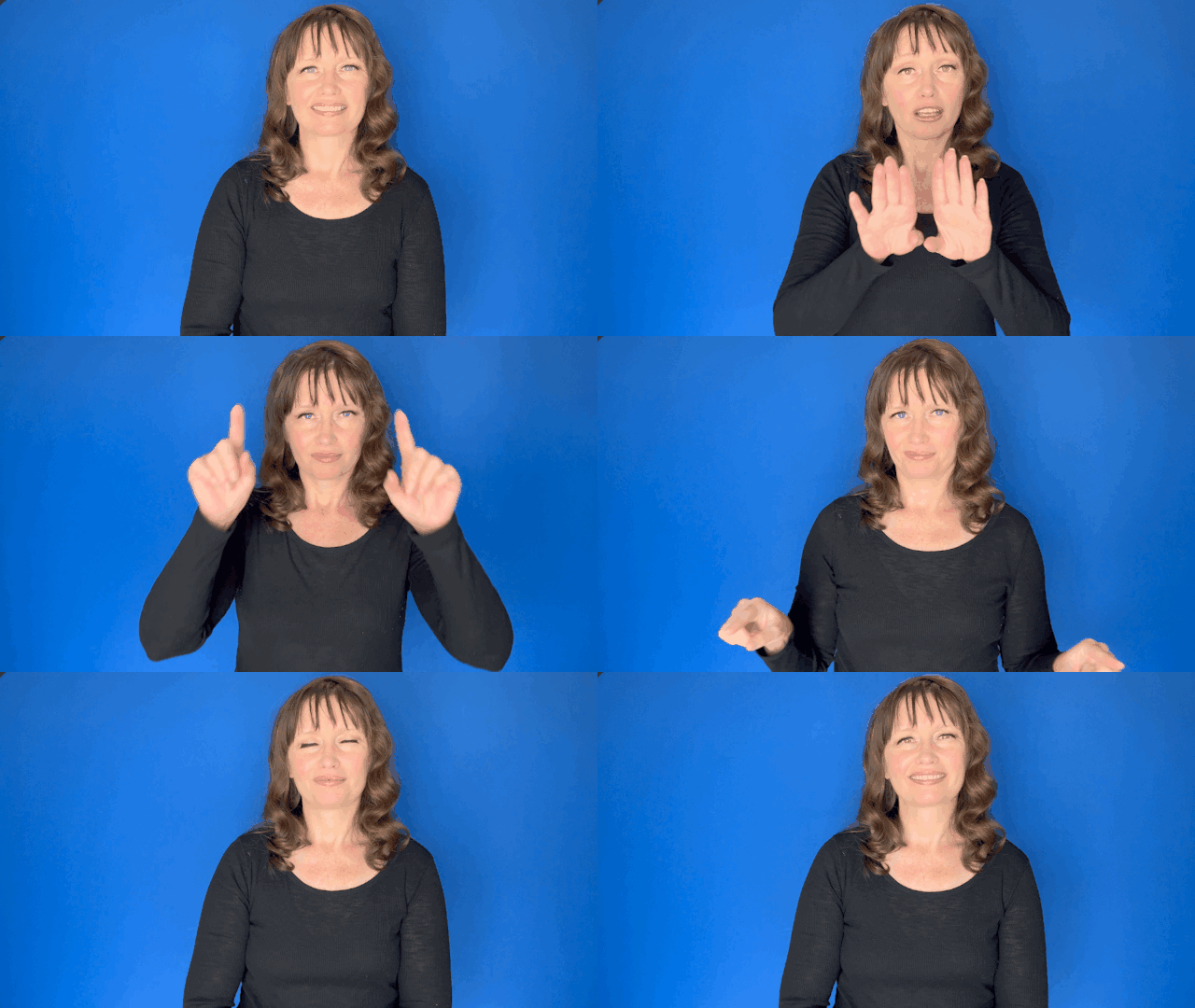
The handshape used in the sign for BOARD 2 in ASL involves using flat B-handshapes on both hands . Fingers are together and extended, with the thumbs tucked in against the palm.
In the sign for BOARD 2 in ASL, both hands move apart horizontally in front of the chest, resembling the shape or surface of a board. This handshape helps convey the visual dimension of a physical board or surface area.
*Palm Orientation*:
The palm orientation in the sign for BOARD 2 in ASL typically faces downward or slightly inward, depending on the variation used. Both flat hands start in front of the body, palms facing down, and move horizontally outward as if showing the surface or layout of a board .
For this version of the sign for BOARD 2 in ASL, the orientation helps depict a flat rectangular surface, mimicking an actual board. The hands remain parallel throughout the motion, which supports the visual representation of the word.
*Location*:
The sign for BOARD 2 in ASL is typically produced in the neutral space directly in front of the chest. Both hands are positioned at about chest height, approximately shoulder-width apart, facing each other in a flat-hand shape.
This location allows clear visibility and precise articulation when demonstrating the sign for BOARD 2 in ASL, ensuring it is easily distinguishable from similar signs produced at different levels. The movement and orientation may also refer visually to the shape or concept of a board-like surface.
*Movement*:
The movement for the sign for BOARD 2 in ASL involves placing both flat hands, palms facing down and fingers pointing forward, in front of you at about chest level. Then move the hands outward simultaneously in a horizontal line, as if outlining a flat rectangular surface such as a whiteboard or chalkboard. ️
This sign mimics the shape and surface of a board and is typically used in educational or instructional contexts. The sign for BOARD 2 in ASL may vary slightly depending on regional or school-specific variations.
*Non-Manual Signals*:
When demonstrating the sign for BOARD 2 in ASL, maintain a neutral facial expression unless the context of the sentence calls for specificity like surprise or questioning. Slight eyebrow raises may appear if the word is used in an interrogative sentence. Keep your head steady with clear eye contact to support clarity.
The sign for BOARD 2 in ASL may involve context, such as a school board or committee, and your facial tone should reflect seriousness or formality if needed. Avoid exaggerated expressions to maintain the intended meaning in professional or institutional settings.
*Prosody, Dominant/Non-Dominant Hand*:
For the sign for BOARD 2 in ASL, the dominant hand and non-dominant hand are both formed with flat B-handshapes, palms facing each other. The hands start apart at about shoulder width and move inward slowly to indicate the rectangular shape of a board, such as a chalkboard or whiteboard ️.
The prosody of the sign for BOARD 2 in ASL emphasizes spacing and size, often associated with classroom or instructional contexts. Maintaining parallel movement and steady pace helps clearly convey the concept.
Tips for Beginners:
When learning the sign for BOARD 2 in ASL, it’s essential to understand the specific context in which this version of “board” is used. BOARD 2 often refers to a flat, rectangular surface like a chalkboard, whiteboard, or bulletin board. Use both hands to mimic the rectangle shape, moving them outward from a central point to outline the board’s edges. Make sure your hands are flat with fingers together and your motions are smooth and deliberate.
A common mistake to avoid is using the similar sign for TABLE or PAPER instead, which can be confusing in conversation. The sign for BOARD 2 in ASL relies on the space in front of you to imply a vertical surface, so hand placement and orientation are critical. Practicing in front of a mirror can help you maintain accuracy and consistency in sign production. Also watch ASL videos or converse with fluent signers to check the precision of your form and movement.
Beginners should remember that facial expression and body orientation matter. A neutral face works well for this sign, as adding emotion may change the meaning depending on context. Also, observe native or fluent signers to emulate the subtle aspects of how the sign for BOARD 2 in ASL integrates with overall conversation flow.
Work on your confidence and muscle memory by repeating the sign in different practice sentences. For example, sign “I write on the board” or “Look at the board.” These real-life phrases help reinforce the sign in context. Don’t worry if your version looks slightly different at first—variation exists, especially across regions, but core positioning should remain clear.
Consistency is key with the sign for BOARD 2 in ASL. Stay patient as you refine. Over time, both comprehension and expressive accuracy will improve ✨.
Connections to Other topics:
The sign for BOARD 2 in ASL, commonly referring to a flat vertical surface like a whiteboard or chalkboard, closely connects to signs for class, teach, or school due to its frequent appearance in academic and instructional contexts. This sign often appears in conversations about classrooms, learning environments, or visual presentations, anchoring it firmly within educational vocabulary in ASL. Because of this, it has contextual overlap with signs like TEACH and LESSON, especially during school or office-related discussions.
When used in compound signs or phrases, the sign for BOARD 2 in ASL can combine with SMART or WRITE to convey expressions like smartboard or writing on the board. Another common incorporation is with CLEAN to express “clean the board,” which is often signed as a natural sequence depending on context. These combinations allow users to create more precise expressions in both academic and professional settings.
The handshape and motion of the sign for BOARD 2 in ASL visually resembles the rectangular shape of a board, aligning with how ASL often represents physical features of objects. This visualization technique links it to other signs that use shape classifiers, like ROOM or DOOR, which also describe rectangular spaces or entities. Understanding these classifiers and spatial referencing enhances a signer’s fluency across topics like architecture, design, and space.
Additionally, signs involving storytelling or visual setups in ASL narratives might include the sign for BOARD 2 in ASL to represent acts like writing notes, pointing to diagrams, or highlighting key points. In this setting, the sign takes on a broader role that touches on performance, explanation, and instruction. It helps bridge concepts between tangible tools and their communicative function in educational and informational storytelling ️.
Summary:
The sign for BOARD 2 in ASL is closely related to educational environments, especially classrooms, where a chalkboard or whiteboard is commonly used. This version of the sign typically references a broad flat surface, such as a display or presentation board. Understanding the context helps clarify which variation of “board” one should use.
To produce the sign for BOARD 2 in ASL, both hands are used. Each hand holds a flat-B handshape and they are positioned in front of the body, shoulder-width apart. The hands move parallel toward each other, simulating the shape or boundary of a rectangular board surface.
The orientation of the palms faces each other, and the movement is relatively slow and deliberate. The sign mimics the width or edge of a board mounted on a wall, such as a whiteboard. This representation is iconic and visually descriptive.
This sign belongs to a category of iconic signs in ASL, where the form of the sign reflects its meaning in the real world. The visual-spatial nature makes the sign for BOARD 2 in ASL intuitive for both Deaf and hearing learners of ASL. Such visual mapping helps users comprehend and remember the sign more easily.
The use of BOARD 2 typically refers to an object construction or feature in space, common in classroom or meeting settings. This makes it especially useful in educational interpreting or academic discussions. It often appears in narratives about lessons, instructions, or visual displays.
When using the sign for BOARD 2 in ASL in a sentence, it’s important to contextualize it with directional or locative features. Spatial referencing is core to ASL grammar and can help indicate where the board is in the environment. For example, one may indicate whether the board is behind, in front, or to the side of the speaker.
This particular version of the sign differs from BOARD 1, which might represent a committee or lodging, showing the importance of semantic context. BOARD 2 clearly designates a flat surface used for displaying written or visual information. It avoids confusion by relying on visual clarity and natural mapping.
In ASL, classifiers also play an important role in describing objects like boards. Once the sign for BOARD 2 in ASL has been established in discourse, a classifier such as a B-handshape might be used to show movement along the board, such as pointing or writing. This allows for rich, three-dimensional storytelling.
ASL leans on spatial grammar and topographical referencing, so the signer may assign a location in signing space representing the board and refer back to it throughout a discussion or story. This reinforces cohesion in the message. This feature of ASL makes it remarkably adaptive to real-world space mapping.
Classroom signs, including the sign for BOARD 2 in ASL, form a subset of vocabulary often taught in introductory ASL classes. Educators utilize it while describing classroom behaviors such as writing on the board or reading from it. It can be paired with other signs like WRITE, READ, or TEACH to build complex educational narratives.
In ASL linguistics, the sign for BOARD 2 is considered a compound iconic sign. It does not need to be fingerspelled or borrowed from English due to its clear visual resemblance to the object it signifies. This spotlights a unique blend of morphology and semantics in ASL.
The cultural relevance of BOARD 2 in Deaf education is significant. In Deaf classrooms, visual aids such as whiteboards are central to learning. The sign embodies the visual nature of Deaf pedagogy, where concepts are often reinforced through diagrams and written explanations on a board.
In applied linguistics, analyzing how signs like BOARD 2 are taught can shed light on second language acquisition strategies in ASL. Learners often grasp such signs quicker due to their iconic and mimetic nature. Iconicity functions as an effective cognitive scaffold during acquisition.
From a discourse analysis standpoint, signs like BOARD 2 often function as referential anchors in educational dialogues. In a classroom narrative, once a signer establishes the board’s location, later signs can draw back to it, using classifiers to describe writing, pointing, or erasing actions. This demonstrates spatial cohesion.
There are also connections between BOARD 2 and other visual elements in signed discourse. Visual referencing or eye gaze can accompany the sign for BOARD 2 in ASL, reinforcing where in space the board is placed. This non-manual signal enriches the discourse with spatial accuracy.
An interesting feature of the sign for BOARD 2 in ASL is its adaptability to different kinds of boards, such as bulletin boards, whiteboards, or chalkboards. The handspace and movement remain consistent, while context helps discern specific meanings. This demonstrates semantic versatility.
In educational interpreting, interpreters may modify the sign slightly to clarify meaning when referencing digital boards or smartboards. Such adaptations maintain the integrity of the sign while accommodating technological advances. These shifts reflect both language evolution and sociolinguistic awareness.
The sign for BOARD 2 in ASL also interacts with
Want more? Check out some of our popular learning activities!
ASL Interactive Resources
ASLInteractive YouTube Channel
Follow us on tiktok: @aslinteractive.com
Follow us on Instagram: aslinteractive
Facebook page: aslinteractive
Facebook group: aslinteractive
LInkedIn: ASL Interactive LLC
Twitter: @ASL_interactive
*Some information on this page is AI-generated. AI can make mistakes. Please check the information.
Responses