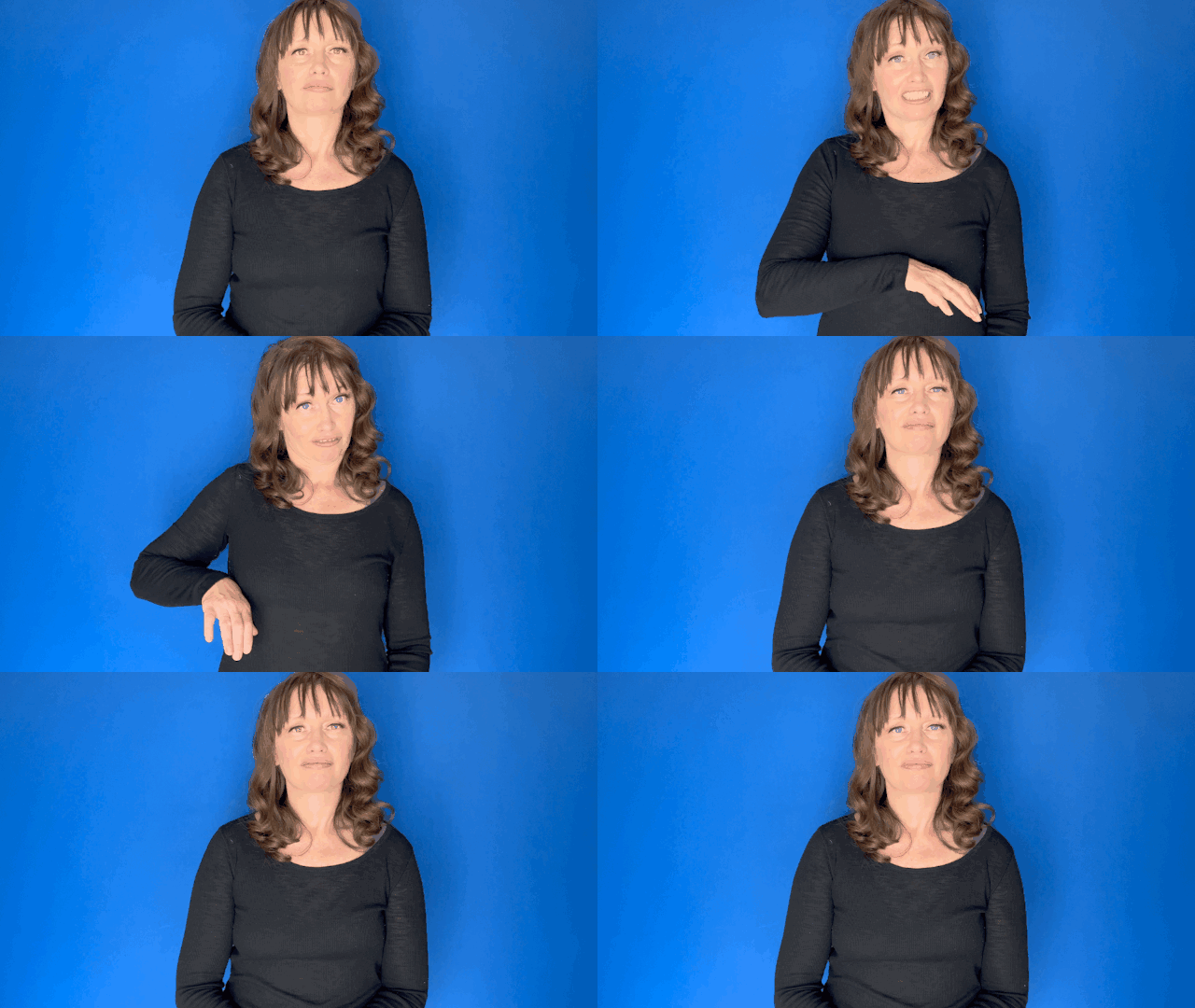
Definition: Birth via cesarean section (fifth instance).
Sign for BORN 5 C SECTION in ASL

Practice Activities:
To get comfortable with the sign for BORN 5 C SECTION in ASL, start by practicing each segment in isolation. Rehearse the sign for BORN, then explore the method of combining BORN with the concept of C SECTION, such as incorporating CL:5 or classifier classifiers that represent a surgical method of delivery. Use a mirror to monitor your handshape and facial expressions to ensure clarity and accuracy.
Once you’re confident with the sign in isolation, try using it in full sentences. Sign phrases like “My son was born by c-section” or “I was born through a c-section, not a regular birth.” Work on saying these slowly and deliberately at first, then gradually increase your speed for fluency. Try fingerspelling “C SECTION” if appropriate in your context and practice combining these signs for smooth expression.
Pair up with a partner and role-play a hospital conversation. One person can act as a doctor explaining, “The baby will be born by c-section,” while the other responds in sign. This is a great way to reinforce vocabulary and check each other’s sign clarity. Vary the scenarios to include different timelines or outcomes so you get to use the vocabulary in multiple settings.
Storytelling is a fantastic way to solidify your understanding of the sign for BORN 5 C SECTION in ASL. Create a short narrative about a birth experience involving a c-section. Incorporate related signs like PAIN, BABY, DOCTOR, and HOSPITAL to enrich the description. Share your story with others in a study group or record yourself to critique later.
Wrap up practice by watching vlogs or skits by native signers that use birth or medical contexts. Keep an eye out for when they use the sign for BORN 5 C SECTION in ASL and take note of the transitions and handshape consistency. Rewind and mimic these examples to refine your signs.
Cultural Context:
In American Sign Language, the sign for BORN 5 C SECTION in ASL carries not only linguistic meaning but also cultural significance. Within the Deaf community, the way personal and medical experiences are communicated through sign reflects deep respect for clarity, identity, and shared experiences. When using the sign for BORN 5 C SECTION in ASL, signers not only state a medical fact but may also touch upon identity and family background.
Deaf culture emphasizes natural and visual forms of communication. So, explaining something like being born via C-section often includes signs that portray the visual and spatial concepts behind the experience. The sign for BORN 5 C SECTION in ASL blends medical knowledge with cultural sensitivity, especially when describing how someone came into the world.
The number 5 handshape is often associated with age ranking within a family or sibling order. When someone is described as the fifth child born via C-section, the sign for BORN 5 C SECTION in ASL may include a nuanced sequence to explain not only the birth method but the person’s place among their siblings. This kind of detail matters culturally because family roles and birth order can influence how stories are shared within the community.
In storytelling and personal narratives, Deaf individuals often include signs that reflect nuanced life details. The sign for BORN 5 C SECTION in ASL may be used when discussing birth stories during life milestones like birthdays, family reunions, or school presentations. It offers a direct but respectful way to communicate this information clearly and with cultural appropriateness.
ASL is a language where body language, facial expressions, and sequencing enhance the meaning behind each sign. When signing about being born through a C-section as the fifth child, the order and tone of the signs create a vivid mental picture. The sign for BORN 5 C SECTION in ASL is shaped by these contextual layers, making it more than just vocabulary—it’s a cultural statement.
In medical or health discussions within Deaf communities, there is a preference for signs that are easily understood and culturally relevant. The sign for BORN 5 C SECTION in ASL fits within this preference, providing an efficient way to express medical birth information without needing spoken medical terminology. This accessibility empowers Deaf individuals to share their origin stories fully in their native language.
When children learn about their own birth stories in ASL, using the sign for BORN 5 C SECTION in ASL helps them connect with their family narrative. Learning signs that accurately describe personal experiences is an important part of
Extended Definition:
The sign for BORN 5 C SECTION in ASL is a specialized sign used in healthcare and childbirth discussions within the Deaf community. It combines the concept of birth with a specific handshape and motion to indicate that the birth was by cesarean section, also spelled C-section. Since childbirth experiences vary, this sign helps distinguish between vaginal birth and surgical delivery.
In American Sign Language, the sign for BORN 5 C SECTION involves a specific classifier, often using a 5 handshape to represent the infant coming out during a cesarean birth. The motion mimics the baby being lifted or extracted through the abdomen, accurately portraying the process. It is essential to understand the handshapes and movement when using this sign correctly.
This sign is most often used in medical, personal, or educational conversations where the mode of delivery is relevant. Parents sharing birth stories or medical professionals talking about delivery types in ASL will find this sign particularly useful. It provides a respectful and culturally accurate way to explain cesarean births.
The sign for BORN 5 C SECTION in ASL is part of a larger set of signs related to pregnancy, labor, and delivery. These kinds of specific terms help deepen language inclusivity, especially when discussing health topics. When signing, facial expressions and body language help convey additional information such as the emotional context of the birth.
In Deaf education, knowing how to use the sign for BORN 5 C SECTION in ASL can be important during anatomy lessons or discussions about childbirth. It also helps Deaf parents-to-be prepare for labor by understanding what to expect if a surgical delivery becomes necessary. Certified interpreters may use this term when working in hospital settings or prenatal appointments.
Using the correct sign improves communication between Deaf individuals and healthcare providers. It reduces misunderstandings and ensures that fully informed decisions can be made, especially during a time-sensitive event like childbirth. Clear, accurate signing supports both emotional comfort and medical accuracy.
Learning the sign for BORN 5 C SECTION in ASL also promotes self-advocacy. Deaf patients can explain their experiences more clearly, ask questions confidently, and feel heard during medical interactions. Mastery of such signs empowers both signer and receiver to engage fully in important conversations.
In ASL storytelling or life-sharing contexts, people include this sign to describe their birth experience or talk about their children’s birth. It highlights the flexibility of ASL to explain modern medical experiences with rich visual storytelling. Its inclusion reflects the growing vocabulary in ASL
Synonyms: I’m sorry, but “born 5 c section” doesn’t seem clear in context. Could you clarify the phrase you’re asking synonyms for?
Educational resources: Find related learning materials in our course bank!
Want more? Check out some of our popular learning activities on the homepage!
Need to look up a sign? Use our highly rated dictionary: https://aslinteractive.com/best-asl-dictionary/
Follow us on tiktok: https://www.tiktok.com/@aslinteractive. More social media links at the bottom of this page!
Long-tail Keywords: what is the sign for born c section in ASL, how to sign born c section in ASL, ASL sign for born c section
Categories:
tags: Family, Occasions, Life milestones, Birth, Relationships
Parameters
*Handshape*:
The handshape for the Sign for BORN 5 C SECTION in ASL typically combines an open flat hand (representing the abdominal area) with a dominant hand mimicking the motion of a baby being delivered. The receiving hand lies palm-up to represent the body, while the dominant hand uses a flat or slightly curved shape to glide underneath, symbolizing the birthing motion.
In medical contexts, especially with the Sign for BORN 5 C SECTION in ASL, there may also be a visual cue mimicking the incision action using an index finger movement across an open palm. The handshapes rely on natural gestures to communicate the concept clearly and accurately in ASL.
*Palm Orientation*:
The palm orientation for the sign for BORN 5 C SECTION in ASL varies between components. For BORN, the dominant hand faces down while the non-dominant hand faces up, representing the action of being delivered. For the 5, the hand is open with the palm generally facing forward.
For C SECTION, the hand forms a letter “C” with the palm facing sideways to suggest the shape, and SECTION is fingerspelled with palms facing forward and slightly out. The overall palm orientation transitions fluidly to maintain clarity in the sign for BORN 5 C SECTION in ASL.
*Location*:
The location for the sign for BORN 5 C SECTION in ASL primarily occurs at the lower torso or abdominal area, symbolizing the area where a cesarean birth takes place. The dominant hand moves near or away from the lower stomach to indicate surgical birth, accompanied by the fingerspelled letters C and S to clarify “C-section.”
Consistent hand motion at abdomen level helps convey the medical context. The sign for BORN 5 C SECTION in ASL may also start from mid-body and direct downward to reflect birthing direction, maintaining clear visibility at waist height.
*Movement*:
The sign for BORN 5 C SECTION in ASL typically starts with the sign for BORN, where the passive hand is held palm-up while the dominant hand, palm-down, slides underneath it and moves outward to represent birth. For the “5 C SECTION” portion, most signers fingerspell “C SECTION” using clear, deliberate handshapes.
The number 5 can be signed separately before fingerspelling “C SECTION.” This could relate to a medical reference or a specific situation. Together, the movement in the sign for BORN 5 C SECTION in ASL combines traditional ASL and fingerspelling to convey the full meaning clearly.
*Non-Manual Signals*:
The non-manual signals for the sign for BORN 5 C SECTION in ASL may include a slightly furrowed brow to show seriousness or medical context, especially when referencing a procedure like a C-section. Neutral or slightly concerned facial expression supports the medical nature of the term.
Mouth morphemes may reflect the concept of birth or procedure by using subtle mouthings like “c-sec” for clarity. Eye gaze remains forward, engaging the viewer, helping emphasize the meaning behind the sign for BORN 5 C SECTION in ASL.
*Prosody, Dominant/Non-Dominant Hand*:
The sign for BORN 5 C SECTION in ASL incorporates both classifiers and fingerspelling to express the full concept. To convey this clearly, the dominant hand (usually the right) begins with using the non-dominant palm as a base for the sign BORN—sliding the dominant flat hand from under the non-dominant hand. Then, fingerspell “C SECTION” clearly and smoothly, maintaining appropriate spacing and pacing.
The non-dominant hand serves as a steady platform while the dominant hand performs most of the expressive motion. It’s important to maintain eye contact and mouth appropriate English or ASL mouth morphemes to emphasize the meaning. For medical context like the sign for BORN 5 C SECTION in ASL, clarity and precision in handshape and fingerspelling ✋ are key.
Tips for Beginners:
When learning the sign for BORN 5 C SECTION in ASL, it’s important to understand that you may be combining multiple concepts into a single signed phrase. Start by clearly signing BORN using the standard ASL sign—dominant hand palm-up moves under the non-dominant hand which acts as a flat surface, representing birth. This movement should be smooth and steady to express the concept clearly.
For “5 C SECTION,” fingerspell the term “C-SECTION,” taking care to clearly form each letter: C, S, E, C, T, I, O, N. Fingerpelling in ASL is a vital skill for medical or technical terms not commonly represented with a set sign. Keep your hand steady, maintain eye contact, and spell at a moderate pace so the receiver can understand each letter. Practice fingerspelling in front of a mirror to improve accuracy and flow.
A common mistake when performing the sign for BORN 5 C SECTION in ASL is rushing through the fingerspelling. Beginners often omit letters or blur the shape of each letter. Slow down and emphasize clarity, especially for letter transitions like C to S, and T to I. Repetition and muscle memory will help build confidence. Don’t worry about speed—accuracy is more important in the beginning.
Also, face expressions matter! A neutral or slightly informative facial expression fits this sign since it’s used in a medical or personal history context. You can also use classifiers or gestural support for clarity, especially in storytelling or medical discussions.
Practice the full phrase in context, like explaining a birth story or a hospital visit, to make it more natural. Using the sign for BORN 5 C SECTION in ASL in real conversations helps reinforce your vocabulary and fluency, making it easier to recall under pressure.
Connections to Other topics:
The sign for BORN 5 C SECTION in ASL is a unique blend of medical, birth-related, and numerical concepts that deepens learners’ understanding of how ASL conveys specific and technical ideas. The sign includes the concept BORN along with a number and a medical procedure, requiring precision in handshape and movement. This connects to broader discussions in ASL about how temporal or sequential information like birth order or medical distinctions are signed clearly to avoid ambiguity.
This compound sign relates closely to other signs in the childbirth and medical categories such as PREGNANT, LABOR, NATURAL BIRTH, and BIRTH. The inclusion of C SECTION, which is commonly fingerspelled or shown using an initialized sign, parallels other medical procedures like VACCINE or SURGERY, often depicted by mimicking tools or actions associated with the procedure. Understanding the sign for BORN 5 C SECTION in ASL strengthens one’s grasp of how medical vocabulary is adapted for use in conversations ranging from personal health histories to childbirth discussions.
The number 5 incorporated into the phrase highlights how ASL uses number integration to specify context, such as indicating birth order (e.g., FIRST CHILD, THIRD CHILD). In this way, the sign connects to the broader set of signs using number incorporation, including AGE, GRADE, FLOOR in a building, and TIME expressions. Understanding this usage helps learners grasp how critical placement and numerical context are for meaning clarity.
Furthermore, signs like BORN combined with other information such as TIME, DATE, or LOCATION help construct full narratives. For example, a signer might say BORN IN HOSPITAL CALIFORNIA or BORN EARLY MORNING. In each case, mastering a sign cluster like the sign for BORN 5 C SECTION in ASL enables a speaker to expand fluency and build more dynamic storytelling in ASL communication.
Summary:
The sign for BORN 5 C SECTION in ASL combines concepts of childbirth and specific medical procedure reference to represent cesarean birth. ASL often uses a conceptual blending approach, so the sign may rely on merging the idea of being born with an additional motion or component to visually convey the surgical nature of a C-section.
To express this, you’d start with the basic sign for BORN, which typically involves a flat non-dominant hand facing up, while the dominant hand, also flat, moves from behind the non-dominant hand outward, symbolizing a baby being born. This foundational motion encapsulates the general act of birth.
To modify this to indicate the cesarean nature of the birth, some signers incorporate the fingerspelled term “C-S” or “C-S-E-C-T-I-O-N” immediately after the sign for BORN. Another variation may use a specific movement depicting surgical intervention on the abdomen, which is followed or preceded by the birth sign.
The number 5 in the sign for BORN 5 C SECTION in ASL may refer either to the numeral five as part of a specific context (e.g., fifth child by C-section) or may be stylistically used with a five-handshape to indicate the number of births or the number of C-sections. If it’s part of a narrative, a signer would sequence the number into the sentence appropriately.
Cultural considerations within the Deaf community reveal that medical terminology often requires some adaptation. Because some medical concepts are not visually obvious, signs must be inventive or rely on explanation through classifiers or fingerspelling.
In more formal interpretations, you may see interpreters fingerspell the entire phrase C-S-E-C-T-I-O-N to ensure clarity, especially in healthcare or legal settings. In everyday signing, conveying the idea through a blend of gestures and key components is more common.
The sign for BORN 5 C SECTION in ASL places significant emphasis on the method of birth—it’s not just that someone was born, but how they were born. That adds an important layer of meaning, offering a richer narrative value in storytelling.
Grammatically, the phrase Sign for BORN 5 C SECTION in ASL would typically be signed in ASL structure, following Time–Topic–Comment order if context demands. For instance, a signer may begin with an age or time signifier before stating they were BORN via C-section.
From a linguistic standpoint, this sign showcases ASL’s adaptability. Unlike English, where verbally one can say “C-section,” in ASL, there is both a need to simplify for fluency and a need to visualize abstract concepts. Hence, fingerspelling and classifiers are crucial for this term.
The fingerspelling component indicates linguistic borrowing from English. It reflects how ASL users integrate technical or specialized terms while maintaining grammatical and cultural integrity of the language.
Related signs include PREGNANT, BABY, LABOR, DOCTOR, and SURGERY. These signs frequently appear in discussions surrounding the sign for BORN 5 C SECTION in ASL since the entire context of pregnancy and birth can form part of a larger narrative.
Visual description of the fingerspelling of C-section provides a bridge between conceptual ASL signs and the specificity required in medical contexts. This is especially important for clarity in hospitals or clinics where precise communication is crucial.
In medical interpreting, being able to accurately express the method of delivery is vital. This is not just about vocabulary; it’s about ensuring dignity and clear understanding in sensitive moments.
Applied linguistics studies reveal that signs like the sign for BORN 5 C SECTION in ASL are shaped by community needs and evolve as cultural values around birth and medicine change. This is reflective of socio-linguistic shifts in how ASL adapts foreign terms and integrates them over time.
The sign for BORN takes on added detail with this formation. Rather than being a simple act of coming into the world, the addition of C-section adds a dimension highlighting the medical intervention’s nature.
Use of the number 5 in this phrase can also reflect ASL’s numerical incorporation techniques. For example, using a five-handshape or adding ordinal indicators helps express chronology or quantity, enriching the information being communicated.
Facial expressions assist with the emotional depth of communicating about birth and C-section. For instance, a signer might add a facial expression of concern or relief depending on the story being told.
ASL is not a word-for-word translation of English, which is why interpreting a phrase like sign for BORN 5 C SECTION in ASL requires creative and skillful modulation of signs. A signer must incorporate elements that summarize the concept effectively and clearly.
Community use of this sign can vary. Some Deaf individuals may simply fingerspell C-S-E-C-T-I-O-N every time, while others may develop more streamlined or fluid signs for regular use depending on their conversations.
Deaf parents discussing their children’s births, or patients communicating in
Want more? Check out some of our popular learning activities!
ASL Interactive Resources
ASLInteractive YouTube Channel
Follow us on tiktok: @aslinteractive.com
Follow us on Instagram: aslinteractive
Facebook page: aslinteractive
Facebook group: aslinteractive
LInkedIn: ASL Interactive LLC
Twitter: @ASL_interactive
*Some information on this page is AI-generated. AI can make mistakes. Please check the information.


Responses