Definition: Birth (seventh instance).
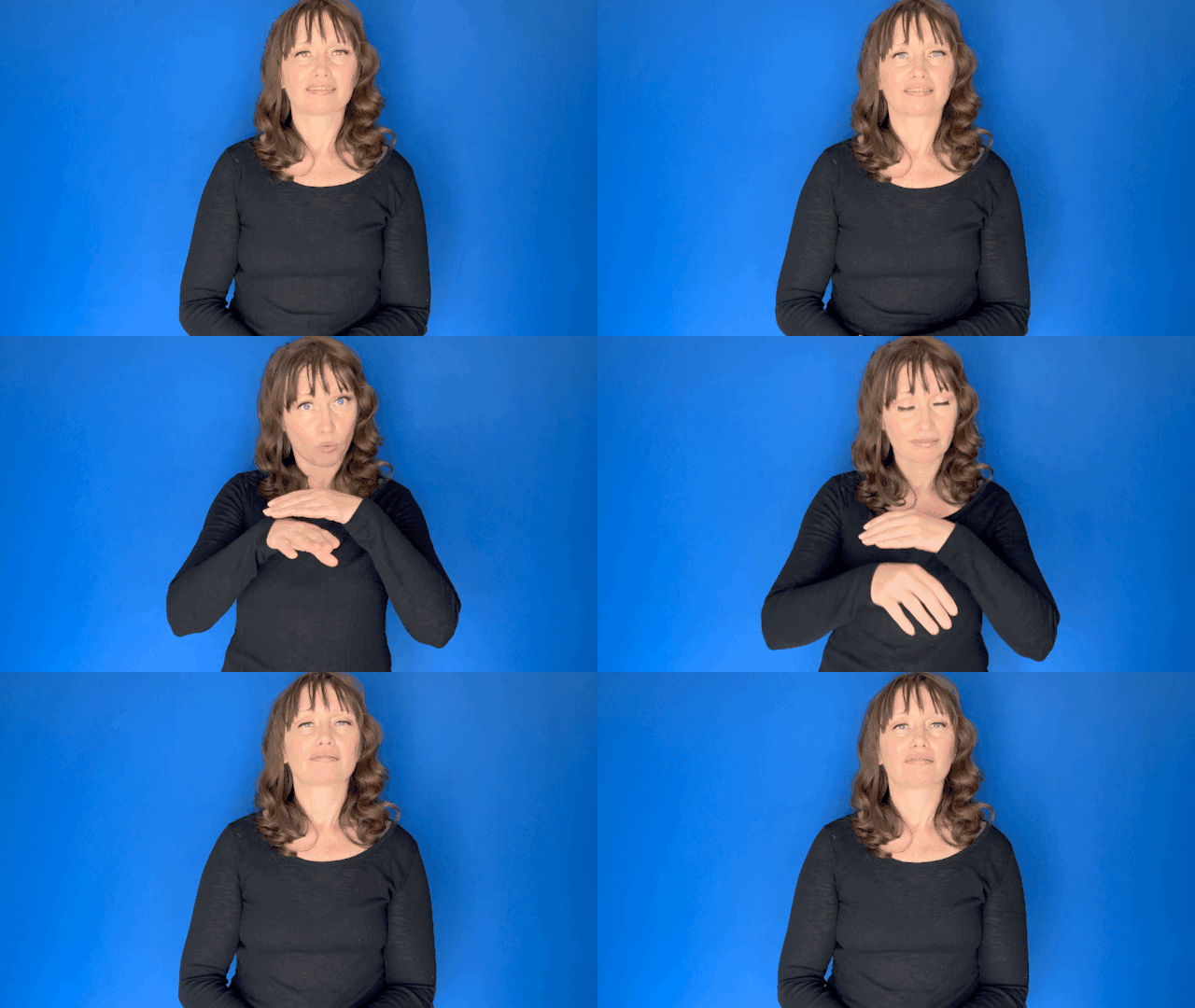
Sign for BORN 7 in ASL

Practice Activities:
Start by practicing the sign for BORN 7 in ASL in front of a mirror to ensure correct handshape and movement. Repeat the sign slowly at first, focusing on the motion of the dominant hand moving under the non-dominant flat hand as if representing a birth. Then, speed up as you gain confidence and control.
Use flashcards with family-related vocabulary on one side and personal stories on the other to build contextual use. Create sentences using the sign for BORN 7 in ASL, such as “I was born in June” or “My daughter was born in Seattle.” Sign each sentence aloud, pausing to visualize the meaning.
Partner up with a fellow learner and take turns creating scenarios like introducing family members, sharing birth years, or talking about where you were born. One person can ask questions like “Where were you born?” and the other responds using the sign appropriately in context. Switch roles after each round to keep both people actively engaged.
Write a short personal story, about five to seven sentences long, using the sign multiple times—for example, a story about your birth or a new baby in the family. Practice signing the story to make your retelling fluid. This will help associate the sign for BORN 7 in ASL with real-life conversations and storytelling.
Challenge yourself with a timed drill. Set a timer for two minutes and see how many full sentences you can sign that include the target term. Review your sentences afterward and refine them to increase accuracy. This is a great way to build signing speed and confidence.
Finally, watch ASL storytelling videos or vlogs where the sign for BORN 7 in ASL is used. Try to identify it in context and then pause the video to mimic the signer’s movements. Repetition and context-based exposure will deepen your fluency and understanding.
Cultural Context:
In American Sign Language (ASL), the sign for BORN 7 holds a unique cultural and linguistic significance, especially within the Deaf community. This sign is often used when referring to someone’s birth year or when discussing historical or nostalgic moments tied to 1970s culture. The sign for BORN 7 in ASL isn’t just about a date — it connects a person to their generational identity.
The way numbers are used in ASL differs from English. When signing years, particularly decades, ASL users often incorporate unique movements or hand shapes that provide context. The sign for BORN 7 in ASL communicates both time and identity in one expressive gesture.
For native ASL users, the visual and spatial structure of sign language allows for quick, vivid storytelling. When someone uses the sign for BORN 7 in ASL, it paints a picture of their roots and helps set the scene for deeper conversations. It’s not uncommon to use it in introductions, especially in Deaf spaces where age and generational context are meaningful.
Deaf culture tends to value shared history and life experiences deeply. Using number signs for birth years, like the sign for BORN 7 in ASL, can help establish rapport and shared understanding in the community. Generations within Deaf culture often connect through similar educational experiences or influential historical events.
The use of number-specific signs in ASL adds rich layers to communication. BORN 7 is more than just a simple reference—it can evoke memories of key events in Deaf history during the 1970s. Whether it be policy changes in Deaf education or the rise of Deaf-led advocacy, signs like BORN 7 in ASL offer a direct way to reference that era.
In storytelling, the sign for BORN 7 in ASL is often paired with facial expressions and body language to bring the narrative to life. ASL is not just about the hands—it’s a fully animated language. Cultural and generational identity often come through clearly in such phrases.
Many educators and interpreters use the sign for BORN 7 in ASL to help students and learners place events in a personal or historical timeline. Because ASL expresses time visually and not linearly as spoken English does, it helps learners conceptualize historical context more intuitively.
Parents of Deaf children who were born in the 70s might teach the sign for BORN 7 in ASL as part of recounting family history. This helps root signed language in real events and provides
Extended Definition:
The sign for born 7 in ASL is a unique and specific depiction used when referring to someone born in the seventh month or as the seventh child. In American Sign Language, numbers often get combined with common signs to create more precise expressions. This is especially useful when discussing birth order, dates, or important milestones.
To create the sign for born 7 in ASL, you will generally start with the sign for born. This sign is made by showing a movement that represents someone being delivered or coming into the world. It usually involves a downward motion of one hand moving from behind the other, symbolizing birth.
After signing born, you immediately follow with the number 7, made by touching the tip of your thumb to your ring finger while the other fingers stay extended. The flow between the two signs is what gives this phrase meaning in context. When paired, they clearly communicate the concept of someone being the seventh person born in a sequence or a specific month like July.
Context matters a lot in American Sign Language, and the sign for born 7 in ASL can change slightly depending on the setting. For example, if you’re talking about your place in a family of many siblings, you could include facial expressions or listing techniques on your non-dominant hand. This helps give more clarity and depth to the sign.
If you are referencing the seventh month of the year, like July, you might combine this sign with fingerspelling the month for confirmation. ASL relies heavily on visual cues and situational relevance, so these additional details matter. The positioning and direction of your hands, along with the visual context, allow for clear communication.
Children learning ASL at an early age benefit from understanding number signs in combination with natural life events like birth. The sign for born 7 in ASL is a good example of how numbers and actions come together in the language. It’s especially popular in storytelling or describing family history.
In classroom settings, educators may teach this sign when introducing numbers, birth order, or simple narrative structures. It also appears in conversations at home, among friends, or during introductions. Deaf culture places value on family and history, making this a frequently used and meaningful sign.
Fluency in ASL involves more than just knowing separate signs; it includes transitioning between them smoothly. The sign for born 7 in ASL is a perfect illustration of how fluent signers express multi-layered ideas with clarity. Practicing this sign involves mastering both the motion for
Synonyms: born, delivered, birthed, brought into the world, came into existence
Educational resources: Find related learning materials in our course bank!
Want more? Check out some of our popular learning activities on the homepage!
Need to look up a sign? Use our highly rated dictionary: https://aslinteractive.com/best-asl-dictionary/
Follow us on tiktok: https://www.tiktok.com/@aslinteractive. More social media links at the bottom of this page!
Long-tail Keywords: what is the sign for born in ASL, how do you sign born in ASL, ASL sign for born
Categories:
tags: Family, Occasions, Life milestones, Birth, Relationships
Parameters
*Handshape*:
The handshape for the Sign for BORN 7 in ASL starts with the non-dominant hand held flat, palm facing up, symbolizing a surface or ground. The dominant hand uses a flat handshape as well, palm facing down, and it moves from above the non-dominant hand, passing under it in a downward, arcing motion, as if something is being birthed or emerging .
In the Sign for BORN 7 in ASL, both hands use open B-handshapes with fingers extended and close together, thumbs tucked in. The motion of the dominant hand simulates being born or coming into the world, a graceful movement showing emergence and transition.
*Palm Orientation*:
For the sign for BORN 7 in ASL, the dominant hand starts with the palm facing upward, resting behind the non-dominant hand, which also has the palm oriented downward and flat. As the sign is executed, the dominant hand moves forward and underneath the non-dominant hand, maintaining the upward palm orientation throughout.
The palm orientation in the sign for BORN 7 in ASL is key to showing the conceptual meaning of emerging or being born. This directional motion with palms in opposite orientations visually conveys the idea of movement from one place to another.
*Location*:
The sign for BORN 7 in ASL is typically performed in the lower torso area, with one hand representing a surface (often the non-dominant) and the dominant hand moving underneath and out, mimicking the action of being born or emerging. This location is symbolic of the process and is made in front of the body just above the lap.
The location of the sign for BORN 7 in ASL helps convey the concept through spatial representation. Because it occurs in the lower center of the body space, it aligns naturally with the meaning of birth, emphasizing emergence or origin.
*Movement*:
The sign for BORN 7 in ASL uses a directional movement to illustrate the concept of being born. Start with your dominant hand in a flat B-handshape, palm upward, beneath the non-dominant hand, which also uses a flat B-handshape, palm down. The dominant hand then moves forward and slightly down from beneath the non-dominant hand, mimicking the motion of something emerging or being born.
This controlled motion gives visual context to the sign for BORN 7 in ASL. Keep the movement fluid and natural, avoiding jerky actions. Adding facial expression can enhance clarity and meaning, particularly if you’re distinguishing among variations for time or context.
*Non-Manual Signals*:
The non-manual signals for the sign for BORN 7 in ASL include a neutral facial expression with slight head movement forward to indicate the natural action of being born or emerging. If contextually implying a deeper meaning or dramatic emphasis, the signer may use raised eyebrows or a softened gaze.
In the sign for BORN 7 in ASL, the mouth may stay closed or slightly open, maintaining a composed look. The body leans subtly forward, complementing the downward motion of the dominant hand as part of the sign’s structure.
*Prosody, Dominant/Non-Dominant Hand*:
The sign for BORN 7 in ASL requires the dominant hand to be in a flat B-handshape, palm facing up, while the non-dominant hand also forms a flat hand, palm facing down. The dominant hand slides under the non-dominant hand, mimicking the action of being born or emerging.
This motion, used in the sign for BORN 7 in ASL, symbolizes birth or coming into the world. Maintain a smooth and fluid motion to convey the concept clearly within ASL prosody.
Tips for Beginners:
When learning the sign for BORN 7 in ASL, it’s important to first distinguish whether you’re referring to a birth year or a titled phrase. If it’s referencing a birth year like 2007 or 1907, the appropriate way to sign that is to fingerspell “B-O-R-N” and then use number signs to show “7” or “0-7” depending on context. Make sure your hand is steady and your fingers are clearly separated when fingerspelling each letter.
A common beginner mistake with the sign for BORN 7 in ASL is rushing through the fingerspelling or improperly transitioning to the number. To avoid this, pause slightly between spelling “BORN” and signing “7” to ensure your meaning comes across. Practice fingerspelling slowly at first to get the correct handshapes and then build speed once muscle memory kicks in .
Lighting is key when fingerspelling—try practicing in front of a mirror or recording yourself to make sure each letter of “BORN” and the number “7” is visible and not sloppy. Another helpful tip is to keep your hand near shoulder or chest level when fingerspelling so it’s in the natural visual space that signers are used to watching.
If you’re using the sign for BORN 7 in ASL in a storytelling context, try to match your facial expressions appropriately. Adding a cultural or narrative context, such as someone proud of being born in ’07, can help convey extra meaning beyond just the sign itself. Practice with a peer or tutor who can give real-time corrections.
Lastly, exposure to fluent signers is crucial. Observe how native signers fingerspell the phrase in live conversations or videos. Repetition and consistent practice will help you become more fluent when using the sign for BORN 7 in ASL.
Connections to Other topics:
The sign for BORN 7 in ASL connects strongly to timelines, milestones, and number incorporation in storytelling. It is often used in narratives that include personal history, age-specific memories, or generational context. The number “7” is incorporated seamlessly into the concept of being born, reflecting one of ASL’s unique grammatical strategies: number incorporation directly into base signs.
This sign links closely with age-related signs such as AGE 7, TURN-7, or when discussing school levels like FIRST-GRADE or SECOND-GRADE. When discussing childhood events, the sign for BORN 7 in ASL integrates naturally within larger sentence structures like “WHEN I BORN 7, MOVE NEW YORK” or “BORN 7, START SCHOOL SAME TIME,” showing how it supports chronological context in Deaf narration.
It can also be seen in compound expressions related to developmental experiences, such as BORN 7 HOSPITAL or BORN 7 HOME, which enhance storytelling by adding setting details. Its use also intersects with cultural identity signs like DEAF BORN 7 or CODA BORN 7, helping express when a Deaf or hearing identity emerged in relation to familial context.
Learners can connect this sign to educational or medical signs when recounting significant events, such as BORN 7, THEN FIND OUT DEAF or BORN 7, RIGHT-AWAY HEARING-AID. This expands vocabulary and gives relevance to sequencing. Grammatical facial expressions often match the context of the birth story, and the chronological marker supports the visual pacing native to ASL syntax.
Understanding the sign for BORN 7 in ASL also reinforces temporal mapping techniques, pairing well with signs like BEFORE, AFTER, or GROW-UP. These time-based transitions are essential in building fluency for narrative storytelling. As learners become more advanced, they may explore similar formats, like BORN 10 or BORN 3, to build consistent narrative styles across many age references.
Summary:
The sign for BORN 7 in ASL involves a nuanced use of classifiers, number incorporation, and body placements to indicate time and occurrence. This sign connects the concept of birth with a specific number, in this case, 7, and is often used in contexts that refer to either the chronological order of birth among siblings or a calendar-based date. It involves blending numerical identification with a sign that typically symbolizes birth, emerging, or coming into existence.
To express the keyword phrase clearly, the signer usually begins with the dominant hand in a flat-B handshape, palm facing up, while the non-dominant hand is also in a flat-B position facing down. The dominant hand then moves underneath the non-dominant hand and out, symbolizing something being born or coming out. Immediately after that, the number 7 is shown by forming an “L” shape with the index finger and thumb extended and touching.
This combination makes the sign for BORN 7 in ASL both grammatically and contextually rich. The number is not randomly appended—it’s smoothly woven into the sign, allowing for a streamlined presentation of birth order or timeframe. The number incorporation method helps reduce the need for additional separate signs, supporting the efficient, visual grammar ASL is known for.
This sign is often used by Deaf individuals when discussing their position in the family. For example, saying someone is the seventh child born can simply be stated using the sign for BORN 7 in ASL without needing to sign “born” and then state “seven” separately. It’s not only a grammatical efficiency but also a cultural shorthand that shows familiarity with language norms within the signing community.
In family history conversations, or while reminiscing about life stages, Deaf individuals might use this sign fluidly. It often appears in storytelling, as ASL storytelling places strong emphasis on sequence, order, and vivid imagery. Using the sign for BORN 7 in ASL helps in preserving the chronological flow that ASL narratives value.
Grammatically, this sign shows how ASL allows for topical structure. A signer might first establish the topic by signing BORN 7 in ASL and then elaborate on events surrounding that birth. This can include the year, the season, or any personal anecdotes related to being the seventh-born child. The topic-comment structure suits this perfectly.
The sign also highlights how classifiers operate in ASL. While it’s not a classifier in itself, the underlying movement of one hand going under another contributes to the spatial-temporal classifiers that help ASL convey dynamic meaning through motion and position.
The cultural significance of this term is especially visible in Deaf family structures. Each birth placement may have associated roles or expectations within the family, and these may be expressed or hinted at subtly through the concise sign. This cultural reading of the order of birth lends deeper context to the sign for BORN 7 in ASL, indicating more than just chronology—it often suggests identity.
For ASL learners, mastering such signs reinforces competence with number incorporation. Learning signs like BORN 7 in ASL expands fluency and grammatical finesse. It’s not enough to know numbers and nouns independently; it’s important to apply them in integrated, meaningful constructions that mirror real Deaf community usage.
In applied linguistics, this sign showcases simultaneous morphology—a feature where information is layered within a single sign. Simultaneous morphology stands in contrast to sequential morphology used in spoken languages, allowing ASL to communicate compactly and visually. The sign for BORN 7 in ASL exemplifies this, combining action and number at once.
This embodiment of information confirms non-linearity in sign language structure. While spoken languages often follow a linear syntax, ASL and other signed languages can overlay elements—like adding a number directly into a sign that references an event. The sign for BORN 7 in ASL is one of many signs that reinforce this compositional quality.
The economy of motion demonstrates how ASL grammar is adapted to visual gestures. There’s no need to sign many words to represent “the seventh child was born.” The economy is vital in conversation flow, so signs like BORN 7 in ASL serve as cornerstones for clear and swift dialogue.
Variations in the way this sign is produced can occur depending on regional dialects within ASL. Some may incorporate the number differently, either by showing it before or after the basic “born” sign, though the general structure remains consistent. This shows the flexibility of ASL while maintaining mutual understanding.
In classroom settings, the sign for BORN 7 in ASL is useful in exercises that combine numeracy and language practice. It allows Deaf educators and interpreters to engage students in discussions about family, sequence, and time—all important categories in both language learning and social understanding.
There is also a connection to sociolinguistic markers in signs like this. Age, birth order, and familial positions often carry connotative value, and using signs like this can reflect social
Want more? Check out some of our popular learning activities!
ASL Interactive Resources
ASLInteractive YouTube Channel
Follow us on tiktok: @aslinteractive.com
Follow us on Instagram: aslinteractive
Facebook page: aslinteractive
Facebook group: aslinteractive
LInkedIn: ASL Interactive LLC
Twitter: @ASL_interactive
*Some information on this page is AI-generated. AI can make mistakes. Please check the information.
Responses