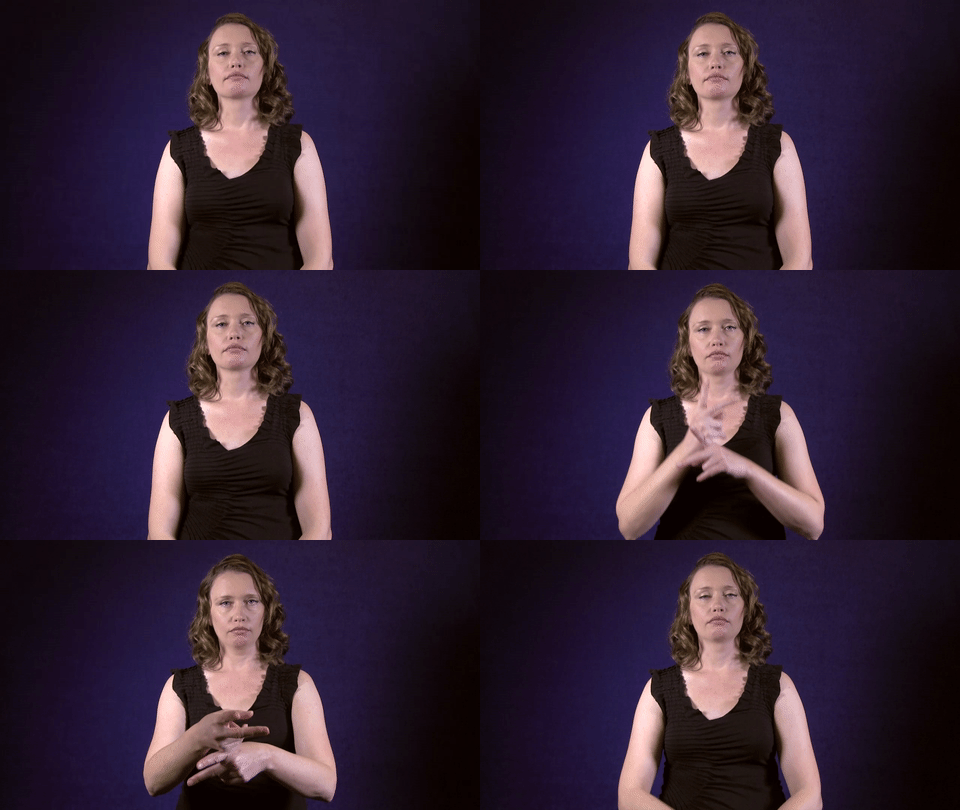
Definition: To take and use something belonging to someone else.
Sign for BORROW-FROM in ASL

Practice Activities:
To practice the sign for BORROW-FROM in ASL, start with isolated repetition. Stand in front of a mirror and practice the handshape and directional movement several times while watching your form and face for clarity and fluency. Focus on directional accuracy, showing where the item is being borrowed from and to whom.
Use flashcards or a vocabulary list to create short phrases, such as “borrow-from library” or “borrow-from teacher.” Repeat these combinations several times to build your comfort level with changing direction based on who is giving or receiving. This helps reinforce the classifier-like function of the sign.
Next, place the sign for BORROW-FROM in ASL into complete sentences. Try practicing this sentence: “Can I borrow-from you your book?” Change the subject and object each time to develop variety: “You borrow-from me,” or “She borrow-from her friend.” Try increasing speed gradually while maintaining clarity.
Work with a partner and take turns using the sign for BORROW-FROM in ASL within short skits. Create casual settings like borrowing a pencil in class, borrowing money at a store, or borrowing clothes from a sibling. Role-play each scenario with appropriate facial expressions to convey attitude, urgency, or politeness.
Write or sign a short story that involves multiple instances of borrowing. For example, a child might borrow-from a brother, a friend, and a parent during a single day. Sign the story, recording it if possible, then reflect on how accurately the directional aspect of the sign was used.
Game-style drills can boost fluency. Assign each other different objects or people, and sign borrow-from creatively using rapid cues. Make it fun with emojis, like borrowing , , or from people around. Practicing the sign for BORROW-FROM in ASL in dynamic contexts will strengthen recall and conversational use.
Cultural Context:
In American Sign Language, understanding the cultural context of the sign for BORROW-FROM in ASL is essential for meaningful communication. ASL is deeply tied to the values and norms of the Deaf community, and each sign carries more than just its direct translation.
The sign for BORROW-FROM in ASL reflects the idea of temporary ownership. When someone uses this sign, it involves a directional movement that shows who is lending and who is borrowing. This distinction is very important in ASL grammar and helps clarify the action in a visual and spatial way.
In Deaf culture, clear communication is a top priority. The sign for BORROW-FROM in ASL is often used in everyday conversations, especially in community-centered environments like schools, events, or family gatherings. Because ASL is a visual language, the use of space and direction while signing BORROW-FROM adds precision and depth to the conversation.
The cultural value of sharing is common in Deaf communities, and the sign for BORROW-FROM in ASL often goes beyond just material items. It can refer to borrowing concepts, support, or even emotional presence. This makes the sign culturally richer and layered with meaning beyond its English counterpart.
Deaf culture places importance on trust and mutual understanding. When someone uses the sign for BORROW-FROM in ASL, it shows a reliance on that trust. It also highlights the communal nature of the Deaf world, where resources and support are often shared freely.
The directionality of the sign also has cultural weight. Since ASL is highly spatial, making sure to sign in the correct direction when using BORROW-FROM helps avoid misunderstandings. Pointing and movement help represent who the action is coming from and going to, adding clarity that spoken language doesn’t always require.
Respecting personal space and eye contact is another cultural aspect connected with how the sign for BORROW-FROM in ASL is perceived. Signers often maintain eye contact to show attentiveness and sincerity, which is especially important when discussing trust-based actions like borrowing.
Children learning ASL often pick up the sign for BORROW-FROM early because it reflects social interactions they engage in regularly. Parents and teachers use the sign while teaching values like sharing, responsibility, and honesty. These early lessons are vital and become part of a broader understanding of social roles in the Deaf community.
In storytelling and visual narratives within Deaf culture, the sign for BORROW-FROM in ASL can take on symbolic meaning. It might represent passage of wisdom or
Extended Definition:
The sign for BORROW-FROM in ASL represents the concept of receiving something temporarily with the intention of returning it. This sign is commonly used in everyday conversations when referring to borrowing items, tools, money, or anything that is temporarily taken for use.
In American Sign Language, directional motion plays an important role in the meaning of this sign. The sign for BORROW-FROM in ASL uses a movement that shows the direction of the action: from the lender to the borrower. This means that the orientation of the hands changes depending on who is borrowing and who is lending.
To express this concept correctly, the signer uses a handshape that represents people—often the “V” handshape. The hands begin outward and move toward the person who is doing the borrowing. This suggests the motion of taking something in a temporary and respectful way.
Context is key when using the sign for BORROW-FROM in ASL. It can apply in personal, academic, or professional settings. For example, one might use it to indicate borrowing a book from a friend or a laptop from a co-worker.
Sometimes, facial expressions and non-manual signals are added to show the level of politeness or urgency. Raising the eyebrows or tilting the head forward can emphasize a polite request. These markers are essential and help convey the tone and intention behind the request to borrow.
The sign for BORROW-FROM in ASL should not be confused with the sign for LEND or GIVE. Although the signs are similar, the direction of movement changes the meaning completely. This is what makes directional signs like BORROW-FROM powerful and efficient in ASL communication.
Children learning ASL will often use the sign for BORROW-FROM while practicing school-related conversations. It also appears in many ASL teaching materials, especially those focused on everyday vocabulary and social situations. Teachers frequently include role-playing activities around borrowing and returning items to help reinforce the sign.
When used in a sentence, the sign for BORROW-FROM in ASL can be placed naturally within ASL grammar. For example, to say “Can I borrow a pen from you?” the sign is shaped and directed appropriately to show the subject and object of the action. The question can then be clearly understood, even without spoken words.
Understanding the correct form of the sign for BORROW-FROM in ASL helps build clarity and trust in communication. Using it accurately also supports deaf culture and polite interaction norms. Clear signing maintains the flow of conversation and reduces
Synonyms: loan, lend, take on loan, obtain temporarily, use
Educational resources: Find related learning materials in our course bank!
Want more? Check out some of our popular learning activities on the homepage!
Need to look up a sign? Use our highly rated dictionary: https://aslinteractive.com/best-asl-dictionary/
Follow us on tiktok: https://www.tiktok.com/@aslinteractive. More social media links at the bottom of this page!
Long-tail Keywords: What is the ASL sign for borrow from, How do you sign borrow from in American Sign Language, borrow from sign in ASL
Categories:
tags: Borrow, Possessives, Commands, Everyday Activities, Verbs
Parameters
*Handshape*:
The sign for BORROW-FROM in ASL uses both hands in an “H” handshape, where the index and middle fingers are extended together while the other fingers are folded down. These handshapes represent the concept of transfer or sharing.
When performing the sign for BORROW-FROM in ASL, the dominant “H” hand moves from the non-dominant “H” hand outward, away from the body, indicating a borrowing action. The precise symmetry and direction help convey the relationship between the two parties involved in borrowing.
*Palm Orientation*:
In the sign for BORROW-FROM in ASL, both hands use the “V” handshape. The palm orientation for the dominant hand faces inward and slightly forward, while the non-dominant hand also faces inward.
As the sign for BORROW-FROM in ASL is performed, both hands move from the non-dominant side toward the dominant side, keeping the palm orientation consistent throughout. This directional movement helps clarify the concept of borrowing from another person .
*Location*:
The sign for BORROW-FROM in ASL is typically produced in the neutral space in front of the chest. Both hands use an “H” handshape and move together from the signer toward the person being addressed, indicating the transfer of an item from someone to the signer.
This location emphasizes the directional aspect of the sign for BORROW-FROM in ASL, showing who is borrowing from whom. The movement direction clearly indicates the source and destination of the action.
*Movement*:
To perform the sign for BORROW-FROM in ASL, place both hands in the “K” handshape. Position them together, with the dominant hand slightly on top of the non-dominant hand near your body. Move the hands outward, away from the body, in a small smooth arc motion toward the intended recipient.
The sign for BORROW-FROM in ASL uses directionality to show who is lending to whom, so the movement may change depending on context. ➡️
*Non-Manual Signals*:
When performing the sign for BORROW-FROM in ASL, a slight forward lean and raised eyebrows often accompany the gesture to indicate a question or request. Your facial expression should be inquisitive or mildly pleading, suggesting you’re asking to take something temporarily.
Head tilt toward the person you’re addressing can add clarity, especially in directional signing. These non-manual signals help reinforce the meaning and intent of the sign for BORROW-FROM in ASL.
*Prosody, Dominant/Non-Dominant Hand*:
The sign for BORROW-FROM in ASL uses both hands, typically in the “K” handshape. The dominant hand, which leads the motion, is placed on top of the non-dominant hand, also in the “K” handshape, palm facing side. Both hands move forward together in a small arc away from the body, showing the action of lending or borrowing.
In the sign for BORROW-FROM in ASL, prosody is expressed by modifying the speed or repetition of the movement depending on context. Facial expression—such as raised eyebrows for a yes/no question—helps convey the intent of borrowing. The direction of movement may shift slightly based on the source or recipient in directional verbs.
Tips for Beginners:
When learning the sign for BORROW-FROM in ASL, it’s helpful to first practice the base concept of “borrow” by using your dominant and non-dominant hands in the correct configuration. Both hands should take the shape of an “H” handshape (index and middle fingers together and extended), with one hand representing the person lending and the other representing the person borrowing. Move the “H” handshape from the non-dominant position toward your body to show the direction of borrowing.
Directionality plays a critical role in the sign for BORROW-FROM in ASL. Always remember that the orientation of the movement should reflect real-world spatial grammar: from the lender toward the borrower. If you do it in reverse, the meaning becomes “lend,” which can cause confusion during conversation. Practicing in front of a mirror can help reinforce the correct angle and movement.
One common mistake beginners make is stiff or unclear movement in the wrists or fingers. This can make the sign appear robotic or difficult to interpret. Relax your hands and allow fluid, controlled motion to maintain clarity and natural animation. Keep handshapes precise—don’t let your fingers droop, and make sure both hands start in a clean “H” shape before moving.
Facial expression can also enhance the contextual meaning of the sign for BORROW-FROM in ASL. For instance, a questioning eyebrow raise can indicate, “Can I borrow from you?” while a more assertive tone might come from a serious or confident expression.
Lastly, observe how native signers incorporate body shifting and eye gaze to reinforce who is doing the borrowing. Since ASL is a spatial language, these elements complement the directional movement and ensure your use of the sign for BORROW-FROM in ASL is both accurate and expressive. ✋
Connections to Other topics:
The sign for BORROW-FROM in ASL shares structural similarities with signs like LOAN and LEND, which all involve directional movement to indicate the giver and receiver. This directional aspect is essential in many ASL verb signs and helps express who is doing what to whom without the need for extra words. Understanding how directionality works in the sign for BORROW-FROM in ASL helps learners master similar transitives and enhances overall fluency.
Compound expressions using the sign for BORROW-FROM in ASL often occur in social or transactional contexts. For instance, when discussing situations like “Can I borrow-from you?” or “You borrowed-from her,” the pronouns are indicated through the movement of the sign. This illustrates how facial grammar and body orientation complement the handshape and movement in communicating clear and nuanced meaning.
Learners often find meaningful connections between the sign for BORROW-FROM in ASL and signs emphasizing permission or obligation, such as ALLOW or NEED. These may appear together in conceptual groupings like “He needs to borrow-from me” or “You should allow them to borrow-from us.” In such phrases, role shifting and non-manual markers contribute to the full expression of interpersonal dynamics.
In conversations about finance, tools, or favor exchanges, the sign for BORROW-FROM in ASL can appear in coordinated structures involving signs like MONEY, TOOL, or HELP. These compound expressions are widely used in everyday communication and depict transactions or cooperative activities. The clarity in expressing these relationships through spatial referencing and role shifting is central to natural ASL discourse.
The sign for BORROW-FROM in ASL also connects to classifiers when describing objects being passed or transferred. A signer might describe someone borrowing a pen by pairing the general sign with a classifier depicting the pen’s shape, combining grammatical structure and visual storytelling. This allows users to expand the range of the original sign dynamically.
Summary:
The sign for BORROW-FROM in ASL is a directional sign, which means its movement conveys information about the subject and the object. The basic handshape used is the dominant and non-dominant hands in the “K” or “V” handshape, placed palm down on top of each other, then moved toward the person being referred to as the source.
To sign BORROW-FROM, start by identifying the directionality of action. That is, who is borrowing and from whom. If you’re borrowing something from another person, the movement usually goes from them toward the signer.
This directional movement is central to the grammar of the sign. You can reverse the motion to indicate “lend to someone,” where the movement begins with the signer and moves outward toward the other person.
Directionality is an important part of ASL syntax. The sign for BORROW-FROM in ASL relies heavily on this feature to reduce the need for extra pronouns or clarifying phrases.
This sign captures a moment of obligation or temporary use, which aligns with how we view borrowing in a cultural context. Borrowing implies permission and returning, values deeply rooted in community and interpersonal trust.
When using this sign in a sentence, it supports subject-verb-object grammar but also allows for flexibility due to its built-in directionality. The verb itself often includes both subject and object roles by where and how it moves.
Common sentence examples include “I BORROW-FROM MOM” or “HE/SHE BORROW-FROM ME.” These express full ideas with minimal hand movement by leveraging the visual grammar of ASL.
The sign for BORROW-FROM in ASL is closely related to the sign for LEND. Both use the same handshape and general movement, but the direction changes depending on the action.
This highlights how ASL grammar incorporates visual modality to express relationships without changing the word form. It’s functionally similar to how English adds -er or -ed for grammatical transitions.
In applied linguistics, the sign for BORROW-FROM in ASL demonstrates morphosyntactic flexibility. The same base handshape takes on multiple linguistic roles depending on movement and direction.
This mirrors how spoken languages utilize intonation or stress to shape meaning. But ASL uses spatial referencing and movement, activating different cognitive processes.
From a broader linguistic standpoint, ASL verbs of transfer—such as BORROW-FROM, GIVE, SEND, and SHOW—have rich directional features. These enrich the language’s ability to express complex ideas concisely.
Borrowing as a concept holds cultural weight across cultures. In Deaf culture, borrowing also connects to mutual aid and a culture of reciprocity due to shared experiences of marginalization.
Understanding the sign for BORROW-FROM in ASL means understanding community values. It’s not about mere personal gain—it’s often about helping and supporting others within one’s close-knit circle.
Use of this sign shows how ASL users convey concepts not just through words but through embodied, situational context. The signer’s body acts as a narrative space.
This sign may appear simple at first but carries layers of meaning in how it is executed. Subtle changes in eyebrow position or gaze direction give context and emotional tone.
Body language and facial expressions are key. A raised eyebrow might indicate a yes/no question, while a serious face could imply urgency or importance in the act of borrowing.
The grammar embedded in the sign for BORROW-FROM in ASL also aligns with classifiers. For example, you can incorporate object classifiers to show what exactly is being borrowed.
This multimodal layering makes the sign more nuanced. For instance, borrowing a book versus borrowing a car can be shown through classifiers integrated into the sentence alongside this directional sign.
Because this verb can include both subject and object, it reduces cognitive load for the viewer. This grammatical efficiency is important in real-time interaction.
The sign encourages concise, visually rich communication. ASL, unlike constrained voice-based languages, allows for this efficiency and clarity in spatial domains.
Some regional variations might modify the handshape slightly but maintain the primary directional concept. Still, the core of the sign remains intact due to its grammatical utility across dialects.
Learning the sign for BORROW-FROM in ASL also improves understanding of how ASL expresses interpersonal actions. Unlike static dictionary entries, ASL signs are dynamic and situational.
Other verbs in ASL follow similar directional patterns, like TELL, SHOW, or GIVE. Learning one helps in understanding the function of many others.
In pedagogical settings, teaching the sign for BORROW-FROM in ASL improves both productive and receptive skills. It makes the student aware of how relationships between people are mapped spatially.
Classroom activities often use this sign in role play or imagined dialogues to illustrate borrowing and lending scenarios. These scenarios help reinforce directionality using real-world applications.
In historical linguistics, the development of directional verbs in ASL may have roots in natural gestures evolving toward institutional signs. These signs were
Want more? Check out some of our popular learning activities!
ASL Interactive Resources
ASLInteractive YouTube Channel
Follow us on tiktok: @aslinteractive.com
Follow us on Instagram: aslinteractive
Facebook page: aslinteractive
Facebook group: aslinteractive
LInkedIn: ASL Interactive LLC
Twitter: @ASL_interactive
*Some information on this page is AI-generated. AI can make mistakes. Please check the information.


Responses