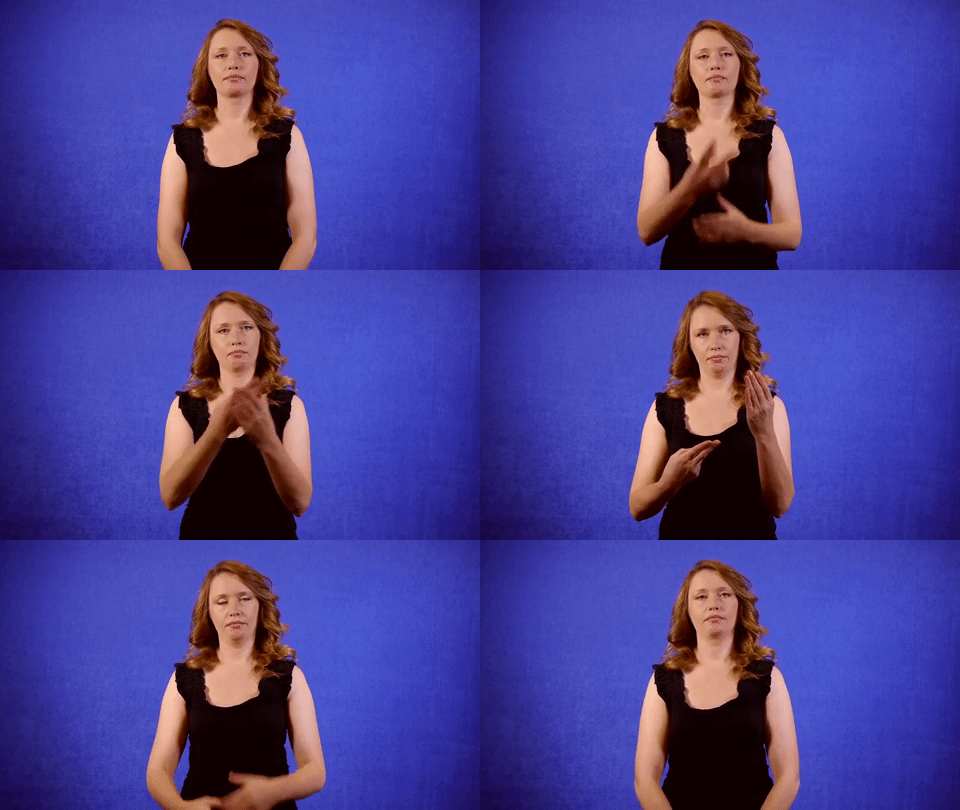
Definition: Two together.
Sign for BOTH in ASL

Practice Activities:
To become confident using the sign for BOTH in ASL, start by practicing the sign in isolation. Use a mirror to check handshape, movement, and palm orientation. Repeat the sign slowly and then gradually speed up to build muscle memory.
After you’re comfortable with the form, try incorporating it into short phrases like “both of them,” “both dogs,” or “both options.” Sign these while thinking about two specific people or objects to give your practice more meaning. Saying the words aloud while signing can help reinforce the sign’s usage.
Create simple storytelling prompts to reinforce the sign for BOTH in ASL. For example, practice telling a short story like, “I had two pets. I love both of them.” Include the sign naturally where it fits in the storyline to develop fluency and timing.
Try making a list of things that come in pairs and sign sentences about them. For example, “Both shoes are new,” or “Both eyes are itchy.” This will help you associate the sign with common dual items in real life.
Partner up with another learner and take turns describing situations where the sign would be used. One person could ask a question like, “Do you like cats or dogs?” and the other could reply, “I like both.” This builds conversational confidence using the sign for BOTH in ASL.
Another solo activity is watching short ASL videos and identifying when the sign appears. Pause the video and mimic the signer’s motion and context. This helps you get exposure to the natural use of the sign.
Use flashcards with visual prompts of two objects or people, and quickly respond using the sign. The quicker you recognize situations that need the sign for BOTH in ASL, the more fluent you’ll become.
Cultural Context:
The sign for BOTH in ASL is used in many cultural and conversational contexts within the Deaf community. It’s commonly taught in beginner ASL classes because of how often it appears in everyday conversation. Understanding how to correctly use the sign for BOTH in ASL helps improve clarity and fluidity when signing with native users.
In ASL culture, clarity is key due to the visual nature of the language, and the sign for BOTH in ASL helps express combinations or inclusion clearly. For example, it is used when discussing two people, options, or objects being included together. Whether you’re saying you like both movies or both of your friends are here, this sign is essential.
The sign for BOTH in ASL also reflects how ASL simplifies complex spoken ideas into visual grammar. Instead of listing items, using the sign for BOTH in ASL condenses the message into a clean and quick statement. This is appreciated in ASL culture, where efficiency and meaning go hand-in-hand .
Facial expressions and body language often accompany the sign for BOTH in ASL, especially when emphasizing the importance of inclusion. Signing this concept without appropriate non-manual markers can affect the meaning. Culturally, the Deaf community emphasizes full expression, making your knowledge of signs like BOTH even more important.
Children who grow up using ASL or attend Deaf schools learn the sign for BOTH in ASL early because of its necessity in academic and social settings. Students sign BOTH when comparing subjects, discussing experiences, or choosing between two favorites in class. Teachers and parents use the sign for BOTH in ASL to reinforce dual participation or inclusion.
Social interaction within the Deaf community often centers on storytelling, where the sign for BOTH in ASL allows for more dynamic narratives. It helps signers clearly identify two events or people without much repetition. Story clarity and flow improve when signs like BOTH are integrated correctly and naturally.
In Deaf families, it’s common to sign BOTH when assigning tasks or talking about shared responsibilities. For example, saying BOTH children need to clean their room becomes fast and expressive with the sign for BOTH in ASL. It’s a practical sign for daily use and strengthens household communication .
The sign for BOTH in ASL also shows up frequently in religious, social, and political discussions in the community. Deaf church services and meetings often include this sign when talking about unity, shared beliefs, or joint participation. Its cultural relevance goes beyond language—it reflects shared perspective.
Online Deaf spaces like vlogs and social media
Extended Definition:
The sign for both in ASL is a common and useful sign to know, especially when expressing two options, two people, or two ideas together in one statement. It captures the meaning of unity or inclusion of two elements without the need to sign each one separately every time. Understanding the sign for both in ASL can help make conversations in American Sign Language smoother and more natural.
In ASL, the sign for both is typically made using the dominant hand in a “V” handshape, pulled down through the non-dominant hand, which starts in a closed position and opens slightly like a tunnel. As the dominant hand moves through, it transforms into a “U” handshape representing the concept of two together. This visual transition adds clarity and memorability, making it easier for signers to grasp the meaning.
When learning ASL, it is important to not only memorize how the sign looks but also understand how and when it is used. The sign for both in ASL can be seen frequently in everyday dialogue, such as when talking about liking both coffee and tea, or describing two people going to the same place. It simplifies conversation and replaces the need to individually sign each item when discussing two related subjects.
Context matters when using the sign for both in ASL. Facial expressions, body movement, and sentence flow all work together to give full meaning. It’s also useful to note that the sentence structure in ASL may differ from English, and placing the sign in the right part of the sentence helps keep meaning clear and fluent.
The sign for both in ASL can also be used with classifiers or in storytelling to point out that two subjects are acting together or experiencing something at the same time. For example, in a narrative context, a signer might describe two characters walking into a room together by using the sign for both along with appropriate role-shifting techniques. This adds depth and visual imagery to conversations.
New learners may confuse the sign for both in ASL with similar signs that use a “V” or “U” handshape. That’s why practicing with a fluent signer or watching video examples is recommended. This helps build confidence and minimizes errors during real conversation.
In addition to formal settings, the sign for both in ASL is commonly used in casual dialogue. Whether talking about food preferences, weekend plans, or favorite songs, this sign helps express dual ideas quickly with minimal effort.
When teaching the sign for both in ASL to children or beginners, using objects or flashcards with
Synonyms: both, the two, each together, the pair, one and the other
Educational resources: Find related learning materials in our course bank!
Want more? Check out some of our popular learning activities on the homepage!
Need to look up a sign? Use our highly rated dictionary: https://aslinteractive.com/best-asl-dictionary/
Follow us on tiktok: https://www.tiktok.com/@aslinteractive. More social media links at the bottom of this page!
Long-tail Keywords: what is the sign for both in ASL, how do you sign both in ASL, ASL sign for both
Categories:
tags: Language Learning, Wh-words, Basic Grammar, Vocabulary, Education
Parameters
*Handshape*:
The handshape for the sign for BOTH in ASL involves using the dominant hand in the “V” handshape. The non-dominant hand forms a “C” or loosely closed shape, representing a container. The “V” handshape pulls down through the “C” hand, and as it passes through, the fingers close together to form a “U” or “H” handshape. This shows both items being taken together.
The movement of the fingers through the hand emphasizes inclusion of two items or entities. The sign for BOTH in ASL relies on clarity in finger positioning and smooth downward motion to convey the concept. This handshape clearly supports the duality expressed in the sign.
*Palm Orientation*:
The palm orientation for the sign for BOTH in ASL starts with the dominant hand forming a “V” shape, palm facing inward toward the non-dominant hand. The non-dominant hand is held upright in a “C” shape with the palm facing to the side.
As the dominant “V” hand moves downward through the non-dominant “C” shape, the fingers close together into a “U” handshape while maintaining the inward palm orientation. This movement helps convey the concept expressed in the sign for BOTH in ASL.
*Location*:
The sign for both in ASL is located in the neutral space in front of the body, slightly lower than chest level. It begins with the dominant hand in the “V” handshape held above the non-dominant fist, then pulled downward through the fist.
During the motion, the “V” handshape closes into a “U” shape, reinforcing the meaning expressed by the sign for both in ASL. The movement stays within the central signing space, making it clearly visible.
*Movement*:
Start by forming both hands into the “L” handshape, palms facing each other, dominant hand above the non-dominant hand. Then move the dominant hand downward through the space between the index and thumb of the non-dominant hand, ending in a “U” handshape below. This downward sliding action emphasizes the inclusion of two items or individuals, which reflects the meaning in the sign for both in ASL. This sign is smooth and fluid, typically done at chest level .
*Non-Manual Signals*:
The non-manual signals for the sign for BOTH in ASL are generally neutral. Maintain a neutral or mild facial expression, with minimal to no exaggerated movement in the eyebrows or mouth.
This sign is more focused on the handshape and motion than facial expression. When using the sign for BOTH in ASL, slight head nodding may complement the downward movement of the dominant hand. Keep your posture relaxed and your gaze directed forward .
*Prosody, Dominant/Non-Dominant Hand*:
The dominant hand starts in a “V” handshape, while the non-dominant hand remains stationary in an open “C” handshape, palm facing in. To produce the sign for both in ASL, the dominant “V” hand moves downward through the non-dominant “C” hand and out the bottom, transforming into a closed “U” or “H” shape as it emerges. This motion visually represents two items exiting or being included together, emphasizing the meaning behind the sign for both in ASL.
Tips for Beginners:
When learning the sign for BOTH in ASL, handshape and movement are key. Start with your dominant hand in a “V” handshape, and place it inside your non-dominant hand, which is held in an open “C” shape. As you move your dominant hand downward through the “C”, close it into a “U” handshape. This represents pulling both objects or ideas through a shared space, emphasizing the duality of “both.”
For beginners, one of the biggest challenges with the sign for BOTH in ASL is keeping the movement fluid while maintaining correct handshapes. Be sure not to rush the motion, as sloppy transitions can confuse the meaning. Practice the motion slowly, focusing on precision—especially the transformation from the “V” to the “U” shape as your dominant hand exits your non-dominant hand.
Another important tip is hand orientation. The non-dominant hand should remain steady with the palm facing slightly inward or upward, depending on your comfort and viewing angle. Inconsistent orientation can distort the sign or cause misunderstandings. It’s helpful to watch yourself sign in a mirror or record a video to check how it looks from another person’s perspective.
Consistency and clarity are more important than speed as you learn. The sign for BOTH in ASL is much easier to understand when each motion is deliberate and smooth. Once you’re comfortable, try using the sign in real conversations where you’re talking about two people, choices, or items.
Make a habit of practicing the sign within full sentences so your muscle memory builds the transition fluidly. Phrases like “both of us” or “both options” are great practice. Regular repetition and real-life usage are the best ways to master the sign for BOTH in ASL and build your confidence .
Sign for BOTH in ASL, american sign language BOTH, BOTH sign meaning, how to sign BOTH in ASL, BOTH ASL sign usage
Connections to Other topics:
The sign for BOTH in ASL connects with several foundational signs that involve duality or enumeration. It uses a motion where the dominant “2” handshape is pulled through the non-dominant “C” handshape and emerges as a “2” handshape again, emphasizing the concept of two elements moving as one unit. This structure can link conceptually with signs like EACH, BOTH-OF-US, or ALL, which also express quantity or inclusion.
In classifier use, the sign for BOTH in ASL complements plural classifiers such as two-person classifiers or paired object representations. For example, if discussing “both shoes” or “both people,” a signer may use a classifier after introducing BOTH to continue the idea in spatial representation. This enhances the signer’s ability to convey relationships and actions between paired entities.
The sign for BOTH in ASL also appears in compound constructions, especially in narrative contexts. When telling a story that involves two characters making the same decision or performing the same task, a signer might use BOTH to set the stage and then rely on indexing and verbs like AGREE, DECIDE, or GO to elaborate on the shared action. This shows how BOTH functions as a bridge between two agents.
There is also a conceptual overlap with comparative and contrasting structures in ASL. Signs like DIFFERENT or SAME often appear in sentences with BOTH to highlight similarities or differences between two things. A sentence might be structured as “BOTH boys SAME bed” or “BOTH books DIFFERENT cover,” aligning with visual-spatial tendencies in ASL grammar.
Finally, the sign for BOTH in ASL is useful for multilingual or bicultural references, especially when discussing two languages, countries, or identities. Phrases like “BOTH English and ASL” or “BOTH Deaf and hearing worlds” demonstrate its utility in expressing complex, binary ideas in community discourse and identity talk.
Summary:
The sign for BOTH in ASL combines visual clarity and symmetry through a distinct motion. It typically begins with the dominant hand forming a downward-facing “V” handshape. This “V” is then pulled downward and through the non-dominant hand, which is shaped in a relaxed “C,” showing visually that both elements belong together.
The movement conveys the concept of dual inclusion. It’s especially impactful because it doesn’t just state a quantity; it expresses a relationship between the items. This subtle representation emphasizes that the two items share a connection, not just a count of two.
In context, the sign for BOTH in ASL is often used to pair elements—like BOTH parents, BOTH hands, or BOTH classes. Its grammatical function often mirrors that of determiners or pronouns in English. It modifies or emphasizes that two subjects or objects are being included together.
The cultural nuance of this sign reflects the value of inclusion and wholeness within Deaf culture. Rather than focus on enumeration, the sign captures unity and symmetry. This highlights how ASL favors conceptual accuracy over direct translation.
The transition of the “V” handshape through the non-dominant hand is key. The pulling through motion suggests that the two things share a commonality or experience. This spatial movement allows a deeper layer of visual reasoning in ASL.
The orientation of the hands is also significant. The non-dominant hand remains stable, while the dominant hand denotes inclusion. This dynamic often reflects broader language tendencies in ASL where the dominant hand shows action or change.
Linguistically, the sign for BOTH in ASL represents a closed lexical item. It’s a distinct sign that doesn’t require fingerspelling or auxiliary indicators. It stands alone to convey this exact concept efficiently.
It is important to note that placement in a sentence can vary depending on the topic-comment structure often used in ASL. For example, “I like BOTH” would likely be structured with the object first. This adds dimension to its use and interpretation.
From a morpho-syntactic standpoint, the sign serves multiple grammatical roles. It can function like a determiner, noun modifier, or standalone response depending on context. This flexibility supports ASL’s non-linear grammatical structure.
Compared to English, where “both” can be used with prepositions like “of” or with a conjunction, ASL simplifies expression. The sign naturally carries a sense of pairing without extra phonological burden. This shows ASL’s lean and elegant syntax.
In terms of learning acquisition, the sign for BOTH in ASL is usually introduced early. Its conceptual clarity and hand usage make it easy for learners to grasp. It also models how ASL uses space and motion to represent relationships between items.
When combined with pronouns or classifiers, the sign can point to very specific types of inclusivity. For instance, “BOTH of us” or “BOTH of them” adds layers using body shifts, index pointing, or signing space markers. This spatial anchoring is a hallmark of ASL grammar.
It’s worth noting there are multiple variations of the sign depending on region or signer preference. Some may slightly vary the motion direction or handshape, but the core meaning and iconic representation remain. This shows the diversity within ASL communities.
The ASL lexicon often relies on iconicity, and the sign for BOTH in ASL is a perfect example. The visual metaphor of one item passing through both hands elegantly communicates inclusivity. Gesture and visual metaphor work closely together in this form.
In non-manual markers, eye gaze or head movement may accompany the sign to emphasize shared inclusion or point to subjects. This adds depth and can affect the meaning subtly—like suggesting camaraderie or mutual action.
Within applied linguistics, this ASL sign holds cognitive interest. It reveals how visual-spatial languages encode concepts differently from spoken ones. Pedagogically, it shows how conceptual mapping works through physical space rather than linear syntax.
The use of bodily space and motion here also supports theories of embodied cognition. The meaning arises from physical experience and spatial reasoning, not abstract rules. This aligns with how children and adults learn ASL through sensation and imagery.
Semantically, the sign for BOTH in ASL captures conjunction and identity. It’s not merely quantitative; it relates elements relationally. That’s an essential understanding for full ASL fluency.
In storytelling or poetic settings within the Deaf community, the sign can carry symbolic meaning. It may be used to suggest unity, shared experience, or duality in character. Its use often leans on its visual aesthetic and symmetrical grace.
ASL classifiers can be influenced by this sign when classifiers are used in pairs. For instance, when referencing two people or two same-shaped objects, the idea of BOTH naturally prepares the space. This creates more coherent narrative flow.
When used in legal or formal interpreting, precision matters. Interpreters must understand that BOTH in English might not always map to the same use in ASL
Want more? Check out some of our popular learning activities!
ASL Interactive Resources
ASLInteractive YouTube Channel
Follow us on tiktok: @aslinteractive.com
Follow us on Instagram: aslinteractive
Facebook page: aslinteractive
Facebook group: aslinteractive
LInkedIn: ASL Interactive LLC
Twitter: @ASL_interactive
*Some information on this page is AI-generated. AI can make mistakes. Please check the information.


Responses