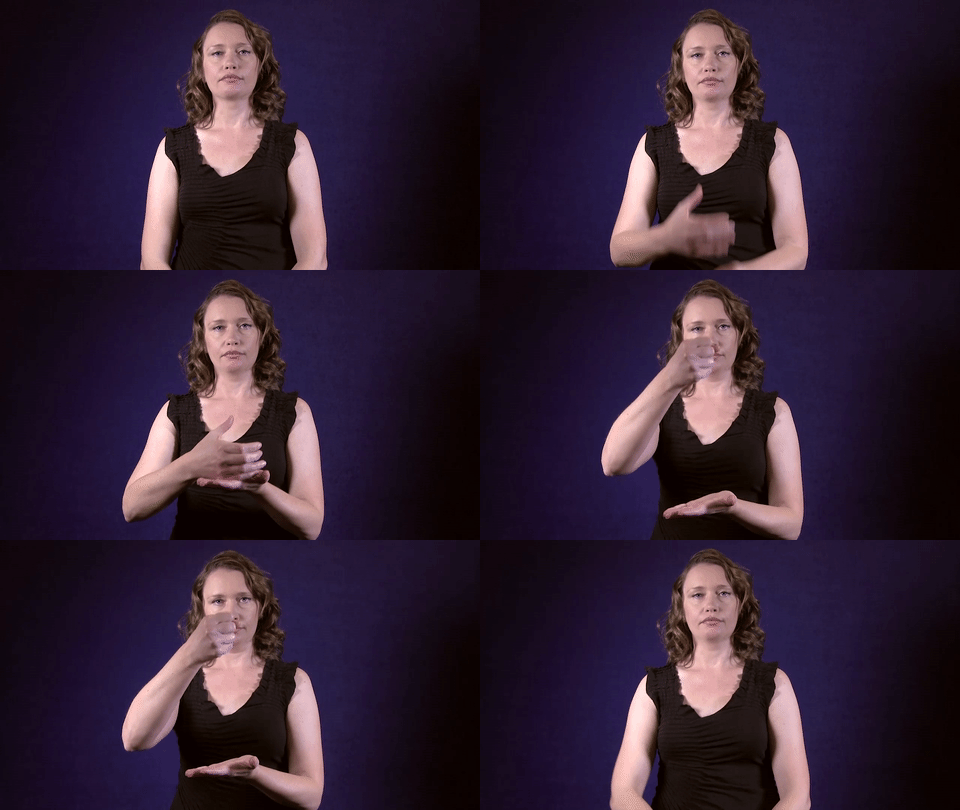
Definition: A container with a narrow neck.
Sign for BOTTLE in ASL

Practice Activities:
Start by practicing the sign for BOTTLE in ASL in isolation. Stand in front of a mirror and repeat the motion several times, focusing on the shape of your dominant hand and how it mimics the movement up the base of your non-dominant palm. Watch for clean, deliberate handshapes and smooth motion as you repeat the sign at slow and regular speeds.
Next, incorporate the sign for BOTTLE in ASL into simple phrases like “water bottle,” “milk bottle,” or “empty bottle.” You can fingerspell the contents (e.g., W-A-T-E-R) before signing bottle to create full ideas. Repeat each phrase five times while maintaining clarity and fluidity.
Try creating full sentences using the sign. Examples include “I found a bottle,” “That bottle is full,” and “The baby drinks from a bottle.” Sign the sentences while imagining a scenario where each makes sense. Consider the facial expressions that naturally go with the meaning for better ASL grammar practice.
Practice storytelling by describing what happens when you recycle bottles. Begin with “I drink water from a bottle,” then go step by step through placing it in a recycling bin. Keep the story under one minute, using the sign multiple times.
Work with a partner and challenge each other with object descriptions. One person signs items commonly found at home (e.g., shampoo, ketchup, soda), and the other confirms whether it comes in a bottle. This builds vocabulary and increases comfort using the sign in context.
For receptive practice, watch videos with people using the sign for BOTTLE in ASL. Identify how it’s embedded in larger conversations or stories. Write down what you understand and compare it with a transcript or summary to check comprehension.
Cultural Context:
In American Sign Language, everyday objects carry cultural experiences, and this is true for the sign for BOTTLE in ASL. The sign for bottle has practical importance in daily conversation, especially for referencing water bottles, baby bottles, or other containers used across different settings.
The sign for BOTTLE in ASL is commonly taught early in ASL learning because it reflects frequent use in homes, schools, and public settings. From feeding a baby to asking for water at a restaurant, knowing the sign for bottle allows for clearer communication between Deaf individuals and the hearing world.
This sign is particularly relevant when discussing care for infants and toddlers. Caregivers, including Deaf parents and teachers, use the sign for BOTTLE in ASL as part of routine vocabulary to meet a child’s needs through visual language. Babies raised in signing environments often recognize and use the sign early, even before they develop spoken language or more advanced signs.
Among Deaf adults, the sign for BOTTLE in ASL comes up often in conversations about drinks at social events, reusable products, and eco-friendly practices. Referring to a reusable bottle during conversations about sustainability shows how American Sign Language adapts to cultural shifts. The vocabulary reflects a growing awareness of environmental issues among signers.
In Deaf schools and classrooms, the sign for BOTTLE in ASL is also taught in lessons around health, nutrition, and hydration. Students and teachers engage with signs like this as part of learning routines focused on wellness and independence. Understanding this common but essential noun helps students make appropriate choices and communicate clearly.
The sign for BOTTLE in ASL also connects with DeafBlind communication through tactile sign language. For DeafBlind individuals, describing common, tangible objects like a bottle supports accessibility in personal care and daily support routines. Caretakers and DeafBlind signers use such basic vocabulary for clearer connections in touch-based interaction.
Regional variations also play a role with the sign for BOTTLE in ASL. While the standard sign remains widely recognized, local Deaf communities might adjust the motion or orientation slightly based on regional or generational influences. This makes understanding context essential, just like spoken dialects vary across areas.
Signing bottle intentionally and accurately also promotes inclusivity. When public service workers, educators, or parents of Deaf children learn and use the sign for BOTTLE in ASL, it creates a more inclusive environment where visual language is welcomed. This strengthens access and understanding across communication barriers.
Whether referring to a baby needing their feeding bottle
Extended Definition:
The sign for BOTTLE in ASL is a common and practical sign used in daily communication. Whether you’re referring to a baby bottle, water bottle, or even a wine bottle, this sign helps clarify the type of container being discussed. In American Sign Language, contextual clues often help indicate the kind of bottle, and facial expressions can further enhance the meaning.
To make the sign for BOTTLE in ASL, you typically mimic the shape of a bottle using your hands. One common version begins with a flat non-dominant hand held out in front of you, palm up. Then, using your dominant hand, you curve your fingers and pretend to lift an invisible bottle from the base to the top. This motion indicates the cylindrical shape and vertical structure of a bottle.
The sign for BOTTLE in ASL may slightly change depending on the specific type of bottle. For example, for a baby bottle, you might use gestures that emphasize the nipple or feeding motion. Context is important, and sometimes fingerspelling the word BOTTLE followed by a mime or classifier can also be used for more clarity, especially when discussing multiple types or shapes of bottles.
In daily ASL usage, you’ll often see the sign for BOTTLE paired with other descriptors like water, soda, or milk to create a more precise phrase. For example: WATER BOTTLE or MILK BOTTLE uses both the sign for the liquid and then the sign for BOTTLE. This creates an efficient and visual language flow that matches how sign language naturally conveys information.
Learning the sign for BOTTLE in ASL supports effective communication in a variety of environments. It’s especially useful in parenting situations, restaurants, care facilities, or schools where requests for drinks or feeding items are common. Knowing this sign also helps young children who use sign language express their needs more clearly during early language development stages.
Using proper facial expressions when using the sign for BOTTLE in ASL can enhance understanding. If you’re asking a question like “Where is the bottle?” your eyebrows will raise to signal the interrogative nature of the sentence. On the other hand, if you’re simply naming a bottle or labeling something, a neutral expression is more common.
Variations of the sign exist regionally, and some signers may use different handshapes or motions. However, the core concept of showing the shape or lifting the bottle remains consistent. As with many ASL signs, exposure and practice with native ASL speakers
Synonyms: container, vessel, flask, canteen, jar
Educational resources: Find related learning materials in our course bank!
Want more? Check out some of our popular learning activities on the homepage!
Need to look up a sign? Use our highly rated dictionary: https://aslinteractive.com/best-asl-dictionary/
Follow us on tiktok: https://www.tiktok.com/@aslinteractive. More social media links at the bottom of this page!
Long-tail Keywords: What is the sign for bottle in ASL, how do you sign bottle in American Sign Language, ASL sign for bottle
Categories:
tags: Objects, Everyday Activities, Kitchen, Drinking, Containers
Parameters
*Handshape*:
The sign for BOTTLE in ASL begins with a dominant hand in a curved “C” handshape, representing the cylindrical shape of a bottle. The non-dominant hand stays flat, palm up, mimicking a base or table. The dominant “C” hand moves upward along the palm, as though outlining the bottle’s shape.
To master the sign for BOTTLE in ASL, focus on maintaining the curved shape of the dominant hand and a steady base with the non-dominant hand. This visually conveys the contour and presence of a bottle.
*Palm Orientation*:
The palm orientation for the sign for BOTTLE in ASL starts with the dominant hand in a curved “C” shape, palm facing down. The non-dominant hand is flat, palm facing up, representing a surface like a table.
To complete the sign for BOTTLE in ASL, the dominant hand moves upward from the base of the non-dominant hand, as if outlining the shape of a bottle. During this motion, the palm gradually turns upright.
*Location*:
The sign for BOTTLE in ASL is typically made in the neutral space in front of the body, around chest to mid-torso level. The movement mimics the shape and contour of a bottle being outlined in the air using one or both hands.
This location allows for clear visibility and avoids obstruction from the face or upper body. When demonstrating the sign for BOTTLE in ASL, maintain your hands in this central area to ensure clarity and accuracy.
*Movement*:
To perform the sign for BOTTLE in ASL, place your non-dominant hand palm-up to represent a flat surface. Use your dominant hand in a C-shape and start at the base of your palm, then move it upward slightly, curving the motion to mimic the shape of a bottle.
This curved upward movement simulates the contour of a bottle rising from the surface. The sign for BOTTLE in ASL emphasizes both the shape and spatial relationship of the object.
*Non-Manual Signals*:
When performing the sign for BOTTLE in ASL, maintain a neutral or slightly inquisitive facial expression, especially if using the sign in a sentence asking about the object. Light eye contact helps reinforce clarity, and raised eyebrows can add emphasis when seeking confirmation.
The non-manual signals for the sign for BOTTLE in ASL should support the concept of size or delicacy, as if indicating a fragile container. A slight tilt of the head or pursed lips can help express careful handling or attention to the object.
*Prosody, Dominant/Non-Dominant Hand*:
The sign for BOTTLE in ASL uses the dominant hand to represent the shape of a bottle. Start with your non-dominant hand palm-up and flat, representing a table. The dominant hand, formed in a curved ‘C’ shape, moves upward from the palm as if outlining the shape of a bottle standing on the surface.
This movement emphasizes the cylindrical form associated with a bottle. The sign for BOTTLE in ASL illustrates both the object’s base and body using spatial representation , making the concept clear through shape and motion.
Tips for Beginners:
When learning the sign for BOTTLE in ASL, it’s important to focus on the shape and movement of your dominant hand. The sign mimics the contour of a bottle being formed or held, so your handshape and fluid motion are key. Practice in front of a mirror to develop confidence and make any handshape adjustments as needed.
One helpful tip for beginners is to visualize holding an actual bottle as you sign. This mental anchor can improve your muscle memory and help your brain link the movement with the concept. Be sure to keep your body relaxed and face expressive, as ASL relies heavily on non-manual markers.
A common mistake when trying the sign for BOTTLE in ASL is using stiff or awkward hand motions. The movement should be smooth and curved, not abrupt or overly forced. Also, avoid making the gesture too fast, which can make it hard for others to recognize.
Repetition is your friend while practicing this sign. Incorporate it into daily conversation to reinforce learning. For example, describe your meal or ask for a drink using the sign for BOTTLE in ASL to give yourself natural practice opportunities.
It’s also helpful to watch videos or observe native signers perform this sign. Take note of their speed, facial expressions, and any subtle nuances in their motion. Rewind and mimic until your version feels comfortable and looks accurate.
Always sign with intention. A clear, confident sign—no matter how slow—communicates better than a rushed or unsure one. Don’t worry about perfect speed early on; fluency will come with experience and exposure.
Try combining the sign for BOTTLE in ASL with other common food or object signs to expand your expressive vocabulary. This kind of contextual learning deepens understanding and makes signs easier to remember long term.
sign for BOTTLE in ASL, bottle in sign language, how to sign bottle in ASL, ASL sign for bottle
Connections to Other topics:
The sign for BOTTLE in ASL is often associated with everyday concepts like eating, drinking, and caregiving, making it essential in both domestic and medical contexts. It connects closely with signs such as MILK, BABY, and FEED, as bottles are typically used in feeding infants . This sign also relates to broader health-related signs like MEDICINE or VITAMINS when referring to prescription bottles, showing its versatility in communication.
In compound signs, the sign for BOTTLE in ASL can combine with WATER to describe a water bottle, often used when talking about hydration or carrying drinks. Similarly, pairing it with BABY creates context for baby bottle, an important tool in discussions around parenting or child development. These combinations enhance clarity and allow for more precise conversation in narrative or instructional settings.
The sign is also linked to cooking and kitchen vocabulary such as REFRIGERATOR, TABLE, and CUPBOARD, where bottles are common storage items. Learners can explore how the sign for BOTTLE in ASL fits into sequences describing kitchen routines or recipe instructions, helping to develop comprehensive language use around food and drink.
The sign closely mirrors its use in recycle-related topics, especially when discussing environmental concerns (e.g., recycling plastic bottles). It can also pair with THROW-AWAY or TRASH to clarify disposal actions, especially useful in classroom or community cleanup contexts .
This sign is helpful in understanding tactile and shape-based classifiers as well, because BOTTLE can be represented using a cylindrical or contouring motion, easing learners into using classifier handshapes. That connection supports skills in descriptive storytelling, especially when explaining the size or movement of objects. The sign for BOTTLE in ASL therefore opens doors to many functional topics, making it a valuable addition to daily conversation practice.
Summary:
The sign for BOTTLE in ASL generally mimics the shape and motion associated with a physical bottle. To produce the sign, start with the non-dominant hand held flat, palm up, to represent a surface. Then, place the dominant hand in a curved “C” shape and move it upward from the base of the non-dominant hand, tapering slightly as if outlining the cylindrical form of a bottle.
This sign offers a visually intuitive metaphor, which is common in ASL vocabulary where the physicality of objects often informs sign production. The tapering hand shape mimics the narrowing of a typical bottle neck, making it a natural sign that is easy for learners to recall.
The sign for BOTTLE in ASL can vary slightly based on regional dialects or specific contexts. For instance, some users might emphasize a longer motion, delineating a full wine bottle, while others may use a shorter movement to reflect a baby bottle or a small container.
Culturally, bottles carry a range of meanings in Deaf and hearing cultures alike. In Deaf homes, the presence of a bottle might indicate anything from baby feeding to water containers—practical objects that carry significance depending on age, activity, and environment.
The sign for BOTTLE in ASL is mostly used as a noun, though its grammatical function can shift depending on sentence structure and context. ASL syntax allows a sign’s role within a sentence to evolve based on facial expressions, classifiers, and accompanying verbs or adjectives.
Classifiers frequently enhance the nuanced meaning behind this sign. For example, after using the sign for BOTTLE in ASL, a signer might follow with a CL:1 classifier to indicate the bottle rolling, or a CL:C to indicate holding or movement, adding spatial and temporal information to the narrative.
In everyday communication, this sign is often paired with adjectives or modifiers. People might sign BOTTLE followed by signs such as MILK, WATER, WINE, or SODA to clarify content, providing semantic layering within the sentence.
The phonological structure of this sign involves a dominant curved handshape resembling the letter “C,” movement upward from base to neck, and palm orientation reflecting the curvature and spatial positioning of an upright bottle. This combination is designed for visual clarity and efficiency.
For learners of ASL, the sign for BOTTLE is accessible due to its iconicity, making it one of the more intuitive nouns to acquire early. Language acquisition studies highlight that high-iconicity signs are often acquired faster by both Deaf and hearing students due to their visual correlation with real-world referents.
In early language development, particularly among babies who use baby sign, the sign for BOTTLE becomes an essential early sign to express needs. The sign functions as a bridge between pre-verbal communication and later expressive linguistic abilities.
With regard to sign variation, some ASL users fingerspell B-O-T-T-L-E when referring to brand names or very specific bottles—like prescription bottles where common bottle signs may not offer enough specificity. Code-switching between initialized signs and fingerspelled words reveals the flexible nature of ASL in accommodating specificity without undermining visual grammar.
Language contact between spoken English and ASL sometimes influences the choice of signs. In bilingual contexts, signers may borrow constructs or word orders from English yet embed them in ASL grammar, affecting signs like BOTTLE when used in more complex sentences involving quantity or purpose.
In Deaf storytelling, a bottle can symbolize many things: nourishment, addiction, containment, or even messages. Thus, the sign for BOTTLE in ASL might be uniquely stylized for theatrical or poetic impact, particularly when used metaphorically.
The morphological possibilities of this sign connect it with other container-related signs. For example, signs like CAN, CUP, or JAR share similar curved handshapes and container-oriented motions, forming a semantic network within ASL lexicon.
Under the lens of applied linguistics, teaching the sign for BOTTLE in ASL reveals how form and function align through spatial mapping. Signing BOTTLE on top of the hand gives learners a tactile-spatial reference, useful in understanding how ASL operates on physical space instead of linearly.
From a sociolinguistic viewpoint, referencing the sign for BOTTLE in ASL in different settings could say something about the signer’s age, social context, and familiarity with specific sub-dialects of ASL. Younger Deaf or CODA people may employ different movements or switch to descriptive classifiers more fluently.
There’s linguistic evidence showing that concrete nouns like BOTTLE tend to be more resistant to change in sign languages. This contributes to their stability over time, even while adjacent signs or classifier uses may evolve. This gives educators a reliable sign to teach across age and proficiency levels.
In contextualizing the sign for BOTTLE in ASL within larger grammatical constructions, it often precedes action verbs such as DRINK, OPEN, DROP, or USE
Want more? Check out some of our popular learning activities!
ASL Interactive Resources
ASLInteractive YouTube Channel
Follow us on tiktok: @aslinteractive.com
Follow us on Instagram: aslinteractive
Facebook page: aslinteractive
Facebook group: aslinteractive
LInkedIn: ASL Interactive LLC
Twitter: @ASL_interactive
*Some information on this page is AI-generated. AI can make mistakes. Please check the information.


Responses