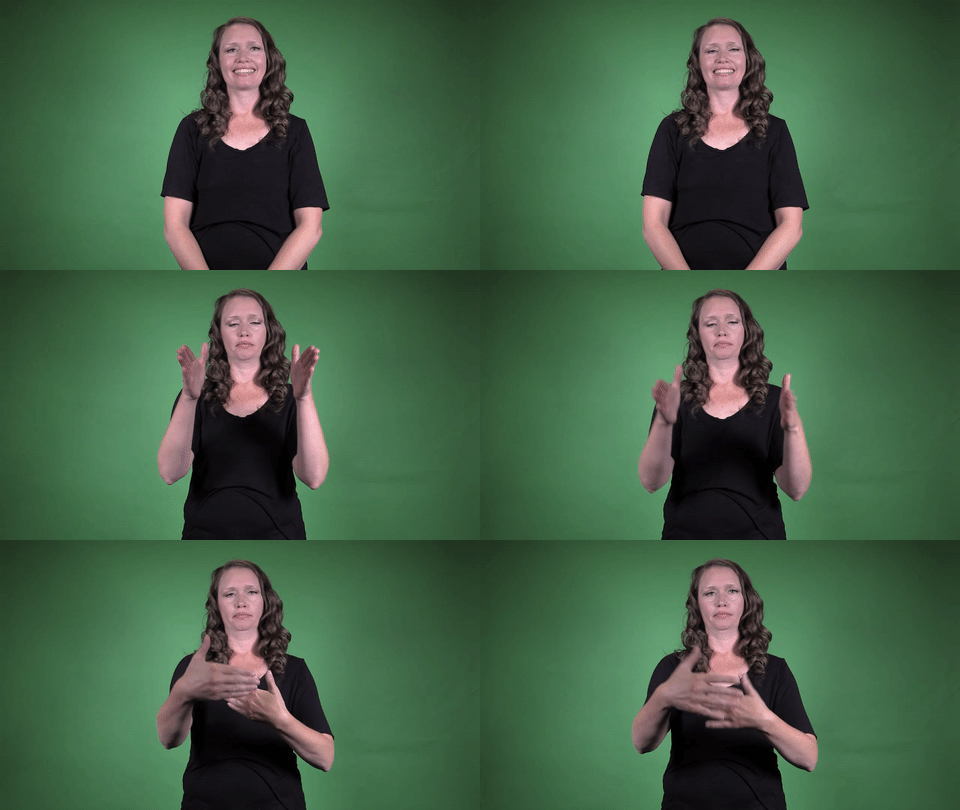
Definition: A rectangular container.
Sign for BOX in ASL

Practice Activities:
Practice the sign for BOX in ASL by standing in front of a mirror and using both hands to trace the shape of a rectangle in the air. Focus on making the sides of the box parallel and evenly spaced to give a clear representation of the object. Repeat the sign slowly and then increase your speed as you become more confident with the correct shape and movement.
Create a list of common types of boxes, such as shoe box, gift box, or cardboard box. Practice fingerspelling the adjectives (like “shoe” or “gift”) and then signing the word BOX. This will help reinforce combining fingerspelling with a main sign in context.
Use the sign for BOX in ASL while describing items contained inside a box to a study buddy. For example, sign sentences like, “In the box, there is a book,” or “I opened the box and found candy.” Try pulling props from an actual box to make the practice more fun and interactive.
Have a partner play a sorting game with you using signs. Lay out several actual or imaginary boxes and assign each one a label using fingerspelling. Your partner can describe where different objects go using only ASL, and you place or sign back your understanding, using the sign for BOX in ASL throughout the activity.
Storytelling activities work well to master this sign. Describe receiving a surprise in the mail and describe the moment you opened the box. Explain where it came from and what you found. Emphasize facial expressions to show emotion and include signs for shape, object, and location along with the focal sign.
Try a drawing activity where you sketch boxes of different sizes and label them with their ASL sign value. Then sign a sentence about each box and what is in it. These varied approaches will help reinforce the sign for BOX in ASL both visually and contextually.
Cultural Context:
In American Sign Language, the sign for BOX is more than just a way to communicate a physical object — it’s a reflection of how Deaf culture perceives and interacts with the world visually. Many ASL signs are iconic, meaning they resemble what they represent, and the sign for BOX is a great example. It mimics the shape of a box using hand movements, which is intuitive for signers and easy to understand.
In Deaf culture, spatial awareness and the use of space are central to communication. The sign for BOX uses the space in front of the body to illustrate the shape and dimensions of a box. This visual and spatial mode of communication is a key part of how ASL differs from spoken languages.
Deaf storytelling and daily conversations often involve describing objects by shape, size, and use. The sign for BOX is often used when referencing packages, containers, or even abstract ideas like thinking outside the box. In this way, the sign becomes both literal and metaphorical within communication contexts.
Because ASL is deeply connected to visual experiences, signs like the sign for BOX come with natural gestures that clarify meaning. It’s common in Deaf spaces for people to add facial expressions or additional classifiers to show what kind of box—small, large, heavy, empty—that they’re referring to. This layered communication adds richness to the interaction.
The sign for BOX also plays a role in classroom settings, where Deaf students learn classification, spatial reasoning, and problem-solving with visual aids. Teachers often use physical boxes and the corresponding ASL sign to teach concepts like volume and storage in a fully accessible way. It’s a functional and educational sign that supports hands-on learning.
In casual settings, the sign for BOX is often included when talking about deliveries, moving, or organizing. As daily life increasingly involves online shopping and package deliveries, the use of the sign for BOX has become more common in signed conversations. It reflects how language evolves with cultural habits.
The visual nature of the sign allows it to blend into other signs and expressions naturally. In art and creative spaces in the Deaf community, the sign for BOX may be used in metaphorical ways, incorporated into visual poetry, storytelling, and performance. These creative uses enrich the cultural meaning of the sign beyond its dictionary definition.
The sign for BOX in ASL is not just a single movement — it’s a representation of how communication in Deaf culture often includes gesture, space, and visual metaphor all at once. Whether in a practical context or a creative one, knowing how to use
Extended Definition:
The sign for box in ASL is a visual representation that uses the hands to mimic the shape of a box. This sign is commonly used in both casual and formal conversations to describe physical boxes, packaging, or to symbolize the concept of containment, space, or storage.
To create the sign for box in ASL, position both hands in front of your body with fingers extended and palms facing each other. Move your hands outward and then bring them back in to outline the shape of a rectangle or box. This helps visually convey the idea of a three-dimensional container, making the sign intuitive and easy to understand.
This sign is fundamental in American Sign Language as it is often used when discussing topics like moving, shipping, storage, or organizing objects. Whether talking about a cardboard box, a gift box, or even a shipping box, this version of the sign is highly versatile across different settings and conversations.
In addition to being used to describe physical containers, the sign for box in ASL can be metaphorical. It can help describe abstract ideas like thinking outside the box, being boxed in, or something being inside or outside of a conceptual boundary. These uses make this sign quite flexible, allowing for both literal and figurative communication.
Children learning ASL often learn the sign for box early on because it’s simple and associated with everyday objects. Toys, presents, or even food items are often found in boxes, and being able to sign the word helps empower young learners to express themselves clearly and independently.
Adults who use ASL, whether native speakers or those learning it as a second language, also find the sign for box helpful in everyday scenarios. It’s a useful sign when giving directions, discussing storage solutions, organizing home and office spaces, or during activities such as packing for a move.
The sign for box in ASL is a part of a broader category of shape-based signs. These signs rely on hand shapes and movements that represent the form of real-world objects. Practicing these types of signs supports better spatial thinking and visual communication skills.
When using the sign for box in ASL in conversations, you can modify it with additional signs or facial expressions to indicate size, weight, or what’s inside the box. For example, you can combine it with signs like heavy, light, big, or small to give more information and context.
Cultural uses of the sign for box in ASL often include idiomatic expressions or creative storytelling techniques. In poetry or signed narratives, it might be used to build visual
Synonyms: container, case, crate, carton, package
Educational resources: Find related learning materials in our course bank!
Want more? Check out some of our popular learning activities on the homepage!
Need to look up a sign? Use our highly rated dictionary: https://aslinteractive.com/best-asl-dictionary/
Follow us on tiktok: https://www.tiktok.com/@aslinteractive. More social media links at the bottom of this page!
Long-tail Keywords: what is the sign for box in ASL, how do you sign box in american sign language, ASL sign for box
Categories:
tags: box sign language, how to sign box in ASL, ASL box gesture, learn ASL box, sign for box in American Sign Language
Parameters
*Handshape*:
The handshape for the sign for BOX in ASL uses both hands in a flat “B” handshape . Fingers are together, thumbs extended alongside the fingers, forming a clear and structured shape.
To produce the sign for BOX in ASL, both hands move outward and inward to represent the flat sides of a box . The movement mimics drawing the shape of a rectangular box in the air, emphasizing its three-dimensional form.
*Palm Orientation*:
For the sign for BOX in ASL , both hands are held in a flat handshape with palms generally facing each other. The palm orientation shifts slightly as you move your hands outward and then inward to outline the shape of a box.
The palms start facing each other vertically, then rotate slightly to face downward when forming the top and bottom edges. This consistent palm change helps clearly show the 3D concept in the sign for BOX in ASL.
*Location*:
The sign for BOX in ASL is produced in the neutral space directly in front of the torso. Both hands are used and positioned slightly apart at chest level. This sign for BOX in ASL begins with hands shaped like the letter “B” or in flat-hand position, showing the outline of a rectangular box. The movement stays in front of the body and does not touch the face or torso.
*Movement*:
To make the sign for BOX in ASL, start with both hands in flat B-handshapes, palms facing each other at about shoulder-width apart. Move the hands toward each other until they are about six inches apart, then shift the hands down and apart as if outlining the edges of a 3D box .
This movement mimics the shape of a rectangular container. The sign for BOX in ASL visually represents the object through space and hand positioning, clearly conveying the concept.
*Non-Manual Signals*:
When using the sign for BOX in ASL, the eyebrows remain neutral to show the concept is a physical object rather than a question or emotion. The mouth may stay relaxed or form a slight “mm” shape to indicate size, depending on the context or size of the box being described .
Facial expression should match the purpose of the sign, whether describing a standard, large, or heavy box. Keeping appropriate eye gaze and slight head tilts helps reinforce spatial reference, especially if showing the shape or size while using the sign for BOX in ASL.
*Prosody, Dominant/Non-Dominant Hand*:
The sign for BOX in ASL uses both hands, typically in flat B-handshapes. The hands start in front of the body about shoulder-width apart, then move inward and meet at the fingertips, as if outlining the front and then the sides of a box.
To express the sign for BOX in ASL clearly, both hands mirror each other, simulating the shape of a box in the air. It creates a visual representation of a three-dimensional object , helping convey meaning through shape.
Tips for Beginners:
The sign for BOX in ASL is visually iconic, making it easier for beginners to remember. To perform the sign, start by forming both hands into flat “B” handshapes, palms facing each other. Then mime outlining the front and sides of a 3D box by moving your hands apart and then down to indicate the edges of a square or cube. It’s helpful to visualize a box’s dimensions while signing—this adds clarity and intention to your movement.
To master the sign for BOX in ASL, focus on spatial awareness . Make sure your movements are smooth and in one consistent plane, as jagged or uncontrolled motions can change the intended meaning. Practicing in front of a mirror can drastically improve your muscle memory and spatial representation. With time, you’ll develop more fluidity and control in mimicking the shape of a box accurately.
Be careful not to make your motions too small or vague. A common mistake is reducing the space between the hands, which might confuse the sign with others that also use a similar handshape. Confidence in gesture size helps make your signs both correct and legible. Don’t forget to maintain eye contact and engage facial expressions when appropriate—it enhances your signing clarity and receptiveness.
The sign for BOX in ASL also appears often in everyday situations—such as at work, while moving, or during classroom conversations—so look out for those moments to reinforce your learning . Use flashcards or label physical boxes around your house to drill the sign in natural contexts. Repetition combined with real-life application makes mastery much faster.
Lastly, observe fluent signers via online videos or apps and mimic their pacing and fluidity. This will fine-tune not just your use of the sign for BOX in ASL but also your understanding of conversational signing flow.
Connections to Other topics:
The sign for BOX in ASL uses both hands to mime the shape of a 3D rectangular object, symbolizing the basic concept of a container or package. This visual-spatial approach mirrors other shape-related signs in ASL, such as ROOM, HOUSE, or CUBE, where outlining the object helps convey its physical structure. These signs share a focus on dimensionality and help learners strengthen spatial reasoning in ASL.
Understanding the sign for BOX in ASL can support comprehension of compound or related signs like POST-OFFICE, GIFT-BOX, or STORAGE-BOX. These signs often layer the concept of BOX with added information about usage or context. For example, adding the sign for MAIL or GIFT before BOX refines its meaning within the broader conversation.
The sign also connects to classifier use, especially classifier B (flat hands), which is often used to talk about objects shaped like containers or square items. In descriptive discourse, classifiers help describe the size, shape, or how a box is handled, such as lifted, stacked, or opened. This deepens the viewer’s understanding through movement and setup in space.
In classifier storytelling, the sign for BOX in ASL plays a fundamental role when describing packaging, storage, or even events like someone opening a surprise. It’s also commonly used in educational or workplace conversations about moving, shipping, or organizing items. Learners will often use BOX in narratives involving logistics or personal experiences, such as receiving deliveries .
The concept of BOX links closely with verbs of handling, like PUT-IN, TAKE-OUT, or OPEN, which frequently appear together in daily contexts. Structuring these signs in sequence can help learners build fluid expressions. Incorporating the sign for BOX in ASL into frequent dialogues strengthens vocabulary and encourages natural story-building within the language.
Summary:
The sign for BOX in ASL visually mimics the shape of a rectangular or square container. To produce the sign, both hands are held in front of the body, palms facing each other, fingers spread slightly apart. The signer then outlines the corners of a box in space using their hands, typically moving from side to side and then front to back, to show the box’s dimensions.
This sign is iconic and spatial, meaning it reflects the actual shape or function of the item it refers to. The use of iconicity in ASL often enhances comprehension, especially for new learners. The sign for BOX in ASL is a great example of how the language represents concrete objects through visual-spatial modeling.
The sign is also classified as a classifier construction when used in broader contexts. Classifiers in ASL can indicate different types of boxes, their size, and even how they interact with other objects. For example, a large box might be shown with more exaggerated hand movement to reflect its larger size.
In conversation, the sign for BOX in ASL can be used both literally and metaphorically. Literally, it refers to any rectangular container such as a cardboard box, wooden crate, or storage bin. Metaphorically, it can be used in expressions like “thinking outside the box,” which would typically be adapted through facial expression, context, or accompanying signs.
The grammatical context of the sign for BOX in ASL varies depending on sentence structure. It can function as a noun and is often modified by adjectives or classifiers. For instance, you could sign “big box” by modifying the size of the space indicated during the BOX sign and adding the adjective BIG before or after.
Facial expressions and directional usage play an important role in signing BOX. A surprised expression with the sign might imply an unexpected delivery. A tedious look while signing it may show annoyance with how many boxes are being referenced.
The placement of the sign in the signing space can also help to maintain clarity in multi-object storytelling. For instance, a signer may position one BOX to the left side of their body to distinguish it from another referenced later on the right. This use of spatial referencing reflects the grammar of ASL.
From a cultural viewpoint, the sign for BOX in ASL illustrates how important visual context is in Deaf culture. Items associated with delivery, movement, and storage are common in daily life, and the sign bridges those tactile associations into meaningful visual representations.
The visual-spatial nature of ASL makes signs like BOX particularly intuitive for Deaf individuals. These signs often do not need further explanation once shown, especially within a context. This reduces the cognitive effort needed to understand or produce the sign, supporting efficient communication.
Linguistically, the sign for BOX in ASL is an example of how nouns are formed through iconic representation rather than arbitrary symbols. Unlike many spoken words, which often carry no visual relation to their meanings, ASL often benefits from visual motivation.
Linguists also note how spatial grammar in signs like BOX supports a three-dimensional model of language not found in auditory-based languages. This reveals a unique modality of human communication. Instead of relying solely on linear syntax, ASL integrates space, movement, and simultaneity.
In applied linguistics, the conceptual metaphors used in signs like BOX can be deeply explored to analyze how ASL users perceive their environment. This includes how tangible items like boxes become mental symbols, such as containers for ideas, memories, or emotions. ASL can demonstrate these metaphors dynamically.
Educators teaching the sign for BOX in ASL often use real-life props to emphasize the meaning and enhance memory recall. Manipulating actual boxes alongside the sign helps reinforce comprehension. This multimodal approach supports language learners in both Deaf and hearing communities.
Children acquiring ASL naturally are often exposed to signs such as BOX early, especially during play or daily routines. The familiarity of the object helps in anchoring the sign in real-world experiences. Play sequences like unpacking or stacking boxes are commonly used in Deaf preschools and learning environments.
Teachers also encourage semantic expansions with BOX. For instance, connecting signs like OPEN, CLOSE, PUT-IN, or TAKE-OUT reinforces meaningful associations. These links support deeper grammar learning and promote expressive signing.
The evolution of the sign for BOX in ASL reflects practical needs. As technology and shipping have advanced, use of the sign has become more frequent. Discussions around packages, deliveries, and internet orders often involve the BOX sign, sometimes accompanied by the verbs DELIVER or RECEIVE.
In digital communication, such as video calls or classrooms, signers may need to adjust the BOX sign to stay within the camera frame. This challenges spatial accuracy but emphasizes hand positioning and clarity. Technology is subtly shaping how traditional signs are formed and used in virtual contexts.
From a semantic standpoint, the sign for BOX in ASL can symbolize order, compartmentalization, or restriction. Deaf poets and visual performers sometimes use the BOX sign in artistic expression to symbolize limitation or confinement, visually
Want more? Check out some of our popular learning activities!
ASL Interactive Resources
ASLInteractive YouTube Channel
Follow us on tiktok: @aslinteractive.com
Follow us on Instagram: aslinteractive
Facebook page: aslinteractive
Facebook group: aslinteractive
LInkedIn: ASL Interactive LLC
Twitter: @ASL_interactive
*Some information on this page is AI-generated. AI can make mistakes. Please check the information.


Responses